









- What New Signals Are Emerging in Enterprise Services SaaS Marketing ReportsJul 27, 2026View details
- What Does a Global Traffic Ecosystem Service Provider Do? What Are the Differences from a Single Advertising AgencyJul 16, 2026View details
- What should you focus on in the latest enterprise SaaS report? From renewal rates and delivery costs to overseas growth opportunitiesJul 12, 2026View details
- What signals are worth paying attention to in a cross-border marketing trend report? B2B companies should look at these 6 signalsJul 11, 2026View details
- How to Read a Cross-Border Marketing Trends Report? Five Key Dimensions for Evaluating Channel OpportunitiesJul 11, 2026View details
- Which channel has the highest ROI in the global traffic ecosystem? Comparative analysis of search, social media, and advertisingJul 10, 2026View details
- What multilingual website services are available in Sanya? Which model is more suitable for local businesses going global?Jul 08, 2026View details
- How to view the complete list of China SaaS companies in the top 100? Practical methods for screening website-building and marketing service providersJul 08, 2026View details
How to Build a More Stable LinkedIn B2B Marketing Strategy
How can LinkedIn corporate marketing be structured more steadily? If what you truly care about is not superficial actions like “posting a few pieces of content,” but rather how to continuously acquire high-quality customer leads, reduce ineffective ad spend, and drive synchronized growth in both brand influence and inquiries, then the answer is very clear: LinkedIn cannot operate in isolation. It must be coordinated with website conversion support, SEO content optimization, advertising campaigns, multilingual pages, and data analytics. For the website + integrated marketing services industry, as well as businesses targeting corporate decision-makers, executors, distributors, and end customers, more stable LinkedIn marketing is essentially about building a complete growth chain of “content reach — trust building — page conversion — data review,” rather than treating platform operations as an isolated activity.
From the perspective of search intent, when users search for “how to structure LinkedIn corporate marketing more steadily,” what they are really looking for is an executable, measurable, and low-risk enterprise marketing methodology. The questions readers usually care about most tend to focus on these areas: how to avoid gaining visibility without gaining inquiries; how content, advertising, the homepage, and employee accounts should work together; how to judge whether the investment is worthwhile; whether the website can effectively receive traffic after overseas users click through; and, in multi-market and multilingual scenarios, how to balance brand image, lead quality, and campaign efficiency. Content that is truly helpful should focus on answering how the strategy should be built, how execution should be implemented, how metrics should be evaluated, and how common mistakes should be avoided, rather than speaking vaguely about platform features.
Why many companies find LinkedIn marketing unstable: the problem often does not lie with the platform itself
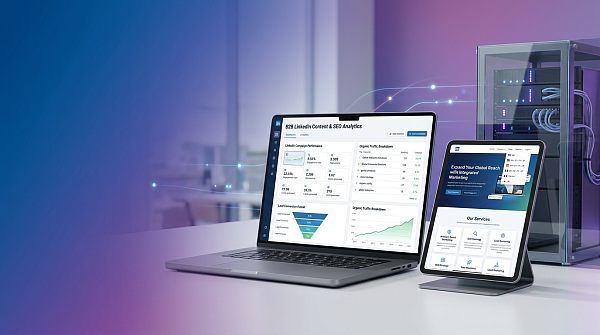
After operating on LinkedIn for some time, many companies discover a typical phenomenon: they publish a fair amount of content, their follower count grows, but effective inquiries remain unstable, and even advertising costs keep rising. This usually does not mean LinkedIn is ineffective, but rather that there is a problem with the overall setup.
There are four most common mistakes. First, companies only manage accounts but do not build conversion support. After users see content on LinkedIn, if the destination page loads slowly, the language does not match, or the structure is confusing, leads will naturally be lost. Second, companies only look at exposure and engagement, but not lead quality. Likes and views are not the ultimate goal; the core is whether you can generate effective leads from target regions, target industries, and target roles. Third, content is not built around the customer decision-making chain and remains only at the level of company promotion. Fourth, platform activities are disconnected from website SEO, advertising campaigns, and sales follow-up, resulting in traffic that cannot be accumulated and data that cannot be properly reviewed.
Therefore, if a company wants to make LinkedIn corporate marketing more stable, the first step is not “posting more content,” but clarifying its role in the entire overseas customer acquisition chain: LinkedIn is responsible for reach and trust building, the official website is responsible for receiving traffic and conversion, SEO is responsible for long-term search traffic accumulation, advertising is responsible for accelerating scale, and the data system is responsible for attribution and optimization. Only when these links are connected can marketing results become stable.
What companies truly need is a LinkedIn marketing framework for sustainable customer acquisition
Stability does not mean being conservative; stability means results are predictable, investment is assessable, and processes are replicable. For business decision-makers, the most important thing is judging whether this setup has the ability to support long-term growth; for executors, it is understanding how each module should work together.
A more stable LinkedIn marketing framework usually includes the following five layers:
1. A clear account matrix:The company page is responsible for conveying brand authority and product capabilities, core executive accounts are responsible for industry insights and trust endorsement, and sales or marketing accounts are responsible for interaction, connections, and lead outreach. If a company relies only on a single company page to publish content, the results are often limited.
2. Clearly layered content:Do not turn all content into promotional posters. A more effective approach is to arrange content according to the user decision path, such as delivering industry trends and pain point analysis at the awareness stage, solution differences and case breakdowns at the comparison stage, and service processes, delivery capabilities, FAQs, and customer results at the decision stage.
3. Effective landing page support:Traffic brought by LinkedIn is usually closer to business opportunities than ordinary traffic. If landing pages are not optimized by industry, country, language, and conversion action, then the more successful the front-end marketing is, the greater the waste in the back end will be.
4. Coordination between ads and organic content:Organic content is responsible for building long-term trust, while advertising is responsible for precise amplification. Especially in B2B scenarios, relying only on organic traffic often leads to slow growth, while relying only on advertising easily causes high costs; combining the two is more stable.
5. A closed-loop data review system:Do not only look at click-through rates and engagement rates; you also need to look at lead cost, conversion cycle, sales acceptance rate, customer regional distribution, and final deal contribution. Without a closed loop, optimization can only rely on intuition.
For companies with overseas business expansion needs, especially foreign trade companies, website access speed and cross-region stability directly affect LinkedIn marketing performance. For example, users may be attracted by content in a post, but if the official website loads too slowly after they click through, or if the experience varies too much across different regions, this will significantly increase bounce rates and reduce ad quality and organic conversions. Capabilities such as Yiyingbao global server deployment, which are designed for foreign trade companies, essentially solve the issue of stable traffic reception: faster page access, broader node coverage, and higher security make marketing activities more likely to convert into real business opportunities.
How to plan LinkedIn content to balance brand influence and lead conversion

When many companies create LinkedIn content, they tend to fall into two extremes: either everything is brand promotion and readers feel nothing, or everything is professional knowledge but without any business direction. A steady approach is to make content both build a professional image and guide users to take the next step.
It is recommended to divide content into four categories:
Industry insight content:Suitable for attracting the attention of potential customers and partners, such as market trends, policy changes, procurement risks, production management, after-sales maintenance, and so on. For decision-makers, this type of content helps them judge the direction of cooperation; for executors, it is more likely to generate resonance and sharing.
Solution education content:Explain how you solve problems, rather than just saying you are “professional.” For example, how to improve the quality of overseas inquiries through a multilingual website + SEO + social media marketing, how to optimize ad budgets through data-driven methods, and how to reduce customer loss caused by slow-loading overseas websites.
Case proof content:This is one of the types of content most likely to drive inquiries. Case studies do not necessarily have to be very long, but they must clearly explain the customer’s original problem, what solution was adopted, and what changed in the results. The more specific the numbers are, the stronger the trust becomes.
Conversion guidance content:This includes consultation booking, white paper downloads, industry diagnosis, solution evaluation, and so on. Without a clear next-step action, no matter how good the content is, it is difficult to accumulate leads.
In content expression, two practical issues should also be noted. First, the LinkedIn audience is relatively professional, so content should reduce empty slogans and use more scenarios, data, and judgment. Second, different readers focus on different things. Business decision-makers care more about growth logic, return on investment, and risk control; operators care more about execution steps, tools, methods, and collaboration workflows; distributors and agents care more about brand support, regional opportunities, and conversion efficiency; while end consumers care more about credibility, service assurance, and real experience.
How advertising, SEO, and website conversion support should work together to make LinkedIn marketing more stable
If LinkedIn is viewed as the traffic entry point, then the official website is the conversion hub, SEO is the long-term growth engine, and advertising is the accelerator. Only when the three work together can corporate marketing shift from “relying on one-time campaigns” to “continuously accumulating assets.”
Let’s start with SEO. Many companies underestimate the supporting role of SEO in LinkedIn marketing. In fact, after users first see your brand on LinkedIn, they often do not convert immediately, but instead return to Google to continue searching for your company name, product terms, and solution-related keywords. If your website content is weak, keyword structure is unclear, or case pages are missing, you will lose points in this second round of evaluation. In other words, LinkedIn not only brings on-site traffic, but also triggers brand searches and solution searches, so SEO must keep up.
Now let’s talk about official website conversion support. A more stable official website conversion system should at least meet the following requirements: fast page loading, clear structure, multilingual support, clear core selling points, short form paths, stable mobile experience, the ability to embed tracking codes, and support for data attribution. Especially for overseas marketing, speed and stability are hidden conversion variables. High global access latency, insufficient nodes, and weak security capabilities all affect ad quality scores, search crawl frequency, and user dwell time.
This is why more and more companies, when structuring LinkedIn and overseas search marketing, also optimize their servers and website infrastructure at the same time. Taking foreign trade scenarios as an example, if a website can achieve global node deployment, intelligent load balancing, full-site HTTPS, security protection, and support for independent multilingual websites, it is usually more conducive to improving overseas access experience and reducing business opportunity loss caused by slow or abnormal pages. For companies pursuing stable customer acquisition, this type of infrastructure investment is not a “technical cost,” but part of marketing conversion efficiency.
How business decision-makers should judge whether LinkedIn investment is worthwhile and whether the setup is healthy
For management, the biggest concern is not investment itself, but unclear results. To judge whether LinkedIn corporate marketing is worth continued investment, do not look only at the monthly number of inquiries, but at a more complete set of health indicators.
First, look at lead quality, not total lead volume.Target industry match, role match, country match, and follow-up response rate are often more important than the number of form submissions.
Second, look at whether the customer acquisition path is reusable.If results rely heavily on one viral piece of content or one employee account, that indicates the system is unstable. A truly stable setup should be able to continuously replicate results through collaboration among content, advertising, the official website, and sales.
Third, look at whether traffic is being accumulated into brand assets.This includes whether official website organic traffic is growing, whether branded keyword searches are increasing, whether industry keyword rankings are improving, and whether sales outreach is becoming easier to accept.
Fourth, look at the investment return cycle.LinkedIn is especially suitable for businesses with medium-to-high customer value, longer decision-making chains, and a strong emphasis on professional trust. If a company’s products are complex and target overseas B-end customers, short-term results may not explode immediately, but mid-term value is often higher. In such cases, trends should be evaluated quarterly rather than judged emotionally on a weekly basis.
Fifth, look at whether risks are under control.This includes account security, content compliance, data attribution, website stability, overseas access speed, and privacy regulations. Especially in global markets, compliance requirements such as GDPR and CCPA directly affect a company’s long-term operational security.
If a company is already running overseas advertising, SEO, and social media, but finds that channel performance fluctuates greatly, website access experience is unstable, and conversion differences across regions are significant, then it needs to go back and check whether its infrastructure and conversion support capabilities are keeping up. For such companies, in addition to optimizing content and advertising strategies, solutions like Yiyingbao global server deployment, with global 7-node deployment, 99.99% availability assurance, intelligent route switching, and banking-grade encryption capabilities, can also improve the stability of the marketing chain from the foundation up, helping truly retain traffic and convert it.
If you want to make LinkedIn stable, companies can move forward at this pace
If you want to take fewer detours, you can proceed in the order of “build the foundation first, then scale up”:
Phase 1: Clarify goals and audience.First define that what you want is not “more followers,” but brand exposure, distributor recruitment, overseas inquiries, or high-quality sales leads. Different goals require completely different content and advertising strategies.
Phase 2: Build the conversion pages properly.First check whether the official website supports multilingual content, mobile devices, form conversion, page tracking, and stable overseas access, and then begin systematic promotion.
Phase 3: Establish a content rhythm.Center content around industry pain points, solutions, case results, and conversion guidance to form continuous output. It is recommended to set monthly themes rather than posting whatever comes to mind.
Phase 4: Test advertising on a small scale.First test audiences, creatives, landing pages, and conversion paths, and then gradually increase the budget. Do not start with large-scale investment immediately.
Phase 5: Coordinate sales follow-up.LinkedIn leads often place greater emphasis on follow-up speed and professionalism. If marketing and sales do not have unified messaging, tags, and grading mechanisms, front-end investment will be dragged down by back-end inefficiency.
Phase 6: Review monthly and adjust quarterly.Use monthly reviews to identify execution issues, and quarterly reviews to evaluate business trends. This allows timely optimization without being misled by short-term fluctuations.
For website + integrated marketing service companies, a truly stable LinkedIn setup is not a stack of platform tricks, but connecting brand, content, search, advertising, website, and data into one line. As long as the chain is complete, results will become more and more stable; as long as the chain is broken, no matter how hard the platform works, it will be difficult to sustain growth.
In summary, the key to structuring LinkedIn corporate marketing more steadily is not “posting more content” or “running more ads,” but building a complete growth system around user search intent and the customer decision path. Companies should prioritize solving three core questions: whether there is a clear audience and content strategy; whether the official website can receive and convert traffic; and whether data can support continuous optimization. For companies seeking global growth, LinkedIn is only the front-end entry point. What truly determines long-term performance is the back-end website foundation, SEO content assets, campaign coordination, and operational closed loop. When all of these links are done well together, marketing becomes more stable and growth becomes more sustainable.
Related Articles
Related Products
 EasyCamp SaaS Smart Website Marketing SystemE-Yingbao SaaS Smart Website Marketing System: AI-powered, zero-code website building. Rapidly launch multilingual independent e-commerce sites in just 10 minutes. Global server acceleration and AI-driven SEO optimization empower businesses to efficiently connect with global markets. The seamless integration of technology and user-friendly operation makes building e-commerce sites incredibly simple.
 AI+SEM Intelligent Advertising Marketing SystemAI+SEM drives intelligent ad creation, empowering full-funnel precision advertising marketing. The system automatically generates weekly/monthly reports, AI recommends keywords and target countries, monitors core metrics in real-time with intelligent alerts, and enables one-click high-conversion ad solutions to help quickly acquire customers and improve ROI.
 AI+SEO Dual Engine Optimization ServiceEasyWin AI+SEO Dual Engine Optimization System leverages AI-powered keyword mining, content generation, and comprehensive technical optimization to help foreign trade enterprises acquire high-quality organic traffic, significantly improving search rankings and conversion rates.
 AI+SNS Social Media Marketing SystemYingbao AI+SNS Social Media Marketing System - Precision social capture for the social media era. Supports one-click content synchronization across major platforms like Facebook and LinkedIn. AI intelligently rewrites posts for enhanced relevance. 24/7 AI customer service and user profiling analysis empower businesses to efficiently expand into global markets.
 AI+SEO营销解决方案易营宝AI+SEO营销解决方案,通过AI批量写作、智能生成TDK、精准关键词扩词等功能,全面优化网站SEO效果,提升流量与转化率。助力企业构建高效智能网站新生态。
 AI+SEM Advertising Marketing SolutionsAI+SEM Advertising Marketing Solution leverages AI technology to deeply empower SEM ad campaigns. It automatically generates weekly/monthly reports using AI, presenting account data across multiple dimensions for comprehensive insights into campaign performance and trends. The system precisely recommends keywords and target countries, intelligently generates high-conversion ad copy, and enables one-click activation of efficient campaign plans to help businesses rapidly acquire customers. Simultaneously, it monitors core metrics in real time, intelligently identifies abnormal fluctuations, and issues timely alerts to ensure stable, high-return advertising results.
 Domain Name ServicesEasyWin provides professional domain name services, including intelligent queries, one-stop registration, brand protection, and full lifecycle management, helping businesses build a digital brand image.
 EasyOperate B2C Cross-Border E-Commerce Platform & Independent WebsiteEasyStore B2C Cross-border E-commerce Independent Store is an intelligent website building and cross-border e-commerce integrated solution independently developed by EasyStore Information Technology (Beijing) Co., Ltd. The system is specially designed for small and medium-sized as well as large export enterprises, integrating 'website building, operation, marketing, advertising, and conversion' into one, helping enterprises quickly establish cross-border e-commerce independent stores to achieve brand globalization and global sales growth.
The platform supports multiple languages, multiple currencies, and multi-channel marketing, with built-in AI intelligent translation and SEO optimization systems, suitable for mainstream markets such as Southeast Asia, Europe and America, Latin America, and the Middle East, assisting Chinese manufacturing enterprises in efficiently deploying international e-commerce strategies. SSL证书易营宝提供专业SSL安全证书服务,包括单域名和泛域名证书,确保网站数据传输加密、身份验证和完整性保护,助力企业建立安全可信的在线业务环境。









