









- What stages does the cross-border services ecosystem include? How do website building, promotion, payment, and compliance work togetherJun 22, 2026View details
- How will email marketing costs change in 2026Jun 22, 2026View details
- The China-US tariff arrangement has reached a preliminary consensus, and the trade association will be establishedJun 15, 2026View details
- Should overseas brand marketing start with ads or contentJun 21, 2026View details
- What determines B2C cross-border e-commerce website development costs? A breakdown of features, interfaces, and deployment methodsJun 17, 2026View details
- China-Morocco zero-tariff access, a breakthrough in the cost of Moroccan goods exports to ChinaJun 11, 2026View details
- What signal should be released for the suspension of exports to JapanJun 10, 2026View details
- China's May LNG imports rebounded, with increased volumes from Russia and Canada filling the Middle East supply gapJun 10, 2026View details
Facebook ad optimization keeps going over budget? Check these 3 settings first
Facebook ad campaign optimization often goes over budget. The problem is often not the creatives, but the key settings. Don’t rush to increase the budget first. First check these 3 most easily overlooked areas so you can stabilize costs and improve conversions faster.
Why you should first troubleshoot overspending with a checklist-based approach
For frontline media buyers and operations teams, the biggest challenge in Facebook ad campaign optimization is not a lack of ideas, but too many possible problem points: audience, placements, bidding, learning phase, attribution window, and budget allocation can all affect spending speed. If you immediately start changing creatives, increasing budget, or switching objectives, you will often amplify what was originally a controllable issue. A more efficient approach is to troubleshoot first based on “setting priority,” confirm which parameters are directly causing the system to burn through budget too quickly, and then decide whether to move on to creative and landing page optimization.
Especially in an integrated website + marketing services scenario, advertising is not an isolated action. Ad performance is closely related to landing page speed, on-site conversion paths, and the completeness of data feedback. When serving global growth clients over the long term, Easyab Information Technology (Beijing) Co., Ltd. usually starts with account settings and data structure, then coordinates website tracking, SEO handoff, and conversion funnels to avoid the typical problem of “money burned on the front end, data lost on the back end.”
First check these 3 settings: the most common root-cause checklist for overspending
1. Is the budget level set incorrectly: Campaign Budget or Ad Set Budget
In many accounts, overspending is not because the budget itself is too high, but because it is assigned at the wrong level. In Facebook ad campaign optimization, if you enable budget optimization at the campaign level, the system will automatically skew spending toward the ad sets it judges as “more likely to generate results.” This is not necessarily wrong, but if the testing phase is not over yet, the differences between ad sets are large, or audience overlap is obvious, one ad set can easily spend abnormally fast and drive the overall cost out of control.
- If you are running a cold-start test, first check whether campaign budget is being misused, causing the system to concentrate spend too early.
- If you want to control the testing amount for each audience, ad set budget is usually more suitable.
- If a campaign includes both new and old creatives, different countries, or different conversion stages at the same time, automatic budget allocation is more likely to become unbalanced.
- If minimum spend or spend caps have already been set, also review whether they conflict with the overall budget logic.
The judgment standard is simple: if you find that a few ad sets are spending too quickly while other sets can barely get impressions, first go back and check the budget level. For operators, this is often more effective than blindly lowering bids or pausing creatives.
2. Is the bidding strategy too aggressive: lowest cost does not mean lowest spend
The second easily overlooked point is the bidding strategy. Many people misunderstand “lowest cost” and assume the system will save money for them, but in reality its core objective is to get results whenever possible, not to help you slow down spending. If your audience pool is large and the competition period is intense, the system may quickly raise bids to win volume, thereby spending the budget in a short period of time.
During Facebook ad campaign optimization, it is recommended to focus on checking the following: whether a cost cap unsuitable for the current stage is being used; whether bids are being adjusted too frequently during the learning phase; and whether the conversion event is set too far down the funnel, causing the system to compete aggressively for high-priced traffic for a limited number of target actions. For accounts with insufficient conversion volume, applying strict cost controls too early can instead push the system into a state of “high volatility, high spend, low stability.”
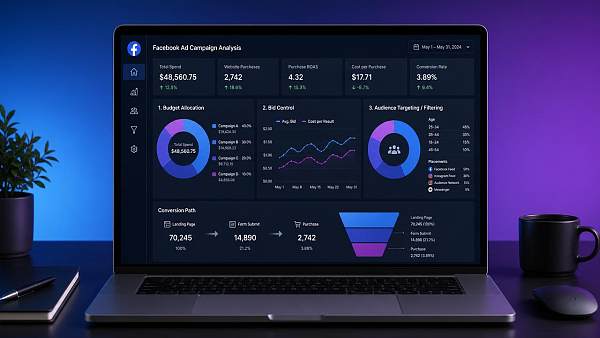
A more reliable execution recommendation is: during the testing phase, first look at the actual CPM, CPC, and initial conversion rate, and then decide whether to introduce a cost cap. Do not treat bidding tools as a button that can fix everything; they can only amplify the strengths or weaknesses of the account’s underlying structure.
3. Are the audience and placements too broad: just because the system can spend it does not mean the spend is worthwhile
The third key setting is audience and placement scope. In many accounts, the surface-level sign of overspending is “a lot of traffic,” but the real issue is traffic that is too mixed. Especially when automatic placements and broad interest targeting are enabled at the same time, the system may prioritize cheap but low-intent traffic. Spending may look smooth, but actual conversion efficiency continues to decline.
Operationally, it is recommended that you first check three issues: first, whether different countries, languages, and audience stages are mixed in the same ad set; second, whether remarketing audiences and cold-start audiences are sharing the same budget; third, whether obviously low-quality placements have not been excluded. Facebook ad campaign optimization is not simply about pursuing broader reach. Especially when budget is limited, precise control is more important than blindly scaling volume.
Understand it at a glance: what to check first when overspending occurs
Under different campaign scenarios, the troubleshooting priorities are also different
Independent website customer acquisition scenario
If your goal is website inquiries or orders, in addition to doing Facebook ad campaign optimization, you must also review the website’s conversion capacity at the same time. For example, slow page loading, overly long forms, or unclear mobile buttons can all make it look like the front end is overspending when the real issue is conversion leakage on the back end. In this case, ad setting optimization and website optimization must be carried out together, otherwise customer acquisition costs will only keep rising repeatedly.
Brand awareness scenario
If you are running brand awareness or video view objectives, the overspending issue is often not “the budget is being spent too fast,” but “it is being spent quickly without creating follow-up value.” At this time, you should focus on checking audience expansion, frequency control, and placement quality to avoid spending awareness budget on people unrelated to the business.
Remarketing scenario
Remarketing audiences are usually limited in size. If the budget is set too high, the system will repeatedly reach the same group of users, frequency will rise quickly, and costs will also increase. Instead of continuing to add budget, it is better to first check the audience window period, exclude users who have already converted, and verify whether creatives are layered according to visit depth.
4 risk reminders that are most easily overlooked
- Frequently editing ad sets. Every major change to budget, audience, or bidding may cause the system to re-enter the learning phase, intensifying short-term fluctuations.
- Looking only at spend, not at feedback. When Pixel, Conversion API, or on-site event mapping is incomplete, the “low conversion” you see may be underreporting rather than actual inefficiency.
- Ignoring time-of-day differences. In some industries, there are more clicks during the day and higher conversions at night. Without time-slot analysis, it is easy to misjudge budget as being out of control.
- Overly complex account structure. Too many campaigns and overly fragmented ad sets will scatter the budget and make it difficult to identify the source of the problem.
In internal review and process management, many teams also draw on more systematic methods, such as using structured thinking to organize risks, permissions, and execution responsibilities. If your team is building a more standardized data and media management process, you may also refer to the relevant ideas in Research on the Development of Internal Control Systems in Public Institutions Based on Risk Prevention and Control to help establish a more robust review mechanism.
Practical execution suggestions for operators: handle it in this order
If you need to handle an account today where “spend is abnormally fast,” it is recommended to carry out Facebook ad campaign optimization in the following order instead of making chaotic changes all at once:
- First export the data from the past 7 days and break down spend distribution by campaign, ad set, placement, country, and device.
- Confirm whether the budget level is aligned with the testing objective, and separate mixed tests when necessary.
- Review the bidding strategy to avoid over-restricting cost or blindly chasing volume when data is insufficient.
- Check audience overlap and placement quality, and prioritize cutting obviously inefficient traffic sources.
- At the same time, verify website loading, forms, tracking tags, and conversion feedback to avoid mistaking page issues for ad issues.
- Change only one core variable at a time, observe at least one complete data cycle, and then decide the next step.
FAQ: how to judge whether you should increase budget during Facebook ad campaign optimization
In what situations should you not rush to increase budget?
When conversion tracking is unstable, the learning phase is not over, the audience is too mixed, or placements have not been filtered, it is not recommended to increase budget directly. Adding money at this point will only magnify the problem.
In what situations can you scale gradually?
When cost per conversion tends to be stable, the website is converting normally, and the main audiences and placements have been verified as effective, you can increase budget gradually in small steps and continue monitoring fluctuations.
First clarify the settings, then talk about scaling and creative upgrades
When Facebook ad campaign optimization runs into overspending, the first things worth checking are not whether the creatives look good, but these 3 core settings: budget level, bidding strategy, and audience placements. For users and operators, clarifying these three items first often makes it possible to quickly determine whether the issue lies in account structure, system allocation, or website conversion handling. Only when settings are reasonable, data is complete, and pages run smoothly does it make more sense to increase budget, expand audiences, or change creatives.
If you want to further evaluate your campaign plan next, it is recommended to first prepare this information: current account objective, daily budget structure, key data from the past 7 days, main audience breakdown, website conversion path, and Pixel and feedback status. Only after these basic parameters are clearly communicated can a more efficient optimization plan be developed to support business growth.
Related Articles



Related Products
 EasyCamp SaaS Smart Website Marketing SystemE-Yingbao SaaS Smart Website Marketing System: AI-powered, zero-code website building. Rapidly launch multilingual independent e-commerce sites in just 10 minutes. Global server acceleration and AI-driven SEO optimization empower businesses to efficiently connect with global markets. The seamless integration of technology and user-friendly operation makes building e-commerce sites incredibly simple.
 AI+SEM Intelligent Advertising Marketing SystemAI+SEM drives intelligent ad creation, empowering full-funnel precision advertising marketing. The system automatically generates weekly/monthly reports, AI recommends keywords and target countries, monitors core metrics in real-time with intelligent alerts, and enables one-click high-conversion ad solutions to help quickly acquire customers and improve ROI.
 AI+SEO Dual Engine Optimization ServiceEasyWin AI+SEO Dual Engine Optimization System leverages AI-powered keyword mining, content generation, and comprehensive technical optimization to help foreign trade enterprises acquire high-quality organic traffic, significantly improving search rankings and conversion rates.
 AI+SNS Social Media Marketing SystemYingbao AI+SNS Social Media Marketing System - Precision social capture for the social media era. Supports one-click content synchronization across major platforms like Facebook and LinkedIn. AI intelligently rewrites posts for enhanced relevance. 24/7 AI customer service and user profiling analysis empower businesses to efficiently expand into global markets.
 AI+SEO营销解决方案易营宝AI+SEO营销解决方案,通过AI批量写作、智能生成TDK、精准关键词扩词等功能,全面优化网站SEO效果,提升流量与转化率。助力企业构建高效智能网站新生态。
 AI+SEM Advertising Marketing SolutionsAI+SEM Advertising Marketing Solution leverages AI technology to deeply empower SEM ad campaigns. It automatically generates weekly/monthly reports using AI, presenting account data across multiple dimensions for comprehensive insights into campaign performance and trends. The system precisely recommends keywords and target countries, intelligently generates high-conversion ad copy, and enables one-click activation of efficient campaign plans to help businesses rapidly acquire customers. Simultaneously, it monitors core metrics in real time, intelligently identifies abnormal fluctuations, and issues timely alerts to ensure stable, high-return advertising results.
 Domain Name ServicesEasyWin provides professional domain name services, including intelligent queries, one-stop registration, brand protection, and full lifecycle management, helping businesses build a digital brand image.
 EasyOperate B2C Cross-Border E-Commerce Platform & Independent WebsiteEasyStore B2C Cross-border E-commerce Independent Store is an intelligent website building and cross-border e-commerce integrated solution independently developed by EasyStore Information Technology (Beijing) Co., Ltd. The system is specially designed for small and medium-sized as well as large export enterprises, integrating 'website building, operation, marketing, advertising, and conversion' into one, helping enterprises quickly establish cross-border e-commerce independent stores to achieve brand globalization and global sales growth.
The platform supports multiple languages, multiple currencies, and multi-channel marketing, with built-in AI intelligent translation and SEO optimization systems, suitable for mainstream markets such as Southeast Asia, Europe and America, Latin America, and the Middle East, assisting Chinese manufacturing enterprises in efficiently deploying international e-commerce strategies. SSL证书易营宝提供专业SSL安全证书服务,包括单域名和泛域名证书,确保网站数据传输加密、身份验证和完整性保护,助力企业建立安全可信的在线业务环境。









