









- Can Zhejiang foreign trade independent websites still be developed today? Look at changes in traffic and lead generationJul 28, 2026View details
- What New Signals Are Emerging in Enterprise Services SaaS Marketing ReportsJul 27, 2026View details
- What Does a Global Traffic Ecosystem Service Provider Do? What Are the Differences from a Single Advertising AgencyJul 16, 2026View details
- What should you focus on in the latest enterprise SaaS report? From renewal rates and delivery costs to overseas growth opportunitiesJul 12, 2026View details
- What signals are worth paying attention to in a cross-border marketing trend report? B2B companies should look at these 6 signalsJul 11, 2026View details
- How to Read a Cross-Border Marketing Trends Report? Five Key Dimensions for Evaluating Channel OpportunitiesJul 11, 2026View details
How to create a keyword expansion sheet? A detailed explanation of SEO keyword selection and grouping methods for foreign trade websites
How to build a keyword expansion table? First, clarify the target keywords
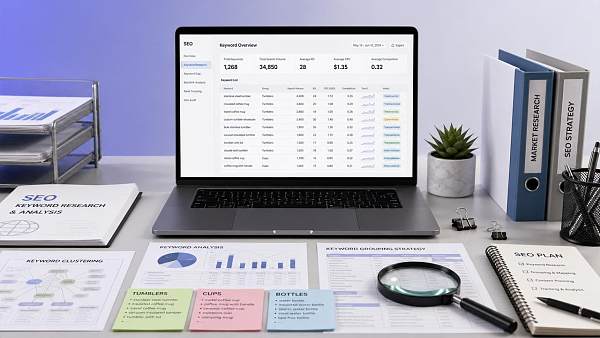
How to build a keyword expansion table determines whether an export website SEO can find the right traffic entry point. This article will combine the export keyword selection scenario to break down keyword mining, filtering, grouping, and layout methods, helping operators efficiently build an actionable SEO keyword library.
Many people rush to find keywords when doing export website SEO. In fact, what matters more is first clarifying what traffic the website should capture, what pages it serves, and what kinds of search needs it should address.
If the target is not clear, even a large keyword expansion table will only mean “many words, scattered traffic, and weak conversions”. This is also an important reason why many websites get indexed but still do not receive inquiries for a long time.
In actual business, the common keyword expansion goals for export websites mainly fall into three categories: product lead generation, industry content traffic, and brand awareness coverage. Different goals require different keyword expansion table structures.
- Product lead generation: focus on product terms, specification terms, application terms, and purchasing terms.
- Content traffic generation: focus on question terms, solution terms, comparison terms, and tutorial terms.
- Brand coverage: focus on brand terms, brand combination terms, and reputation terms.
So, when building a keyword expansion table, the first step is not filling in the table, but defining the framework first. List the website sections, landing page types, target countries and markets, and core product lines first, and then start expanding keywords. The efficiency will be much higher.
The basic fields of a keyword expansion table are best built in one go
A keyword expansion table that can truly be implemented is not just the “keyword” column. A truly useful table should at least support filtering, grouping, assignment, and follow-up tracking.
It is recommended to keep the following fields in the initial version, which will make later content planning and page optimization much easier.
This set of fields looks basic, but it is extremely important. Because export website SEO often involves long cycles, many pages, and multiple languages, without a structured keyword expansion table, content is likely to be repeated later, or multiple pages may compete for the same keyword.
Export website SEO keyword selection usually expands from these four directions
How to build a keyword expansion table depends on whether the “expansion path” is complete. Simply focusing on product names is usually far from enough. Export websites need to take real customer search habits into account.
1. Expand downward from product terms
This is the most basic layer. You can expand around product names, model numbers, materials, dimensions, uses, processes, and application industries. Keywords generated this way are closer to purchasing intent.
2. Expand outward from demand questions
Many customers do not search directly for product names, but first search for questions. For example, installation methods, selection criteria, usage differences, and price influencing factors. These kinds of words are suitable for blogs and knowledge page layouts.
3. Expand forward from purchasing intent
For example, supplier, manufacturer, factory, wholesale, customization, quotation, minimum order quantity, and similar terms. Although search volume may not be the highest, business intent is often stronger, so these are suitable for marking as high-priority keywords.
4. Expand from markets and language variants
Different countries do not always use the same wording. Even for the same product, regional expression differences still appear. When building a keyword expansion table, record the common variants in each target market separately.
If a company is also doing independent website content and social media distribution, these keywords can also guide content topic selection in reverse. Tools like AI+SNS social media full-scope marketing system are more suitable for synchronizing website content to multiple platforms and reducing the time spent repeatedly organizing topics.
Do not only look at search volume when filtering keywords
Many people are easily attracted by high search volume when building a keyword expansion table. But for export websites, search volume is only a reference, not the center of decision-making. More important is the match between the keyword and the business.
A seemingly popular keyword, if the search intent is information-heavy or the competition is too strong, can be difficult to bring effective inquiries in the short term. On the other hand, some more specific long-tail keywords are more likely to produce results.
It is recommended to evaluate at least four indicators when filtering.
- Relevance: whether it is directly related to the product, market, and transaction scenario.
- Intent strength: whether it is for learning and understanding, or for inquiry and purchasing.
- Competition level: whether the current website can enter the ranking.
- Conversion potential: whether it can connect to a suitable page and guide inquiries.
From recent changes, search results pay more attention to content matching and theme completeness. This also means that a keyword expansion table should not only have “words”, but also support content clustering and page depth building.
How to group keywords so they can truly be used for page layout
Many teams make keyword expansion tables at the very end, and the problem is that they do not know how to group them. The keyword library is large, but the pages cannot absorb it, and the content has nowhere to be arranged. The solution is to divide them into three layers: “theme + intent + page”.
Group by theme
Put the same type of products, the same type of applications, and the same type of questions together. This helps form topic pages, category pages, and content clusters.
Group by search intent
Keywords with strong purchasing intent should be prioritized for product pages and category pages. Informational keywords are more suitable for blogs, guides, case studies, and FAQ pages. This better matches search expectations.
Group by page type
Each page should focus on one core keyword, and then be paired with several related keywords. Do not force multiple themes into one page, otherwise page relevance will be weakened.
A more obvious signal is that a well-grouped site will make it much smoother to write titles, descriptions, and body content later, and internal linking planning will also feel more natural. The SEO efficiency of the whole site will be significantly improved.
An actionable keyword expansion table must ultimately lead to action
How to build a keyword expansion table is, in the end, not for “archiving”, but for execution. Whether it can be converted into a page construction checklist is the standard for judging the quality of the keyword table.
It is recommended to directly add action fields to the second half of the table, such as planned launch time, content status, indexing status, ranking changes, and inquiry feedback. In this way, SEO work will not stop at the research stage.
If a company is doing websites, SEO, advertising, and social media at the same time, the keyword table can also serve as a unified content foundation. In the long-term service of export companies, YiYingBao's common approach is to let keyword planning, website structure, content production, and distribution channels advance in sync.
For example, in the overseas content distribution process, with AI+SNS social media full-scope marketing system, website content can be adapted to multiple platforms, combined with user profiles and automated interactions, improving the follow-through efficiency after exposure.
Finally, to summarize, the correct way to build a keyword expansion table can be summarized in four steps: first define the goal, then expand keywords; then filter and group them; finally map them to pages and continuously track the results.
When you truly turn the keyword expansion table into an “actionable keyword library”, export website SEO is no longer about writing content by feel, but about steadily accumulating traffic and inquiries around real needs. This step is often the dividing line for a website to move from having content to having growth.
Related Articles
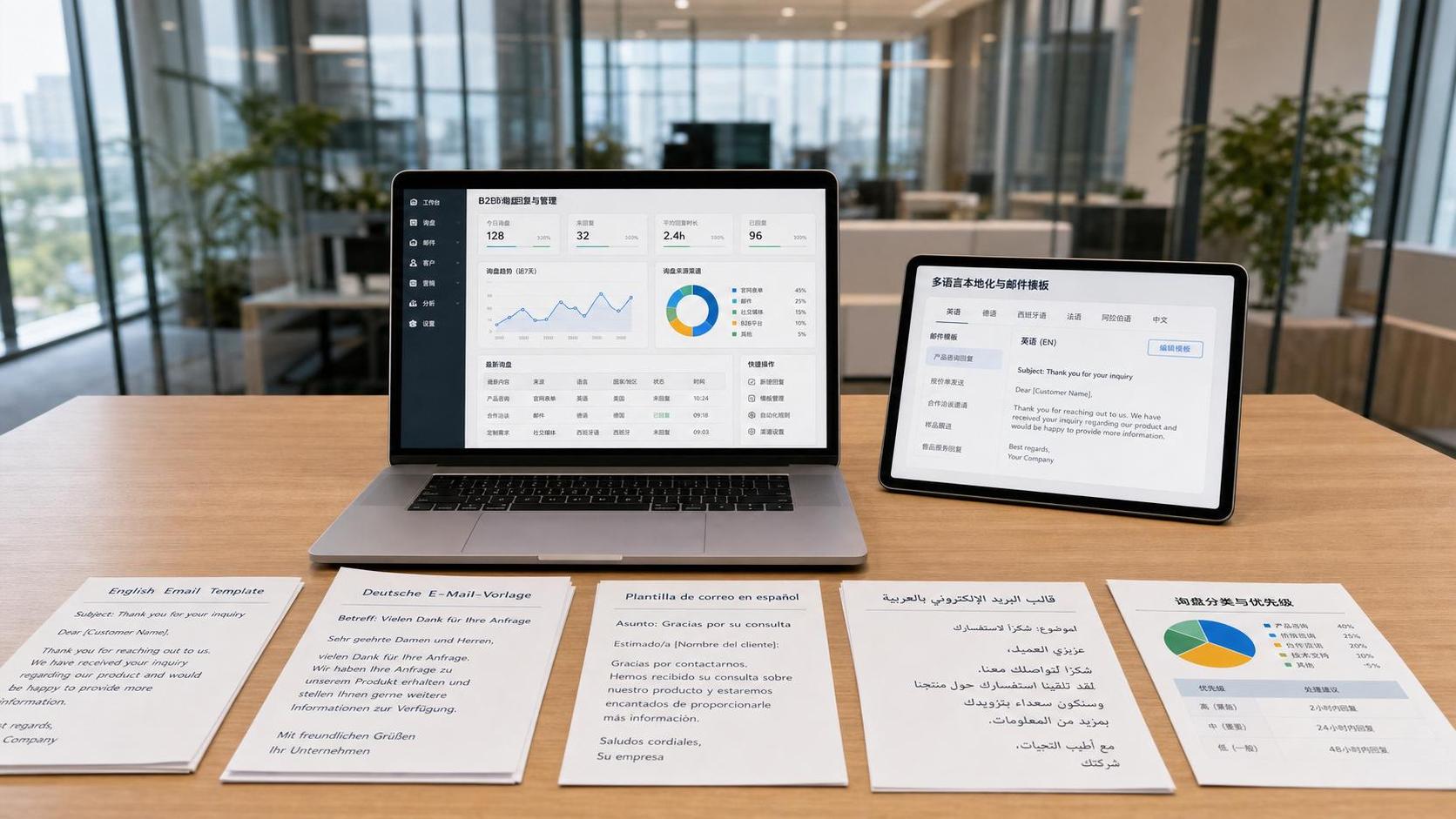
 How to Create a Multilingual Version of a B2B Inquiry Response Template
 SEO Checklist, TDK Template, Foreign Trade Website-Building Checklist, How to Use an Inquiry Email Template More Efficiently
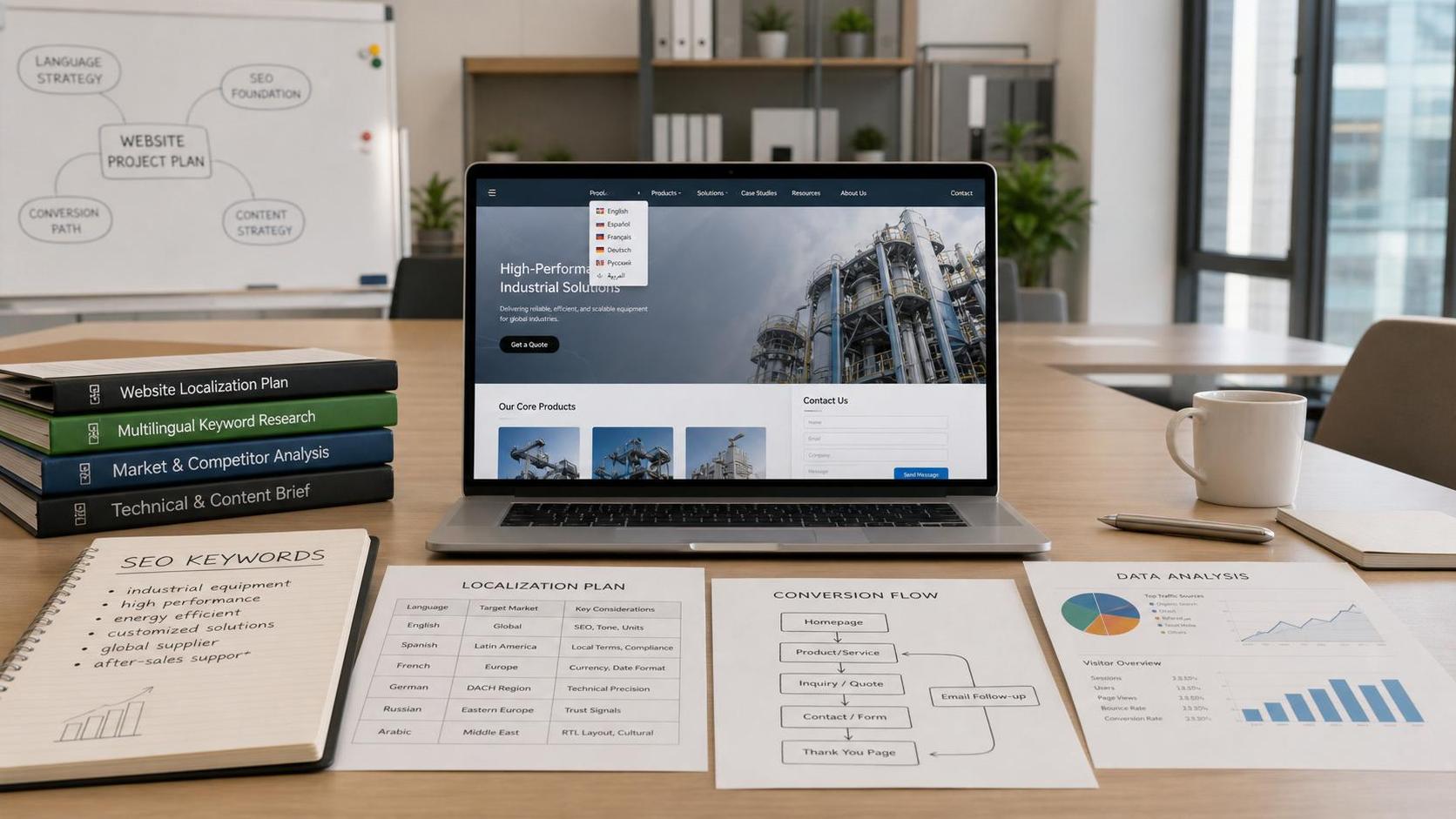
 Foreign Trade Website Checklist Consultant Version: Language, SEO, and Conversion Items to Confirm Before Launch

Related Products
 EasyCamp SaaS Smart Website Marketing SystemE-Yingbao SaaS Smart Website Marketing System: AI-powered, zero-code website building. Rapidly launch multilingual independent e-commerce sites in just 10 minutes. Global server acceleration and AI-driven SEO optimization empower businesses to efficiently connect with global markets. The seamless integration of technology and user-friendly operation makes building e-commerce sites incredibly simple.
 AI+SEM Intelligent Advertising Marketing SystemAI+SEM drives intelligent ad creation, empowering full-funnel precision advertising marketing. The system automatically generates weekly/monthly reports, AI recommends keywords and target countries, monitors core metrics in real-time with intelligent alerts, and enables one-click high-conversion ad solutions to help quickly acquire customers and improve ROI.
 AI+SEO Dual Engine Optimization ServiceEasyWin AI+SEO Dual Engine Optimization System leverages AI-powered keyword mining, content generation, and comprehensive technical optimization to help foreign trade enterprises acquire high-quality organic traffic, significantly improving search rankings and conversion rates.
 AI+SNS Social Media Marketing SystemYingbao AI+SNS Social Media Marketing System - Precision social capture for the social media era. Supports one-click content synchronization across major platforms like Facebook and LinkedIn. AI intelligently rewrites posts for enhanced relevance. 24/7 AI customer service and user profiling analysis empower businesses to efficiently expand into global markets.
 AI+SEO营销解决方案易营宝AI+SEO营销解决方案,通过AI批量写作、智能生成TDK、精准关键词扩词等功能,全面优化网站SEO效果,提升流量与转化率。助力企业构建高效智能网站新生态。
 AI+SEM Advertising Marketing SolutionsAI+SEM Advertising Marketing Solution leverages AI technology to deeply empower SEM ad campaigns. It automatically generates weekly/monthly reports using AI, presenting account data across multiple dimensions for comprehensive insights into campaign performance and trends. The system precisely recommends keywords and target countries, intelligently generates high-conversion ad copy, and enables one-click activation of efficient campaign plans to help businesses rapidly acquire customers. Simultaneously, it monitors core metrics in real time, intelligently identifies abnormal fluctuations, and issues timely alerts to ensure stable, high-return advertising results.
 Domain Name ServicesEasyWin provides professional domain name services, including intelligent queries, one-stop registration, brand protection, and full lifecycle management, helping businesses build a digital brand image.
 EasyOperate B2C Cross-Border E-Commerce Platform & Independent WebsiteEasyStore B2C Cross-border E-commerce Independent Store is an intelligent website building and cross-border e-commerce integrated solution independently developed by EasyStore Information Technology (Beijing) Co., Ltd. The system is specially designed for small and medium-sized as well as large export enterprises, integrating 'website building, operation, marketing, advertising, and conversion' into one, helping enterprises quickly establish cross-border e-commerce independent stores to achieve brand globalization and global sales growth.
The platform supports multiple languages, multiple currencies, and multi-channel marketing, with built-in AI intelligent translation and SEO optimization systems, suitable for mainstream markets such as Southeast Asia, Europe and America, Latin America, and the Middle East, assisting Chinese manufacturing enterprises in efficiently deploying international e-commerce strategies. SSL证书易营宝提供专业SSL安全证书服务,包括单域名和泛域名证书,确保网站数据传输加密、身份验证和完整性保护,助力企业建立安全可信的在线业务环境。









