









- Can Zhejiang foreign trade independent websites still be developed today? Look at changes in traffic and lead generationJul 28, 2026View details
- What New Signals Are Emerging in Enterprise Services SaaS Marketing ReportsJul 27, 2026View details
- What Does a Global Traffic Ecosystem Service Provider Do? What Are the Differences from a Single Advertising AgencyJul 16, 2026View details
- What should you focus on in the latest enterprise SaaS report? From renewal rates and delivery costs to overseas growth opportunitiesJul 12, 2026View details
- What signals are worth paying attention to in a cross-border marketing trend report? B2B companies should look at these 6 signalsJul 11, 2026View details
- How to Read a Cross-Border Marketing Trends Report? Five Key Dimensions for Evaluating Channel OpportunitiesJul 11, 2026View details
- Which channel has the highest ROI in the global traffic ecosystem? Comparative analysis of search, social media, and advertisingJul 10, 2026View details
- What multilingual website services are available in Sanya? Which model is more suitable for local businesses going global?Jul 08, 2026View details
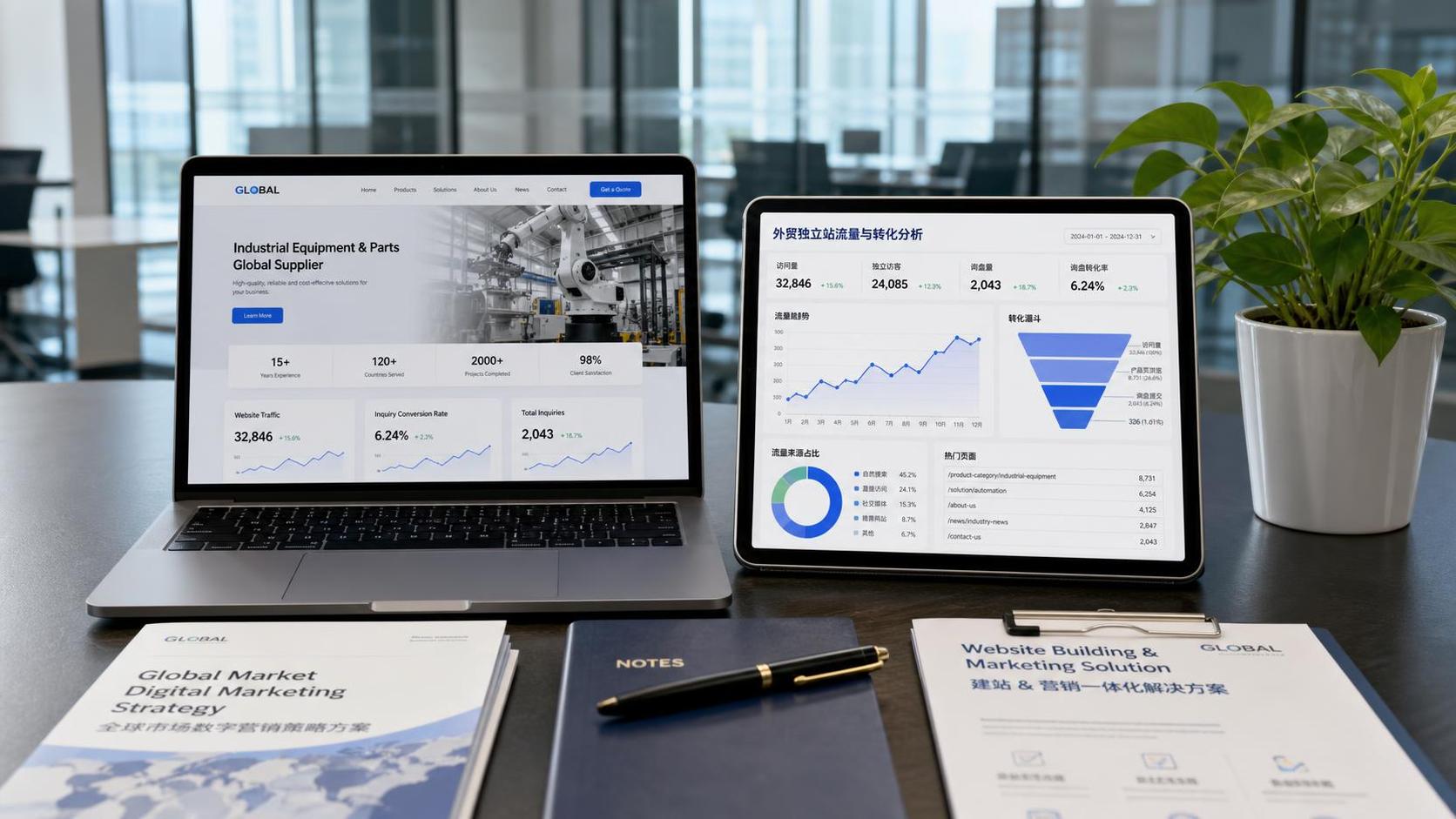
Can Zhejiang foreign trade independent websites still be developed today? Look at changes in traffic and lead generation
Zhejiang Export-Oriented Independent Websites: The Discussion Is No Longer About “Whether to Build One”
Can Zhejiang export-oriented independent websites still be built today? The genuinely valuable answer does not lie in the four words “can they still be built,” but in a more realistic question: Is an independent website still a customer-acquisition asset capable of continuously generating inquiries and orders?
If we go back a few years, the core needs of many Zhejiang foreign trade enterprises when building an independent website were relatively straightforward: have an English website, combine it with search engine optimization or advertising, capture overseas search traffic, and gradually establish an inquiry channel. At that time, the main concerns were “Do we have a website?” and “Does the website look good?” Today, the evaluation criteria have changed. Websites are no longer scarce, and traffic is no longer as dependent on a single entry point as it once was. What truly creates a gap is whether a company can turn its website into an overseas business hub that can be found in searches, understood, trusted, and converted.
This is also the biggest misunderstanding many people have about Zhejiang export-oriented independent websites: they assume that an independent website is simply a website development project, when in fact it is more like an ongoing overseas customer-acquisition system. The website is only the surface. What really matters behind it is the content structure, search visibility, page conversion capability, advertising conversion capability, multilingual strategy, and whether the company can express itself locally for different markets.
Traffic Has Changed, and So Has the Value of Independent Websites
Zhejiang is a major manufacturing and foreign trade province. The types of foreign trade enterprises in Yiwu, Ningbo, Wenzhou, Shaoxing, Taizhou, Hangzhou, and other areas vary greatly. Some focus on standardized product wholesale, some on customized manufacturing, and others on cross-border retail and overseas brand expansion. In the past, people tended to understand an independent website as an “official website,” but today, this way of thinking is often insufficient.
The reason is simple. The ways in which overseas customers reach suppliers have become fragmented. Some enter through Google after searching for industry keywords; some see a brand on social media first and then search for the brand name; some make direct inquiries through advertising landing pages; others encounter a company on a platform first and then visit its independent website to verify its qualifications. More importantly, AI search and generative Q&A are changing how information is distributed. Corporate websites are not only meant to be viewed by people; they increasingly need to be accurately understood by search engines and intelligent systems.
This means that independent websites have not become obsolete. On the contrary, they now perform more functions than before. They are not merely used to display products, but also serve as a hub for handling traffic from multiple channels, building trust, accumulating data, and supporting repeat visits and conversions. If a company still understands an independent website as a template plus a few product pages, it is not surprising that the results are poor.

The real problem is that traffic costs have risen, and extensive growth tactics are becoming increasingly difficult. Relying solely on organic traffic from platforms leaves companies vulnerable to rule changes; relying only on advertising may lead to continuously rising lead costs; and if the website cannot effectively handle incoming traffic, the investment will ultimately be wasted. The reason independent websites remain necessary is precisely that they are among the few digital assets a company can control over the long term.
They Can Still Be Built, but Not Every Company Should Build One in the Same Way
When many people ask whether independent websites can still be built, they are essentially asking whether there will still be a return after investment. This depends on the business model, not on the regional label. Whether a Zhejiang export-oriented independent website is worth building should first be assessed across at least three scenarios.
For the many integrated trading-and-manufacturing companies, OEMs, and ODMs in Zhejiang, an independent website is still worth building and may be even more valuable than before. The core competitiveness of these companies is often not low prices, but delivery capability, manufacturing expertise, customization experience, certification foundations, and project coordination capabilities. Platform pages have difficulty presenting these aspects comprehensively, whereas an independent website can clearly explain “who you are, what you can do, and how you differ from others.” For inquiry-based businesses, this directly affects whether customers are willing to leave their contact information.
However, if a company expects to “build a website and get orders immediately,” it will most likely be disappointed. An independent website is not a universal channel that produces instant results. It is more like compound growth: in the early stage, the company needs to establish a solid foundation through coordinated technical architecture, content, and channels. Only afterward can its value gradually emerge through organic search, branded searches, advertising conversions, and customer trust.
What Zhejiang Companies Face Is Not Whether to Build a Website, but the Restructuring of Customer-Acquisition Logic
In the past, the overseas expansion path of many foreign trade enterprises was relatively straightforward: platforms, trade fairs, referrals from existing customers, and a website providing supplementary information. All of these paths are now changing. The recovery of trade fairs does not mean that digital channels are becoming less important. On the contrary, because purchasing decisions have become more cautious, customers often repeatedly verify suppliers online. Platform traffic remains stable, but homogeneous competition is evident. Advertising channels remain effective, but advertising increasingly depends on landing-page quality and data feedback. Search optimization is still important, but it has shifted from “keyword stuffing” to solving problems, covering needs, and building topical relevance.
This is why the industry has increasingly emphasized “integrated website development and marketing” in recent years. It is not a conceptual packaging exercise, but a response to the fact that standalone tools are becoming less capable of solving problems independently. A website with poor indexing will struggle to gain SEO visibility; a website with weak page logic will waste advertising traffic; and a website without localized content support will make multilingual versions merely formal. If companies continue to view website development, SEO, advertising, and social media as separate functions, they often end up doing a little in each area without forming a complete growth loop.
From this perspective, Zhejiang export-oriented independent websites have not become outdated; the threshold has simply risen. In the past, companies could compete by having “a website.” Now they must compete through “website quality + channel coordination + continuous operations.”
Which Changes Deserve the Most Attention from Business Decision-Makers?
One obvious change is that content is no longer merely used to fill pages; it directly affects search performance and inquiry quality. The problem with many factory websites is not that they have too few pages, but that the entire site repeats undifferentiated claims such as “high quality, excellent service, and extensive experience.” What overseas buyers really want to see are application scenarios, material selection, delivery-time considerations, production-line capabilities, applicable certification scopes, customization procedures, and solutions to common issues. Whoever explains these matters clearly is more likely to attract high-intent traffic.
Another change is that the technical foundation is beginning to affect marketing results. Website loading speed, mobile experience, whether the page structure facilitates indexing, whether multilingual versions are properly implemented, whether forms work smoothly, and whether data tracking is complete—these were once often treated as technical details, but they now directly affect customer-acquisition efficiency. In particular, for companies targeting multiple markets, simply translating English, Russian, Spanish, and Japanese websites without considering local search habits and content organization can easily reduce the return on investment.
Another easily overlooked change is visibility in the AI search environment. Many companies have noticed that customers may no longer rely solely on traditional search results pages to find suppliers. They may also obtain information through intelligent Q&A, generative search summaries, and industry content aggregation pages. This creates new requirements for websites: content must be clear, structure must be standardized, and topics must be focused. A site cannot consist only of scattered pages without systematic communication. Those that are easier for machines to “understand” will have more initiative in future traffic distribution.
Common Misconceptions Often Cause More Delays Than Budget Constraints
A common misconception is to view independent websites and platforms as opposing options. In reality, for most Zhejiang foreign trade enterprises, they are not substitutes but complementary tools with different roles. Platforms are suitable for capturing existing demand and achieving rapid exposure, while independent websites are suitable for building brand awareness, accumulating search traffic, demonstrating professional capabilities, and handling off-site leads. Connecting platforms with independent websites is generally more stable than relying entirely on either one.
Another misconception is treating template-based website development as a low-cost trial. On the surface, launching the website first and addressing issues later may seem reasonable. However, if the underlying architecture is unfavorable for indexing, the content cannot be expanded, or the website cannot support future advertising and multilingual growth, the cost of rebuilding it later is often much higher. For a company, what is truly inexpensive is not a low initial price, but a website that can continue to deliver value over two or three years without being repeatedly rebuilt from scratch.
Some people also understand SEO as slow and advertising as fast, and therefore treat them as mutually exclusive options. In practice, this distinction is too simplistic. A more reasonable approach is to use advertising to validate the market, SEO to accumulate long-term demand, content to strengthen conversion, and social media to expand reach, while using the website to connect these channels. For companies expanding overseas in particular, marketing efficiency increasingly depends on system coordination rather than the short-term performance of a single channel.
To Decide Whether It Is Worth Building One, Start by Considering These Practical Questions
Instead of asking whether independent websites can still be built, companies should first ask themselves several questions: Do we need to continuously acquire new overseas customers? Do we want to reduce our dependence on a single platform or channel? Can we provide more complete professional information than our competitors? Are we willing to spend six months to a year building a long-term traffic asset? Do we plan to enter multiple regional markets and implement localized strategies?
If the answer to most of these questions is yes, then Zhejiang export-oriented independent websites can not only still be built, but should be built in a more systematic manner. At this point, the key issue is no longer “building a website,” but choosing a system and service model that places website development, SEO, advertising, social media, content operations, and AI search visibility within the same growth framework. For platforms such as 易营宝 that integrate intelligent website development, SEO optimization, advertising, social media marketing, and generative engine optimization, the value lies not merely in adding tools together, but in reducing the losses caused by fragmented execution and designing the website around promotion, indexing, and conversion from the moment it goes live.
Ultimately, a Zhejiang export-oriented independent website is not an outdated option, but a form of infrastructure that requires more sophisticated methods. Traffic still exists, but its entry points have changed; customers are still looking for suppliers, but they are making decisions more cautiously; independent websites are still effective, but they can no longer rely on simply “having a website” to deliver results. Those who recognize this sooner will be more likely to build a stable position in future overseas customer acquisition.
Related Articles
 Can Zhejiang foreign trade independent websites still be developed today? Look at changes in traffic and lead generation
 What New Signals Are Emerging in Enterprise Services SaaS Marketing Reports
 Google Bidding Has Undergone a Major Overhaul at 8.17! Your Customer Acquisition Costs Are Going Up—Part 1

Related Products
 EasyCamp SaaS Smart Website Marketing SystemE-Yingbao SaaS Smart Website Marketing System: AI-powered, zero-code website building. Rapidly launch multilingual independent e-commerce sites in just 10 minutes. Global server acceleration and AI-driven SEO optimization empower businesses to efficiently connect with global markets. The seamless integration of technology and user-friendly operation makes building e-commerce sites incredibly simple.
 AI+SEM Intelligent Advertising Marketing SystemAI+SEM drives intelligent ad creation, empowering full-funnel precision advertising marketing. The system automatically generates weekly/monthly reports, AI recommends keywords and target countries, monitors core metrics in real-time with intelligent alerts, and enables one-click high-conversion ad solutions to help quickly acquire customers and improve ROI.
 AI+SEO Dual Engine Optimization ServiceEasyWin AI+SEO Dual Engine Optimization System leverages AI-powered keyword mining, content generation, and comprehensive technical optimization to help foreign trade enterprises acquire high-quality organic traffic, significantly improving search rankings and conversion rates.
 AI+SNS Social Media Marketing SystemYingbao AI+SNS Social Media Marketing System - Precision social capture for the social media era. Supports one-click content synchronization across major platforms like Facebook and LinkedIn. AI intelligently rewrites posts for enhanced relevance. 24/7 AI customer service and user profiling analysis empower businesses to efficiently expand into global markets.
 AI+SEO营销解决方案易营宝AI+SEO营销解决方案,通过AI批量写作、智能生成TDK、精准关键词扩词等功能,全面优化网站SEO效果,提升流量与转化率。助力企业构建高效智能网站新生态。
 AI+SEM Advertising Marketing SolutionsAI+SEM Advertising Marketing Solution leverages AI technology to deeply empower SEM ad campaigns. It automatically generates weekly/monthly reports using AI, presenting account data across multiple dimensions for comprehensive insights into campaign performance and trends. The system precisely recommends keywords and target countries, intelligently generates high-conversion ad copy, and enables one-click activation of efficient campaign plans to help businesses rapidly acquire customers. Simultaneously, it monitors core metrics in real time, intelligently identifies abnormal fluctuations, and issues timely alerts to ensure stable, high-return advertising results.
 Domain Name ServicesEasyWin provides professional domain name services, including intelligent queries, one-stop registration, brand protection, and full lifecycle management, helping businesses build a digital brand image.
 EasyOperate B2C Cross-Border E-Commerce Platform & Independent WebsiteEasyStore B2C Cross-border E-commerce Independent Store is an intelligent website building and cross-border e-commerce integrated solution independently developed by EasyStore Information Technology (Beijing) Co., Ltd. The system is specially designed for small and medium-sized as well as large export enterprises, integrating 'website building, operation, marketing, advertising, and conversion' into one, helping enterprises quickly establish cross-border e-commerce independent stores to achieve brand globalization and global sales growth.
The platform supports multiple languages, multiple currencies, and multi-channel marketing, with built-in AI intelligent translation and SEO optimization systems, suitable for mainstream markets such as Southeast Asia, Europe and America, Latin America, and the Middle East, assisting Chinese manufacturing enterprises in efficiently deploying international e-commerce strategies. SSL证书易营宝提供专业SSL安全证书服务,包括单域名和泛域名证书,确保网站数据传输加密、身份验证和完整性保护,助力企业建立安全可信的在线业务环境。









