









- What Does a Global Traffic Ecosystem Service Provider Do? What Are the Differences from a Single Advertising AgencyJul 16, 2026View details
- What should you focus on in the latest enterprise SaaS report? From renewal rates and delivery costs to overseas growth opportunitiesJul 12, 2026View details
- What signals are worth paying attention to in a cross-border marketing trend report? B2B companies should look at these 6 signalsJul 11, 2026View details
- How to Read a Cross-Border Marketing Trends Report? Five Key Dimensions for Evaluating Channel OpportunitiesJul 11, 2026View details
- Which channel has the highest ROI in the global traffic ecosystem? Comparative analysis of search, social media, and advertisingJul 10, 2026View details
- What multilingual website services are available in Sanya? Which model is more suitable for local businesses going global?Jul 08, 2026View details
How to Create a Multilingual Version of a B2B Inquiry Response Template
How to Build a Multilingual B2B Inquiry Response Template
Building an efficient multilingual system for B2B inquiry response templates can not only improve response speed, but also strengthen customer trust and conversion rates. This article avoids abstract concepts and focuses directly on the problems encountered in day-to-day operations: customers come from different countries, inquiry quality varies, sales follow-up is inconsistent, and translations are prone to errors. If a template is merely “Chinese translated into multiple languages,” the actual results are usually poor. A truly effective system must be built around scenarios, customer stages, and target markets.
This is particularly important for teams providing integrated website and marketing services. Customer inquiries do not come only from the contact forms on the official website. They may also come from multilingual website landing pages, advertising pages, social media direct messages, or organic SEO traffic pages. When the entry points differ, the response strategy cannot be one-size-fits-all.
Before Writing Templates, First Distinguish the Response Scenarios
Many companies make their first mistake when creating multilingual B2B inquiry response templates by “writing a standard email first.” As a result, the template appears complete, but no one actually wants to use it. A more reliable approach is to first list the most common scenarios.
- An inquiry is received for the first time, and the customer’s needs and identity need to be confirmed
- The customer asks only about the price, but provides severely insufficient information
- The customer has clearly provided specifications, quantities, and target markets, and is close to the quotation stage
- The customer has not replied for a long time and requires a second follow-up
- Delivery time, certifications, samples, minimum order quantities, or payment terms need to be explained
- The inquiry comes from an advertising or social media channel and needs to be screened for authenticity first
This step determines whether the templates can actually be implemented. In practice, there is no need to pursue a large number of templates. Covering 80% of common situations is sufficient. Too many templates make them difficult for sales staff to find; too few will lead back to improvised responses.
A Truly Effective Template Is Not a Translation, but a “Master Version + Localized Versions”
Many teams send Chinese templates directly to translation tools and then forward them to overseas customers. The grammar may be correct, but the business tone, market conventions, and forms of address can easily feel unnatural. Customers can tell at a glance that the message was pieced together by a machine, and trust can decline quickly.
A more reliable approach is to first create a Chinese or English “master version,” then adapt it into localized versions in different languages. Localization is not limited to the language itself; it also includes details such as:
- Whether the form of address is sufficiently formal. Some European markets prefer complete and polite business language, while some regions favor more direct communication.
- Whether the quotation is clearly expressed. The currency, trade terms, and whether taxes are included must be stated clearly so that customers do not have to guess a second time.
- Whether the order of information about certifications, delivery, samples, and after-sales service matches local purchasing practices.
- Whether the formats for dates, telephone numbers, time zones, and units are consistent. For example, millimeters, inches, kilograms, and pounds should not be mixed up.
If the company itself is building a multilingual website or conducting overseas promotion, the template system should ideally be synchronized with the website’s language versions. It is common for a customer to submit an inquiry on a Spanish-language page but receive a stiff English response. This disconnect can seriously hurt conversion rates.
For an integrated service platform such as 易营宝, which covers intelligent website building, multilingual website development, SEO optimization, advertising, and overseas social media operations, it is suitable to connect inquiry entry points, form fields, automatic assignment, and multilingual response rules. The factor that truly affects efficiency is often not whether there is a template, but whether the template corresponds to the website, channel, and customer source.
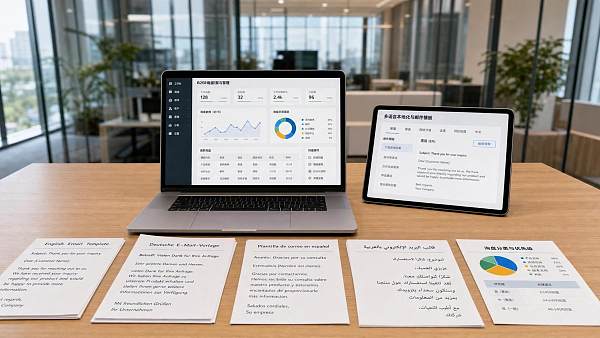
Which Content in a Template Should Be Fixed and Which Should Be Left Blank
There are two common extremes here. One is to fix everything, so that every customer receives exactly the same message. The other is to write almost everything manually, making the template virtually pointless.
It is recommended to divide the template into “fixed sections” and “variable sections.” Fixed sections ensure professionalism and completeness, while variable sections demonstrate relevance and personalization.
In particular, do not insert a lengthy company introduction into the initial response. The most important things in the first reply are to tell the customer that you have seen the inquiry, understood it, and know how to move forward. Too much information can instead slow down reading.
Inquiry Screening Rules Must Be Included in the Checklist
In practice, an inquiry response template is not only a “reply text”; it is also a screening tool. This is especially true when inquiries come from Google Ads, social media advertising, or overseas short-video traffic, where the number of low-quality leads may increase significantly.
It is recommended to include a set of evaluation criteria in the template system, covering at least the following points:
- Whether the company name, official website, or verifiable business information has been provided
- Whether the email suffix is unusual and whether disposable email addresses are used extensively【To be verified before assessment】
- Whether the requirements are specific and whether there are inquiries involving large quantities but no parameters at all
- Whether the target market, purchasing cycle, and quantity are reasonable
- Whether the customer repeatedly asks only about the lowest price while not responding to any technical or business confirmations
This does not mean that sales staff should refuse to respond. It means that responses should be differentiated. High-intent customers can be moved directly toward quotations and meetings; for customers with insufficient information, the template should focus on collecting additional details; for clearly abnormal inquiries, only a basic response should be provided without investing excessive manpower.
The Most Common Problems with Multilingual Templates Are in the Details, Not the Vocabulary
Some mistakes may seem minor but can cause significant problems later. For example, translating “business days” unclearly may lead customers to assume calendar days; vague payment terms can cause disputes later; and writing that a certification “can be provided” when it is actually available only for certain models can create misunderstandings. Whenever delivery times, certifications, testing, compliance, or after-sales coverage are involved, do not include statements in the template that the company cannot consistently fulfill.
If entering a specific market requires certifications, testing, or compliance documents, it is recommended that business, product, legal, or quality-related colleagues confirm the information together before incorporating it into the template. For content that has not been internally confirmed, it is better to phrase it cautiously rather than add it prematurely “to appear professional.” When an item is uncertain, wording such as “This can be further confirmed based on the specific model” is more reliable.
Do Not Prepare Just One Follow-Up Template; Establish at Least a Basic Rhythm
Many teams put considerable effort into the initial response but then stop following up. B2B project decision cycles are inherently long, and a customer’s lack of response does not necessarily mean there is no interest. More commonly, the customer may be discussing the matter internally, dealing with time differences, comparing samples, or experiencing delays in the procurement process.
Therefore, the templates should include at least a three-stage follow-up sequence:
- Within 24 to 72 hours after the initial response, send a gentle reminder focusing on providing additional materials or confirming requirements.
- After about one week, if there is still no response, provide a more specific next step, such as a sample, proposal, or meeting time.
- If there is still no response after two weeks, send one final follow-up. Keep the tone polite and leave the customer with a low-pressure way to reply.
One practical rule is that each follow-up should ideally include some new information. Do not simply ask, “Have you seen this?” New information could include updated parameter recommendations, explanations of applicable markets, packaging options, or answers to common purchasing questions. Even a short addition is more effective than an empty reminder.
Update the Templates Together with the Website Forms, or Efficiency Will Not Improve
If a form collects only a name, email address, and message, sales staff will still need to repeatedly ask additional questions no matter how quickly they respond. A more efficient approach is to let the website’s front-end form collect key information first, such as the product model, purchase quantity, target country, required delivery time, whether customization is needed, and whether the customer already has a website or promotional plan.
This is also why website-building systems and inquiry management cannot be separated when conducting overseas marketing. If fields can be configured consistently across AI-powered website building, multilingual websites, advertising landing pages, and SEO pages, multilingual response templates will have a practical foundation. For users, the most direct change is simple: one less round of questions and one less day of waiting.
Conduct a Small-Scale Stress Test Before Launching
Do not enable the templates for everyone immediately after completing them. It is more reliable to simulate responses using the most recent 30 to 50 real inquiries. The number does not need to be mechanically fixed; the key is to cover different sources and countries. During testing, focus on four points: whether sales staff can quickly find the appropriate template, whether variable fields are left blank, whether the multilingual versions contain obvious ambiguities, and whether the customer’s next action is clearer.
If testing shows that people still frequently edit the templates manually, it usually means that the templates are too vague or that the scenarios have not been divided appropriately. This is the time to revise them rather than force implementation.
Keep an Eye on These Results During Implementation
Finally, do not look only at “whether a reply was sent.” Examine whether the templates have actually improved the process after launch. Users should continuously monitor at least the following: whether the initial response time has been reduced, whether the rate of collecting additional information has increased, whether invalid inquiries are identified more quickly, and whether the subsequent response rates of customers in different languages vary.
If you are creating multilingual B2B inquiry response templates, you may wish to review the process against this checklist: Have the scenarios been clearly distinguished? Have the master version and localized versions been separated? Is there a clear boundary between fixed and variable content? Do the website forms support the process? Has the follow-up rhythm been designed? Once these areas are connected, the templates become more than a collection of copy; they become an operational system that can genuinely support inquiry conversion.
Related Articles
 How to Create a Multilingual Version of a B2B Inquiry Response Template
 SEO Checklist, TDK Template, Foreign Trade Website-Building Checklist, How to Use an Inquiry Email Template More Efficiently
 Foreign Trade Website Checklist Consultant Version: Language, SEO, and Conversion Items to Confirm Before Launch

Related Products
 EasyCamp SaaS Smart Website Marketing SystemE-Yingbao SaaS Smart Website Marketing System: AI-powered, zero-code website building. Rapidly launch multilingual independent e-commerce sites in just 10 minutes. Global server acceleration and AI-driven SEO optimization empower businesses to efficiently connect with global markets. The seamless integration of technology and user-friendly operation makes building e-commerce sites incredibly simple.
 AI+SEM Intelligent Advertising Marketing SystemAI+SEM drives intelligent ad creation, empowering full-funnel precision advertising marketing. The system automatically generates weekly/monthly reports, AI recommends keywords and target countries, monitors core metrics in real-time with intelligent alerts, and enables one-click high-conversion ad solutions to help quickly acquire customers and improve ROI.
 AI+SEO Dual Engine Optimization ServiceEasyWin AI+SEO Dual Engine Optimization System leverages AI-powered keyword mining, content generation, and comprehensive technical optimization to help foreign trade enterprises acquire high-quality organic traffic, significantly improving search rankings and conversion rates.
 AI+SNS Social Media Marketing SystemYingbao AI+SNS Social Media Marketing System - Precision social capture for the social media era. Supports one-click content synchronization across major platforms like Facebook and LinkedIn. AI intelligently rewrites posts for enhanced relevance. 24/7 AI customer service and user profiling analysis empower businesses to efficiently expand into global markets.
 AI+SEO营销解决方案易营宝AI+SEO营销解决方案,通过AI批量写作、智能生成TDK、精准关键词扩词等功能,全面优化网站SEO效果,提升流量与转化率。助力企业构建高效智能网站新生态。
 AI+SEM Advertising Marketing SolutionsAI+SEM Advertising Marketing Solution leverages AI technology to deeply empower SEM ad campaigns. It automatically generates weekly/monthly reports using AI, presenting account data across multiple dimensions for comprehensive insights into campaign performance and trends. The system precisely recommends keywords and target countries, intelligently generates high-conversion ad copy, and enables one-click activation of efficient campaign plans to help businesses rapidly acquire customers. Simultaneously, it monitors core metrics in real time, intelligently identifies abnormal fluctuations, and issues timely alerts to ensure stable, high-return advertising results.
 Domain Name ServicesEasyWin provides professional domain name services, including intelligent queries, one-stop registration, brand protection, and full lifecycle management, helping businesses build a digital brand image.
 EasyOperate B2C Cross-Border E-Commerce Platform & Independent WebsiteEasyStore B2C Cross-border E-commerce Independent Store is an intelligent website building and cross-border e-commerce integrated solution independently developed by EasyStore Information Technology (Beijing) Co., Ltd. The system is specially designed for small and medium-sized as well as large export enterprises, integrating 'website building, operation, marketing, advertising, and conversion' into one, helping enterprises quickly establish cross-border e-commerce independent stores to achieve brand globalization and global sales growth.
The platform supports multiple languages, multiple currencies, and multi-channel marketing, with built-in AI intelligent translation and SEO optimization systems, suitable for mainstream markets such as Southeast Asia, Europe and America, Latin America, and the Middle East, assisting Chinese manufacturing enterprises in efficiently deploying international e-commerce strategies. SSL证书易营宝提供专业SSL安全证书服务,包括单域名和泛域名证书,确保网站数据传输加密、身份验证和完整性保护,助力企业建立安全可信的在线业务环境。









