









- What Does a Global Traffic Ecosystem Service Provider Do? What Are the Differences from a Single Advertising AgencyJul 16, 2026View details
- What should you focus on in the latest enterprise SaaS report? From renewal rates and delivery costs to overseas growth opportunitiesJul 12, 2026View details
- What signals are worth paying attention to in a cross-border marketing trend report? B2B companies should look at these 6 signalsJul 11, 2026View details
- How to Read a Cross-Border Marketing Trends Report? Five Key Dimensions for Evaluating Channel OpportunitiesJul 11, 2026View details
- Which channel has the highest ROI in the global traffic ecosystem? Comparative analysis of search, social media, and advertisingJul 10, 2026View details
- What multilingual website services are available in Sanya? Which model is more suitable for local businesses going global?Jul 08, 2026View details
3 Pitfalls to Avoid When Creating a Multilingual Website
3 Pitfalls to Avoid When Creating a Multilingual Website
Creating a multilingual website may seem like simply translating pages, but it actually affects traffic acquisition and overseas conversion. If localization, technical structure, and SEO adaptation are overlooked, even a high budget may deliver little impact. At the selection stage, many companies ask, “Does it support multiple languages?” and “Can users switch languages?” However, what truly affects the results is often not whether the feature exists, but whether it is implemented correctly.
If you are currently preparing to build an overseas corporate website, a foreign trade inquiry website, or a cross-border e-commerce store, or if you plan to rebuild an existing English website, you can use the following checklist when reviewing a service provider’s proposal. The key is not how many features the provider describes, but whether the solution will leave you paying continuously to fix problems later.
Pitfall 1: Understanding “Multilingual” as “Page Translation”
This is the most common misconception. When many projects go live, they appear to have English, French, German, and Japanese pages, and the menus can be switched between languages. However, three months after launch, companies discover that search performance has not improved and inquiries remain unstable. The problem is usually not the number of languages, but the fact that the content has not actually been localized.
Business decision-makers should first clarify one point: You are not creating a multilingual website to “show that your company is international.” You are doing it so that users in different markets can understand you, trust you, and be willing to contact you. This involves at least three layers, none of which can be solved by translation alone.
- Language habits: The way users search for the same product may differ by region. A literal translation is often not the term users actually search for.
- Business communication: B2B customers care more about qualifications, delivery, production capacity, and application scenarios, while B2C users focus more on price, delivery, after-sales service, and reviews.
- Trust-building information: Currency, contact details, time zones, how case studies are presented, privacy statements, and form fields can all affect conversion.
Here is a very practical example. When Chinese companies create websites for European and American markets, they often transfer the entire structure of their Chinese website, including “Company Profile,” “Products,” and “News.” This structure is common in China, but from the perspective of overseas users, it may not be the most convenient browsing path. This is especially true for manufacturing, equipment, and raw material websites. Buyers are more concerned with “What can you make? Which industries do you serve? What parameter ranges are available? How can I contact technical support?” They are not necessarily interested in reading a long company history first.
Therefore, during the creation of a multilingual website, we recommend checking directly whether the service provider has included the following in the proposal, rather than simply writing “AI translation supported”:
- Are target markets differentiated, rather than using one English website for the entire world?
- Will titles, selling points, and form content be adjusted by region?
- Can different languages be edited independently, rather than having all language versions passively follow the source text?
- Will key pages be reviewed by people, especially the homepage, product pages, landing pages, and inquiry pages?
- Can professional terminology be standardized to prevent the same product from having multiple translations?
If the provider’s proposal only includes “machine translation + bulk generation” and does not mention keyword adaptation, page rewriting, form localization, or content review, you can basically predict the outcome: the website may go live quickly, but its organic traffic and conversion rate will most likely require additional rework later.
For foreign trade companies, a more reliable approach is to develop key pages in depth first and then expand into more languages. Thoroughly covering your core markets, core products, and core landing pages is more effective than launching more than a dozen languages all at once.
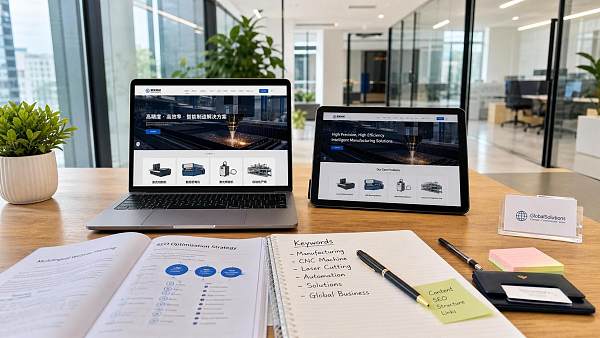
Pitfall 2: The Technical Structure Looks Usable but Is Actually Unfavorable for Indexing
This pitfall is more difficult to detect than content issues. During acceptance testing, many companies check whether pages open properly and whether language switching is smooth, but search engines follow a different logic. If your website’s technical structure is not properly built, even carefully written content may be indexed slowly, rank poorly, or even cause pages in different languages to compete with one another.
When creating a multilingual website, the following areas deserve particular attention.
One common practice deserves special mention here: the front end switches between different languages, but the address bar barely changes, or only adds a parameter. This may be usable for a basic presentation website, but it is not SEO-friendly enough. Search engines more easily recognize pages with a clear structure, independent content, and explicit relationships.
Another easily overlooked point is backend functionality. Companies need to continuously update content, expand products, and test advertising landing pages. If technical staff must handle every newly added language page, execution costs will be high. In this situation, whether the website system itself supports independent management of URLs, titles, descriptions, navigation, forms, and redirects is not a “minor feature,” but an issue that affects future growth efficiency.
If you are selecting a supplier, you can ask these questions directly:
- Does each language version have an independent URL?
- How are different language versions associated and identified by search engines?
- Can sitemaps be submitted and indexing rules be configured separately?
- Can titles, descriptions, and image alt text be maintained independently for each language?
- When new markets are added later, is a template copied or does development have to start over?
Experienced service teams generally consider whether a website can be operated sustainably over the long term during the website-building stage. The advantage of integrated service providers such as Yiyingbao, which work on intelligent website building, SEO optimization, and overseas marketing at the same time, usually lies here: they do not treat website building, indexing, and promotion as three disconnected tasks. For decision-makers, a solution that structures the website around promotion from the beginning saves more time and requires less rework later.
Pitfall 3: Launching a Multilingual Website Without Market-Specific SEO and Conversion Design
Many companies assume that the project ends once the website is completed. In reality, launch is only the beginning. Search habits and conversion paths vary significantly across regions such as North America, Europe, Southeast Asia, Japan and South Korea, and the Middle East. Applying one standardized template to every market usually creates one of two problems: either traffic cannot get in, or visitors arrive but do not submit inquiries.
First, SEO. Being multilingual does not automatically produce rankings. At a minimum, you need to confirm that the core pages in each target language are written around the real search needs of local users, rather than mechanically translating Chinese keywords. For businesses involving industrial products, machinery and equipment, components, and chemical materials, industry terminology, specification expressions, and purchase-intent keywords can differ significantly. If the keywords are wrong, adding more pages will not bring in qualified traffic.
Next, conversion. Corporate websites often overlook the fact that “looking complete” and “actually converting” are not the same thing. Many pages contain all the information, but lack designs that encourage customers to take the next step, such as:
- Too many form fields, making completion costly on mobile devices;
- Contact information limited to Chinese business hours, without considering time differences;
- No clear entry points based on product lines, application industries, or cooperation models;
- Landing pages receive advertising traffic, but the copy still uses the tone of a general corporate website introduction;
- Missing privacy statements, delivery information, or FAQs, causing visitors to hesitate before submitting their information.
There is a straightforward standard for evaluating this: Has the multilingual website merely completed “content presentation,” or has it considered the “lead generation journey”? If the service provider only discusses the number of website pages and does not discuss keyword planning, a content update plan, the inquiry path, or coordination with advertising landing pages, the project is more like a one-time design delivery than a growth project.
A more reliable approach is generally to view the website as part of a complete overseas lead-generation journey: Is the website structure conducive to SEO? Does the page content support Google advertising? Are suitable landing pages available after traffic is directed from social media? Can the website also support GEO optimization for AI search visibility in the future? More and more companies are now paying attention to GEO optimization. Its specific results vary by industry, language, and platform, and some implementation details still need to be verified in practice. However, one point is clear: if the underlying content structure of the website is disorganized, the cost of both SEO and AI search optimization will be higher later.
An Implementation Checklist for Decision-Makers
If you are comparing multilingual website development proposals, we recommend treating the following items as questions that must be asked before making a decision, rather than adding them after the project begins:
- Have target markets been analyzed separately, rather than using one set of content globally?
- Can the website system support independent URLs, SEO settings, and content management for each language?
- Are the homepage, product pages, and inquiry pages subject to human review, rather than being launched through fully automated translation?
- Does the service provider understand website building, SEO, advertising landing pages, and overseas conversion, rather than delivering only the visual design of the pages?
- Is there a continuous optimization mechanism after launch, including content updates, search performance tracking, and inquiry data reviews?
A multilingual website is successful not because it has been “translated into several languages,” but because it enables customers in different markets to find you, understand you, and want to contact you. For business decision-makers, the biggest risk is not overspending, but spending the budget on a website that can only display information and cannot generate growth. If you ask the right questions during the selection stage, you can avoid many unnecessary detours caused by these three pitfalls.
Related Articles
Related Products
 EasyCamp SaaS Smart Website Marketing SystemE-Yingbao SaaS Smart Website Marketing System: AI-powered, zero-code website building. Rapidly launch multilingual independent e-commerce sites in just 10 minutes. Global server acceleration and AI-driven SEO optimization empower businesses to efficiently connect with global markets. The seamless integration of technology and user-friendly operation makes building e-commerce sites incredibly simple.
 AI+SEM Intelligent Advertising Marketing SystemAI+SEM drives intelligent ad creation, empowering full-funnel precision advertising marketing. The system automatically generates weekly/monthly reports, AI recommends keywords and target countries, monitors core metrics in real-time with intelligent alerts, and enables one-click high-conversion ad solutions to help quickly acquire customers and improve ROI.
 AI+SEO Dual Engine Optimization ServiceEasyWin AI+SEO Dual Engine Optimization System leverages AI-powered keyword mining, content generation, and comprehensive technical optimization to help foreign trade enterprises acquire high-quality organic traffic, significantly improving search rankings and conversion rates.
 AI+SNS Social Media Marketing SystemYingbao AI+SNS Social Media Marketing System - Precision social capture for the social media era. Supports one-click content synchronization across major platforms like Facebook and LinkedIn. AI intelligently rewrites posts for enhanced relevance. 24/7 AI customer service and user profiling analysis empower businesses to efficiently expand into global markets.
 AI+SEO营销解决方案易营宝AI+SEO营销解决方案,通过AI批量写作、智能生成TDK、精准关键词扩词等功能,全面优化网站SEO效果,提升流量与转化率。助力企业构建高效智能网站新生态。
 AI+SEM Advertising Marketing SolutionsAI+SEM Advertising Marketing Solution leverages AI technology to deeply empower SEM ad campaigns. It automatically generates weekly/monthly reports using AI, presenting account data across multiple dimensions for comprehensive insights into campaign performance and trends. The system precisely recommends keywords and target countries, intelligently generates high-conversion ad copy, and enables one-click activation of efficient campaign plans to help businesses rapidly acquire customers. Simultaneously, it monitors core metrics in real time, intelligently identifies abnormal fluctuations, and issues timely alerts to ensure stable, high-return advertising results.
 Domain Name ServicesEasyWin provides professional domain name services, including intelligent queries, one-stop registration, brand protection, and full lifecycle management, helping businesses build a digital brand image.
 EasyOperate B2C Cross-Border E-Commerce Platform & Independent WebsiteEasyStore B2C Cross-border E-commerce Independent Store is an intelligent website building and cross-border e-commerce integrated solution independently developed by EasyStore Information Technology (Beijing) Co., Ltd. The system is specially designed for small and medium-sized as well as large export enterprises, integrating 'website building, operation, marketing, advertising, and conversion' into one, helping enterprises quickly establish cross-border e-commerce independent stores to achieve brand globalization and global sales growth.
The platform supports multiple languages, multiple currencies, and multi-channel marketing, with built-in AI intelligent translation and SEO optimization systems, suitable for mainstream markets such as Southeast Asia, Europe and America, Latin America, and the Middle East, assisting Chinese manufacturing enterprises in efficiently deploying international e-commerce strategies. SSL证书易营宝提供专业SSL安全证书服务,包括单域名和泛域名证书,确保网站数据传输加密、身份验证和完整性保护,助力企业建立安全可信的在线业务环境。









