









- What Does a Global Traffic Ecosystem Service Provider Do? What Are the Differences from a Single Advertising AgencyJul 16, 2026View details
- What should you focus on in the latest enterprise SaaS report? From renewal rates and delivery costs to overseas growth opportunitiesJul 12, 2026View details
- What signals are worth paying attention to in a cross-border marketing trend report? B2B companies should look at these 6 signalsJul 11, 2026View details
- How to Read a Cross-Border Marketing Trends Report? Five Key Dimensions for Evaluating Channel OpportunitiesJul 11, 2026View details
- Which channel has the highest ROI in the global traffic ecosystem? Comparative analysis of search, social media, and advertisingJul 10, 2026View details
- What multilingual website services are available in Sanya? Which model is more suitable for local businesses going global?Jul 08, 2026View details
How Can GEO Content Optimization Improve AI Search Indexing?
How GEO Content Optimization Improves AI Search Indexing
As AI search rapidly reshapes traffic entry points, GEO content optimization has become an important indicator for technical evaluators to assess website indexing efficiency and content visibility. Understanding its underlying logic helps improve AI search indexing and marketing conversion performance.
If you are currently responsible for evaluating whether a website is worth optimizing with GEO content, do not start by focusing on “how many articles have been written.” What truly affects AI search indexing is usually not the amount of content, but whether the content can be consistently identified by machines, cited by them, and kept consistent across multilingual and multi-page scenarios. Many websites appear to contain substantial content, yet have almost no presence in AI search. The problem often lies in structure and signals rather than word count.
The checklist below is suitable for technical evaluators to use during an assessment. It is not a generic SEO template, but a set of practical evaluation criteria.
First Check Whether the Website Is “Readable,” Not Merely “Viewable”
Many corporate websites look fine visually but do not meet requirements from the perspective of AI search crawling and comprehension. During a technical evaluation, the first step is to determine whether the main page content exists directly in the HTML, or whether core information relies heavily on front-end rendering, collapsible components, asynchronous interfaces, or image banners.
- Can product descriptions, industry solutions, FAQs, specifications, and delivery scope be read directly from the source code?
- Does the above-the-fold area contain only slogans, without parseable business entity information?
- Has important content been turned into images, especially the common “full image with text” format on multilingual pages?
- Do mobile and desktop versions output different main text, resulting in inconsistent crawling results?
If this item fails, discussing GEO content optimization later will be difficult. AI search is not conducting a design review. It must first understand the content before it can cite it.
This is especially true for foreign trade companies, multilingual websites, and cross-border e-commerce stores. The value of an integrated website-building and marketing platform such as 易营宝 lies precisely in turning “being able to display” into “being indexable, promotable, and convertible.” If the technical foundation of the website is not properly handled, adding more content later only means continuously filling an inefficient structure.
Content Is Not About Piling Up Knowledge Points; Entity Information Comes First
AI search tends to prefer “verifiable objects.” Who is your website, what do you sell, whom do you serve, which regions do you cover, and how do you deliver your services? These are not merely brand copywriting issues, but entity recognition issues.
During a technical evaluation, directly check whether the following types of pages clearly explain these points: the company profile page, product pages, industry solution pages, regional market pages, contact page, and privacy and terms pages. The purpose is not to fill up the website with pages, but to provide search systems with stable context.
The most common mistake here is that the homepage makes broad claims, while the internal pages contain no corresponding evidence chain. What AI search sees is fragmented information, so it naturally becomes unwilling to use the website as a source of answers.
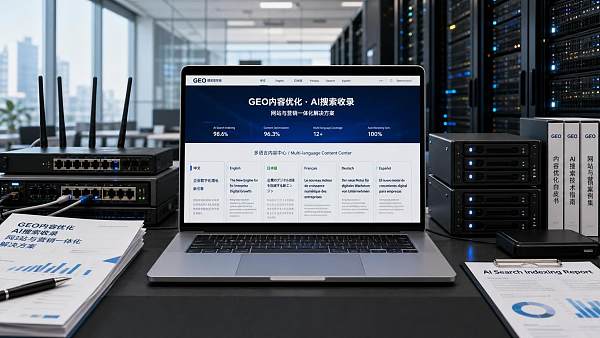
Do Not Reduce GEO Content Optimization to “Writing Articles with Different Keywords”
During a technical evaluation, it is recommended to examine content in three layers.
- Basic facts layer: company, products, industry, regions, functions, processes, and delivery methods.
- Decision-support layer: why the solution suits a particular type of company, what needs to be prepared before implementation, and what common risks exist.
- Citable answer layer: concise and accurate answers to specific questions that can be summarized by machines.
Many websites complete only the first layer, and a few reach the second. The content most likely to be extracted in AI search is often found in the third layer. For example: “Why is a multilingual website still not indexed after going live?”, “Should a manufacturing website be split into country-specific sites when implementing GEO content optimization?”, and “Should a B2B inquiry website’s product pages retain specification tables?” The more specific the answers to these questions are, the more likely they are to become source material for machine-generated summaries.
Do not write empty trend articles. Technical evaluators care about the granularity of verifiable information.
For Multilingual Websites, Focus on Consistency; Translation Is Not the End
For websites serving overseas markets, many AI search indexing problems originate from multilingual version management. Having multiple versions does not mean that a content asset has been created.
- Do pages in different languages clearly link to one another to avoid duplicate content competing internally?
- Are product names, industry terms, and delivery methods consistent? Do not call it “智能建站” on the Chinese page while using the generic term “web service” on the English page.
- Do regional pages genuinely distinguish market needs? For example, Europe and North America place greater emphasis on privacy and compliance statements, while the Middle East and Latin America focus more on delivery methods and local outreach channels.
- Are there issues such as obvious machine-translation traces, incomplete sentences, or inconsistent terminology?
Without unified standards in this area, AI search can easily classify a website as low-trust content. This is particularly important for B2B manufacturing websites and cross-border brand sites. Once specifications, materials, scope of application, lead times, or after-sales statements become inconsistent across languages, the result is not only poor indexing but also lower inquiry quality.
When Reviewing Content Structure, First Check Whether It Is Easy to “Cite”
Many traditional SEO practitioners focus on ranking positions, but GEO content optimization requires one additional assessment: whether the page can easily be extracted by AI search as part of an answer. This logic is somewhat similar to featured snippets, but the requirements are higher because the system not only extracts a sentence, but also evaluates credibility by combining the context of the entire page.
In practice, check the following:
- Does each page discuss one clear topic, rather than placing website development, SEO, advertising, and social media all on the same page?
- Do section headings correspond to real questions, rather than being purely promotional headings?
- Are key definitions, applicable scenarios, and limitations explained separately and clearly?
- Are high-extraction-value elements such as FAQs, step-by-step instructions, specification tables, and comparison tables retained?
Some pages are written smoothly, but contain no paragraph that can directly answer a question. Such content is not particularly friendly to AI search.
Do Not Miss Several Basic Technical Items; They May Look Old, but They Still Work
The following checks remain critical in technical evaluations and are directly related to AI search indexing:
- Are page response codes normal? Important pages should not have long-term 302 redirect chains.
- Is the sitemap updated continuously, and can newly added content be discovered promptly?
- Are canonical tags used appropriately to prevent pages on the same topic from conflicting with one another?
- Use structured data when applicable, but do not mark it up arbitrarily. If a field is uncertain, it is better to leave it blank; incorrect markup is more troublesome than missing markup.
- Is page loading stable, especially at overseas access points? The website should not load quickly domestically while being slow for overseas crawlers.
One reminder: structured data can indeed help, but it is not a remedy. If the body content itself is unclear, simply adding layers of markup will not improve AI search performance.
When Assessing Content Credibility, Focus Less on “Presence” and More on the Evidence Boundaries
GEO content optimization can easily turn into marketing copy, and this should be actively prevented during technical evaluation. Statements such as “serving customers worldwide,” “significant results,” and “industry-leading” may not be accepted by AI search without corresponding explanations, and users may not trust them either.
A more reliable approach is to clearly explain verifiable facts and set boundaries around information that cannot be confirmed. Information such as 易营宝 “founded in 2013,” “headquartered in Beijing,” and “providing AI-powered website development, multilingual website development, Google SEO optimization, advertising, and GEO generative engine optimization services” constitutes effective signals as long as it remains consistent throughout the website and appears on specific pages. As for customer results, market data, and certification details, do not expand on them if no publicly verifiable evidence is available, and do not draw conclusions on behalf of customers.
The same applies to policies, regional regulations, and industry certifications. If there is no accurate source, mark the content as 【To be verified】 or leave it unwritten for the time being.
Finally, Review the Operational Loop: Is There a Mechanism for Continuous Correction?
AI search indexing is not a one-time project. By the end of a technical evaluation, the focus usually returns to two questions: which pages have been indexed but not cited, and which pages have not even been discovered? The former is mostly a content-expression issue, while the latter is mostly a structural or crawling issue.
A practical approach is to maintain a checklist every month covering the launch date of new pages, crawl status, index status, core query terms, whether pages contain summarizable paragraphs, whether multilingual versions are synchronized, and whether new FAQs or scenario descriptions have been added. Do not only check whether traffic has increased. First determine whether the content assets have achieved stable visibility.
If you are evaluating an integrated website-building and marketing service solution, the focus is not how beautifully a single article is written, but whether the entire platform can address website structure, content production, overseas reach, and continuous optimization at the same time. GEO content optimization becomes genuinely effective not usually because of “publishing more content,” but because every layer of the website, from its foundation to its pages, is helping AI search understand it.
Therefore, one sentence is enough to keep in mind during an assessment: Is the page clear, is the content credible, is the structure crawlable, and can the answer be cited? If any one of these four aspects remains inaccurate over time, AI search indexing will most likely fail to gain traction. Conversely, when all four are handled properly, even a moderate amount of content will usually achieve more stable indexing quality than a large volume of generic copy.
Related Articles


Related Products
 EasyCamp SaaS Smart Website Marketing SystemE-Yingbao SaaS Smart Website Marketing System: AI-powered, zero-code website building. Rapidly launch multilingual independent e-commerce sites in just 10 minutes. Global server acceleration and AI-driven SEO optimization empower businesses to efficiently connect with global markets. The seamless integration of technology and user-friendly operation makes building e-commerce sites incredibly simple.
 AI+SEM Intelligent Advertising Marketing SystemAI+SEM drives intelligent ad creation, empowering full-funnel precision advertising marketing. The system automatically generates weekly/monthly reports, AI recommends keywords and target countries, monitors core metrics in real-time with intelligent alerts, and enables one-click high-conversion ad solutions to help quickly acquire customers and improve ROI.
 AI+SEO Dual Engine Optimization ServiceEasyWin AI+SEO Dual Engine Optimization System leverages AI-powered keyword mining, content generation, and comprehensive technical optimization to help foreign trade enterprises acquire high-quality organic traffic, significantly improving search rankings and conversion rates.
 AI+SNS Social Media Marketing SystemYingbao AI+SNS Social Media Marketing System - Precision social capture for the social media era. Supports one-click content synchronization across major platforms like Facebook and LinkedIn. AI intelligently rewrites posts for enhanced relevance. 24/7 AI customer service and user profiling analysis empower businesses to efficiently expand into global markets.
 AI+SEO营销解决方案易营宝AI+SEO营销解决方案,通过AI批量写作、智能生成TDK、精准关键词扩词等功能,全面优化网站SEO效果,提升流量与转化率。助力企业构建高效智能网站新生态。
 AI+SEM Advertising Marketing SolutionsAI+SEM Advertising Marketing Solution leverages AI technology to deeply empower SEM ad campaigns. It automatically generates weekly/monthly reports using AI, presenting account data across multiple dimensions for comprehensive insights into campaign performance and trends. The system precisely recommends keywords and target countries, intelligently generates high-conversion ad copy, and enables one-click activation of efficient campaign plans to help businesses rapidly acquire customers. Simultaneously, it monitors core metrics in real time, intelligently identifies abnormal fluctuations, and issues timely alerts to ensure stable, high-return advertising results.
 Domain Name ServicesEasyWin provides professional domain name services, including intelligent queries, one-stop registration, brand protection, and full lifecycle management, helping businesses build a digital brand image.
 EasyOperate B2C Cross-Border E-Commerce Platform & Independent WebsiteEasyStore B2C Cross-border E-commerce Independent Store is an intelligent website building and cross-border e-commerce integrated solution independently developed by EasyStore Information Technology (Beijing) Co., Ltd. The system is specially designed for small and medium-sized as well as large export enterprises, integrating 'website building, operation, marketing, advertising, and conversion' into one, helping enterprises quickly establish cross-border e-commerce independent stores to achieve brand globalization and global sales growth.
The platform supports multiple languages, multiple currencies, and multi-channel marketing, with built-in AI intelligent translation and SEO optimization systems, suitable for mainstream markets such as Southeast Asia, Europe and America, Latin America, and the Middle East, assisting Chinese manufacturing enterprises in efficiently deploying international e-commerce strategies. SSL证书易营宝提供专业SSL安全证书服务,包括单域名和泛域名证书,确保网站数据传输加密、身份验证和完整性保护,助力企业建立安全可信的在线业务环境。









