









- What Does a Global Traffic Ecosystem Service Provider Do? What Are the Differences from a Single Advertising AgencyJul 16, 2026View details
- What should you focus on in the latest enterprise SaaS report? From renewal rates and delivery costs to overseas growth opportunitiesJul 12, 2026View details
- What signals are worth paying attention to in a cross-border marketing trend report? B2B companies should look at these 6 signalsJul 11, 2026View details
- How to Read a Cross-Border Marketing Trends Report? Five Key Dimensions for Evaluating Channel OpportunitiesJul 11, 2026View details
- Which channel has the highest ROI in the global traffic ecosystem? Comparative analysis of search, social media, and advertisingJul 10, 2026View details
- What multilingual website services are available in Sanya? Which model is more suitable for local businesses going global?Jul 08, 2026View details
Before translating a full B2C cross-border e-commerce store site, you must assess 3 types of semantic risks
Whole-site translation is not text relocation, but the starting point of localization decision-making
Whole-site translation for B2C cross-border e-commerce stores is often mistakenly regarded as a simple “language switch” operation—translating Chinese pages page by page into English, Spanish, or Arabic. But in real business scenarios, a translation that has not been semantically calibrated may turn “limited-time flash sale” into offensive wording in the local culture, cause “free shipping” to be understood in the Middle East as “customs duties not included”, or even make product descriptions disappear completely from Google’s first page due to mismatched search terms. Through serving more than 100,000 enterprises going global, EasyYingbao has found that in cases where conversion rates dropped by more than 30%, nearly 60% of the root causes were not traffic or design, but the lack of scenario-based semantic evaluation.
These risks cannot be automatically avoided by machine translation engines. They require business evaluators, before launching translation, to systematically identify three types of deep semantic deviations using local consumer behavior, platform search logic, and regional compliance frameworks as benchmarks—distorted cultural adaptation, shifted search intent, and overstepped compliance expression. These three are intertwined, yet they carry different weights in different markets.
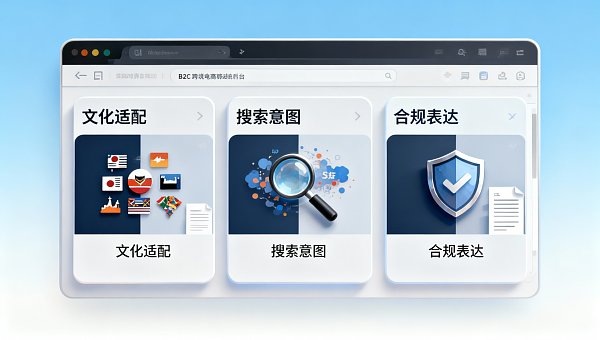
When users click “Buy Now”, what do they really understand?
Cultural adaptation risk is the easiest to underestimate, yet it has the most direct impact on trust building. For example, in the Japanese and Korean markets, the term “light luxury” can be literally translated as “light luxury”, but local consumers identify more with “上質な日常” (high-quality everyday life); in Saudi Arabia, if “free shipping” is not clearly marked at the same time with “including customs clearance and VAT”, it may instead trigger after-sales disputes. When EasyYingbao built a multilingual B2C cross-border store for a Shenzhen home furnishing brand, it found that the Russian version translated “eco-friendly material” directly as “экологичный материал”. Although grammatically correct, because it was not linked to certification marks familiar to Russian consumers (such as the EAC eco label), the bounce rate on product detail pages increased by 42%.
The key judgment is not whether it is “fluent”, but whether it “triggers local cognitive anchors”. It is necessary to conduct cross-verification in combination with the target market’s holiday customs, color taboos, number preferences (for example, avoiding “4” in Southeast Asia and favoring “7” in Brazil), and even religious expression conventions. Simply applying a general-purpose dictionary or AI translation result is equivalent to handing the brand over to semantic blind spots.
What is entered in the search box is never the literal meaning
Search intent deviation is often first exposed in SEO performance. When English-speaking users search for “wireless earbuds”, they expect technical specifications and wearing comfort; when German-speaking users search for “drahtlose Ohrhörer”, they care more about battery life and ear canal compatibility—behind the same product, the demand structure behind the keywords has already shifted. EasyYingbao’s AI+SEO/GEO optimization system monitored that a sports headphone brand on its French site directly translated the Chinese term “flagship noise cancellation” as “casque antibruit haut de gamme”. Although there was no grammatical error, the actual high-frequency local search term was “casque sport antibruit longue autonomie”. Because the page content and search motivation were misaligned, organic traffic dropped by 57%.
This type of risk requires translation to be embedded in advance with local search keyword databases and user Q&A data. It cannot rely only on dictionary matching, but must trace back to “who is searching, why they are searching, and what they want to do after searching”. Especially in long-tail keyword-driven markets such as North America and Latin America, the semantic reconstruction of product titles and Meta descriptions is more critical than translating the main body text on the page.
Compliance is not just the legal department’s concern, but the first line of defense in front-end copywriting
Compliance expression risk is the most concealed, yet it may trigger substantive business interruption. The EU GDPR requires privacy policies to use localized wording that is “clear, understandable, and unambiguous”; Turkey’s E-Commerce Law mandates that prices must include all taxes and indicate the currency code; Brazil’s INMETRO certification must be declared in a prominent position on the product page. These are not formatting issues, but semantic responsibilities—“tax included” in Portuguese must clearly distinguish between “I.V.A. incluído” (VAT included) and “Imposto incluso” (tax included in a broad sense), and the latter may be deemed by regulators as insufficient information.
More common are the finance and medical categories. When a Shenzhen health device brand entered the South Korean market, it directly translated the Chinese phrase “promotes blood circulation” as “혈액 순환을 촉진합니다”, without adjusting it according to MFDS guidelines to “혈액 순환 개선에 도움을 줄 수 있음” (may help improve blood circulation), resulting in the product page being temporarily taken down. Such risks cannot be identified by general translation tools and must be connected with local legal and industry regulatory databases.
How do the three risks work together? A typical case of misjudgment
When a small home appliance company in Zhejiang launched its Spanish website, it entrusted a third party to complete the whole-site translation. On the surface, everything seemed fine: accurate grammar, consistent terminology, and smooth loading. But three months after launch, advertising ROI kept declining and customer service inquiries surged. The post-analysis found that at the cultural level, “smart temperature control” was translated as “control inteligente de temperatura”, which matched the literal meaning but failed to reflect the implicit value of “energy saving and lower electricity bills” that Spanish households care about; at the search level, it did not cover the high-conversion local term “termostato wifi bajo consumo”; at the compliance level, the energy-efficiency label description lacked CE certification grading details, resulting in Google Shopping disapproval. The superposition of these three semantic fractures rendered the technical advantages completely ineffective.
The essence of this misjudgment is treating translation as the end point rather than an intermediate link in the localization chain. The semantic validation module built into EasyYingbao’s cross-border mall system is based precisely on ten years of service accumulation: mapping cultural adaptation to a visual symbol library, binding search intent to the GEO generation engine, and embedding compliance requirements into CMS field-level validation rules. For example, for the fund management needs of customers in the power industry, the system can synchronously invoke a discussion of optimization strategies for power enterprise fund management based on cash flow forecasting to reverse-validate the compliance boundaries of financial copy through regional fiscal and tax models.
Next step: start with a semantic audit
It is recommended to prioritize three actions: first, extract four types of core pages—the homepage, product listing page, payment page, and return and exchange policy page—and conduct semantic benchmarking against real search terms in the target market, localized copy from mainstream competitors, and publicly disclosed regulatory cases; second, invite local personnel whose native language is the target language and who have e-commerce operations experience to participate in short-phrase testing, and observe whether their first reaction is consistent with expectations; third, review whether all expressions involving amounts, timeliness, qualifications, and efficacy meet the minimum semantic unit requirements of local regulations.
The value of whole-site translation lies not in “how many pages were completed”, but in “how many semantic traps were avoided”. Only when the three dimensions of culture, search, and compliance are incorporated into the same evaluation framework can a B2C cross-border store truly gain the linguistic immunity needed to take root in global markets.
Related Articles


Related Products
 EasyCamp SaaS Smart Website Marketing SystemE-Yingbao SaaS Smart Website Marketing System: AI-powered, zero-code website building. Rapidly launch multilingual independent e-commerce sites in just 10 minutes. Global server acceleration and AI-driven SEO optimization empower businesses to efficiently connect with global markets. The seamless integration of technology and user-friendly operation makes building e-commerce sites incredibly simple.
 AI+SEM Intelligent Advertising Marketing SystemAI+SEM drives intelligent ad creation, empowering full-funnel precision advertising marketing. The system automatically generates weekly/monthly reports, AI recommends keywords and target countries, monitors core metrics in real-time with intelligent alerts, and enables one-click high-conversion ad solutions to help quickly acquire customers and improve ROI.
 AI+SEO Dual Engine Optimization ServiceEasyWin AI+SEO Dual Engine Optimization System leverages AI-powered keyword mining, content generation, and comprehensive technical optimization to help foreign trade enterprises acquire high-quality organic traffic, significantly improving search rankings and conversion rates.
 AI+SNS Social Media Marketing SystemYingbao AI+SNS Social Media Marketing System - Precision social capture for the social media era. Supports one-click content synchronization across major platforms like Facebook and LinkedIn. AI intelligently rewrites posts for enhanced relevance. 24/7 AI customer service and user profiling analysis empower businesses to efficiently expand into global markets.
 AI+SEO营销解决方案易营宝AI+SEO营销解决方案,通过AI批量写作、智能生成TDK、精准关键词扩词等功能,全面优化网站SEO效果,提升流量与转化率。助力企业构建高效智能网站新生态。
 AI+SEM Advertising Marketing SolutionsAI+SEM Advertising Marketing Solution leverages AI technology to deeply empower SEM ad campaigns. It automatically generates weekly/monthly reports using AI, presenting account data across multiple dimensions for comprehensive insights into campaign performance and trends. The system precisely recommends keywords and target countries, intelligently generates high-conversion ad copy, and enables one-click activation of efficient campaign plans to help businesses rapidly acquire customers. Simultaneously, it monitors core metrics in real time, intelligently identifies abnormal fluctuations, and issues timely alerts to ensure stable, high-return advertising results.
 Domain Name ServicesEasyWin provides professional domain name services, including intelligent queries, one-stop registration, brand protection, and full lifecycle management, helping businesses build a digital brand image.
 EasyOperate B2C Cross-Border E-Commerce Platform & Independent WebsiteEasyStore B2C Cross-border E-commerce Independent Store is an intelligent website building and cross-border e-commerce integrated solution independently developed by EasyStore Information Technology (Beijing) Co., Ltd. The system is specially designed for small and medium-sized as well as large export enterprises, integrating 'website building, operation, marketing, advertising, and conversion' into one, helping enterprises quickly establish cross-border e-commerce independent stores to achieve brand globalization and global sales growth.
The platform supports multiple languages, multiple currencies, and multi-channel marketing, with built-in AI intelligent translation and SEO optimization systems, suitable for mainstream markets such as Southeast Asia, Europe and America, Latin America, and the Middle East, assisting Chinese manufacturing enterprises in efficiently deploying international e-commerce strategies. SSL证书易营宝提供专业SSL安全证书服务,包括单域名和泛域名证书,确保网站数据传输加密、身份验证和完整性保护,助力企业建立安全可信的在线业务环境。









