









- What Does a Global Traffic Ecosystem Service Provider Do? What Are the Differences from a Single Advertising AgencyJul 16, 2026View details
- What should you focus on in the latest enterprise SaaS report? From renewal rates and delivery costs to overseas growth opportunitiesJul 12, 2026View details
- What signals are worth paying attention to in a cross-border marketing trend report? B2B companies should look at these 6 signalsJul 11, 2026View details
- How to Read a Cross-Border Marketing Trends Report? Five Key Dimensions for Evaluating Channel OpportunitiesJul 11, 2026View details
- Which channel has the highest ROI in the global traffic ecosystem? Comparative analysis of search, social media, and advertisingJul 10, 2026View details
- What multilingual website services are available in Sanya? Which model is more suitable for local businesses going global?Jul 08, 2026View details
Do I need to redo the TDK for full-site translation of an independent website? Differences in SEO settings across different language versions
After Full-Site Translation, TDK Must Never Be “One-Click Copied”
Full-site translation for an independent website is often mistakenly regarded as a “technical task”——once the language switch is completed, the content is in place, and SEO naturally carries over. But in real-world operations, search engines’ logic for identifying multilingual pages is far more complex than literal translation. Google will not automatically understand the semantic equivalence between a Spanish version and its Chinese page just because the page has a Spanish version; it cares more about: does this page truly serve the search intent of Spanish-speaking users? Does the title match high-frequency local keywords? Can the description trigger clicks? Are keywords embedded in localized expressions and usage habits? All of these judgments depend entirely on the deeply localized restructuring of TDK.
Through serving more than 100,000 companies going global, Easy Marketing Pro has found that multilingual sites that directly copy Chinese TDK experience an average indexing delay of 47 days, and their rate of reaching first-page rankings is less than 32%. The problem is not translation itself, but equating “language conversion” with “SEO migration”. Real multilingual SEO is a repositioning for a new market.
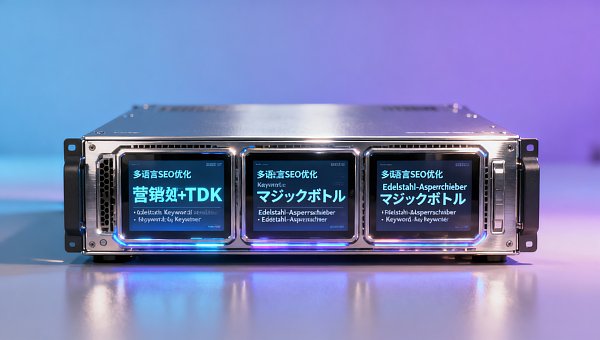
B2B Inquiry Scenario: Keywords Must Match the Procurement Terminology System
For an independent website targeting German industrial customers, if the Chinese phrase “high-quality stainless steel valve” is used directly as the title, the actual search volume is almost zero. German procurement personnel more often use compound terms like “Edelstahl-Absperrschieber DIN 3357” that include a standard number + function + material. If the Meta description only emphasizes “durable, precise”, it is less effective than explicitly stating “CE certified, supports TÜV test report download”. The core judgment point in this type of scenario is whether the real procurement decision-making path of the target market has been restored——from search terms to technical document acquisition, and then to inquiry form submission.
At this point, TDK is not copy optimization, but B2B professional semantic modeling. It needs to be reverse-engineered in combination with local industry directories, high-frequency terms in bidding documents, and the naming logic of competitors’ technical documentation.
B2C Brand Global Expansion: Emotional Anchors and Cultural Symbols Are Irreplaceable
When Japanese consumers search for “insulated cup”, what they expect is the culturally shared term “magic bottle” (マジックボトル); while when French users click “thermos”, it implies expectations of design and lifestyle aesthetics. If the English TDK directly translates the Chinese phrase “smart constant temperature”, it may trigger the negative association of “technologie lourde” (cumbersome technology) in French-speaking markets. Adding “élégant” or “sans effort” to the title instead is closer to the real conversion path.
In this type of scenario, the essence of TDK is brand tone translation. It requires going beyond literal accuracy and turning toward emotional resonance and restoration of the consumer context——this is exactly one of the core capabilities continuously iterated by Easy Marketing Pro’s AI+SEO/GEO optimization system.
Ad Landing Page Coordination: TDK Must Dynamically Align with Delivery Strategy
When running a “summer clearance” promotional ad campaign in Mexico, if the landing page TDK still uses conventional brand terms, it will significantly weaken the ad quality score. The ideal state is: the title embeds “oferta verano 2024 + category term”, the description highlights “envío gratis hoy”, and the URL includes “verano-oferta”. This strong relevance allows Google to clearly identify the page as a high-intent promotional page rather than a generic brand page.
At this time, the value of the AI+SEM Smart Ad Delivery Marketing System becomes evident——it can automatically recommend suitable TDK combinations based on real-time bidding keyword packages, and simultaneously verify URL structure, H1 consistency, and Schema markup completeness, avoiding gaps caused by manual configuration.
Common Misjudgment: Treating “Translation Completed” as “SEO Ready”
- Mistakenly assuming that once hreflang tags are added, TDK can be reused——in fact, hreflang only solves page relationships, not content relevance;
- Ignoring differences in local search habits: for example, Russian-speaking markets prefer long-tail question-style titles (“Где купить…?”) rather than noun stacking;
- Failing to verify whether TDK generated by translation tools contains grammatical errors or ambiguity——the “professionalism” of machine translation may in fact be a trust barrier;
- Treating multilingual TDK as a one-time task, while overlooking seasonal trending keyword updates (such as Ramadan in the Middle East, or back-to-school season in Europe and the United States).
Next Actionable Recommendations
First, sort out the languages currently covered by your independent website and their core business goals: is it to obtain B2B technical inquiries? Or to drive immediate B2C conversions? Or to support a closed-loop social media traffic funnel? Different goals correspond to different TDK weighting logics.
For each language, create a three-column comparison list: the left column lists the local Top 20 search terms (not literal translations), the middle column lists the core value proposition of the corresponding page, and the right column lists the localized modifiers that need to be embedded (such as geographic qualifiers, trust endorsement terms, and timeliness terms). This process itself is a deep calibration of localization requirements.
Finally, incorporate TDK into collaborative management across the entire digital asset chain——it should maintain semantic consistency with ad creatives, social media copy, and email subject lines. Easy Marketing Pro’s cloud intelligent website-building system already supports two-way synchronization between TDK fields and advertising platform APIs, ensuring that every keyword strategy adjustment can be reflected in real time in the page metadata layer.
Related Articles


Related Products
 EasyCamp SaaS Smart Website Marketing SystemE-Yingbao SaaS Smart Website Marketing System: AI-powered, zero-code website building. Rapidly launch multilingual independent e-commerce sites in just 10 minutes. Global server acceleration and AI-driven SEO optimization empower businesses to efficiently connect with global markets. The seamless integration of technology and user-friendly operation makes building e-commerce sites incredibly simple.
 AI+SEM Intelligent Advertising Marketing SystemAI+SEM drives intelligent ad creation, empowering full-funnel precision advertising marketing. The system automatically generates weekly/monthly reports, AI recommends keywords and target countries, monitors core metrics in real-time with intelligent alerts, and enables one-click high-conversion ad solutions to help quickly acquire customers and improve ROI.
 AI+SEO Dual Engine Optimization ServiceEasyWin AI+SEO Dual Engine Optimization System leverages AI-powered keyword mining, content generation, and comprehensive technical optimization to help foreign trade enterprises acquire high-quality organic traffic, significantly improving search rankings and conversion rates.
 AI+SNS Social Media Marketing SystemYingbao AI+SNS Social Media Marketing System - Precision social capture for the social media era. Supports one-click content synchronization across major platforms like Facebook and LinkedIn. AI intelligently rewrites posts for enhanced relevance. 24/7 AI customer service and user profiling analysis empower businesses to efficiently expand into global markets.
 AI+SEO营销解决方案易营宝AI+SEO营销解决方案,通过AI批量写作、智能生成TDK、精准关键词扩词等功能,全面优化网站SEO效果,提升流量与转化率。助力企业构建高效智能网站新生态。
 AI+SEM Advertising Marketing SolutionsAI+SEM Advertising Marketing Solution leverages AI technology to deeply empower SEM ad campaigns. It automatically generates weekly/monthly reports using AI, presenting account data across multiple dimensions for comprehensive insights into campaign performance and trends. The system precisely recommends keywords and target countries, intelligently generates high-conversion ad copy, and enables one-click activation of efficient campaign plans to help businesses rapidly acquire customers. Simultaneously, it monitors core metrics in real time, intelligently identifies abnormal fluctuations, and issues timely alerts to ensure stable, high-return advertising results.
 Domain Name ServicesEasyWin provides professional domain name services, including intelligent queries, one-stop registration, brand protection, and full lifecycle management, helping businesses build a digital brand image.
 EasyOperate B2C Cross-Border E-Commerce Platform & Independent WebsiteEasyStore B2C Cross-border E-commerce Independent Store is an intelligent website building and cross-border e-commerce integrated solution independently developed by EasyStore Information Technology (Beijing) Co., Ltd. The system is specially designed for small and medium-sized as well as large export enterprises, integrating 'website building, operation, marketing, advertising, and conversion' into one, helping enterprises quickly establish cross-border e-commerce independent stores to achieve brand globalization and global sales growth.
The platform supports multiple languages, multiple currencies, and multi-channel marketing, with built-in AI intelligent translation and SEO optimization systems, suitable for mainstream markets such as Southeast Asia, Europe and America, Latin America, and the Middle East, assisting Chinese manufacturing enterprises in efficiently deploying international e-commerce strategies. SSL证书易营宝提供专业SSL安全证书服务,包括单域名和泛域名证书,确保网站数据传输加密、身份验证和完整性保护,助力企业建立安全可信的在线业务环境。









