









- What Does a Global Traffic Ecosystem Service Provider Do? What Are the Differences from a Single Advertising AgencyJul 16, 2026View details
- What should you focus on in the latest enterprise SaaS report? From renewal rates and delivery costs to overseas growth opportunitiesJul 12, 2026View details
- What signals are worth paying attention to in a cross-border marketing trend report? B2B companies should look at these 6 signalsJul 11, 2026View details
- How to Read a Cross-Border Marketing Trends Report? Five Key Dimensions for Evaluating Channel OpportunitiesJul 11, 2026View details
- Which channel has the highest ROI in the global traffic ecosystem? Comparative analysis of search, social media, and advertisingJul 10, 2026View details
- What multilingual website services are available in Sanya? Which model is more suitable for local businesses going global?Jul 08, 2026View details
Is Link Building Still Effective for Foreign Trade Independent Websites in 2026?
In 2026, is link building for B2B overseas independent websites still effective? The answer is not simply “effective” or “ineffective.” Greater emphasis is placed on quality, relevance, and natural growth. Only by understanding the new rules can you truly maximize SEO and inquiry conversion results.
Is it still worth investing in link building for B2B overseas independent websites in 2026?
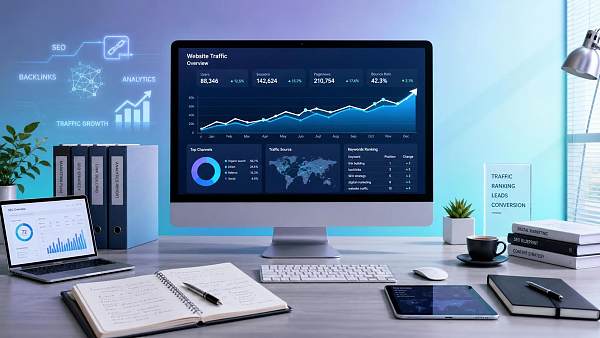
When conducting overseas promotion, many foreign trade companies commonly ask: Is link building for B2B overseas independent websites still effective in 2026? If it is, why do some companies invest heavily but achieve neither rankings nor inquiries? The problem usually lies not in “whether to do it,” but in “how to do it.”
The search environment has changed significantly in 2026. Search engines no longer encourage the accumulation of links in bulk, of low quality, or based on templates. Instead, they place greater importance on whether link sources are trustworthy, whether the content is relevant, whether the growth curve is natural, and whether links can genuinely generate visits and conversions.
For B2B overseas independent websites, backlinks remain important factors affecting crawling, trust transfer, topical relevance, and keyword rankings, especially during new-site launch, competition for industry keywords, and expansion into multilingual markets. However, their role has shifted from a “quantity game” to refined operations based on “content assets + channel coordination.”
- New-site stage: Backlinks can help pages get discovered more quickly and establish basic credibility.
- Competitive stage: Highly relevant backlinks can help improve ranking stability for core product pages and solution pages.
- Conversion stage: Backlinks from vertical media, industry directories, and local resources are more likely to directly generate inquiry leads.
Why do many companies think backlinks have become ineffective? What are the common misconceptions?
Is link building for B2B overseas independent websites still effective in 2026? Many companies conclude that it is “useless” because they have adopted outdated practices. It is not backlinks themselves that have become ineffective; rather, low-quality backlinks can no longer produce positive results and may even drag down overall website performance.
Common misconceptions mainly include the following
- Focusing only on quantity while ignoring sources. Dozens of forum signature and comment links are usually less valuable than a single link from an industry media report.
- Linking only to the homepage instead of internal pages. Without link support, product pages, case study pages, and technical pages may struggle to rank.
- Over-concentrating anchor text. Pointing all links to the same keyword can easily appear unnatural.
- Disconnecting backlinks from content. Even if a website obtains backlinks, weak content makes it difficult to retain traffic and generate conversions.
- Ignoring market differences. The media ecosystems and user search journeys in North America, Europe, the Middle East, and Southeast Asia are not the same.
Therefore, backlinks should not be considered in isolation. They should be evaluated together with website architecture, content planning, multilingual strategies, advertising coordination, and AI search visibility. This is also why an integrated website + marketing services solution is more effective than executing individual services separately.
What characteristics should truly effective backlinks have in 2026?
To determine whether link building for B2B overseas independent websites is still effective in 2026, the first step is to clarify what types of backlinks are worth building. The following table can be used to quickly screen backlink resources and avoid wasting budget on ineffective placements.
From a practical perspective, truly effective backlinks usually come from industry media, partner websites, professional directories, local chamber of commerce resources, technical blogs, republished case studies, and high-quality press release pages. They may not be numerous, but they are more likely to build long-term rankings and accumulated trust.
In which situations do B2B overseas independent websites need link building more?
Not every company needs to build backlinks with the same level of intensity. The degree of reliance on backlinks varies according to the stage of development, target market, and website structure. The following table can help companies make decisions based on their own development stage.
If a company operates in a highly competitive industry, such as machinery and equipment, building materials, electronic components, custom home furnishings, or industrial consumables, on-site optimization alone is usually insufficient for achieving sustained breakthroughs. In such cases, link building combined with content topics, advertising data feedback, and social media exposure can more easily create comprehensive growth.
How should link building work together with website development, content, and advertising?
In 2026, conducting link building alone is no longer enough for overseas marketing. A more effective approach is to treat backlinks as a “traffic amplifier” rather than an “isolated tactic.” This is also the core logic behind Yiyingbao’s emphasis on integrated website + marketing services: first build a website that can be indexed, promoted, and converted, and then expand exposure through multiple channels.
Integrated execution typically includes four steps
- Build the website first: Use a cloud-based intelligent website-building system to create a clear information architecture and ensure that multilingual pages, product categories, inquiry forms, and technical content can be crawled and indexed.
- Develop content next: Create linkable content around product advantages, application scenarios, frequently asked questions, and solutions, giving backlinks clearly defined landing pages.
- Conduct promotion simultaneously: Use Google Ads, Facebook Ads, and overseas social media to test high-converting topics and guide backlink placement priorities in return.
- Continue optimizing: Use the AI+SEO/GEO optimization system to track page indexing, rankings, inquiry sources, and backlink performance, and adjust resource allocation in a timely manner.
The advantage of this model is that backlinks are no longer used solely for keyword rankings. Instead, they serve broader objectives, including brand exposure, search visibility, support for advertising conversions, opportunities for citation in AI search, and long-term organic inquiry growth.
What metrics should companies focus on most when purchasing backlink services?
When purchasing backlink services, many companies are easily attracted by promises such as “a guaranteed number of links” or “guaranteed publication.” However, such promises often cannot be linked to actual business results. What companies should truly focus on is whether the service provider understands the industry, website structure, and how to coordinate with overall marketing.
The following points should be carefully checked
- Does the provider first analyze the website fundamentals, including indexing status, page quality, technical structure, target countries and markets, and keyword difficulty?
- Does the provider differentiate backlink strategies for brand keywords, product keywords, and scenario-based keywords instead of applying one template to every client?
- Can the provider offer content support? Without high-quality English or multilingual content, it is difficult to continuously improve backlink quality.
- Can the provider coordinate execution with SEO, advertising, and social media to avoid disconnected traffic channels?
- Can the provider match localized resources for different regions, including North America, Europe, Southeast Asia, and the Middle East?
For foreign trade companies, the biggest concern is not spending money on backlinks, but failing to turn backlinks into order growth. If procurement focuses only on unit price rather than strategy and the execution loop, rework is often required later, making the overall cost even higher.
FAQ: What other questions do companies commonly ask about link building for B2B overseas independent websites?
Is link building for B2B overseas independent websites still effective in 2026? Is it worthwhile for new websites?
Yes, but the prerequisite is to establish a solid on-site foundation first. If a new website has few pages, weak content, or a disorganized structure, the effectiveness of backlinks will be significantly reduced. A more reliable approach is to complete the homepage, product pages, About page, case study pages, and FAQ first, and then begin link building.
How many backlinks are appropriate?
There is no universal quantity standard. Industry competitiveness, website age, content volume, and target market all affect the pace. In general, more important than “how many” is whether the links are sustained, relevant, and natural, and whether they genuinely support improved rankings for core pages.
Is it still advisable to buy low-cost bulk backlinks?
Generally, it is not recommended if the goal is to operate a B2B overseas independent website for the long term. Low-cost bulk resources are often made up of duplicate websites, pages with weak content, or pages with no actual traffic. They may appear inexpensive in the short term, but can affect website trust and the efficiency of subsequent optimization in the long term.
What is the relationship between backlinks and AI search visibility?
High-quality backlinks affect not only traditional search rankings but also the likelihood of a brand being cited in industry pages, topical content, and knowledge-based results. When website content, brand mentions, and authoritative sources are sufficiently stable, they can further improve the likelihood of appearing in AI search.
Why are more and more companies choosing integrated solutions instead of purchasing backlinks separately?
Because what companies truly need is overseas growth, not simply a “number of links.” Yiyingbao has long served foreign trade companies, manufacturing factories, cross-border sellers, and brands expanding overseas. Its advantage lies not in a single stage, but in integrating AI-powered intelligent website development, multilingual website construction, Google SEO optimization, advertising, social media operations, and GEO optimization into one growth framework.
For companies seeking to determine whether link building for B2B overseas independent websites is still effective in 2026, the wiser approach is not to ask first, “Should I buy backlinks?” Instead, first confirm: Is my website suitable for link building? Which pages should be prioritized? What resources does the target market require? How long will it take to see phased changes? Is simultaneous support from content and advertising needed?
If you are planning growth for an overseas independent website, you can further consult Yiyingbao about website architecture recommendations, backlink strategy assessments, multilingual market planning, delivery timelines, keyword priorities, content landing-page planning, and integrated quotation solutions. Confirming the parameters and objectives before investing the budget generally makes it easier to make decisions that generate inquiries and long-term growth.
Related Articles
Related Products
 EasyCamp SaaS Smart Website Marketing SystemE-Yingbao SaaS Smart Website Marketing System: AI-powered, zero-code website building. Rapidly launch multilingual independent e-commerce sites in just 10 minutes. Global server acceleration and AI-driven SEO optimization empower businesses to efficiently connect with global markets. The seamless integration of technology and user-friendly operation makes building e-commerce sites incredibly simple.
 AI+SEM Intelligent Advertising Marketing SystemAI+SEM drives intelligent ad creation, empowering full-funnel precision advertising marketing. The system automatically generates weekly/monthly reports, AI recommends keywords and target countries, monitors core metrics in real-time with intelligent alerts, and enables one-click high-conversion ad solutions to help quickly acquire customers and improve ROI.
 AI+SEO Dual Engine Optimization ServiceEasyWin AI+SEO Dual Engine Optimization System leverages AI-powered keyword mining, content generation, and comprehensive technical optimization to help foreign trade enterprises acquire high-quality organic traffic, significantly improving search rankings and conversion rates.
 AI+SNS Social Media Marketing SystemYingbao AI+SNS Social Media Marketing System - Precision social capture for the social media era. Supports one-click content synchronization across major platforms like Facebook and LinkedIn. AI intelligently rewrites posts for enhanced relevance. 24/7 AI customer service and user profiling analysis empower businesses to efficiently expand into global markets.
 AI+SEO营销解决方案易营宝AI+SEO营销解决方案,通过AI批量写作、智能生成TDK、精准关键词扩词等功能,全面优化网站SEO效果,提升流量与转化率。助力企业构建高效智能网站新生态。
 AI+SEM Advertising Marketing SolutionsAI+SEM Advertising Marketing Solution leverages AI technology to deeply empower SEM ad campaigns. It automatically generates weekly/monthly reports using AI, presenting account data across multiple dimensions for comprehensive insights into campaign performance and trends. The system precisely recommends keywords and target countries, intelligently generates high-conversion ad copy, and enables one-click activation of efficient campaign plans to help businesses rapidly acquire customers. Simultaneously, it monitors core metrics in real time, intelligently identifies abnormal fluctuations, and issues timely alerts to ensure stable, high-return advertising results.
 Domain Name ServicesEasyWin provides professional domain name services, including intelligent queries, one-stop registration, brand protection, and full lifecycle management, helping businesses build a digital brand image.
 EasyOperate B2C Cross-Border E-Commerce Platform & Independent WebsiteEasyStore B2C Cross-border E-commerce Independent Store is an intelligent website building and cross-border e-commerce integrated solution independently developed by EasyStore Information Technology (Beijing) Co., Ltd. The system is specially designed for small and medium-sized as well as large export enterprises, integrating 'website building, operation, marketing, advertising, and conversion' into one, helping enterprises quickly establish cross-border e-commerce independent stores to achieve brand globalization and global sales growth.
The platform supports multiple languages, multiple currencies, and multi-channel marketing, with built-in AI intelligent translation and SEO optimization systems, suitable for mainstream markets such as Southeast Asia, Europe and America, Latin America, and the Middle East, assisting Chinese manufacturing enterprises in efficiently deploying international e-commerce strategies. SSL证书易营宝提供专业SSL安全证书服务,包括单域名和泛域名证书,确保网站数据传输加密、身份验证和完整性保护,助力企业建立安全可信的在线业务环境。









