









- What Does a Global Traffic Ecosystem Service Provider Do? What Are the Differences from a Single Advertising AgencyJul 16, 2026View details
- What should you focus on in the latest enterprise SaaS report? From renewal rates and delivery costs to overseas growth opportunitiesJul 12, 2026View details
- What signals are worth paying attention to in a cross-border marketing trend report? B2B companies should look at these 6 signalsJul 11, 2026View details
- How to Read a Cross-Border Marketing Trends Report? Five Key Dimensions for Evaluating Channel OpportunitiesJul 11, 2026View details
- Which channel has the highest ROI in the global traffic ecosystem? Comparative analysis of search, social media, and advertisingJul 10, 2026View details
- What multilingual website services are available in Sanya? Which model is more suitable for local businesses going global?Jul 08, 2026View details
- How to view the complete list of China SaaS companies in the top 100? Practical methods for screening website-building and marketing service providersJul 08, 2026View details
- How to view pricing in the global traffic ecosystem? Cost comparison of search, social media, and content channel advertisingJul 06, 2026View details
How Much Does Website Speed Optimization Affect Search Rankings
How much does website speed optimization really affect SEO rankings? Its impact is real, but it cannot simply be understood as “the faster the website, the higher the ranking.” More precisely, speed is an important basic factor search engines use to evaluate website quality. It affects crawling efficiency, page experience, bounce rate, conversion rate, and overall marketing performance. For corporate websites, speed optimization is often not the only factor determining rankings, but it is a key condition for determining whether SEO results can be consistently amplified.
If a website has good content and a reasonable structure but loads slowly and provides a poor mobile experience, it is difficult for search engines to consistently deliver high-quality traffic, and users are also less likely to stay and complete an inquiry, registration, or purchase. This is especially true for overseas independent websites, brand websites, and cross-border e-commerce stores. Because visitors are distributed across different regions and network conditions are complex, website speed is no longer merely a technical issue. It directly affects customer acquisition costs and overseas conversion efficiency.
Why Website Speed Affects SEO but Is Not the Only Determining Factor
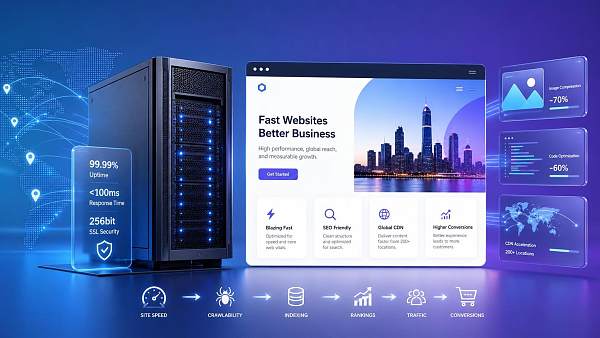
When many companies search for “How much does website speed optimization really affect SEO rankings?”, what they really want to know is not a single technical principle, but whether the investment is worthwhile. The answer is yes, but it should be viewed as part of the overall SEO system. Speed alone rarely pushes an ordinary page to the first page, but it often determines whether a page with ranking potential can actually perform well.
The goal of search engines is to present users with pages that offer greater value and a more stable experience. The slower a page loads, the longer users have to wait, and the more likely they are to return to the search results page. For search engines, these signals often indicate a poor page experience. Even when content relevance is strong, speed issues can undermine overall performance, especially on mobile devices and for highly competitive commercial keywords.
In other words, speed is not the “only winning factor” in SEO, but it is a typical “weakest-link factor.” A company may optimize its content, keyword layout, backlinks, and internal structure, only to have slow loading affect crawling, indexing, and conversion. This is very common among corporate websites. If a company focuses only on publishing content while ignoring page performance, it will often encounter significant bottlenecks during later-stage growth.
How Website Speed Specifically Affects Search Rankings
The first pathway is crawling efficiency. When search engine spiders visit a website, slow server response times, oversized page resources, and frequent timeouts reduce the number of pages that can be crawled within a given period. For corporate websites with many product pages, multiple language versions, and continuously updated content, crawl budget is very important. The more stable the speed, the easier it is for search engines to discover new pages and complete index updates more quickly.
The second pathway is page experience. Google has clearly incorporated page experience into its evaluation system. Core Web Vitals, such as loading speed, interaction latency, and visual stability, all affect how search engines assess page quality. Although these signals are generally not overriding ranking factors, when several pages have similar content quality, pages with a better experience are more likely to gain an advantage.
The third pathway is user behavior data. If the above-the-fold content takes a long time to load after users enter a page, or if images, buttons, and forms are slow to respond, both session duration and conversion rates will decline. For marketing websites, this impact is more direct than “ranking fluctuations.” Even when traffic is acquired, slow speed reduces its value, diluting the return on advertising costs and SEO investment.
What Companies Should Care About Most Is Not How Much Faster the Website Is, but Whether Business Results Improve
When focusing on speed optimization, many managers can easily be misled by metrics such as “achieving a score above 90” or “loading within just 1 second.” In practice, companies should pay more attention to whether indexing has improved after speed optimization, whether the bounce rate of core pages has declined, whether inquiry conversion rates have improved, and whether access stability has increased across different overseas regions. These are the key indicators for evaluating return on investment.
For example, a B2B international trade website may originally require more than 6 seconds to fully load its product detail pages, causing potential customers to leave before seeing the core selling points. After image compression, code reduction, CDN acceleration, and server optimization, the above-the-fold content loads significantly faster. Users then become more willing to browse product specifications, case studies, and contact information. At this point, traffic generated by SEO has a better chance of converting into genuine business opportunities.
The same applies to cross-border e-commerce stores. Slow speed affects not only organic rankings but also add-to-cart, checkout, and payment completion rates during the shopping process. Many companies attribute declining sales to insufficient traffic while overlooking user loss caused by poor page performance. In this context, the value of speed optimization is often reflected in “enabling existing traffic to generate greater value,” rather than simply pursuing an abstract ranking improvement.
Which Types of Websites Especially Need to Prioritize Speed Optimization
The first category is multilingual international trade websites. These websites typically target multiple markets, including North America, Europe, the Middle East, and Southeast Asia. Access routes vary greatly across regions, and without appropriate global acceleration and resource distribution, overseas loading speeds can be highly unstable. This can undermine the experience perceived by both search engines and users, ultimately affecting brand trust and inquiry generation.
The second category is websites with a large number of content pages and product pages. The more pages a website has, the greater the pressure on search engine crawling and updates. If response times are slow and resources are heavy, crawling efficiency will decline significantly. For sites such as manufacturing company websites, B2B product websites, and cross-border e-commerce stores, performance issues often do not cause just one page to lose points; they slow down the growth efficiency of the entire website.
The third category is websites that rely heavily on the coordination of advertising and SEO. Many companies conduct Google SEO as well as Google advertising, social media advertising, and landing page promotion. If page speed is unstable, conversion rates after ad clicks will decline, and organic traffic generated by SEO will also be difficult to convert. In this situation, speed optimization is not merely an SEO action, but the underlying foundation of the entire digital marketing process.
What Should Be Prioritized in Website Speed Optimization to Avoid Misallocated Investment
In terms of execution order, the first step is not to modify code blindly, but to identify where the problem lies. Common bottlenecks include slow server response, oversized images, excessive JS and CSS, third-party scripts that cause delays, redundant resource loading on mobile devices, and the absence of a CDN. Only by identifying the core weaknesses first can subsequent optimization avoid requiring substantial investment for nothing more than superficial score changes.
The second step is to prioritize the pages with the greatest business impact. Companies do not need to begin with an intensive performance project for the entire website. Instead, they should first focus on the homepage, core product pages, key landing pages, inquiry pages, and high-traffic blog pages. These pages are directly related to rankings, bounce rates, and conversions. They are more likely to produce visible results after optimization and make it easier for management to assess the value of the project.
The third step is to incorporate speed optimization into long-term operations and maintenance. Many websites perform well initially but become slower several months later as plugins are added, images accumulate, scripts multiply, and content expands. The truly effective approach is to integrate website development, content publishing, advertising landing page creation, and SEO updates into standardized processes, keeping the website consistently crawlable, accessible, and capable of converting visitors.
How Can Companies Determine Whether Current Website Speed Issues Are Already Affecting SEO and Customer Acquisition
The most direct way to make this determination is not to look only at the score from a single speed testing tool, but to consider several types of signals together. First, check whether crawling and indexing performance in Google Search Console is abnormal. Second, examine the bounce rate, session duration, and conversion rate of core pages on mobile devices. Third, check whether access speeds differ significantly across overseas regions. Fourth, determine whether there is obvious user loss on advertising landing pages.
If new content is indexed slowly after being published, users fail to stay after clicking on impressions for important pages, or the cost per advertising click continues to rise without a corresponding improvement in lead quality, page performance should generally be investigated. Many companies do not have a problem because “SEO was not done”; rather, their basic user experience was not properly established, preventing front-end marketing investments from being effectively converted into results.
For companies seeking long-term overseas growth, the significance of website speed optimization also lies in building sustainable digital asset capabilities. A website that loads quickly, has a clear structure, and is mobile-friendly is more likely to accumulate search visibility and better able to handle visits from advertising, social media, and AI search channels. Once this underlying capability is established, subsequent customer acquisition efficiency is generally more stable than repeatedly increasing advertising investment.
Conclusion: Website Speed Is Not a Finishing Touch but a Basic Condition for SEO Growth
Returning to the original question, how much does website speed optimization affect search rankings? The answer is that it is usually not the only factor determining rankings, but it has a sustained impact on crawling, indexing, experience, session duration, and conversion, enough to determine whether SEO results can truly be implemented. For corporate marketing websites in particular, the earlier speed issues are resolved, the easier it is to amplify the results of subsequent content, promotion, and conversion efforts.
Therefore, companies do not need to treat speed as a “universal ranking switch,” but they should not regard it as an optional technical detail either. A more rational approach is to view website speed as part of the infrastructure of digital marketing. First ensure that the website can be accessed quickly, crawled stably, and browsed smoothly; then amplify investment in SEO, advertising, and content. Only in this way can the website truly become an asset for sustainable growth.
Related Articles


Related Products
 EasyCamp SaaS Smart Website Marketing SystemE-Yingbao SaaS Smart Website Marketing System: AI-powered, zero-code website building. Rapidly launch multilingual independent e-commerce sites in just 10 minutes. Global server acceleration and AI-driven SEO optimization empower businesses to efficiently connect with global markets. The seamless integration of technology and user-friendly operation makes building e-commerce sites incredibly simple.
 AI+SEM Intelligent Advertising Marketing SystemAI+SEM drives intelligent ad creation, empowering full-funnel precision advertising marketing. The system automatically generates weekly/monthly reports, AI recommends keywords and target countries, monitors core metrics in real-time with intelligent alerts, and enables one-click high-conversion ad solutions to help quickly acquire customers and improve ROI.
 AI+SEO Dual Engine Optimization ServiceEasyWin AI+SEO Dual Engine Optimization System leverages AI-powered keyword mining, content generation, and comprehensive technical optimization to help foreign trade enterprises acquire high-quality organic traffic, significantly improving search rankings and conversion rates.
 AI+SNS Social Media Marketing SystemYingbao AI+SNS Social Media Marketing System - Precision social capture for the social media era. Supports one-click content synchronization across major platforms like Facebook and LinkedIn. AI intelligently rewrites posts for enhanced relevance. 24/7 AI customer service and user profiling analysis empower businesses to efficiently expand into global markets.
 AI+SEO营销解决方案易营宝AI+SEO营销解决方案,通过AI批量写作、智能生成TDK、精准关键词扩词等功能,全面优化网站SEO效果,提升流量与转化率。助力企业构建高效智能网站新生态。
 AI+SEM Advertising Marketing SolutionsAI+SEM Advertising Marketing Solution leverages AI technology to deeply empower SEM ad campaigns. It automatically generates weekly/monthly reports using AI, presenting account data across multiple dimensions for comprehensive insights into campaign performance and trends. The system precisely recommends keywords and target countries, intelligently generates high-conversion ad copy, and enables one-click activation of efficient campaign plans to help businesses rapidly acquire customers. Simultaneously, it monitors core metrics in real time, intelligently identifies abnormal fluctuations, and issues timely alerts to ensure stable, high-return advertising results.
 Domain Name ServicesEasyWin provides professional domain name services, including intelligent queries, one-stop registration, brand protection, and full lifecycle management, helping businesses build a digital brand image.
 EasyOperate B2C Cross-Border E-Commerce Platform & Independent WebsiteEasyStore B2C Cross-border E-commerce Independent Store is an intelligent website building and cross-border e-commerce integrated solution independently developed by EasyStore Information Technology (Beijing) Co., Ltd. The system is specially designed for small and medium-sized as well as large export enterprises, integrating 'website building, operation, marketing, advertising, and conversion' into one, helping enterprises quickly establish cross-border e-commerce independent stores to achieve brand globalization and global sales growth.
The platform supports multiple languages, multiple currencies, and multi-channel marketing, with built-in AI intelligent translation and SEO optimization systems, suitable for mainstream markets such as Southeast Asia, Europe and America, Latin America, and the Middle East, assisting Chinese manufacturing enterprises in efficiently deploying international e-commerce strategies. SSL证书易营宝提供专业SSL安全证书服务,包括单域名和泛域名证书,确保网站数据传输加密、身份验证和完整性保护,助力企业建立安全可信的在线业务环境。









