









- What Does a Global Traffic Ecosystem Service Provider Do? What Are the Differences from a Single Advertising AgencyJul 16, 2026View details
- What should you focus on in the latest enterprise SaaS report? From renewal rates and delivery costs to overseas growth opportunitiesJul 12, 2026View details
- What signals are worth paying attention to in a cross-border marketing trend report? B2B companies should look at these 6 signalsJul 11, 2026View details
- How to Read a Cross-Border Marketing Trends Report? Five Key Dimensions for Evaluating Channel OpportunitiesJul 11, 2026View details
- Which channel has the highest ROI in the global traffic ecosystem? Comparative analysis of search, social media, and advertisingJul 10, 2026View details
- What multilingual website services are available in Sanya? Which model is more suitable for local businesses going global?Jul 08, 2026View details
How Can Multilingual Website Translation Services Balance Efficiency and Accuracy
Multilingual Website Translation Services: What Needs to Be Solved First Is Not the Translation Itself
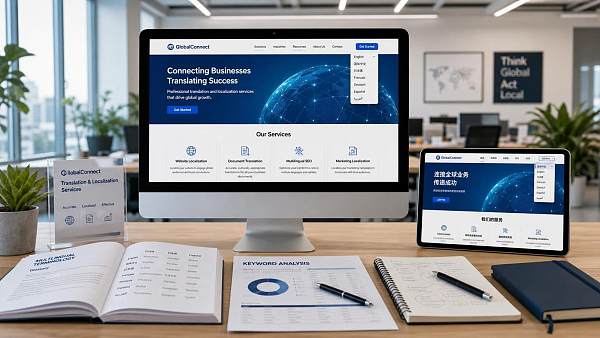
Multilingual website translation services may appear to be simply a matter of converting content, but in practice they affect whether a website can be understood, found in search results, and trusted, ultimately influencing inquiry quality and advertising efficiency.
In integrated website and marketing projects, language processing is never an isolated step. Page structure, keyword placement, regional language preferences, and conversion path design all affect the priorities of the translation solution.
This is why different businesses have very different requirements for multilingual website translation services, even when they are all building overseas websites. Some place greater emphasis on launch speed, some care more about terminology accuracy, while others focus on the website’s future SEO scalability.
Platforms such as 易营宝, which cover smart website building, SEO optimization, advertising, and social media operations, typically evaluate translation as part of the growth chain of the entire website rather than looking only at whether the text on an individual page reads smoothly.
In Practice, Differences in Requirements Often Come from Different Business Objectives
Multilingual website translation services are difficult to choose not because there are many languages, but because business objectives differ. Once the objective changes, translation depth, proofreading methods, update frequency, and budget allocation all change accordingly.
If a website mainly generates B2B inquiries, the focus is usually on whether product specifications, industry terminology, certification information, and contact details are expressed clearly. The sentences do not need to be ornate, but they must minimize misunderstandings.
For a B2C standalone website or cross-border e-commerce store, page copy needs to balance search, conversion, and consumer context. Titles, selling points, review sections, and delivery information often require more localization than the company introduction.
In advertising landing page scenarios, multilingual website translation services must also take the advertising schedule into account. When campaign materials are updated frequently, efficiency and consistency are often more important than meticulous sentence-by-sentence refinement.
The Key Considerations Differ Across Common Scenarios
Inquiry Websites, E-Commerce Websites, and Brand Websites Require Different Translation Strategies
A more common misjudgment is to treat all overseas websites as the same type of website. Although they may all appear to require multilingual website translation services, their functions differ in practice, so their translation strategies cannot be used interchangeably.
Inquiry-oriented websites are generally better suited to the approach of “refining core pages and standardizing long-tail pages.” The homepage, product pages, solution pages, and form prompts require focused proofreading because these elements directly affect conversion decisions.
E-commerce websites rely more heavily on batch processing efficiency. When the number of products increases, translating each page manually becomes too costly. In such cases, it is more important to combine AI-assisted initial translation, a terminology database, and human review to maintain consistent wording during large-scale updates.
Brand websites follow a different logic. They must balance search indexing with consistency in brand communication. An expression that is acceptable in one region may not sound natural in another, especially in slogans and value propositions.
Therefore, when selecting multilingual website translation services, a more effective approach is not to first ask how many languages are supported, but to first determine whether the website is intended for lead generation, sales conversion, or brand awareness.
Efficiency and Accuracy in Parallel: The Key Lies in Process Design Rather Than Individual Capabilities
Many projects fail to move forward on schedule not because the translation quality is inadequate, but because the process has not been clearly broken down. Which content is suitable for machine-assisted acceleration and which pages require in-depth human review should be determined at the outset.
In practical applications, efficiency and accuracy are not completely contradictory. The prerequisite is to establish a tiered processing mechanism and classify pages according to risk and value, rather than applying the same standard to everything.
- High-risk content: Product specifications, legal statements, and payment and logistics terms should receive priority for human proofreading.
- High-conversion content: Titles, selling points, button copy, and form prompts should emphasize localized expression.
- Frequently updated content: Campaign pages, advertising pages, and blog pages are suitable for AI-assisted acceleration followed by unified review.
- Basic content: Frequently asked questions, company introductions, and news updates can be processed in batches according to terminology standards.
This approach is particularly important for integrated website and marketing service projects. The translated content not only needs to be published, but also needs to enter subsequent distribution channels for SEO, advertising, social media, and AI search. Once the wording becomes inconsistent at the front end, subsequent maintenance costs can rise rapidly.
Before Implementation, What Is Easily Overlooked Is Not Only Language but Also Search and Technical Compatibility
When selecting multilingual website translation services, many teams focus only on textual accuracy while overlooking the compatibility of the search structure and the website system itself. As a result, the content may appear fine after translation, but its ranking and indexing performance may be unsatisfactory.
For example, the search terms for the same product in English-, French-, and Spanish-speaking markets do not always correspond through direct translation. If translation is based only on the source text without considering the search habits of the target market, a page can easily end up in a situation where it “can be understood but cannot be found.”
Another common issue is that multilingual paths, tags, metadata, and internal links are not processed in sync. Even if the main body has been translated, search engines may still find it difficult to accurately understand the region and content hierarchy to which the page belongs.
This is also why platforms with website-building systems, SEO capabilities, and marketing coordination capabilities are better suited to handling complex projects. For platforms such as 易营宝 that have long served multi-region markets, the advantage typically lies not only in carrying out translations, but also in connecting content, pages, and promotional channels as a whole.
To Determine Whether a Service Is Suitable, Start by Checking These Items
- Does it support terminology databases, style guidelines, and the reuse of historical content?
- Can it process key on-site elements such as titles, descriptions, buttons, and forms simultaneously?
- Does it take SEO keywords into account rather than providing only literal translation?
- Is it suitable for long-term iteration, including the launch of new pages and updates to existing pages?
- Can it support advertising, social media content, and AI search visibility optimization?
How to Evaluate the Next Step Is Usually More Valuable Than Comparing Prices Directly
Multilingual website translation services need to balance efficiency and accuracy. Essentially, this means finding the appropriate level of investment for different business scenarios. Not every page needs to be fully retranslated, and not every type of content is suitable for batch generation.
A more reliable approach is to first clarify the website’s objectives, target regions, core pages, and update frequency, then decide which parts should prioritize speed and which should retain in-depth proofreading. This makes it easier to align the budget, timeline, and conversion objectives.
If the website will later require Google SEO, advertising, social media lead generation, or AI search optimization, multilingual website translation services should be evaluated within the growth framework of the entire website rather than treated merely as a one-time content task.
Before implementation, you can first create a scenario suitability checklist that defines language priorities, keyword strategies, proofreading standards, the scope of technical support, and the pace of subsequent maintenance. The more detailed the evaluation, the smoother global operations will be afterward.
Related Articles
Related Products
 EasyCamp SaaS Smart Website Marketing SystemE-Yingbao SaaS Smart Website Marketing System: AI-powered, zero-code website building. Rapidly launch multilingual independent e-commerce sites in just 10 minutes. Global server acceleration and AI-driven SEO optimization empower businesses to efficiently connect with global markets. The seamless integration of technology and user-friendly operation makes building e-commerce sites incredibly simple.
 AI+SEM Intelligent Advertising Marketing SystemAI+SEM drives intelligent ad creation, empowering full-funnel precision advertising marketing. The system automatically generates weekly/monthly reports, AI recommends keywords and target countries, monitors core metrics in real-time with intelligent alerts, and enables one-click high-conversion ad solutions to help quickly acquire customers and improve ROI.
 AI+SEO Dual Engine Optimization ServiceEasyWin AI+SEO Dual Engine Optimization System leverages AI-powered keyword mining, content generation, and comprehensive technical optimization to help foreign trade enterprises acquire high-quality organic traffic, significantly improving search rankings and conversion rates.
 AI+SNS Social Media Marketing SystemYingbao AI+SNS Social Media Marketing System - Precision social capture for the social media era. Supports one-click content synchronization across major platforms like Facebook and LinkedIn. AI intelligently rewrites posts for enhanced relevance. 24/7 AI customer service and user profiling analysis empower businesses to efficiently expand into global markets.
 AI+SEO营销解决方案易营宝AI+SEO营销解决方案,通过AI批量写作、智能生成TDK、精准关键词扩词等功能,全面优化网站SEO效果,提升流量与转化率。助力企业构建高效智能网站新生态。
 AI+SEM Advertising Marketing SolutionsAI+SEM Advertising Marketing Solution leverages AI technology to deeply empower SEM ad campaigns. It automatically generates weekly/monthly reports using AI, presenting account data across multiple dimensions for comprehensive insights into campaign performance and trends. The system precisely recommends keywords and target countries, intelligently generates high-conversion ad copy, and enables one-click activation of efficient campaign plans to help businesses rapidly acquire customers. Simultaneously, it monitors core metrics in real time, intelligently identifies abnormal fluctuations, and issues timely alerts to ensure stable, high-return advertising results.
 Domain Name ServicesEasyWin provides professional domain name services, including intelligent queries, one-stop registration, brand protection, and full lifecycle management, helping businesses build a digital brand image.
 EasyOperate B2C Cross-Border E-Commerce Platform & Independent WebsiteEasyStore B2C Cross-border E-commerce Independent Store is an intelligent website building and cross-border e-commerce integrated solution independently developed by EasyStore Information Technology (Beijing) Co., Ltd. The system is specially designed for small and medium-sized as well as large export enterprises, integrating 'website building, operation, marketing, advertising, and conversion' into one, helping enterprises quickly establish cross-border e-commerce independent stores to achieve brand globalization and global sales growth.
The platform supports multiple languages, multiple currencies, and multi-channel marketing, with built-in AI intelligent translation and SEO optimization systems, suitable for mainstream markets such as Southeast Asia, Europe and America, Latin America, and the Middle East, assisting Chinese manufacturing enterprises in efficiently deploying international e-commerce strategies. SSL证书易营宝提供专业SSL安全证书服务,包括单域名和泛域名证书,确保网站数据传输加密、身份验证和完整性保护,助力企业建立安全可信的在线业务环境。









