









- What stages does the cross-border services ecosystem include? How do website building, promotion, payment, and compliance work togetherJun 22, 2026View details
- How will email marketing costs change in 2026Jun 22, 2026View details
- The China-US tariff arrangement has reached a preliminary consensus, and the trade association will be establishedJun 15, 2026View details
- Should overseas brand marketing start with ads or contentJun 21, 2026View details
- What determines B2C cross-border e-commerce website development costs? A breakdown of features, interfaces, and deployment methodsJun 17, 2026View details
- China-Morocco zero-tariff access, a breakthrough in the cost of Moroccan goods exports to ChinaJun 11, 2026View details
Which products are suitable for a cross-border e-commerce independent site? 4 core metrics to determine the market
Product selection is not about chasing trends, but about judging the quality of the track
For cross-border e-commerce independent sites, what products to sell may seem like a product selection issue on the surface, but in reality it is more like a business judgment. Whether a product can be made successful depends not only on the product itself, but also on whether the track has the space to continuously attract traffic, absorb conversions, and amplify profits.
For many overseas businesses, platforms can bring orders, but rules, traffic, and pricing are all constrained by external factors. The value of a cross-border e-commerce independent site lies in helping a brand, content, customer data, and repeat-purchase capability accumulate in your own hands. Therefore, choosing the right track is more important than a short-term hit product.
Especially against the backdrop of rising customer acquisition costs and intensified homogeneous competition, determining whether a product is suitable for an independent site cannot be judged only by whether it “sells,” but also by whether it can sell long term, generate stable profits, and build brand equity.
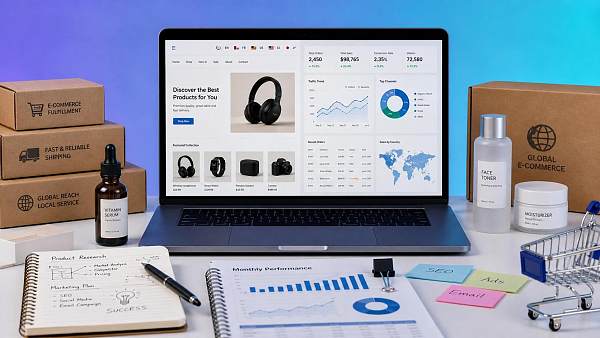
From a practical perspective, market demand, competitive intensity, profit margins, and repeat-purchase potential are often the four core metrics most worthy of priority evaluation.
Start with demand: Is there stable and verifiable buying intent?
A cross-border e-commerce independent site is not something that will naturally generate orders just by listing products. It relies more on search, advertising, social media content, and on-site conversion coordination. Therefore, the first step is not to judge whether the product is new, but to determine whether there is already clear demand in the overseas market.
Stable demand usually shows several signals: keyword search volume continues to exist, social media discussions reflect real scenarios, competitor sites have been advertising for a long time, and user reviews focus on practical pain points rather than just low prices. Such products are better suited to gradually accumulating traffic through an independent site.
If a product can only rely on short-video virality, or if demand is entirely driven by short-term trends, then it may not be suitable for a cross-border e-commerce independent site intended for long-term operations. Because website development, SEO layout, and brand content buildup all take time.
Types of demand better suited to independent sites
- Clear use cases, such as home storage, pet care, and outdoor tools.
- Functional differentiation, where users are willing to compare specifications, materials, and results.
- Room for content explanation, suitable for building trust through articles, videos, and Q&A.
- Regional language differences, where localized expression is needed to improve conversion.
The last type is especially worth attention. In North American, European, Middle Eastern, or Latin American markets, the same product may perform very differently if described differently. If a site can provide multilingual presentation, localized metadata, and synchronized content updates, demand validation efficiency will be higher.
Look at competition again: not avoiding a red ocean, but finding a position you can enter
When evaluating a track, many people give up as soon as they see fierce competition, but that is not entirely correct. No competition often means the market education is not yet complete; very strong competition may also indicate that demand is sufficiently large. The key is not whether competition exists, but whether there is an entry point.
The biggest concern for cross-border e-commerce independent sites is “homogeneous competition.” In other words, products have no differences, pages have no differences, and promotional messaging has no differences, leaving only price as the basis for comparison. Even if orders come in, it is difficult to accumulate profit in such a track.
A more feasible approach is to look for opportunities through audience segmentation, functional upgrades, bundled sales, or regional markets. For example, even within home products, the positioning logic is completely different when targeting small apartments, pet-owning families, or high-end organization needs.
From this perspective, website and marketing are not after-the-fact actions, but part of the track’s competitiveness. Site structure, search visibility, and ad landing page quality all affect whether a product truly fits the independent site model.
Profit margins determine whether an independent site can scale
If product gross margins are too thin, a cross-border e-commerce independent site will be very difficult to operate. That is because an independent site must bear multiple costs, including site building, advertising, content production, payment, logistics, and after-sales service. Being able to sell does not mean the model is viable.
What really deserves attention is not only unit profit, but overall profit. This includes order value, return rate, logistics losses, advertising conversion costs, and the secondary value brought by repeat purchases. In general, products with some pricing power and non-standardized comparison are more suitable for long-term independent site operations.
For example, functional consumer goods, niche categories, branded gifts, and lightly customized products often build margins more easily than pure white-label items. This is because the reasons users buy include not only price, but also experience, design, professionalism, and trust.
To judge whether profit is sufficient, focus on three points
- After deducting logistics and advertising, is there still a stable gross margin?
- Can the order value be increased through bundles, upsells, or subscriptions?
- Can brand content reduce dependence on one-time customer acquisition?
At this stage, many overseas businesses will also optimize the site’s underlying capabilities in parallel. Tools like foreign trade multilingual website solution can integrate multilingual SEO, GA4, GTM, and localized page management together, reducing content maintenance costs and making it easier to measure the true conversion return of different markets.
Repeat-purchase potential determines whether the business is a one-time conversion or a long-term asset
Many cross-border e-commerce independent sites can generate volume in the early stage, but growth slows later, and the reason is repeat-purchase weakness. Every order requires spending again to acquire customers, the business becomes increasingly heavy, and cash flow pressure becomes more obvious.
Repeat purchases are not only for fast-moving consumer goods. Consumables replenishment, accessory upgrades, series combinations, seasonal updates, and membership benefits can all create repeat-purchase logic. As long as users have a reason to keep consuming after the first purchase, the independent site is more likely to form a stable operational loop.
This is also why many brands have begun to value email marketing, remarketing ads, and content subscriptions. The value of an independent site is not just a conversion page, but a long-term channel for customer relationship retention.
If the business spans multiple countries, the repeat-purchase path also needs to be smooth enough. Language version updates, privacy policy compliance, site speed, and ad tracking accuracy all directly affect secondary conversion efficiency. A system with AI translation, localized review, AWS global node acceleration, and multilingual conversion monitoring is better suited to this kind of long-term operation.
Which product directions are more worthy of priority evaluation
Combining the four indicators above, products suitable for cross-border e-commerce independent sites are usually not the cheapest or most generic ones, but those that are easier to build differentiation and trust with.
- Function-improvement products: can solve specific problems, and users are willing to read instructions and case studies.
- Niche interest products: audience is clear and can be reached through content communities.
- Bundled sale products: convenient for increasing order value and driving repeat purchases.
- Products suited to brand expression: design, craftsmanship, and concept can be amplified.
- Products with obvious multilingual needs: different regions have large differences in expression and compliance requirements.
From actual business experience, product selection and site capability often need to be evaluated together. For YiYingBao, which has long served foreign trade companies, manufacturing factories, and brand overseas expansion projects, the core idea is not to build a website alone, but to combine intelligent site building, SEO optimization, advertising, and social media traffic generation so that product-track judgment is closer to real market feedback.
If the target markets are numerous, it is also necessary to pay further attention to multilingual content efficiency. Relevant solutions, in terms of translation accuracy, content synchronization, and localized SEO optimization, can often significantly shorten the testing cycle and make it easier to verify whether different regions are worth continued investment.
Turn the four indicators into an actionable decision framework
Rather than asking what products a cross-border e-commerce independent site is suitable for, it is better to first put the candidate products into the same framework for comparison. Only in this way will product selection not remain at the level of experience judgment or short-term emotion.
You can first list three to five target categories, then evaluate demand strength, competitive structure, profit model, and repeat-purchase path separately. After that, combine the target country language, launch cost, and site absorption capacity for a second round of screening, prioritizing directions that “have verified demand, manageable competition, coverable profit, and designable repeat purchases.”
If you are still in the planning stage, a more stable approach is to first build a cross-border e-commerce independent site that can support multi-market validation, and then gradually add SEO content, ad landing pages, and conversion tracking. The benefit of doing so is that every test can be accumulated into a later growth asset, rather than one-time traffic consumption.
When track judgment returns to data, scenarios, and operating logic, the answer to whether a product can be made usually becomes clearer. The next worthwhile step is not to keep asking “what is hottest,” but to put the candidate product into a real market and verify whether it is suitable for a cross-border e-commerce independent site for long-term operations.
Related Articles


Related Products
 EasyCamp SaaS Smart Website Marketing SystemE-Yingbao SaaS Smart Website Marketing System: AI-powered, zero-code website building. Rapidly launch multilingual independent e-commerce sites in just 10 minutes. Global server acceleration and AI-driven SEO optimization empower businesses to efficiently connect with global markets. The seamless integration of technology and user-friendly operation makes building e-commerce sites incredibly simple.
 AI+SEM Intelligent Advertising Marketing SystemAI+SEM drives intelligent ad creation, empowering full-funnel precision advertising marketing. The system automatically generates weekly/monthly reports, AI recommends keywords and target countries, monitors core metrics in real-time with intelligent alerts, and enables one-click high-conversion ad solutions to help quickly acquire customers and improve ROI.
 AI+SEO Dual Engine Optimization ServiceEasyWin AI+SEO Dual Engine Optimization System leverages AI-powered keyword mining, content generation, and comprehensive technical optimization to help foreign trade enterprises acquire high-quality organic traffic, significantly improving search rankings and conversion rates.
 AI+SNS Social Media Marketing SystemYingbao AI+SNS Social Media Marketing System - Precision social capture for the social media era. Supports one-click content synchronization across major platforms like Facebook and LinkedIn. AI intelligently rewrites posts for enhanced relevance. 24/7 AI customer service and user profiling analysis empower businesses to efficiently expand into global markets.
 AI+SEO营销解决方案易营宝AI+SEO营销解决方案,通过AI批量写作、智能生成TDK、精准关键词扩词等功能,全面优化网站SEO效果,提升流量与转化率。助力企业构建高效智能网站新生态。
 AI+SEM Advertising Marketing SolutionsAI+SEM Advertising Marketing Solution leverages AI technology to deeply empower SEM ad campaigns. It automatically generates weekly/monthly reports using AI, presenting account data across multiple dimensions for comprehensive insights into campaign performance and trends. The system precisely recommends keywords and target countries, intelligently generates high-conversion ad copy, and enables one-click activation of efficient campaign plans to help businesses rapidly acquire customers. Simultaneously, it monitors core metrics in real time, intelligently identifies abnormal fluctuations, and issues timely alerts to ensure stable, high-return advertising results.
 Domain Name ServicesEasyWin provides professional domain name services, including intelligent queries, one-stop registration, brand protection, and full lifecycle management, helping businesses build a digital brand image.
 EasyOperate B2C Cross-Border E-Commerce Platform & Independent WebsiteEasyStore B2C Cross-border E-commerce Independent Store is an intelligent website building and cross-border e-commerce integrated solution independently developed by EasyStore Information Technology (Beijing) Co., Ltd. The system is specially designed for small and medium-sized as well as large export enterprises, integrating 'website building, operation, marketing, advertising, and conversion' into one, helping enterprises quickly establish cross-border e-commerce independent stores to achieve brand globalization and global sales growth.
The platform supports multiple languages, multiple currencies, and multi-channel marketing, with built-in AI intelligent translation and SEO optimization systems, suitable for mainstream markets such as Southeast Asia, Europe and America, Latin America, and the Middle East, assisting Chinese manufacturing enterprises in efficiently deploying international e-commerce strategies. SSL证书易营宝提供专业SSL安全证书服务,包括单域名和泛域名证书,确保网站数据传输加密、身份验证和完整性保护,助力企业建立安全可信的在线业务环境。









