









- What stages does the cross-border services ecosystem include? How do website building, promotion, payment, and compliance work togetherJun 22, 2026View details
- How will email marketing costs change in 2026Jun 22, 2026View details
- The China-US tariff arrangement has reached a preliminary consensus, and the trade association will be establishedJun 15, 2026View details
- Should overseas brand marketing start with ads or contentJun 21, 2026View details
- What determines B2C cross-border e-commerce website development costs? A breakdown of features, interfaces, and deployment methodsJun 17, 2026View details
- China-Morocco zero-tariff access, a breakthrough in the cost of Moroccan goods exports to ChinaJun 11, 2026View details
How to choose a cross-border e-commerce platform? Payment, tax, and logistics integrations are key
In the cross-border business enters a more refined stage, choosing a cross-border e-commerce system is no longer just about whether the pages look good or the checkout flow is smooth. What truly affects long-term efficiency is often whether payments can cover target markets, whether tax compliance can support proper filings, and whether logistics interfaces can reliably connect warehouses, customs clearance, and tracking updates. The front end determines the user experience floor, while interface capabilities determine the operating ceiling; this is also why many companies are re-evaluating the technical foundation of their independent sites.
The core of a cross-border e-commerce system is not just “selling products overseas”
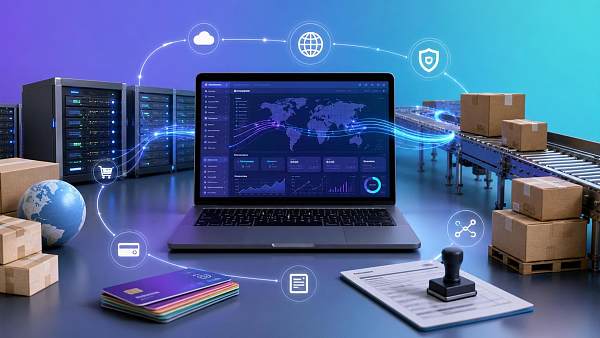
From a business perspective, a cross-border e-commerce system is an integrated digital capability that connects products, content, traffic, transactions, and fulfillment. It is both the transaction hub for an overseas independent site and the core carrier that absorbs ad traffic, search traffic, and repeat-purchase operations throughout the brand’s overseas expansion.
Many projects initially tend to focus on templates, language switching, and theme page design, but once real operations begin, problems often arise not on the page, but in order conversion, payment failure rates, unclear tax display, and delayed logistics status updates.
In other words, a qualified cross-border e-commerce system is not only a website-building tool; it must also support the continuous workflow of marketing, transactions, settlement, and fulfillment. Only when these links connect smoothly can an independent site avoid remaining at the stage of “having a site, but no efficiency.”
Why payment, tax, and logistics interfaces become key decision factors
The complexity of cross-border e-commerce is first reflected in market differences. Different countries have different common payment methods, different tax rules, and different logistics channels and last-mile delivery habits. If system integration capabilities are insufficient, it is difficult for a company to replicate the same e-commerce model across multiple markets.
What is even more worth noting is that interface issues often do not surface on the launch day; they appear only after order volume grows. For example, if payment channels are difficult to expand, tax rate rules cannot be segmented, or logistics statuses cannot be automatically synchronized, these issues will directly affect conversion rates, refund rates, and customer service costs.
For companies building an integrated website and marketing operation, the e-commerce system must also work in coordination with search engine optimization, advertising, and social media traffic acquisition. The front end is responsible for bringing in traffic, while the back end must ensure that every order can complete the loop smoothly; otherwise, the marketing budget can easily be swallowed up by back-end limitations.
Payment interfaces determine transaction efficiency
Payment capability is not only about “whether money can be collected,” but more about “whether leakage can be reduced.” If the cross-border e-commerce system supports too few payment methods, or if local wallets, credit cards, and installment payment coverage is insufficient, users often leave at the final step.
A mature system usually needs to consider multi-currency settlement, risk control strategies, declined payment handling, refund paths, and payment success rate monitoring. Especially in regions such as Europe, North America, Southeast Asia, and the Middle East, where payment preferences vary significantly, more complete localized access usually means more stable conversions.
Tax interfaces determine compliance costs
Tax is often underestimated, but it is directly tied to pricing accuracy and ongoing filing pressure. A reliable cross-border e-commerce system should support tax calculations by country, region, product type, or warehouse-fulfillment model, and display them clearly on the front end to avoid extra disputes when consumers sign for parcels or clear customs.
If the system cannot keep pace with tax rule updates, then expanding into new regions often requires a large amount of manual intervention, which both slows down launch speed and increases operational risk.
Logistics interfaces determine fulfillment experience
The fulfillment chain for cross-border orders is long, involving the first mile, overseas warehouse, last-mile delivery, customs clearance, and returns. Whether the logistics interface is mature determines whether the system can automatically return tracking numbers, sync tracking events, split parcels, identify exceptions, and trigger notifications.
In practice, customer service pressure is usually not caused by too many orders, but by lack of logistics transparency. The more complete the interface connectivity, the easier after-sales costs are to control, and the more stable the repeat-purchase experience becomes.
When evaluating a cross-border e-commerce system, start with these dimensions
If you only look at the demo pages, it is hard to judge whether a system is suitable for long-term investment. A more practical approach is to break requirements down into five layers: “transaction capability, compliance capability, fulfillment capability, marketing capability, and scalability,” and compare them one by one.
On the surface, these may look like technical issues, but in reality they determine whether the operating model can succeed. Especially in multi-region operations, the more standardized the interfaces are, the higher the team’s replication efficiency and the lower the trial-and-error cost.
Website and marketing integration is the long-term value of a cross-border e-commerce system
An independent site is increasingly becoming a comprehensive growth platform, not just an online store. If a cross-border e-commerce system only solves product display and order placement, it will be difficult to support search rankings, ad placement, social campaigns, and content conversion later on.
This is also why many companies shift from a single website-building tool to an integrated platform. Taking Yiyingbao as an example, its long-term focus on intelligent website building, SEO optimization, advertising, and overseas marketing synergy, as well as its self-developed cloud intelligent website system and cross-border e-commerce system, emphasizes not only build speed, but also the complete path from website launch and indexing to conversion.
When the system can support multilingual sites, search visibility optimization, rapid deployment of landing pages, social traffic intake, and order fulfillment loops at the same time, the value of the cross-border e-commerce system becomes truly amplified. For businesses targeting multiple regions such as North America, Europe, Southeast Asia, Japan and South Korea, the Middle East, and others, this integrated capability is especially critical.
From a management perspective, this is consistent with the underlying logic of many digital transformation projects. Whether in e-commerce operations or internal resource allocation, the core lies in making processes concrete and connecting data. Similar research such as research on comprehensive budget management in administrative and public institutions emphasizes the same systems thinking, which is also highly relevant in cross-border business.
Different business stages have different priorities
Not every company needs the most complex setup. To determine whether a cross-border e-commerce system is suitable, you also need to consider the current stage. A mismatch in needs is more likely to cause waste than insufficient functionality.
- At the startup stage, focus more on launch efficiency, multilingual capabilities, basic payment integration, and SEO structure.
- At the growth stage, pay close attention to ad tracking, repeat-purchase operations, logistics automation, and multi-market expansion capabilities.
- At the mature stage, pay more attention to tax rule granularity, overseas warehouse collaboration, data reports, and open system interfaces.
If the current business has already moved from single-site testing to multi-region replication, then whether the cross-border e-commerce system supports unified management of multiple sites, multiple currencies, and multiple logistics channels will directly affect organizational efficiency.
When evaluating go-live readiness, don’t overlook these details
Before formal selection, in addition to reviewing the feature list, you should also ask the vendor to demonstrate real workflows rather than static pages. A more effective evaluation method is to verify system performance across four stages: “before checkout, during payment, after shipment, and after-sales.”
- Check whether product pages and checkout pages support localized display, including currency, tax, and shipping cost explanations.
- Test whether the flows for payment failure redirects, top-up, refunds, and risk-control interception are complete.
- Check whether logistics tracking is synchronized automatically and whether abnormal orders can trigger alerts and notifications.
- Confirm whether the system is compatible with SEO optimization, ad tracking pixels, social source attribution, and conversion attribution.
- Understand whether expanding into additional markets later will require substantial secondary development for payment, tax, and logistics interfaces.
These details may seem scattered, but in practice they create a chain reaction in operations. The more the system can reduce manual entry, manual reconciliation, and manual tracking, the more the team can focus its energy on product selection, content, and growth.
Establish evaluation criteria in advance so later investment is more stable
How to choose a cross-border e-commerce system does not come down to a single feature, but to whether it can support the business rhythm for the next three to five years. Whether payment interfaces affect conversion, whether tax interfaces affect compliance, and whether logistics interfaces affect the user experience of fulfillment—all three determine whether the system can move from “being able to go live” to “being able to grow.”
If you are already planning an overseas independent site, the next step is to first sort out the target markets, payment preferences, tax requirements, and logistics models, and then create a comparable shortlist based on that. Evaluating website development, marketing customer acquisition, and transaction fulfillment on the same chart is often closer to real business needs than simply reviewing website-building features.
Related Articles



Related Products
 EasyCamp SaaS Smart Website Marketing SystemE-Yingbao SaaS Smart Website Marketing System: AI-powered, zero-code website building. Rapidly launch multilingual independent e-commerce sites in just 10 minutes. Global server acceleration and AI-driven SEO optimization empower businesses to efficiently connect with global markets. The seamless integration of technology and user-friendly operation makes building e-commerce sites incredibly simple.
 AI+SEM Intelligent Advertising Marketing SystemAI+SEM drives intelligent ad creation, empowering full-funnel precision advertising marketing. The system automatically generates weekly/monthly reports, AI recommends keywords and target countries, monitors core metrics in real-time with intelligent alerts, and enables one-click high-conversion ad solutions to help quickly acquire customers and improve ROI.
 AI+SEO Dual Engine Optimization ServiceEasyWin AI+SEO Dual Engine Optimization System leverages AI-powered keyword mining, content generation, and comprehensive technical optimization to help foreign trade enterprises acquire high-quality organic traffic, significantly improving search rankings and conversion rates.
 AI+SNS Social Media Marketing SystemYingbao AI+SNS Social Media Marketing System - Precision social capture for the social media era. Supports one-click content synchronization across major platforms like Facebook and LinkedIn. AI intelligently rewrites posts for enhanced relevance. 24/7 AI customer service and user profiling analysis empower businesses to efficiently expand into global markets.
 AI+SEO营销解决方案易营宝AI+SEO营销解决方案,通过AI批量写作、智能生成TDK、精准关键词扩词等功能,全面优化网站SEO效果,提升流量与转化率。助力企业构建高效智能网站新生态。
 AI+SEM Advertising Marketing SolutionsAI+SEM Advertising Marketing Solution leverages AI technology to deeply empower SEM ad campaigns. It automatically generates weekly/monthly reports using AI, presenting account data across multiple dimensions for comprehensive insights into campaign performance and trends. The system precisely recommends keywords and target countries, intelligently generates high-conversion ad copy, and enables one-click activation of efficient campaign plans to help businesses rapidly acquire customers. Simultaneously, it monitors core metrics in real time, intelligently identifies abnormal fluctuations, and issues timely alerts to ensure stable, high-return advertising results.
 Domain Name ServicesEasyWin provides professional domain name services, including intelligent queries, one-stop registration, brand protection, and full lifecycle management, helping businesses build a digital brand image.
 EasyOperate B2C Cross-Border E-Commerce Platform & Independent WebsiteEasyStore B2C Cross-border E-commerce Independent Store is an intelligent website building and cross-border e-commerce integrated solution independently developed by EasyStore Information Technology (Beijing) Co., Ltd. The system is specially designed for small and medium-sized as well as large export enterprises, integrating 'website building, operation, marketing, advertising, and conversion' into one, helping enterprises quickly establish cross-border e-commerce independent stores to achieve brand globalization and global sales growth.
The platform supports multiple languages, multiple currencies, and multi-channel marketing, with built-in AI intelligent translation and SEO optimization systems, suitable for mainstream markets such as Southeast Asia, Europe and America, Latin America, and the Middle East, assisting Chinese manufacturing enterprises in efficiently deploying international e-commerce strategies. SSL证书易营宝提供专业SSL安全证书服务,包括单域名和泛域名证书,确保网站数据传输加密、身份验证和完整性保护,助力企业建立安全可信的在线业务环境。









