









- What stages does the cross-border services ecosystem include? How do website building, promotion, payment, and compliance work togetherJun 22, 2026View details
- How will email marketing costs change in 2026Jun 22, 2026View details
- The China-US tariff arrangement has reached a preliminary consensus, and the trade association will be establishedJun 15, 2026View details
- Should overseas brand marketing start with ads or contentJun 21, 2026View details
- What determines B2C cross-border e-commerce website development costs? A breakdown of features, interfaces, and deployment methodsJun 17, 2026View details
- China-Morocco zero-tariff access, a breakthrough in the cost of Moroccan goods exports to ChinaJun 11, 2026View details
Which Is Better: Responsive Website Development or Independent Mobile Site? Scenario-Based Comparison
Responsive website development and an independent mobile site each have their own advantages, and the key lies in business objectives, budget investment, and post-launch operational efficiency. For technical evaluators, only by combining SEO, user experience, and maintenance costs can a choice be made that is better suited to enterprise growth.
In an integrated website + marketing service scenario, this choice is not just a difference in front-end presentation; it is more closely related to content indexing efficiency, ad delivery compatibility, subsequent multilingual expansion, and consistency in data analytics. For foreign trade companies, manufacturers, cross-border sellers, and brand global expansion teams in particular, coordination between the PC site, mobile site, and search traffic directly affects inquiry costs and conversion paths.
From a technical evaluation perspective, there are at least four common decision dimensions: development and deployment cycle, SEO visibility, operational maintenance complexity, and marketing scalability. Relying on AI smart website building, multilingual website development, and SEO and advertising synergy, 易营宝 can help enterprises launch sites of varying complexity within 7 to 30 days while meeting the needs of global market promotion.
The Core Differences Between Responsive Website Development and an Independent Mobile Site
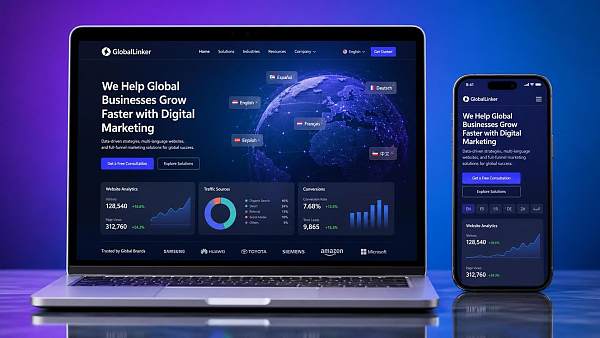
Responsive website development refers to a single set of URLs and a single content system that adapts its front-end layout to different screen sizes. An independent mobile site, by contrast, usually configures a separate mobile URL, template, or even content structure, such as an m-site or a standalone H5 site. Both can serve mobile visitors, but the implementation logic is completely different.
Why Technical Teams Easily Choose the Wrong Solution in the Early Stage
Many companies only focus on whether it can be viewed normally on a phone when the project is launched, while overlooking content expansion and marketing delivery needs over the next 1 to 3 years. If only initial development cost is considered, an independent mobile site may be easier to build as a lightweight page; but if SEO, multilingual support, ad landing pages, and CRM data attribution are added, maintenance costs often rise rapidly in the second phase.
Basic Technical Logic of the Two Solutions
Responsive website development usually uses a single codebase and multiple breakpoints, with common adaptation ranges including mainstream resolutions such as 320px, 768px, 1024px, and 1440px. An independent mobile site is more like a “dual-site parallel” setup, requiring separate handling of URL mapping, redirect rules, asset calls, and page synchronization, making it suitable for businesses with strong customization requirements for mobile experiences.
The table below is more suitable for technical evaluators to quickly determine the practical differences between the two approaches in website building and marketing.
If a company mainly relies on Google SEO, content marketing, and multilingual official website development, responsive website development is usually more stable and reliable. If the mobile side carries high-frequency campaign traffic, short-link promotions, or region-specific flash promotion needs, an independent mobile site is more likely to deliver an advantage.
Which Solution Is Better for Growth from the Perspectives of SEO, Experience, and Maintenance Cost
What technical evaluators care about most is not only page loading performance, but whether the solution can support growth tasks for the next 12 months or longer. For foreign trade marketing websites, the site often needs to承担 three responsibilities at the same time: brand presentation, keyword indexing, and inquiry conversion. At this point, architectural stability is far more important than short-term visual differences.
SEO Visibility: A Unified URL Is Usually More Advantageous
One of the core advantages of responsive website development is that the same page shares the same URL on both PC and mobile. For search engine crawling, this means content signals are more centralized, internal link transmission is clearer, and indexing management is simpler. Technical teams only need to focus on maintaining one set of sitemap rules, one set of canonical rules, and one content update mechanism.
If an independent mobile site is misconfigured, three types of problems can easily occur: inconsistent content between PC and mobile pages, incorrect redirect logic, and duplicate indexing. In multilingual scenarios, if hreflang tag management is also added, the complexity increases from one layer to two or even three layers, which is not conducive to long-term maintenance by small and medium-sized technical teams.
User Experience: It’s Not About Being More Independent, It’s About Being More Compatible
Many people believe that an independent mobile site is always better in terms of user experience, but this judgment is not complete. If an enterprise site is centered on product catalogs, case showcases, technical parameter downloads, and form inquiries, responsive website development can fully achieve a good browsing experience through module collapsing, image compression, button optimization, and mobile navigation restructuring.
Independent mobile sites are truly needed more often for businesses with very short conversion paths, such as ad landing pages with 1-screen to 3-screen length, limited-time campaign pages, single-product promotion pages, or interactive scenarios that require deep use of mobile capabilities. The dwell time on such pages may only be 30 to 90 seconds, and the design goals are not the same as those of a corporate website.
Maintenance Cost: Dual-Site Parallel Operation Greatly Increases Hidden Spending
From an annual budget perspective, initial development cost is only part of the total investment. The technical team also needs to account for monthly content updates, campaign page replacements, plugin upgrades, page testing, and landmark checks. If an independent mobile site is adopted, many operations must be performed twice; especially when the product count exceeds 100 and the number of language versions reaches 3 or more, maintenance pressure will increase significantly.
On this point, 易营宝’s AI smart website building and SEO synergy capabilities are better suited to integrated operations. Enterprises can complete multilingual page setup, content publishing, search optimization, and ad acceptance on one platform, reducing data fragmentation caused by switching between multiple systems. This is also why more and more export-oriented companies prefer responsive website development rather than splitting off a separate mobile site.
Selection Recommendations Under Different Business Scenarios
Selection cannot be judged solely by technical implementation; business model also matters. B2B inquiry sites, B2C brand sites, cross-border stores, and ad landing pages have very different requirements for mobile devices. The following four common scenarios are broken down to facilitate quick use during project initiation meetings or procurement reviews.
Scenario 1: B2B Foreign Trade Inquiry Website
If a company’s goal is to obtain inquiries through Google organic traffic, and the site includes 6 or more sections such as company profile, product center, industry applications, cases, news, and FAQ, responsive website development is the preferred recommendation. Such sites often need to accumulate keywords over the long term and continuously increase content depth, making a unified structure more valuable.
Scenario 2: B2C Brand Independent Site or Cross-Border Store
If the store has between 50 and 500 SKUs and the estimated share of mobile orders exceeds 60%, a responsive solution is still applicable, but special attention must be paid to first-screen loading, filtering interactions, and checkout flow optimization. Only when a specific market requires a separate mobile promotion page is it recommended to add an independent mobile page, rather than splitting the entire site.
Scenario 3: Ad Landing Pages
When the page is meant to support Google Ads, Facebook ads, or short-video traffic acquisition, an independent mobile site or independent mobile landing page offers more room to operate. The reason is that the page structure can be extremely simplified, with common modules controlled within 5 to 8, and button paths shortened to no more than 2 steps, which is more conducive to improving lead conversion rates.
Scenario 4: Multilingual Brand Global Website
When target markets cover North America, Europe, Southeast Asia, Japan and Korea, the Middle East, or Latin America, 2 to 10 language versions are usually required. In this case, responsive website development is more convenient for unified management of language directories, page structures, and technical tags. For enterprises that need to combine AI search visibility improvements, a unified site architecture is also more suitable for subsequent GEO content layout.
For the convenience of procurement and evaluation, a more intuitive scenario selection table is provided below.
In actual projects, it is not an either-or choice. Many mature companies adopt a combined strategy of “responsive official website + independent mobile campaign pages,” using one main site to carry the brand and SEO, while using several dedicated pages to serve ad delivery. This is often more balanced than a completely dual-site parallel setup.
A Decision Checklist That Technical Evaluators Can Use Directly
If you are conducting a solution review, it is recommended to check at least 5 questions: first, what is the expected content update frequency within the next 12 months; second, whether multilingual support is needed; third, whether the estimated share of mobile traffic exceeds 50%; fourth, whether long-term SEO will be pursued; and fifth, whether the technical team can handle dual-platform maintenance.
Signals That Suggest Prioritizing Responsive Website Development
- The site has more than 6 sections, and more than 4 new content pieces are added each month.
- It is expected that 2 or more language versions will be expanded within 1 year.
- Organic search, brand terms, and long-tail traffic are the core sources of leads.
- Unified management of the official website, store, landing pages, and form data is required.
Signals That Make an Independent Mobile Site Worth Considering
- The page mainly receives ad traffic, and its lifecycle may only be 15 to 60 days.
- The mobile conversion path must be compressed to within 2 or 3 steps.
- High-frequency version testing is needed for different countries and channels.
- The company already has mature dual-platform development and operations resources.
What Else Needs Attention During Implementation
No matter which solution is chosen, test speed, tracking points, conversion forms, redirect rules, and content synchronization mechanisms should be written into the requirements document in advance. If the project involves overseas markets, cross-region access testing, form submission validation, and mobile click-area checks for core page modules should also be completed before launch. It is usually recommended to go through at least 3 rounds of testing before going live.
When enterprises carry out digital upgrades, technical selection is often not an isolated decision. For example, when some large organizations simultaneously promote official website, marketing system, and management system transformations, they also pay attention to the overall coordination logic of the information system. If you are evaluating a broader digital construction direction, you may also read the optimization path of state-owned enterprise financial management information systems under digital transformation, as a supplementary reference for system planning ideas.
For most enterprises targeting overseas customer acquisition, responsive website development is usually more suitable as a long-term foundational infrastructure: it is more conducive to SEO accumulation, unified content management, and multilingual expansion, and can also reduce later operational and data fragmentation risks. An independent mobile site is not without value, but it is better suited to short-link marketing, campaign support, and high-conversion landing page scenarios.
If you are conducting a technical evaluation for a foreign trade official website, cross-border store, or brand global expansion project, 易营宝 can provide integrated support from AI smart website building and multilingual website development to Google SEO, ad delivery, and GEO optimization, helping enterprises form a closed loop between website building, promotion, and conversion. If you want to further clarify which architecture is more suitable for your business, contact us now to get a customized solution and implementation recommendations.
Related Articles
Related Products
 EasyCamp SaaS Smart Website Marketing SystemE-Yingbao SaaS Smart Website Marketing System: AI-powered, zero-code website building. Rapidly launch multilingual independent e-commerce sites in just 10 minutes. Global server acceleration and AI-driven SEO optimization empower businesses to efficiently connect with global markets. The seamless integration of technology and user-friendly operation makes building e-commerce sites incredibly simple.
 AI+SEM Intelligent Advertising Marketing SystemAI+SEM drives intelligent ad creation, empowering full-funnel precision advertising marketing. The system automatically generates weekly/monthly reports, AI recommends keywords and target countries, monitors core metrics in real-time with intelligent alerts, and enables one-click high-conversion ad solutions to help quickly acquire customers and improve ROI.
 AI+SEO Dual Engine Optimization ServiceEasyWin AI+SEO Dual Engine Optimization System leverages AI-powered keyword mining, content generation, and comprehensive technical optimization to help foreign trade enterprises acquire high-quality organic traffic, significantly improving search rankings and conversion rates.
 AI+SNS Social Media Marketing SystemYingbao AI+SNS Social Media Marketing System - Precision social capture for the social media era. Supports one-click content synchronization across major platforms like Facebook and LinkedIn. AI intelligently rewrites posts for enhanced relevance. 24/7 AI customer service and user profiling analysis empower businesses to efficiently expand into global markets.
 AI+SEO营销解决方案易营宝AI+SEO营销解决方案,通过AI批量写作、智能生成TDK、精准关键词扩词等功能,全面优化网站SEO效果,提升流量与转化率。助力企业构建高效智能网站新生态。
 AI+SEM Advertising Marketing SolutionsAI+SEM Advertising Marketing Solution leverages AI technology to deeply empower SEM ad campaigns. It automatically generates weekly/monthly reports using AI, presenting account data across multiple dimensions for comprehensive insights into campaign performance and trends. The system precisely recommends keywords and target countries, intelligently generates high-conversion ad copy, and enables one-click activation of efficient campaign plans to help businesses rapidly acquire customers. Simultaneously, it monitors core metrics in real time, intelligently identifies abnormal fluctuations, and issues timely alerts to ensure stable, high-return advertising results.
 Domain Name ServicesEasyWin provides professional domain name services, including intelligent queries, one-stop registration, brand protection, and full lifecycle management, helping businesses build a digital brand image.
 EasyOperate B2C Cross-Border E-Commerce Platform & Independent WebsiteEasyStore B2C Cross-border E-commerce Independent Store is an intelligent website building and cross-border e-commerce integrated solution independently developed by EasyStore Information Technology (Beijing) Co., Ltd. The system is specially designed for small and medium-sized as well as large export enterprises, integrating 'website building, operation, marketing, advertising, and conversion' into one, helping enterprises quickly establish cross-border e-commerce independent stores to achieve brand globalization and global sales growth.
The platform supports multiple languages, multiple currencies, and multi-channel marketing, with built-in AI intelligent translation and SEO optimization systems, suitable for mainstream markets such as Southeast Asia, Europe and America, Latin America, and the Middle East, assisting Chinese manufacturing enterprises in efficiently deploying international e-commerce strategies. SSL证书易营宝提供专业SSL安全证书服务,包括单域名和泛域名证书,确保网站数据传输加密、身份验证和完整性保护,助力企业建立安全可信的在线业务环境。









