









- What stages does the cross-border services ecosystem include? How do website building, promotion, payment, and compliance work togetherJun 22, 2026View details
- How will email marketing costs change in 2026Jun 22, 2026View details
- The China-US tariff arrangement has reached a preliminary consensus, and the trade association will be establishedJun 15, 2026View details
- Should overseas brand marketing start with ads or contentJun 21, 2026View details
- What determines B2C cross-border e-commerce website development costs? A breakdown of features, interfaces, and deployment methodsJun 17, 2026View details
- China-Morocco zero-tariff access, a breakthrough in the cost of Moroccan goods exports to ChinaJun 11, 2026View details
Where to Start with Mechanical Export Marketing? Website, SEO, and Advertising Synergistic Customer Acquisition Path Analysis
Machinery foreign trade marketing starts by clarifying the customer acquisition path
Where should machinery foreign trade marketing begin? Many companies’ first reaction is to run ads first. But when they actually start doing it, they find that traffic is coming in, but inquiries are unstable and customers are still hard to convert.
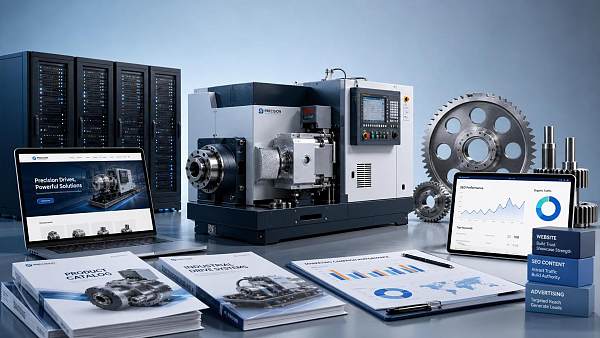
The problem is often not the channel itself, but that the path has not been connected. The official website fails to persuade, SEO lacks a content foundation, and the ad landing page lacks conversion design. The result is fast spending and slow returns.
For the machinery industry, overseas customers have a long decision-making cycle and make more rational purchases, especially when they value technical capability, delivery experience, certification qualifications, and service stability. This also means that machinery foreign trade marketing should not focus only on short-term clicks, but on long-term trust building.
A more effective approach is to place the official website, SEO, and ads within the same growth framework. The official website is responsible for acceptance, SEO is responsible for accumulation, and ads are responsible for amplification. Only when the three work together will inquiry quality and customer acquisition efficiency improve significantly.
Step one: build a website foundation that can convert
In machinery foreign trade marketing, the official website is not an electronic business card, but part of the sales system. After customers enter the website through search, ads, or social media, the first thing they judge is not what you said, but whether you are worth cooperating with.
Therefore, website building should first answer three questions: what you do, what problems you solve, and why customers should choose you. The clearer the page structure, the lower the customer’s understanding cost, and the easier conversion becomes.
What should a machinery industry website focus on presenting
- Clear core product categories, with support for display by equipment, process, and application scenario.
- Complete technical parameters, avoiding only conceptual introductions that lack procurement decision-making basis.
- Case content that is authentic and highlights export markets, customer types, and application results.
- Visible qualification certifications, including factory strength, testing process, and quality control.
- Clear inquiry entry, concise forms, and support for fast submission from multiple devices.
In actual business, many machinery company websites have plenty of content, but the logic is scattered. After viewing the homepage, customers still do not know your main products, service scope, or delivery advantages, which directly lowers the conversion efficiency of machinery foreign trade marketing.
If the company also involves operations planning, capital scheduling, and risk judgment, it can also combine content such as Research on Working Capital Risk Management Strategies for Manufacturing Enterprises to improve the stable image of operations displayed externally and strengthen customer confidence in long-term cooperation.
Step two: use SEO to build sustainable customer acquisition capability
If the website is the receiving site, then SEO is one of the most stable traffic sources in machinery foreign trade marketing. Its value does not lie in short-term explosive growth, but in continuously capturing precise search demand.
Machinery procurement customers often search with clear questions, such as equipment model, processing capacity, material compatibility, application industry, certification standards, and delivery cycle. Whoever can answer these questions more completely is more likely to be seen.
SEO layout should not focus only on the homepage
Many companies put all their keywords on the homepage when doing machinery foreign trade marketing. This may seem centralized, but in practice it is hard to cover the full procurement process. A more reasonable approach is to break content down by decision stage.
- Product pages carry core terms, such as equipment names, model terms, and category terms.
- Solution pages carry scenario terms, such as industry applications, process solutions, and customization needs.
- Article pages carry question terms, such as price factors, model selection suggestions, and maintenance methods.
- Case pages carry trust terms, such as export experience, project results, and customer feedback.
From recent changes, search engines place greater emphasis on the professionalism and relevance of content. If machinery foreign trade marketing only does superficial pseudo-original content, it is very difficult to gain ranking advantages. Truly effective SEO must be built on real product data, application experience, and customer questions.
Platforms like Yi Ying Bao, which integrate websites and marketing services, can connect AI website building, SEO optimization, advertising systems, and multilingual content capabilities, helping companies build overseas independent sites that are indexable, promotable, and convertible more quickly, and reducing the execution disconnects that are common in machinery foreign trade marketing.
Step three: use advertising to validate the market and amplify high-quality inquiries
SEO takes time to show results, while ads can validate the market more quickly. This is also why many companies must synchronize ad channel deployment when advancing machinery foreign trade marketing.
But advertising is not simply about buying traffic. In the machinery industry, customer order values are high, and inquiry quality matters more than clicks. If the keywords, landing pages, form design, and follow-up rhythm are inconsistent, budget consumption will quickly get out of control.
Machinery foreign trade advertising is more suitable for this kind of investment
- First invest in high-intent terms and prioritize clear procurement needs.
- Segment accounts by market, distinguishing North America, Europe, and emerging regions.
- Create landing pages by product line, avoiding one page carrying all traffic.
- Use retargeting to follow up with customers who visit multiple times and shorten the conversion hesitation period.
- Synchronize the recording of invalid inquiries and continuously optimize negative terms and audience targeting.
A more obvious signal is that companies with good ad performance are often not those with the highest bids, but those with a more complete website foundation and more solid SEO content. Because after customers click an ad, they still ultimately judge whether to continue communication through the website.
How to create a closed loop among website, SEO, and ads
The thing machinery foreign trade marketing fears most is doing three things separately. The website team only manages pages, the content team only writes articles, and the advertising team only watches clicks. In the end, the data cannot connect, and strategy is difficult to iterate.
A truly effective collaboration path can be designed as “acceptance—testing—amplification—accumulation.” In this way, investment risk can be controlled, and a stable source of inquiries can gradually be formed.
A more practical execution sequence
- First sort out the core products, market advantages, and target customer profiles.
- Then build a multilingual official website and complete the design of product pages and inquiry paths.
- Deploy keywords and the content system in sync to lay the foundation for SEO.
- Use ads to test countries, term packages, and page conversion performance.
- Sink high-conversion terms into the SEO and content library to reduce long-term costs.
- Optimize the website structure and sales copy in reverse based on inquiry data.
The advantage of this approach is that machinery foreign trade marketing no longer relies on a single-point explosion, but forms a continuous optimization growth mechanism. Even if the market changes, the company can quickly adjust focus channels and page strategies.
If a company, while advancing digital marketing, also wants to improve decision-making quality at the management level, it can pay attention to content related to Research on Working Capital Risk Management Strategies for Manufacturing Enterprises and review market growth and operational safety from the same perspective.
When machinery companies go live, the most common pitfalls
Many companies do not ignore machinery foreign trade marketing; they simply go in the wrong direction during execution. They invest a lot in the early stage, but fail to form stable growth.
- Only focusing on website appearance, without content structure and conversion paths.
- Only pursuing traffic, without distinguishing between qualified inquiries and invalid leads.
- Only ranking the homepage, without laying out product pages and application scenario pages.
- Ads and sales are disconnected, resulting in slow lead follow-up and low conversion.
- Lack of data review, making it impossible to know where the budget went.
These problems may seem scattered, but the root cause is actually the same: machinery foreign trade marketing has not been treated as a systematic engineering operation. When channels are disconnected from each other, growth is naturally hard to sustain.
Conclusion: start with a solution that can close the loop
Back to the original question, where should machinery foreign trade marketing begin? The answer is not to start with one channel, but to first clarify the customer acquisition loop, and then determine the investment order for the website, SEO, and ads.
The website solves trust acceptance, SEO solves long-term exposure, and ads solve rapid traffic generation. The three are not a replacement relationship, but mutually reinforcing. When the path is matched correctly, inquiry growth is more stable and customer acquisition costs are more controllable.
For machinery companies that want to open overseas markets, what is more worth doing now is not blindly increasing the budget, but quickly building a machinery foreign trade marketing solution that is executable, reviewable, and continuously optimizable, and starting from the most critical pages, keywords, and ad tests.
Related Articles


Related Products
 EasyCamp SaaS Smart Website Marketing SystemE-Yingbao SaaS Smart Website Marketing System: AI-powered, zero-code website building. Rapidly launch multilingual independent e-commerce sites in just 10 minutes. Global server acceleration and AI-driven SEO optimization empower businesses to efficiently connect with global markets. The seamless integration of technology and user-friendly operation makes building e-commerce sites incredibly simple.
 AI+SEM Intelligent Advertising Marketing SystemAI+SEM drives intelligent ad creation, empowering full-funnel precision advertising marketing. The system automatically generates weekly/monthly reports, AI recommends keywords and target countries, monitors core metrics in real-time with intelligent alerts, and enables one-click high-conversion ad solutions to help quickly acquire customers and improve ROI.
 AI+SEO Dual Engine Optimization ServiceEasyWin AI+SEO Dual Engine Optimization System leverages AI-powered keyword mining, content generation, and comprehensive technical optimization to help foreign trade enterprises acquire high-quality organic traffic, significantly improving search rankings and conversion rates.
 AI+SNS Social Media Marketing SystemYingbao AI+SNS Social Media Marketing System - Precision social capture for the social media era. Supports one-click content synchronization across major platforms like Facebook and LinkedIn. AI intelligently rewrites posts for enhanced relevance. 24/7 AI customer service and user profiling analysis empower businesses to efficiently expand into global markets.
 AI+SEO营销解决方案易营宝AI+SEO营销解决方案,通过AI批量写作、智能生成TDK、精准关键词扩词等功能,全面优化网站SEO效果,提升流量与转化率。助力企业构建高效智能网站新生态。
 AI+SEM Advertising Marketing SolutionsAI+SEM Advertising Marketing Solution leverages AI technology to deeply empower SEM ad campaigns. It automatically generates weekly/monthly reports using AI, presenting account data across multiple dimensions for comprehensive insights into campaign performance and trends. The system precisely recommends keywords and target countries, intelligently generates high-conversion ad copy, and enables one-click activation of efficient campaign plans to help businesses rapidly acquire customers. Simultaneously, it monitors core metrics in real time, intelligently identifies abnormal fluctuations, and issues timely alerts to ensure stable, high-return advertising results.
 Domain Name ServicesEasyWin provides professional domain name services, including intelligent queries, one-stop registration, brand protection, and full lifecycle management, helping businesses build a digital brand image.
 EasyOperate B2C Cross-Border E-Commerce Platform & Independent WebsiteEasyStore B2C Cross-border E-commerce Independent Store is an intelligent website building and cross-border e-commerce integrated solution independently developed by EasyStore Information Technology (Beijing) Co., Ltd. The system is specially designed for small and medium-sized as well as large export enterprises, integrating 'website building, operation, marketing, advertising, and conversion' into one, helping enterprises quickly establish cross-border e-commerce independent stores to achieve brand globalization and global sales growth.
The platform supports multiple languages, multiple currencies, and multi-channel marketing, with built-in AI intelligent translation and SEO optimization systems, suitable for mainstream markets such as Southeast Asia, Europe and America, Latin America, and the Middle East, assisting Chinese manufacturing enterprises in efficiently deploying international e-commerce strategies. SSL证书易营宝提供专业SSL安全证书服务,包括单域名和泛域名证书,确保网站数据传输加密、身份验证和完整性保护,助力企业建立安全可信的在线业务环境。









