









- What stages does the cross-border services ecosystem include? How do website building, promotion, payment, and compliance work togetherJun 22, 2026View details
- How will email marketing costs change in 2026Jun 22, 2026View details
- The China-US tariff arrangement has reached a preliminary consensus, and the trade association will be establishedJun 15, 2026View details
- Should overseas brand marketing start with ads or contentJun 21, 2026View details
- What determines B2C cross-border e-commerce website development costs? A breakdown of features, interfaces, and deployment methodsJun 17, 2026View details
- China-Morocco zero-tariff access, a breakthrough in the cost of Moroccan goods exports to ChinaJun 11, 2026View details
What are the common paths for social media lead generation? How can B2B companies structure content and private message conversion
Why do social media customer acquisition always bring traffic, but not necessarily inquiries?

Social media customer acquisition is often understood as posting updates, engaging with others, and getting customers to reach out on their own, but in a B2B scenario, the real challenge is not exposure, but turning attention into effective conversations, and then turning those conversations into leads that can be followed up.
Many accounts have content that looks diligent, and their traffic is not low either, but in the end they still fail to generate customers. The reason usually is not the amount of content, but a broken path: after viewing it, where do users go, who receives them, what do they talk about, and how do they keep moving forward? None of this has been designed.
For companies that integrate website + marketing services, social media customer acquisition cannot be viewed in isolation. Social platforms are responsible for attracting interest, the independent website is responsible for taking over trust, private messages and forms are responsible for collecting demand, and only subsequent follow-up determines the quality of the leads.
For service systems like Yiyingbao, which have been deeply engaged in overseas marketing for many years, the emphasis on website building, SEO, advertising, and social media linkage is essentially about solving the problem of “what happens after the traffic comes in and how it converts,” rather than simply pursuing superficial buzz.
How should common social media customer acquisition paths be understood?
In actual operations, social media customer acquisition generally has three common paths, and they are often not used alone, but in combination.
The first type: content attraction followed by directing users to the website
This path is suitable for businesses that need to build professional trust. Content first answers industry questions, then guides visitors to the official website, case pages, solution pages, or landing pages, allowing customers to make decisions in a more complete information environment.
The second type: content interaction followed by private messages
This approach is more suitable for consultation-type needs. Customers first like, comment, or save the content, then request quotations, catalogs, cases, or demo information through private messages. The key is not whether “someone asks,” but whether private messages have a script and a layered reply mechanism.
The third type: advertising targeting to acquire leads directly
When organic content accumulates slowly, advertising becomes the accelerator. It can directly drive the target audience to a form page, instant messaging window, or booking page, but the prerequisite is that the page and conversion actions are clear enough.
A more common mature approach is to use content to build awareness first, then use remarketing ads to bring visitors back, and finally complete lead collection through private messages or forms. This social media customer acquisition path is more stable and better suited to long-term B2B operations.
Why can’t B2B companies do content layout by only posting product information?
Because most customers on social platforms are not rushing to place an order immediately; they first want to judge whether you are professional, reliable, and able to solve problems. Simply posting product parameters makes it hard to keep strangers engaged.
Effective social media customer acquisition content usually needs to cover three layers: first awareness, then solution, and finally proof. Awareness content answers industry questions, solution content explains how to do it, and proof content uses cases, process, and results to build trust.
If the business itself involves website building, overseas promotion, or enterprise digital transformation, technical capabilities can also be integrated into content scenarios. For example, topics such as enterprise network upgrades, overseas access stability, and secure transmission can naturally introduce knowledge related to Internet Protocol Version 6(IPV6), rather than being turned into hard advertising on their own.
If private message conversion is not working well, which step is usually the problem?
The private message stage is the easiest to overlook, but it often determines whether social media customer acquisition produces results. Many accounts treat private messages as a customer service window, but in reality it is more like a sales pre-screening and nurturing touchpoint.
There are generally three common problems: slow replies, too many questions, and no next-step action. When customers are interested, if they only receive a reply several hours later, the momentum is often already gone.
- First confirm the demand background; do not rush to quote directly.
- Then judge whether the customer is in the awareness stage, comparison stage, or purchasing stage.
- Finally provide a clear action, such as viewing cases, filling out a form, or scheduling a conversation.
In practical application, private message scripts are best not used as a one-size-fits-all approach, but designed in layers. Some people only want to understand the trend, while others are already ready to request a quote; the communication depth and pace required by these two types of leads are clearly different.
If used together with a marketing website, social media private message replies can also guide customers to more complete pages. This not only reduces repeated explanations, but also makes data easier to track and accumulate.
How can you tell whether your social media customer acquisition model is healthy?
Many teams focus on follower count and exposure, but B2B should pay more attention to the quality of the path. To judge whether it is healthy, you can start from four signals.
Is there a stable content theme
If you post products today, holiday posters tomorrow, and industry news the day after, users will have a hard time remembering what you are good at. A stable theme leads to stable awareness.
Is there a clear landing page
Social media customer acquisition should not send everyone to the homepage. A better approach is to match themed pages, case pages, or landing pages according to content type, so customers encounter fewer jumps and less confusion.
Is there a repeatable private message process
Relying only on improvisation usually produces unstable results. Only by organizing high-frequency questions, material sending order, and booking actions can social media customer acquisition gradually become standardized.
Is there basic data review capability
At minimum, you should know which type of content brings visits, which type of private messages brings inquiries, and which path is most likely to lose users. The more complete the technical foundation, the clearer the data judgment. For example, when companies deploy global websites, network infrastructure also affects the visitor experience. When security and connection efficiency are involved, capabilities such as Internet Protocol Version 6(IPV6) are often directly related to the site’s delivery efficiency.
What mistakes are B2B companies likely to make when doing social media customer acquisition?
The most common mistake is not doing too little, but doing too scattered. Content, website, advertising, and private messages all operate independently, and in the end everyone is busy, but leads still cannot be retained.
- Only looking at exposure and not lead quality easily wastes resources on ineffective traffic.
- Only posting products and not discussing scenarios and results makes it difficult to build trust.
- Private message replies without standards and incomplete lead records make follow-up impossible.
- Weak official website reception means customers cannot find key information after clicking through, and conversion naturally drops.
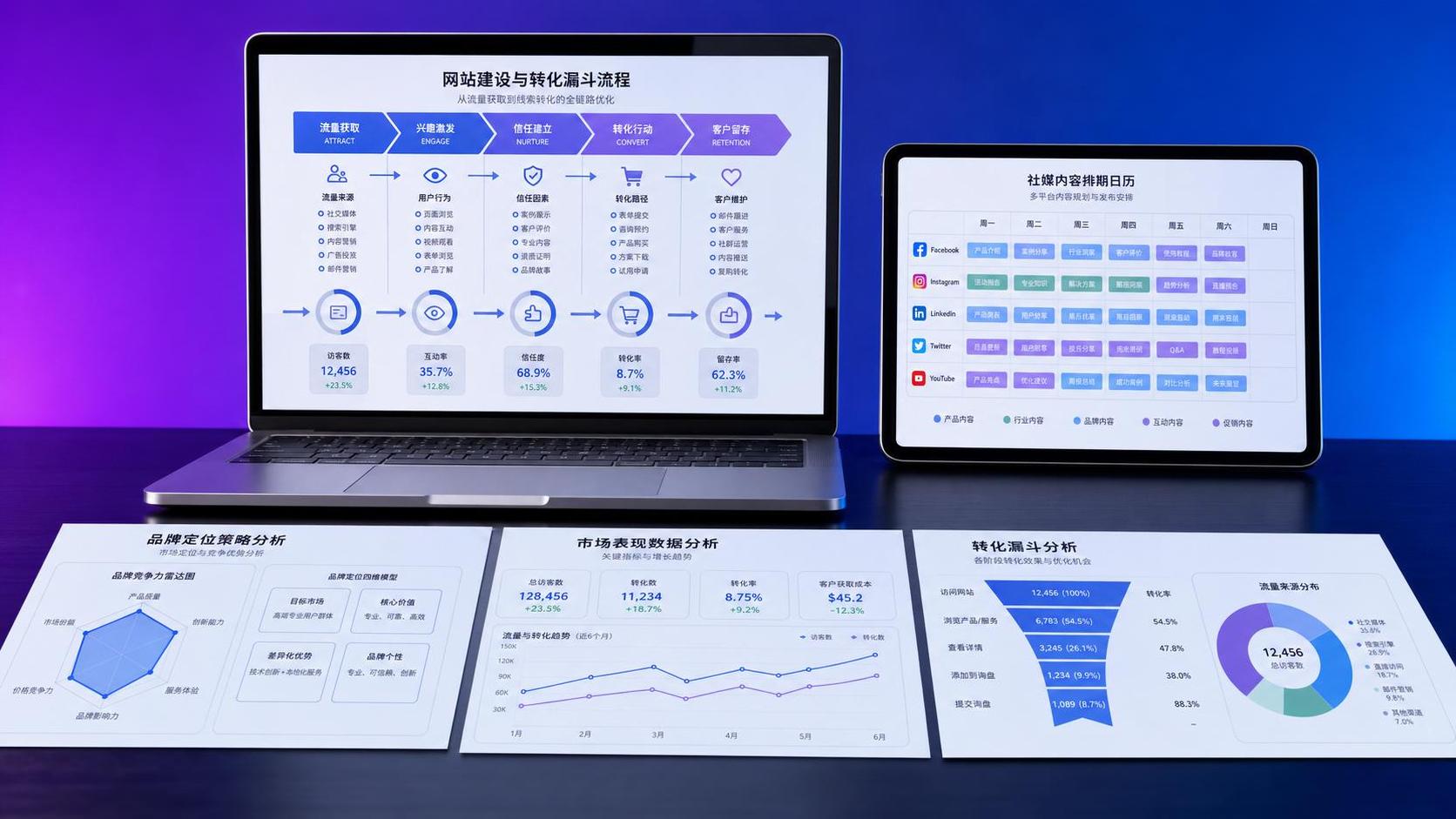
A more stable approach is to treat social media customer acquisition as a complete funnel. Front-end content solves attention, middle-stage pages solve understanding, back-end private messages and forms solve capture, and then sales follow-up or automated nurturing comes next.
Yiyingbao has long emphasized the coordination of “website building + promotion + conversion,” and that is the core here as well. Real sustainable growth does not come from one platform exploding once, but from multiple touchpoints working together to continuously generate high-quality inquiries.
If we start now, which steps are best to implement first?
If the system is not yet mature, there is no need to make everything big at once. First, put the most critical actions in place, and social media customer acquisition efficiency will usually improve significantly.
- First define one core platform to avoid excessive content dispersion.
- Focus on common questions and establish 3 to 5 fixed content themes.
- Set up corresponding landing pages or case pages for each type of content.
- Organize standard private message replies and set clear next-step actions.
- Review each month the visits, private messages, and inquiry quality brought by the content.
In the end, social media customer acquisition is not a single tactic, but an executable conversion design. As long as content layout, website reception, and private message conversion are connected, later optimization will have a starting point.
If you are currently evaluating the next step, you can first sort out whether your existing content really guides visitors, then check whether the website can handle traffic, and finally complete the private message process and data recording standards. Once the path is clear, social media customer acquisition can move from “having activity” to “having results.”
Related Articles
 Why is overseas social media operation always ineffective? Content frequency, account positioning, and conversion funnel review
 How to do YouTube marketing for B2B conversion? Topic selection, publishing cadence, and lead handoff methods
 What are the common paths for social media lead generation? How can B2B companies structure content and private message conversion

Related Products
 EasyCamp SaaS Smart Website Marketing SystemE-Yingbao SaaS Smart Website Marketing System: AI-powered, zero-code website building. Rapidly launch multilingual independent e-commerce sites in just 10 minutes. Global server acceleration and AI-driven SEO optimization empower businesses to efficiently connect with global markets. The seamless integration of technology and user-friendly operation makes building e-commerce sites incredibly simple.
 AI+SEM Intelligent Advertising Marketing SystemAI+SEM drives intelligent ad creation, empowering full-funnel precision advertising marketing. The system automatically generates weekly/monthly reports, AI recommends keywords and target countries, monitors core metrics in real-time with intelligent alerts, and enables one-click high-conversion ad solutions to help quickly acquire customers and improve ROI.
 AI+SEO Dual Engine Optimization ServiceEasyWin AI+SEO Dual Engine Optimization System leverages AI-powered keyword mining, content generation, and comprehensive technical optimization to help foreign trade enterprises acquire high-quality organic traffic, significantly improving search rankings and conversion rates.
 AI+SNS Social Media Marketing SystemYingbao AI+SNS Social Media Marketing System - Precision social capture for the social media era. Supports one-click content synchronization across major platforms like Facebook and LinkedIn. AI intelligently rewrites posts for enhanced relevance. 24/7 AI customer service and user profiling analysis empower businesses to efficiently expand into global markets.
 AI+SEO营销解决方案易营宝AI+SEO营销解决方案,通过AI批量写作、智能生成TDK、精准关键词扩词等功能,全面优化网站SEO效果,提升流量与转化率。助力企业构建高效智能网站新生态。
 AI+SEM Advertising Marketing SolutionsAI+SEM Advertising Marketing Solution leverages AI technology to deeply empower SEM ad campaigns. It automatically generates weekly/monthly reports using AI, presenting account data across multiple dimensions for comprehensive insights into campaign performance and trends. The system precisely recommends keywords and target countries, intelligently generates high-conversion ad copy, and enables one-click activation of efficient campaign plans to help businesses rapidly acquire customers. Simultaneously, it monitors core metrics in real time, intelligently identifies abnormal fluctuations, and issues timely alerts to ensure stable, high-return advertising results.
 Domain Name ServicesEasyWin provides professional domain name services, including intelligent queries, one-stop registration, brand protection, and full lifecycle management, helping businesses build a digital brand image.
 EasyOperate B2C Cross-Border E-Commerce Platform & Independent WebsiteEasyStore B2C Cross-border E-commerce Independent Store is an intelligent website building and cross-border e-commerce integrated solution independently developed by EasyStore Information Technology (Beijing) Co., Ltd. The system is specially designed for small and medium-sized as well as large export enterprises, integrating 'website building, operation, marketing, advertising, and conversion' into one, helping enterprises quickly establish cross-border e-commerce independent stores to achieve brand globalization and global sales growth.
The platform supports multiple languages, multiple currencies, and multi-channel marketing, with built-in AI intelligent translation and SEO optimization systems, suitable for mainstream markets such as Southeast Asia, Europe and America, Latin America, and the Middle East, assisting Chinese manufacturing enterprises in efficiently deploying international e-commerce strategies. SSL证书易营宝提供专业SSL安全证书服务,包括单域名和泛域名证书,确保网站数据传输加密、身份验证和完整性保护,助力企业建立安全可信的在线业务环境。









