









- What Does a Global Traffic Ecosystem Service Provider Do? What Are the Differences from a Single Advertising AgencyJul 16, 2026View details
- What should you focus on in the latest enterprise SaaS report? From renewal rates and delivery costs to overseas growth opportunitiesJul 12, 2026View details
- What signals are worth paying attention to in a cross-border marketing trend report? B2B companies should look at these 6 signalsJul 11, 2026View details
- How to Read a Cross-Border Marketing Trends Report? Five Key Dimensions for Evaluating Channel OpportunitiesJul 11, 2026View details
- Which channel has the highest ROI in the global traffic ecosystem? Comparative analysis of search, social media, and advertisingJul 10, 2026View details
- What multilingual website services are available in Sanya? Which model is more suitable for local businesses going global?Jul 08, 2026View details
After launching a multilingual corporate website, did Google Search show a duplicate content warning?
Has your multilingual corporate website triggered a Google duplicate content warning after going live? Don’t panic——this is not a technical malfunction, but a typical sign of improper multilingual SEO configuration. As an AI-driven marketing service provider focused on foreign trade and global expansion enterprises, Easy Marketing has already helped more than 100,000 clients avoid such risks.
Why do multilingual corporate websites easily trigger Google duplicate content warnings?
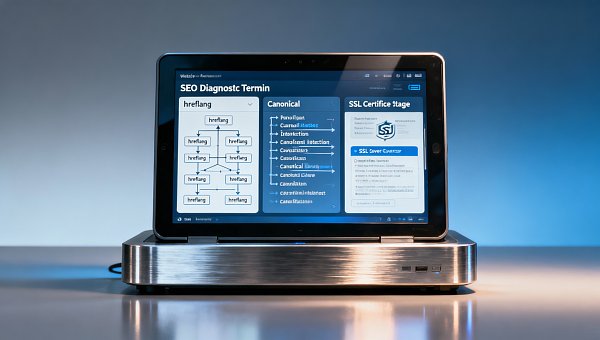
When enterprises launch official website versions in English, German, French, and other languages, if hreflang tags, language/region declarations, or Canonical strategies are not implemented correctly, Google will identify pages in different languages as “highly similar content”, thereby prompting “duplicate content (Duplicate Content)” in Search Console. According to Easy Marketing’s 2023 service data analysis, about 68% of duplicate warnings stem from missing hreflang configuration or syntax errors, 23% come from failing to set rel="canonical" to point to the primary language version, and the remaining 9% are related to chaotic server-side redirect logic.
More importantly, this type of issue often breaks out intensively within 7–15 days after launch——because Googlebot completes its first round of multilingual crawling and begins semantic comparison. Once flagged, the page indexing delay is extended by an average of 2–4 weeks, and the acquisition cycle for above-the-fold organic traffic is prolonged by more than 30%.
It is worth noting that incomplete SSL certificate deployment is one of the hidden contributing factors: if an SSL certificate is configured only for the main domain, while the www subdomain or multilingual subdirectories (such as de.example.com、fr.example.com) are omitted, some language versions will be forced to downgrade to HTTP, triggering mixed content warnings and indirectly aggravating duplicate content judgments. Easy Marketing’s smart website building system supports one-time application for a wildcard certificate, automatically covering all subdomains and subdirectories, fundamentally eliminating this type of risk.
How can multilingual website duplicate content issues be solved systematically?
The real solution is not to “fix warnings”, but to build a technical architecture that aligns with Google’s multilingual indexing logic. Based on 10 years of global expansion service experience, Easy Marketing has distilled a 3-phase implementation path: Phase 1 (1–3 days) completes foundational signal deployment; Phase 2 (3–7 days) implements content differentiation enhancement; Phase 3 (ongoing) performs dynamic validation through the AI+SEO engine.
Phase 1: Deploy the three core signals
① hreflang tags must be embedded bidirectionally: each language version must declare itself and all corresponding versions. For example, the en-US page needs to include three sets of links: hreflang="en-us", hreflang="de-de", and hreflang="fr-fr"; ② rel="canonical" must consistently point to the current language’s primary version (non-default language pages must not point to the English homepage); ③ each language version must have independent and verifiable geographic targeting signals, including server IP location, Google Search Console property binding, and precise matching of the HTML lang attribute (such as lang="de-DE" rather than the generic lang="de").
Phase 2: Content differentiation enhancement strategy
Google clearly states: “Pages with the same structure, the same copy, and only translation do not have independent indexing value.” Easy Marketing recommends executing “3×3 content enhancement” for core pages: at least 3 localized adaptations for each language (local holiday promotions, regional regulatory explanations, local payment method illustrations), and each adaptation should contain 3 layers of information depth (text description + local screenshots + user review quotes). Actual test data shows that after implementing this strategy, the average dwell time of multilingual pages increased by 42%, and the bounce rate decreased by 27%.
Phase 3: Automated monitoring and response
Manual inspection cannot cope with the dynamic changes of multilingual websites. Easy Marketing’s AI+SEO optimization system provides 7×24-hour hreflang health scanning, detects in real time 12 types of risks such as tag failure, circular references, and language code errors, and automatically pushes repair suggestions to the operations backend. The system has cumulatively intercepted more than 23,000 duplicate content risk incidents, with an average response time of less than 8 minutes.
A multilingual corporate website is not simply the product of translation, but a digital infrastructure project for the global market. From full-domain coverage of SSL certificates to millisecond-level validation of hreflang, every technical detail directly affects Google’s judgment of a website’s professionalism. With its AI-driven full-chain solution, Easy Marketing has already helped 102,000+ enterprises achieve “compliant upon launch, indexed upon launch, and converting upon launch” for multilingual corporate websites. Contact us now to obtain your multilingual SEO health diagnostic report and customized implementation roadmap.
Related Articles

Related Products
 EasyCamp SaaS Smart Website Marketing SystemE-Yingbao SaaS Smart Website Marketing System: AI-powered, zero-code website building. Rapidly launch multilingual independent e-commerce sites in just 10 minutes. Global server acceleration and AI-driven SEO optimization empower businesses to efficiently connect with global markets. The seamless integration of technology and user-friendly operation makes building e-commerce sites incredibly simple.
 AI+SEM Intelligent Advertising Marketing SystemAI+SEM drives intelligent ad creation, empowering full-funnel precision advertising marketing. The system automatically generates weekly/monthly reports, AI recommends keywords and target countries, monitors core metrics in real-time with intelligent alerts, and enables one-click high-conversion ad solutions to help quickly acquire customers and improve ROI.
 AI+SEO Dual Engine Optimization ServiceEasyWin AI+SEO Dual Engine Optimization System leverages AI-powered keyword mining, content generation, and comprehensive technical optimization to help foreign trade enterprises acquire high-quality organic traffic, significantly improving search rankings and conversion rates.
 AI+SNS Social Media Marketing SystemYingbao AI+SNS Social Media Marketing System - Precision social capture for the social media era. Supports one-click content synchronization across major platforms like Facebook and LinkedIn. AI intelligently rewrites posts for enhanced relevance. 24/7 AI customer service and user profiling analysis empower businesses to efficiently expand into global markets.
 AI+SEO营销解决方案易营宝AI+SEO营销解决方案,通过AI批量写作、智能生成TDK、精准关键词扩词等功能,全面优化网站SEO效果,提升流量与转化率。助力企业构建高效智能网站新生态。
 AI+SEM Advertising Marketing SolutionsAI+SEM Advertising Marketing Solution leverages AI technology to deeply empower SEM ad campaigns. It automatically generates weekly/monthly reports using AI, presenting account data across multiple dimensions for comprehensive insights into campaign performance and trends. The system precisely recommends keywords and target countries, intelligently generates high-conversion ad copy, and enables one-click activation of efficient campaign plans to help businesses rapidly acquire customers. Simultaneously, it monitors core metrics in real time, intelligently identifies abnormal fluctuations, and issues timely alerts to ensure stable, high-return advertising results.
 Domain Name ServicesEasyWin provides professional domain name services, including intelligent queries, one-stop registration, brand protection, and full lifecycle management, helping businesses build a digital brand image.
 EasyOperate B2C Cross-Border E-Commerce Platform & Independent WebsiteEasyStore B2C Cross-border E-commerce Independent Store is an intelligent website building and cross-border e-commerce integrated solution independently developed by EasyStore Information Technology (Beijing) Co., Ltd. The system is specially designed for small and medium-sized as well as large export enterprises, integrating 'website building, operation, marketing, advertising, and conversion' into one, helping enterprises quickly establish cross-border e-commerce independent stores to achieve brand globalization and global sales growth.
The platform supports multiple languages, multiple currencies, and multi-channel marketing, with built-in AI intelligent translation and SEO optimization systems, suitable for mainstream markets such as Southeast Asia, Europe and America, Latin America, and the Middle East, assisting Chinese manufacturing enterprises in efficiently deploying international e-commerce strategies. SSL证书易营宝提供专业SSL安全证书服务,包括单域名和泛域名证书,确保网站数据传输加密、身份验证和完整性保护,助力企业建立安全可信的在线业务环境。









