









- What Does a Global Traffic Ecosystem Service Provider Do? What Are the Differences from a Single Advertising AgencyJul 16, 2026View details
- What should you focus on in the latest enterprise SaaS report? From renewal rates and delivery costs to overseas growth opportunitiesJul 12, 2026View details
- What signals are worth paying attention to in a cross-border marketing trend report? B2B companies should look at these 6 signalsJul 11, 2026View details
- How to Read a Cross-Border Marketing Trends Report? Five Key Dimensions for Evaluating Channel OpportunitiesJul 11, 2026View details
- Which channel has the highest ROI in the global traffic ecosystem? Comparative analysis of search, social media, and advertisingJul 10, 2026View details
- What multilingual website services are available in Sanya? Which model is more suitable for local businesses going global?Jul 08, 2026View details
Google organic traffic growth is slow? Check these 4 page-level SEO basic settings
Google organic traffic growth has stalled? Don’t rush to optimize backlinks or content. First, check these 4 often-overlooked page-level SEO basics—they directly affect Google crawler crawling, indexing, and rankings. Yiyingbao has served more than 100,000 global expansion enterprises, and found that 83% of traffic bottlenecks stem from basic configuration errors.
Why do many companies overlook page-level SEO basics?
Foreign trade companies, manufacturing factories, and cross-border sellers often focus their efforts on content updates, keyword stuffing, or ad placements, while overlooking the first gateway for Google to crawl and interpret web pages: page-level technical foundations. These settings do not produce directly visible results, but once errors occur, they can lead to pages not being included, delayed indexing, ranking fluctuations, and even site-wide demotion.
After conducting health scans on 12,743 B2B foreign trade independent websites in 2023, the Yiyingbao AI+SEO optimization system found that only 21% of companies had correctly configured all 4 core parameters; among them, “missing Canonical tags” and “structured data errors” accounted for as much as 64%, making them the primary reason why Google organic traffic remains below the industry average over the long term.
The 4 page-level SEO basic settings you must check
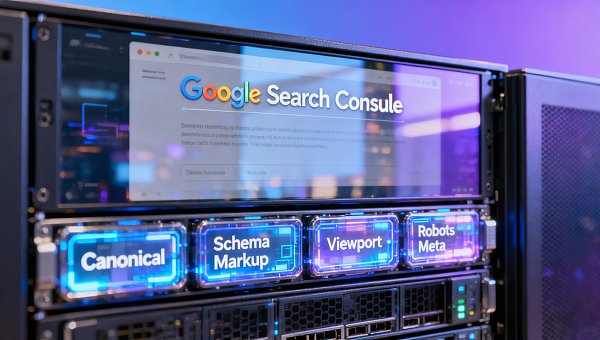
The following 4 items are all page-level technical specifications explicitly required by Google, applicable to all types of overseas independent websites (B2B marketing sites, B2C cross-border stores, multilingual official websites, GEO landing pages):
- ✅ Canonical URL (Canonical tag): Prevent duplicate content from being misjudged, and ensure that Google only indexes the primary version page you specify;
- ✅Structured data (Schema Markup): Clearly communicate the page type to Google (such as Product, Organization, FAQPage), and improve rich media display rates;
- ✅Responsive viewport declaration (Viewport Meta): Determines mobile rendering logic, affecting Core Web Vitals scores and mobile indexing priority;
- ✅Robots Meta directives and HTTP header coordination: Avoid noindex misspellings and X-Robots-Tag conflicts, and ensure that key pages can be crawled normally.
Common configuration error comparison table
Below are the high-frequency error scenarios among Yiyingbao customers and compliance recommendations:
This table is compiled based on Yiyingbao’s customer site audit report for Q1 2024. For customers using the self-developed AI+SEO/GEO optimization system, the page-level basic compliance rate increased to 96.8%, and average Google organic traffic grew by 41.3% within 3 months.
What should you focus on during procurement? Technical implementation capability matters more than price
When choosing an SEO service provider, operators need to pay attention to whether it has underlying technical control capabilities. Teams that only provide “manual inspection + manual fixes” cannot handle the dynamic update requirements of thousands of pages; while service providers that rely on third-party plugins (such as WordPress SEO plugins) often cause Canonical failures or Schema loss due to version compatibility issues.
Yiyingbao’s cloud intelligent website building system is deeply integrated with the AI+SEO/GEO optimization system, supporting:
• Real-time monitoring of the status of 4 basic parameters and alert notifications
• Batch repair of page configurations across languages/devices
• Automatic synchronization of abnormal Google Search Console data to the ticketing system
• Daily generation of the "Page-Level SEO Health Report"
Which scenarios are more suitable for AI-driven page-level optimization?
The following 3 types of companies have significantly improved their Google organic traffic growth curves through Yiyingbao solutions:
- Multilingual B2B foreign trade websites: Covering 8 languages including English, Spanish, and French, requiring each page to be independently configured with hreflang + Canonical + localized Schema;
- Cross-border stores with more than 5000 SKUs: Product pages are dynamically generated, and traditional manual maintenance cannot guarantee the accuracy of structured data;
- GEO-targeted landing page clusters: Deploying hundreds of localized pages for different regions such as North America, the Middle East, and Southeast Asia, requiring millisecond-level configuration synchronization capabilities.
For the above scenarios, Yiyingbao provides closed-loop services ranging from website architecture design, page-level SEO pre-configuration, continuous post-launch monitoring, to algorithm optimization. At the same time, we also make available Analysis of implementation paths for ESG to support enterprises in developing new quality productive forces, providing strategic support for sustainable business growth.
Why choose Yiyingbao? 3 irreplaceable professional values
As an AI-native service provider focused on integrated website + marketing services, Yiyingbao provides operators with verifiable, traceable, and reusable technical delivery:
- Real AI, not pseudo-automation: All page-level SEO configurations are dynamically generated after semantic analysis by a self-developed NLP engine, rather than by applying rule-based templates;
- Full-chain controllability: From website CMS, CDN nodes, crawler access logs to Google indexing status, all data is fully connected, with no black-box links;
- Localized responsiveness: Beijing + Shenzhen dual technology centers support direct Chinese ticket connections, with an average response time of <2 hours and urgent configurations going live within 2 hours.
If you are facing issues such as slow Google organic traffic growth, low page inclusion rates, or delayed indexing, feel free to contact Yiyingbao now to get a free "Page-Level SEO Health Diagnosis Report". We will help you: confirm the validity of current Canonical and Schema configurations, analyze the risk of Robots directive conflicts, output an actionable 3-step optimization checklist, and evaluate the integration cycle and expected ROI of the AI optimization system.
Related Articles


Related Products
 EasyCamp SaaS Smart Website Marketing SystemE-Yingbao SaaS Smart Website Marketing System: AI-powered, zero-code website building. Rapidly launch multilingual independent e-commerce sites in just 10 minutes. Global server acceleration and AI-driven SEO optimization empower businesses to efficiently connect with global markets. The seamless integration of technology and user-friendly operation makes building e-commerce sites incredibly simple.
 AI+SEM Intelligent Advertising Marketing SystemAI+SEM drives intelligent ad creation, empowering full-funnel precision advertising marketing. The system automatically generates weekly/monthly reports, AI recommends keywords and target countries, monitors core metrics in real-time with intelligent alerts, and enables one-click high-conversion ad solutions to help quickly acquire customers and improve ROI.
 AI+SEO Dual Engine Optimization ServiceEasyWin AI+SEO Dual Engine Optimization System leverages AI-powered keyword mining, content generation, and comprehensive technical optimization to help foreign trade enterprises acquire high-quality organic traffic, significantly improving search rankings and conversion rates.
 AI+SNS Social Media Marketing SystemYingbao AI+SNS Social Media Marketing System - Precision social capture for the social media era. Supports one-click content synchronization across major platforms like Facebook and LinkedIn. AI intelligently rewrites posts for enhanced relevance. 24/7 AI customer service and user profiling analysis empower businesses to efficiently expand into global markets.
 AI+SEO营销解决方案易营宝AI+SEO营销解决方案,通过AI批量写作、智能生成TDK、精准关键词扩词等功能,全面优化网站SEO效果,提升流量与转化率。助力企业构建高效智能网站新生态。
 AI+SEM Advertising Marketing SolutionsAI+SEM Advertising Marketing Solution leverages AI technology to deeply empower SEM ad campaigns. It automatically generates weekly/monthly reports using AI, presenting account data across multiple dimensions for comprehensive insights into campaign performance and trends. The system precisely recommends keywords and target countries, intelligently generates high-conversion ad copy, and enables one-click activation of efficient campaign plans to help businesses rapidly acquire customers. Simultaneously, it monitors core metrics in real time, intelligently identifies abnormal fluctuations, and issues timely alerts to ensure stable, high-return advertising results.
 Domain Name ServicesEasyWin provides professional domain name services, including intelligent queries, one-stop registration, brand protection, and full lifecycle management, helping businesses build a digital brand image.
 EasyOperate B2C Cross-Border E-Commerce Platform & Independent WebsiteEasyStore B2C Cross-border E-commerce Independent Store is an intelligent website building and cross-border e-commerce integrated solution independently developed by EasyStore Information Technology (Beijing) Co., Ltd. The system is specially designed for small and medium-sized as well as large export enterprises, integrating 'website building, operation, marketing, advertising, and conversion' into one, helping enterprises quickly establish cross-border e-commerce independent stores to achieve brand globalization and global sales growth.
The platform supports multiple languages, multiple currencies, and multi-channel marketing, with built-in AI intelligent translation and SEO optimization systems, suitable for mainstream markets such as Southeast Asia, Europe and America, Latin America, and the Middle East, assisting Chinese manufacturing enterprises in efficiently deploying international e-commerce strategies. SSL证书易营宝提供专业SSL安全证书服务,包括单域名和泛域名证书,确保网站数据传输加密、身份验证和完整性保护,助力企业建立安全可信的在线业务环境。









