









- What Does a Global Traffic Ecosystem Service Provider Do? What Are the Differences from a Single Advertising AgencyJul 16, 2026View details
- What should you focus on in the latest enterprise SaaS report? From renewal rates and delivery costs to overseas growth opportunitiesJul 12, 2026View details
- What signals are worth paying attention to in a cross-border marketing trend report? B2B companies should look at these 6 signalsJul 11, 2026View details
- How to Read a Cross-Border Marketing Trends Report? Five Key Dimensions for Evaluating Channel OpportunitiesJul 11, 2026View details
- Which channel has the highest ROI in the global traffic ecosystem? Comparative analysis of search, social media, and advertisingJul 10, 2026View details
- What multilingual website services are available in Sanya? Which model is more suitable for local businesses going global?Jul 08, 2026View details
In the early stage of overseas promotion for an independent website, should you prioritize brand keywords or industry keywords? Data-backed insights
In the early stage of overseas promotion for an independent website, should you prioritize branded keywords or industry keywords? This is not only a budget allocation issue, but also concerns cold-start efficiency and long-term traffic structure. Based on Yiyingbao's real-world data from serving 100,000+ enterprises, this article breaks down the differences in ROI and the logic behind conversion paths.
I. Branded Keywords vs Industry Keywords: A Comparison of Conversion Efficiency in the Cold-Start Phase
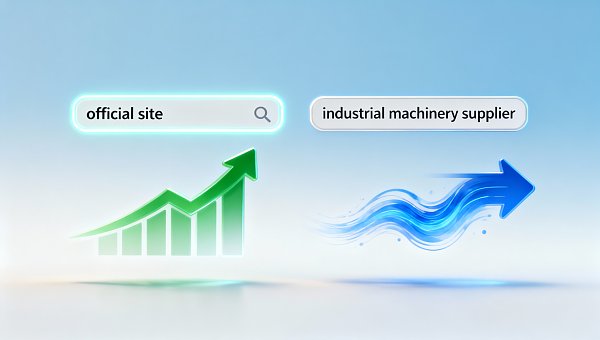
Within the first 30 days of launching overseas promotion for an independent website, Yiyingbao observed that the average CVR for branded keyword campaigns (such as “[English company name]+official site”) reached 8.2%, while industry keywords (such as “industrial machinery supplier” and “B2B wholesale platform”) achieved only 1.7%. However, the UV volume brought by industry keywords was 4.3 times that of branded keywords—this means the former offers high conversion but low traffic, while the latter delivers low conversion but high exposure.
Further analysis found that among branded keyword users, 72% had already completed initial awareness through social media/email/trade shows and belonged to the “active search” type; among industry keyword users, only 19% had clear purchasing intent, while the rest were mostly in the stages of price comparison, research, or information gathering. Therefore, branded keywords are better suited for validating website usability, landing page carrying capacity, and customer service response workflows; industry keywords, by contrast, serve the function of “breaking into new circles and reaching new audiences” and need to be combined with SEO long-tail keyword planning and an advertising remarketing loop.
This table reveals a key fact: the CPQ of branded keywords is less than 1/25 of that of industry keywords, but their traffic ceiling is clearly limited. If an enterprise has not yet established an overseas awareness foundation, blindly cutting the budget for industry keywords will directly result in zero new customers. Yiyingbao recommends allocating the first month's budget at a 7:3 ratio (branded keywords 70%, industry keywords 30%), while simultaneously launching foundational SEO optimization and social media seeding to pave the way for the rise of organic traffic from industry keywords in months 2–3.
II. Decision-Making Framework: Matching Strategies and Execution Rhythm for Three Types of Enterprises
Not all enterprises are suitable for the same advertising logic. Based on profiles from 100,000+ customers, Yiyingbao divides independent website going-global businesses into three categories and matches them with differentiated keyword strategies:
1. Manufacturing factories with an existing overseas channel foundation (accounting for 41%)
These customers usually have more than 3 years of foreign trade experience and stable overseas agents/trade show resources, with branded keyword search volume growing by an average of 23% annually. It is recommended to adopt a “dual-track parallel” approach: in week 1, invest 100% in branded keywords to verify the conversion chain of the independent website; starting from week 2, add precise industry keywords (such as “[product]+OEM manufacturer”) to target regions not yet covered by existing channels. On average, this reduces inquiry cost by 37%, and from week 4 onward, the share of organic branded keyword searches rises to 61%.
2. Emerging cross-border brands (accounting for 36%)
Consumer brands going global through the DTC model generally lack overseas search memory. Data shows that their average monthly branded keyword search volume is <200 searches (Google Keyword Planner), and forcing branded keywords as the main focus will make it difficult for the ad account to learn. The recommended strategy is “industry keywords first + branded keywords as backup”: in the first 15 days, focus on 3–5 long-tail industry keywords with high commercial value (such as “vegan leather handbag wholesale”), while simultaneously deploying AI-generated GEO localized landing pages; from day 16 onward, allocate 5% of the budget to protective branded keyword campaigns to prevent competitor hijacking.
3. Enterprises transitioning from B2B platforms (accounting for 23%)
Enterprises that previously relied on third-party platforms such as Alibaba International face a “trust gap” when migrating to independent websites. Yiyingbao observed that their industry keyword conversion rate was only 0.9% in the first 1–2 months, but jumped to 3.4% in month 3—driven by the synergistic effect of SEO content accumulation and advertising remarketing. It is recommended to adopt an “SEO + advertising” combination strategy: in the first month, 80% of the budget should go to industry keywords, with a focus on LinkedIn and Google Search; at the same time, launch the construction of professional content columns such as Financial Risks and Countermeasures in State-Owned Enterprise Mergers and Acquisitions to strengthen endorsement for B2B procurement decision-making.
It is worth noting that after day 60, all three types of enterprises showed significant commonality: organic branded keyword search volume increased by an average of 142%, and paid CPC for industry keywords fell by 29%, mainly due to the continuous optimization of page semantic authority by the AI+SEO system. Yiyingbao's self-developed AI+SEO/GEO optimization system can automatically identify high-potential long-tail keywords and generate multilingual semantic content, enabling B2B enterprises on average to achieve organic traffic surpassing paid traffic within 92 days.
Overseas promotion for independent websites is not an either-or choice, but a science of dynamically calibrated operations. Branded keywords build the baseline of trust, while industry keywords expand the boundaries of growth; only by coordinating both can the maximum potential of an independent website be unlocked. Relying on ten years of service experience and an AI-driven full-chain tool matrix, Yiyingbao has already helped more than 100,000 enterprises make the leap from cold start to stable customer acquisition. If you are evaluating your overseas promotion strategy for an independent website, feel free to contact us now to obtain customized keyword planning and a first-month execution plan.
Related Articles


Related Products
 EasyCamp SaaS Smart Website Marketing SystemE-Yingbao SaaS Smart Website Marketing System: AI-powered, zero-code website building. Rapidly launch multilingual independent e-commerce sites in just 10 minutes. Global server acceleration and AI-driven SEO optimization empower businesses to efficiently connect with global markets. The seamless integration of technology and user-friendly operation makes building e-commerce sites incredibly simple.
 AI+SEM Intelligent Advertising Marketing SystemAI+SEM drives intelligent ad creation, empowering full-funnel precision advertising marketing. The system automatically generates weekly/monthly reports, AI recommends keywords and target countries, monitors core metrics in real-time with intelligent alerts, and enables one-click high-conversion ad solutions to help quickly acquire customers and improve ROI.
 AI+SEO Dual Engine Optimization ServiceEasyWin AI+SEO Dual Engine Optimization System leverages AI-powered keyword mining, content generation, and comprehensive technical optimization to help foreign trade enterprises acquire high-quality organic traffic, significantly improving search rankings and conversion rates.
 AI+SNS Social Media Marketing SystemYingbao AI+SNS Social Media Marketing System - Precision social capture for the social media era. Supports one-click content synchronization across major platforms like Facebook and LinkedIn. AI intelligently rewrites posts for enhanced relevance. 24/7 AI customer service and user profiling analysis empower businesses to efficiently expand into global markets.
 AI+SEO营销解决方案易营宝AI+SEO营销解决方案,通过AI批量写作、智能生成TDK、精准关键词扩词等功能,全面优化网站SEO效果,提升流量与转化率。助力企业构建高效智能网站新生态。
 AI+SEM Advertising Marketing SolutionsAI+SEM Advertising Marketing Solution leverages AI technology to deeply empower SEM ad campaigns. It automatically generates weekly/monthly reports using AI, presenting account data across multiple dimensions for comprehensive insights into campaign performance and trends. The system precisely recommends keywords and target countries, intelligently generates high-conversion ad copy, and enables one-click activation of efficient campaign plans to help businesses rapidly acquire customers. Simultaneously, it monitors core metrics in real time, intelligently identifies abnormal fluctuations, and issues timely alerts to ensure stable, high-return advertising results.
 Domain Name ServicesEasyWin provides professional domain name services, including intelligent queries, one-stop registration, brand protection, and full lifecycle management, helping businesses build a digital brand image.
 EasyOperate B2C Cross-Border E-Commerce Platform & Independent WebsiteEasyStore B2C Cross-border E-commerce Independent Store is an intelligent website building and cross-border e-commerce integrated solution independently developed by EasyStore Information Technology (Beijing) Co., Ltd. The system is specially designed for small and medium-sized as well as large export enterprises, integrating 'website building, operation, marketing, advertising, and conversion' into one, helping enterprises quickly establish cross-border e-commerce independent stores to achieve brand globalization and global sales growth.
The platform supports multiple languages, multiple currencies, and multi-channel marketing, with built-in AI intelligent translation and SEO optimization systems, suitable for mainstream markets such as Southeast Asia, Europe and America, Latin America, and the Middle East, assisting Chinese manufacturing enterprises in efficiently deploying international e-commerce strategies. SSL证书易营宝提供专业SSL安全证书服务,包括单域名和泛域名证书,确保网站数据传输加密、身份验证和完整性保护,助力企业建立安全可信的在线业务环境。









