









- What Does a Global Traffic Ecosystem Service Provider Do? What Are the Differences from a Single Advertising AgencyJul 16, 2026View details
- What should you focus on in the latest enterprise SaaS report? From renewal rates and delivery costs to overseas growth opportunitiesJul 12, 2026View details
- What signals are worth paying attention to in a cross-border marketing trend report? B2B companies should look at these 6 signalsJul 11, 2026View details
- How to Read a Cross-Border Marketing Trends Report? Five Key Dimensions for Evaluating Channel OpportunitiesJul 11, 2026View details
- Which channel has the highest ROI in the global traffic ecosystem? Comparative analysis of search, social media, and advertisingJul 10, 2026View details
- What multilingual website services are available in Sanya? Which model is more suitable for local businesses going global?Jul 08, 2026View details
In Google keyword mapping, the balance point between long-tail keyword coverage and page capacity
Why Does “the More Stuffed a Page Is, the Worse It Ranks”?
In Google keyword mapping practice, many optimization professionals subconsciously assume that covering 30 long-tail keywords on one page is always more “cost-effective” than targeting only 5. But real data has repeatedly confirmed that when the target keywords on a single page exceed 8–12 (especially when the semantic span is large and user intent differs significantly), the topical relevance of the page declines, the content dilution effect becomes prominent, and rankings for core keywords fall instead of rise. Behind this is not a keyword quantity issue, but Google’s implicit evaluation logic for “page carrying capacity”: it places more trust in content that is focused, credible, and capable of deeply satisfying a single search intent.
With ten years of service experience for over 100,000 companies, E-Marketing Tech has continuously tracked the indexing and conversion paths of 270,000+ foreign trade and cross-border independent websites through its AI+SEO/GEO optimization system, and found that after page keyword density exceeds 2.8%, CTR and dwell time show a significant negative correlation; while deploying long-tail keywords in layers according to the user journey (for example, using “stainless steel flange supplier” for the homepage and “DIN2501 flange size chart PDF” for a resource page) increased overall organic traffic by 41%.
How Do You Determine How Many Long-Tail Keywords a Page Can Actually Carry?
The key is not the number, but three verifiable dimensions: topic clustering, content support strength, and structural extensibility. Simply put, if 5 long-tail keywords can all be accurately covered by the same 300-word explanation, and each has independent subheadings, chart examples, or FAQ support, then they are “compatible and can be carried together”; conversely, if you need to forcibly piece together different technical parameters, regional policies, or procurement processes, then you have already exceeded the reasonable carrying boundary of the page.
For example, “B2B foreign trade website development” and “how to build a multilingual foreign trade website with WordPress” may seem related, but in fact they belong to the strategy layer and the execution layer respectively. Forcing them together easily leads to content fragmentation. A more reliable approach is to use the former as the core keyword of a service page, split the latter into a blog topic, and then drive traffic in a closed loop through internal links.
Should Long-Tail Keywords Be Made into Aggregation Pages? Which Ones Are Suitable to Put Together?
An aggregation page is not a “keyword dumping ground,” but an “intent hub.” Truly effective aggregation must satisfy: the same search scenario, similar decision-making stage, and shareable solutions. For example, on an “industrial filter element” category page targeting North American buyers, it is natural to aggregate “hydraulic filter element replacement guide” “ISO 16889 rated filter cartridge” “filter housing for Parker 1700 series”—all three point to an equipment maintenance scenario, where users need compatibility matching and replacement guidance, and the content can be consistently supported with a size comparison chart + compatible model list + embedded installation video.
By contrast, forcibly stuffing “filter element price” “filter element export customs declaration documents” “filter element CE certification standards” into the same page will undermine Google’s judgment of the page’s topical authority. Such needs are better split into independent landing pages, and then the on-site relationship can be strengthened through the navigation bar and breadcrumbs.
Where Is the Balance Point? Are There Any Practical Evaluation Criteria?
Based on service cases from 2023, we refined a practical evaluation checklist applicable to most B2B foreign trade and cross-border e-commerce independent websites:
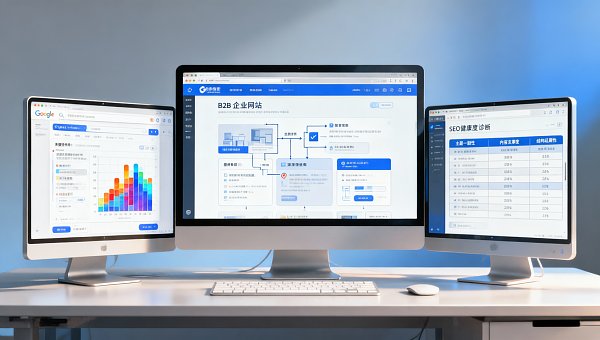
If 2 “risk signals” appear among the 3 items, it is recommended to split the page immediately. The SEO health diagnosis module built into E-Marketing Tech’s cloud intelligent website building system can automatically identify such structural hidden risks and recommend the optimal split path.
When SEO Long-Tail Keyword Mapping Hits a Traffic Bottleneck, What Else Can Fill the Gap?
Pure organic traffic growth has a cyclical ceiling, especially during new product promotion, regional expansion, or peak season sprint stages. At this time, precise supplementation from paid channels becomes particularly critical. Taking Facebook advertising promotion as an example, in actual applications for cross-border e-commerce and B2B companies, its Re-Marketing technology can retarget visitors who browsed the “stainless steel flange technical parameter page” but did not make an inquiry, and combined with homepage Premium Ads to quickly ignite high-intent traffic, reducing the overall customer acquisition cost by 37% and achieving an advertising return on spend of 1:8.3. This dual-track synergy of “SEO lays the foundation, advertising drives conversion” is exactly the core logic of E-Marketing Tech’s full-chain solution.
It is worth noting that high-quality creatives and landing page experience for Facebook ads rely heavily on the understanding of user intent accumulated through earlier SEO efforts. Those long-tail keywords that have already been validated in Google organic search are precisely the most efficient source of advertising targeting tags—the two are not a substitute relationship, but a relationship of mutual calibration and mutual reinforcement.
Next Step, You Can Start Optimizing Like This
There is no need to tear everything down and start over. It is recommended to begin with the current TOP20 organic traffic pages and scan them one by one using the above three-dimensional checklist; mark pages with more than 2 risk signals, and prioritize splitting them into a three-layer structure of “core service page + segmented scenario page + resource download page”; at the same time, import the high-value long-tail keywords released after the split into the audience package building process of Facebook advertising promotion to form a positive cycle of traffic acquisition. E-Marketing Tech’s AI+SEO/GEO optimization system supports one-click generation of page carrying capacity diagnostic reports, and automatically outputs structural optimization suggestions and cross-channel keyword reuse plans.
Related Articles


Related Products
 EasyCamp SaaS Smart Website Marketing SystemE-Yingbao SaaS Smart Website Marketing System: AI-powered, zero-code website building. Rapidly launch multilingual independent e-commerce sites in just 10 minutes. Global server acceleration and AI-driven SEO optimization empower businesses to efficiently connect with global markets. The seamless integration of technology and user-friendly operation makes building e-commerce sites incredibly simple.
 AI+SEM Intelligent Advertising Marketing SystemAI+SEM drives intelligent ad creation, empowering full-funnel precision advertising marketing. The system automatically generates weekly/monthly reports, AI recommends keywords and target countries, monitors core metrics in real-time with intelligent alerts, and enables one-click high-conversion ad solutions to help quickly acquire customers and improve ROI.
 AI+SEO Dual Engine Optimization ServiceEasyWin AI+SEO Dual Engine Optimization System leverages AI-powered keyword mining, content generation, and comprehensive technical optimization to help foreign trade enterprises acquire high-quality organic traffic, significantly improving search rankings and conversion rates.
 AI+SNS Social Media Marketing SystemYingbao AI+SNS Social Media Marketing System - Precision social capture for the social media era. Supports one-click content synchronization across major platforms like Facebook and LinkedIn. AI intelligently rewrites posts for enhanced relevance. 24/7 AI customer service and user profiling analysis empower businesses to efficiently expand into global markets.
 AI+SEO营销解决方案易营宝AI+SEO营销解决方案,通过AI批量写作、智能生成TDK、精准关键词扩词等功能,全面优化网站SEO效果,提升流量与转化率。助力企业构建高效智能网站新生态。
 AI+SEM Advertising Marketing SolutionsAI+SEM Advertising Marketing Solution leverages AI technology to deeply empower SEM ad campaigns. It automatically generates weekly/monthly reports using AI, presenting account data across multiple dimensions for comprehensive insights into campaign performance and trends. The system precisely recommends keywords and target countries, intelligently generates high-conversion ad copy, and enables one-click activation of efficient campaign plans to help businesses rapidly acquire customers. Simultaneously, it monitors core metrics in real time, intelligently identifies abnormal fluctuations, and issues timely alerts to ensure stable, high-return advertising results.
 Domain Name ServicesEasyWin provides professional domain name services, including intelligent queries, one-stop registration, brand protection, and full lifecycle management, helping businesses build a digital brand image.
 EasyOperate B2C Cross-Border E-Commerce Platform & Independent WebsiteEasyStore B2C Cross-border E-commerce Independent Store is an intelligent website building and cross-border e-commerce integrated solution independently developed by EasyStore Information Technology (Beijing) Co., Ltd. The system is specially designed for small and medium-sized as well as large export enterprises, integrating 'website building, operation, marketing, advertising, and conversion' into one, helping enterprises quickly establish cross-border e-commerce independent stores to achieve brand globalization and global sales growth.
The platform supports multiple languages, multiple currencies, and multi-channel marketing, with built-in AI intelligent translation and SEO optimization systems, suitable for mainstream markets such as Southeast Asia, Europe and America, Latin America, and the Middle East, assisting Chinese manufacturing enterprises in efficiently deploying international e-commerce strategies. SSL证书易营宝提供专业SSL安全证书服务,包括单域名和泛域名证书,确保网站数据传输加密、身份验证和完整性保护,助力企业建立安全可信的在线业务环境。









