









- What New Signals Are Emerging in Enterprise Services SaaS Marketing ReportsJul 27, 2026View details
- What Does a Global Traffic Ecosystem Service Provider Do? What Are the Differences from a Single Advertising AgencyJul 16, 2026View details
- What should you focus on in the latest enterprise SaaS report? From renewal rates and delivery costs to overseas growth opportunitiesJul 12, 2026View details
- What signals are worth paying attention to in a cross-border marketing trend report? B2B companies should look at these 6 signalsJul 11, 2026View details
- How to Read a Cross-Border Marketing Trends Report? Five Key Dimensions for Evaluating Channel OpportunitiesJul 11, 2026View details
- Which channel has the highest ROI in the global traffic ecosystem? Comparative analysis of search, social media, and advertisingJul 10, 2026View details
How long does Google SEO optimization usually take to show results?
Many companies are concerned about how long it takes for Google SEO optimization to deliver results. In reality, the time required depends on the website foundation, industry competition, content quality, and execution strategy. Continuous optimization for 3 to 6 months is usually required before a steady improvement in rankings, traffic, and inquiries can gradually be seen.
For foreign trade companies, manufacturing factories, cross-border e-commerce sellers, and brands expanding into overseas markets, SEO is not simply a matter of publishing articles or changing titles. It is a long-term project involving website development, content planning, technical optimization, conversion paths, and data operations.
Especially under an integrated website and marketing services model, companies are concerned not only with higher rankings, but also with indexing speed, qualified traffic growth, improved inquiry quality, and whether SEO can work synergistically with advertising, social media, and multilingual websites to generate leads.
How Long Does Google SEO Optimization Take to Deliver Results? Start with 3 Key Stages
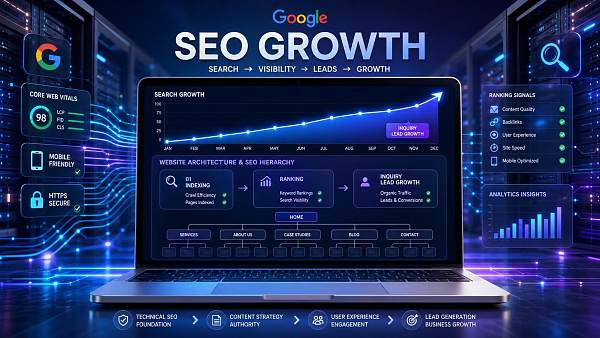
When evaluating how long Google SEO optimization takes to deliver results, companies should not focus only on whether a particular keyword reaches the first page within a few days. A more practical approach is to observe changes in indexing, rankings, traffic, and conversions across three stages: 0 to 30 days, 1 to 3 months, and 3 to 6 months.
0 to 30 Days: Technical Fixes and Indexing Initiation
During the first stage, the focus is generally not on “immediate results,” but on resolving issues related to website crawling, indexing, and loading. Typical tasks include submitting the sitemap, fixing broken links, organizing the page structure, rewriting core titles, optimizing mobile compatibility, and improving page speed.
For a new website, Google usually needs 2 to 8 weeks to establish basic trust. If an existing website is redesigned and SEO is restarted, some pages may regain indexing within 7 to 21 days, but ranking fluctuations can be significant, which is normal.
1 to 3 Months: Keyword Planning and Content Growth
Once the website’s technical foundation is stable, SEO results begin to appear through increased exposure for long-tail keywords and improved rankings for some pages. Common changes during this stage include more indexed pages, increased searches for branded terms, growing visits to inquiry pages, and more precise clicks on key product pages.
For B2B industries with moderate competition, if 4 to 8 highly relevant pieces of content are published consistently each month, while product pages, case study pages, and FAQ pages are optimized at the same time, a more noticeable rise in organic traffic can usually be seen between the 8th and 12th weeks.
3 to 6 Months: Stable Rankings and Inquiry Conversions
Most companies truly begin to feel the effects of Google SEO optimization between the 3rd and 6th months. At this stage, the key development is not only higher keyword rankings, but also more qualified visitors, a lower bounce rate, and increases in conversions such as form submissions and WhatsApp inquiries.
If industry competition is high, such as in machinery and equipment, industrial components, or cross-border consumer goods, achieving higher rankings for core commercial keywords often requires more than 6 months of continuous investment. Some highly competitive keywords may even require 9 to 12 months.
The table below can serve as a concise reference to help companies determine which stage they are currently in.
As the table shows, there is no universal answer to how long Google SEO optimization takes to deliver results. Companies need to assess performance by stage based on their website status and target markets, rather than using unrealistic goals such as “reaching the first page within 7 days” to judge project success or failure.
4 Key Factors Affecting the Time Required for SEO Results
When carrying out Google SEO optimization, some companies see an increase in inquiries after just 2 months, while others see little change after half a year. The difference often comes from four dimensions: the website foundation, industry competition, content quality, and depth of execution.
The Website Foundation Determines the Starting Speed
If the website has issues such as inaccessible pages, a disorganized structure, duplicate URLs, a poor mobile experience, or bloated code, it is difficult for SEO to deliver results quickly, even with continued content investment. For new websites and template-based websites in particular, common issues can directly slow indexing efficiency during the first 60 days.
Common Foundational Issues
- The hierarchy of the homepage, product pages, and article pages is too deep, resulting in low crawling efficiency
- Language versions are not configured correctly on multilingual websites, resulting in duplicate content
- Images are too large, causing above-the-fold loading to exceed 3 to 5 seconds
- Clear CTA buttons are missing, so traffic does not convert even after arriving at the website
Industry Competition Determines Ranking Difficulty
If a company’s target keywords are highly competitive, such as “industrial machinery supplier” or “LED display manufacturer,” competitors may already have been operating for 1 to 3 years, with stable backlinks and accumulated content. The SEO growth cycle will naturally be longer.
By contrast, if a company begins with long-tail keywords, application-related keywords, and location-based keywords, such as the more specific phrase “custom valve manufacturer in China,” it is generally easier to gain visibility within 2 to 4 months.
Content Quality Determines Whether Traffic Is Qualified
Many companies mistakenly believe that SEO is slow to deliver results because they do not have enough content. In reality, the problem is often that the content is disconnected from the purchasing decision. For B2B customers, parameter pages, application solution pages, delivery process pages, and FAQ pages often generate more qualified inquiries than general-purpose blog posts.
High-quality content generally needs to cover four types of information: product capabilities, applicable scenarios, purchasing risks, and contact details. If a piece of content contains only keywords without specifications, processes, case logic, and conversion access points, it may receive clicks but still fail to generate business opportunities.
Execution Strategy Determines Whether Results Can Be Sustained
SEO is not a one-time deliverable. Indexing status should be checked at least weekly, while keyword and traffic changes should be reviewed monthly. It is generally recommended to conduct 1 technical inspection, complete 1 content plan, and update pages 4 to 8 times each month, while continually adjusting the direction based on conversion data.
The table below can help companies identify more quickly which factors are extending the time required for Google SEO optimization to deliver results.
For most companies, the speed at which SEO delivers results is determined not by a single technique, but by whether the foundation, content, and strategy are advanced in coordination. The advantage of an integrated website and marketing services model is precisely that it connects website development, optimization, and the conversion journey instead of handling each element separately.
How Can Companies Shorten the Time Required for Google SEO Optimization to Deliver Results?
Although SEO inherently requires time to accumulate results, companies can use the right methods to bring forward the initial signals that would otherwise appear after 6 months, making it possible to see preliminary results in around 3 months, especially when launching a new website or expanding into overseas markets.
Prioritize Building an Overseas Independent Website Suitable for Promotion
If the website is built according to SEO principles from the outset, results will be achieved much faster later on. This includes clear URL rules, expandable product categories, standardized TDK settings, basic Schema configuration, a multilingual structure, and a mobile-friendly experience. These elements should all be completed during the website development stage.
Taking an integrated website and marketing services platform such as 易营宝 as an example, companies can consider indexing, loading, conversion, and multi-market promotion requirements simultaneously during the intelligent website development stage. This reduces later rework and is generally more efficient than the approach of “building the website first and adding SEO later.”
Create Content Around Inquiry Scenarios Rather Than Just Publishing Information
For B2B companies expanding overseas, the content that truly generates business opportunities is often concentrated on product pages, solution pages, industry application pages, purchasing guide pages, and FAQ pages. It is recommended to build at least five types of pages simultaneously rather than updating only a blog.
Page Types to Prioritize
- Core product pages: Highlight specifications, advantages, and delivery capabilities
- Application scenario pages: Address different industries and operating environments
- Purchasing guide pages: Answer questions about pricing, MOQ, lead times, and customization
- FAQ pages: Address search queries and expand long-tail keyword coverage
- Contact pages: Ensure that forms, email, and instant communication access points are clear
Create Synergy Between SEO, Advertising, and Social Media
When companies carry out SEO alone, they often need to wait longer for data to accumulate. By combining Google Ads, Facebook advertising, social media operations, and short-video content, companies can first validate keywords through traffic while also increasing branded searches and page engagement signals.
For multilingual overseas businesses, it is recommended to proceed in stages according to market priorities—for example, starting with an English website and then expanding to Spanish, Russian, or Japanese versions. Each additional language market requires a new assessment of keywords, local expressions, and conversion access points, rather than simply launching a machine-translated version.
SEO Implementation Paths and Service Selection Recommendations for B2B Companies
When considering how long Google SEO optimization takes to deliver results, another common question is whether to build an in-house team or work with an integrated service provider. The answer depends on the budget, team maturity, number of markets, and lead-generation objectives.
Differences Between In-House Execution and External Services
If a company already has an English content team, website technicians, and a coordination mechanism with overseas sales, it can gradually advance in-house SEO operations. However, for most manufacturing and foreign trade companies, website development, content, advertising, and data analysis are often handled separately, resulting in clear execution gaps.
The value of choosing an integrated service provider lies in combining intelligent website development, SEO optimization, advertising, social media lead generation, and data reviews into the same growth pathway. This reduces communication costs and makes it easier to address foundational issues during the first 90 days.
4 Key Dimensions to Consider When Choosing a Service Provider
- Whether it can coordinate website development and SEO, rather than only selling content or backlinks
- Whether it understands B2B overseas expansion, multilingual operations, and conversion differences across markets
- Whether it can provide monthly data reviews instead of reporting only keyword rankings
- Whether it can extend its services to advertising, social media, and AI search visibility optimization
Why Integrated Solutions Are More Suitable for Long-Term Growth
Looking at 易营宝’s business direction, its core advantage is not limited to providing Google SEO optimization. It also provides an AI-driven intelligent website development system, cross-border e-commerce platform, multilingual website development, advertising marketing system, and AI+SEO/GEO optimization system to help companies build overseas independent websites that can be promoted, indexed, and converted.
This model is particularly suitable for companies that need to cover multiple regions, including North America, Europe, Southeast Asia, Japan and South Korea, the Middle East, Russian-speaking regions, Latin America, and Africa. Search habits, content priorities, and conversion paths differ across markets, making it difficult for isolated optimization efforts to support long-term growth.
If a company wants to see the effects of Google SEO optimization sooner, the key is not to pursue short-term gimmicks, but to advance the website foundation, content structure, keyword strategy, and conversion pathway simultaneously. In general, phased improvements in rankings, traffic, and inquiries can be seen within 3 to 6 months, while highly competitive industries require more continuous optimization investment.
For foreign trade companies, manufacturing factories, cross-border sellers, and brands expanding overseas, choosing an integrated website and marketing services solution is often more reliable than fragmented execution and makes it easier to turn SEO from “having traffic” into “generating business opportunities.” If you are planning an overseas independent website, Google SEO optimization, or multi-channel overseas growth, please contact us now to obtain a customized solution better suited to your industry and target markets.
Related Articles


Related Products
 EasyCamp SaaS Smart Website Marketing SystemE-Yingbao SaaS Smart Website Marketing System: AI-powered, zero-code website building. Rapidly launch multilingual independent e-commerce sites in just 10 minutes. Global server acceleration and AI-driven SEO optimization empower businesses to efficiently connect with global markets. The seamless integration of technology and user-friendly operation makes building e-commerce sites incredibly simple.
 AI+SEM Intelligent Advertising Marketing SystemAI+SEM drives intelligent ad creation, empowering full-funnel precision advertising marketing. The system automatically generates weekly/monthly reports, AI recommends keywords and target countries, monitors core metrics in real-time with intelligent alerts, and enables one-click high-conversion ad solutions to help quickly acquire customers and improve ROI.
 AI+SEO Dual Engine Optimization ServiceEasyWin AI+SEO Dual Engine Optimization System leverages AI-powered keyword mining, content generation, and comprehensive technical optimization to help foreign trade enterprises acquire high-quality organic traffic, significantly improving search rankings and conversion rates.
 AI+SNS Social Media Marketing SystemYingbao AI+SNS Social Media Marketing System - Precision social capture for the social media era. Supports one-click content synchronization across major platforms like Facebook and LinkedIn. AI intelligently rewrites posts for enhanced relevance. 24/7 AI customer service and user profiling analysis empower businesses to efficiently expand into global markets.
 AI+SEO营销解决方案易营宝AI+SEO营销解决方案,通过AI批量写作、智能生成TDK、精准关键词扩词等功能,全面优化网站SEO效果,提升流量与转化率。助力企业构建高效智能网站新生态。
 AI+SEM Advertising Marketing SolutionsAI+SEM Advertising Marketing Solution leverages AI technology to deeply empower SEM ad campaigns. It automatically generates weekly/monthly reports using AI, presenting account data across multiple dimensions for comprehensive insights into campaign performance and trends. The system precisely recommends keywords and target countries, intelligently generates high-conversion ad copy, and enables one-click activation of efficient campaign plans to help businesses rapidly acquire customers. Simultaneously, it monitors core metrics in real time, intelligently identifies abnormal fluctuations, and issues timely alerts to ensure stable, high-return advertising results.
 Domain Name ServicesEasyWin provides professional domain name services, including intelligent queries, one-stop registration, brand protection, and full lifecycle management, helping businesses build a digital brand image.
 EasyOperate B2C Cross-Border E-Commerce Platform & Independent WebsiteEasyStore B2C Cross-border E-commerce Independent Store is an intelligent website building and cross-border e-commerce integrated solution independently developed by EasyStore Information Technology (Beijing) Co., Ltd. The system is specially designed for small and medium-sized as well as large export enterprises, integrating 'website building, operation, marketing, advertising, and conversion' into one, helping enterprises quickly establish cross-border e-commerce independent stores to achieve brand globalization and global sales growth.
The platform supports multiple languages, multiple currencies, and multi-channel marketing, with built-in AI intelligent translation and SEO optimization systems, suitable for mainstream markets such as Southeast Asia, Europe and America, Latin America, and the Middle East, assisting Chinese manufacturing enterprises in efficiently deploying international e-commerce strategies. SSL证书易营宝提供专业SSL安全证书服务,包括单域名和泛域名证书,确保网站数据传输加密、身份验证和完整性保护,助力企业建立安全可信的在线业务环境。









