









- Can Zhejiang foreign trade independent websites still be developed today? Look at changes in traffic and lead generationJul 28, 2026View details
- What New Signals Are Emerging in Enterprise Services SaaS Marketing ReportsJul 27, 2026View details
- What Does a Global Traffic Ecosystem Service Provider Do? What Are the Differences from a Single Advertising AgencyJul 16, 2026View details
- What should you focus on in the latest enterprise SaaS report? From renewal rates and delivery costs to overseas growth opportunitiesJul 12, 2026View details
- What signals are worth paying attention to in a cross-border marketing trend report? B2B companies should look at these 6 signalsJul 11, 2026View details
- How to Read a Cross-Border Marketing Trends Report? Five Key Dimensions for Evaluating Channel OpportunitiesJul 11, 2026View details
How to Implement SEO Content Localization More Reliably
When pursuing overseas growth, SEO content localization should not stop at translation. A truly reliable approach must take search habits, cultural context, and conversion objectives into account so that content can be indexed more easily and generate more leads.
For foreign trade companies, manufacturing plants, cross-border e-commerce brands, and overseas expansion service providers, launching a multilingual site is only the first step. What really affects the quality of organic traffic is often whether the content matches local users’ search terms, decision-making paths, and trust-building methods.
In an integrated website and marketing service scenario, SEO content localization should be designed in coordination with website structure, page conversion, advertising landing pages, and data tracking. This helps avoid common problems such as having no rankings, slow indexing, and few inquiries even three months after content goes live.
Why SEO Content Localization Cannot Rely on Literal Translation Alone
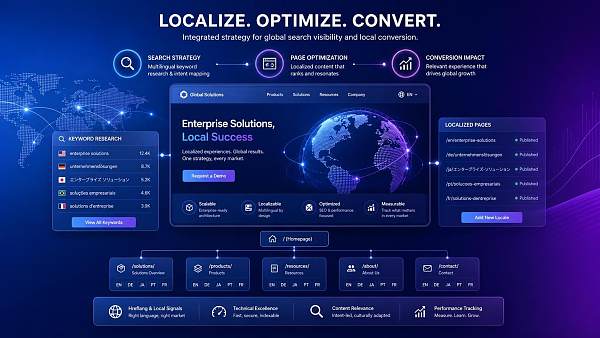
When entering the North American, European, or Southeast Asian markets, many companies typically start by translating Chinese materials into English and other languages, then publishing them in bulk on their official websites. On the surface, this may make it possible to publish 20 pieces of content within 1 week, but that does not mean the site has local search competitiveness.
The reason is that people in different countries do not use the same search expressions for the same product. For example, B2B procurement users are more likely to search for specifications, certifications, MOQ, lead times, and application industries rather than general brand introductions. If the content continues to follow domestic writing logic, both rankings and conversions will usually be weak.
Search Language, Usage Language, and Sales Language Are Not Exactly the Same
The first step in a reliable SEO content localization process is not writing articles, but analyzing user language. It can generally be divided into three levels: search terms, reading terms, and inquiry terms. The first determines whether users can find the content, while the latter two determine whether the content can build trust and drive conversions.
- Search terms: Usually short, scenario-based, or question-based terms, generally consisting of 2–5 words.
- Reading terms: Explanatory language that needs to balance professional terminology with ease of understanding.
- Inquiry terms: Commercial expressions such as quotations, samples, delivery schedules, and after-sales coverage.
4 Types of Risks Most Easily Caused by Literal Translation
If the original Chinese content is simply translated into the target language, four types of problems usually arise: keyword mismatch, inappropriate tone, unsuitable page structure, and broken conversion paths. These problems are often clearly amplified by traffic data 30–90 days after launch.
The table below is suitable for basic checks before content goes live, helping companies determine whether localization has achieved mere “translation” or actual “growth readiness.”
In terms of execution results, the differences in SEO content localization are reflected not only at the language level, but also in whether the content is structured around three key points: search arrival, time spent on the page, and lead submission.
What Process Should a Reliable SEO Content Localization Method Follow?
For most companies expanding overseas, a more reliable approach is not to publish 100 articles at once, but to establish a content framework over 4–6 weeks and then iterate in batches. This helps control language quality while making it easier to optimize direction based on indexing, rankings, and inquiry data.
Step 1: Define the Target Country and Page Type Before Selecting Keywords
Even within English-speaking markets, the search environments in the United States, the United Kingdom, Singapore, and the English-speaking markets of the Middle East are not the same. It is recommended to first define the target market and then classify page types, which generally include product pages, solution pages, industry pages, blog pages, and landing pages.
Keyword Layering Recommendations
- Core keywords: Correspond to the main products or core services, with 10–20 groups per site as a guideline.
- Scenario keywords: Expand around industries, materials, applications, regions, and procurement needs, developing 30–50 groups.
- Question keywords: Build FAQ entry points around pricing, certifications, lead times, installation, and maintenance.
Step 2: Establish Localized Content Templates Instead of Writing Each Article Randomly
Content templates can significantly reduce the cost of cross-team collaboration. For integrated website and marketing service projects, it is recommended that each page type contain at least six fixed modules: title, summary, selling points, technical specifications, application scenarios, and conversion action. This helps prevent uncontrolled content style and information density.
For a B2B independent website, a single piece of content is generally recommended to be controlled within 800–1,500 words in the target language. The first 100–150 words should clearly explain the product value, followed by specifications, applicable industries, delivery methods, and frequently asked questions in the main text. This better matches procurement-oriented search needs.
Step 3: Align Content Production with Website Structure
Many companies produce a considerable amount of content, yet search engines have difficulty understanding their site structure because of disorganized URLs, incorrect switching between language versions, and unclear page aggregation. A reliable SEO content localization method must be planned together with the website architecture.
- Keep page directories consistent within the same language and reduce duplicate paths.
- Link product pages and blog pages to each other, with 3–5 relevant links recommended for each article.
- Clearly distinguish country sites from language sites to prevent one page from serving multiple market objectives at the same time.
The table below is more suitable for companies to use during implementation to arrange the key steps and timelines from website development to content launch.
From a project management perspective, this phased approach is more suitable for controlling budgets and validating results. Developing high-value pages first and then expanding into long-tail content is generally more reliable than carrying out large-scale translation all at once, and it also makes ROI evaluation easier.
Content Localization Priorities Differ Across Overseas Business Models
There is no single template for SEO content localization. B2B factory websites, cross-border brand websites, advertising landing pages, and multilingual official websites have different objectives, so their content priorities naturally differ. If the same writing approach is applied to all pages, conversion rates are often diluted.
B2B Foreign Trade Marketing Websites: Focus on Decision-Making Information and Inquiry Thresholds
B2B procurement users typically submit an inquiry only after 2–3 visits. Therefore, page content should answer questions such as “Can it be produced?”, “How will it be delivered?”, “How long will shipment take?”, and “Does it meet industry requirements?” Compared with brand stories, specifications, production capacity, and application cases are more important.
Content Modules Recommended for Priority Completion
- Specifications and customization scope
- MOQ, sample policy, and delivery schedule
- Applicable industries and export experience by region
- Frequently asked questions and pre-sales communication channels
B2C Cross-Border E-Commerce Stores: Focus on Category Keyword Coverage and a Smooth Purchase Journey
For B2C independent websites, content should not focus only on blogs. It should also cover category pages, collection pages, product Q&A, and buying guides. As a general recommendation, each primary category should include at least one buying guide page and 3–5 related FAQ pages to improve the combined effectiveness of indexing and conversion.
Official Brand Websites Expanding Overseas: Focus on Awareness Building and Multichannel Engagement
When an official website serves SEO, advertising, and social media traffic at the same time, content localization must also consider consistency across channels. Advertising landing pages should emphasize communicating value within 60 seconds, while SEO pages are more suitable for capturing mid- and long-tail searches. Their tone, structure, and CTAs should be designed separately.
How to Determine Whether Localized Content Is Truly Effective
After content goes live, evaluation should not focus only on whether publication has been completed. A more practical approach is to observe data changes at 30-, 60-, and 90-day milestones. For a new site, indexing and keyword volume should be the focus during the first 60 days, followed by inquiries and conversion-assistance data after 90 days.
6 Core Metrics Recommended for Tracking
- Number of indexed pages and the proportion of valid indexed pages
- Number of keywords from target countries ranking in the top 50
- Distribution of landing pages receiving organic traffic
- Average time on page and bounce-rate trends
- Number of inquiry form submissions and valid lead rate
- Click-through conversion path from content pages to product pages
Common Misjudgments
Some companies conclude that their SEO content localization method is ineffective if they do not receive significant inquiries within one month. In reality, organic growth for multilingual content usually requires an observation window of 8–12 weeks. This is especially true for new domains, new markets, and specialized B2B industries, where the ramp-up period is longer.
More importantly, it is necessary to distinguish between “no traffic” and “inaccurate traffic.” The former is usually related to keyword selection and indexing, while the latter often results from a mismatch between content intent and page conversion design. The optimization directions for these two problems are completely different and should not be confused.
What Capabilities Should Companies Focus on When Selecting a Service Provider?
When a company lacks a multilingual operations team, choosing a partner with integrated website and marketing service capabilities is generally more efficient in terms of communication. The effectiveness of content localization depends not only on writing quality, but also on the website system, data tracking, advertising coordination, and the efficiency of ongoing optimization.
4 Practical Evaluation Criteria
- Can it handle multilingual website development, SEO content, conversion page optimization, and data monitoring at the same time?
- Does it understand the different content structures and inquiry logic of B2B and B2C?
- Can it develop content strategies by country and market rather than applying a single template universally?
- Can it continue iterating instead of providing a one-time delivery with no follow-up optimization?
Taking an AI-driven enterprise SaaS intelligent website-building and overseas marketing platform such as EasyYingbao as an example, its advantage lies in coordinating multilingual website development, Google SEO optimization, advertising, social media operations, and AI+SEO/GEO optimization to reduce gaps between content, technology, and marketing.
For companies whose target markets cover North America, Europe, Southeast Asia, Japan and South Korea, the Middle East, Russian-speaking regions, Latin America, and Africa, this integrated model is more suitable for long-term growth. It is particularly effective when companies need to quickly build overseas independent websites, expand pages by language, and acquire organic traffic and advertising leads at the same time.
Reliable SEO content localization is not about merely “translating content,” but about incorporating search needs, page structure, business language, and conversion paths into the content. Only by integrating keyword research, website architecture, local expression, content templates, and data-driven iteration into one process can content assets continue to accumulate value.
If you are planning a multilingual official website, B2B foreign trade marketing website, cross-border e-commerce store, or overseas independent website, and hope to turn your SEO content localization method into an actionable solution, contact us now to obtain customized growth solutions and implementation recommendations better suited to your target market.
Related Articles
Related Products
 EasyCamp SaaS Smart Website Marketing SystemE-Yingbao SaaS Smart Website Marketing System: AI-powered, zero-code website building. Rapidly launch multilingual independent e-commerce sites in just 10 minutes. Global server acceleration and AI-driven SEO optimization empower businesses to efficiently connect with global markets. The seamless integration of technology and user-friendly operation makes building e-commerce sites incredibly simple.
 AI+SEM Intelligent Advertising Marketing SystemAI+SEM drives intelligent ad creation, empowering full-funnel precision advertising marketing. The system automatically generates weekly/monthly reports, AI recommends keywords and target countries, monitors core metrics in real-time with intelligent alerts, and enables one-click high-conversion ad solutions to help quickly acquire customers and improve ROI.
 AI+SEO Dual Engine Optimization ServiceEasyWin AI+SEO Dual Engine Optimization System leverages AI-powered keyword mining, content generation, and comprehensive technical optimization to help foreign trade enterprises acquire high-quality organic traffic, significantly improving search rankings and conversion rates.
 AI+SNS Social Media Marketing SystemYingbao AI+SNS Social Media Marketing System - Precision social capture for the social media era. Supports one-click content synchronization across major platforms like Facebook and LinkedIn. AI intelligently rewrites posts for enhanced relevance. 24/7 AI customer service and user profiling analysis empower businesses to efficiently expand into global markets.
 AI+SEO营销解决方案易营宝AI+SEO营销解决方案,通过AI批量写作、智能生成TDK、精准关键词扩词等功能,全面优化网站SEO效果,提升流量与转化率。助力企业构建高效智能网站新生态。
 AI+SEM Advertising Marketing SolutionsAI+SEM Advertising Marketing Solution leverages AI technology to deeply empower SEM ad campaigns. It automatically generates weekly/monthly reports using AI, presenting account data across multiple dimensions for comprehensive insights into campaign performance and trends. The system precisely recommends keywords and target countries, intelligently generates high-conversion ad copy, and enables one-click activation of efficient campaign plans to help businesses rapidly acquire customers. Simultaneously, it monitors core metrics in real time, intelligently identifies abnormal fluctuations, and issues timely alerts to ensure stable, high-return advertising results.
 Domain Name ServicesEasyWin provides professional domain name services, including intelligent queries, one-stop registration, brand protection, and full lifecycle management, helping businesses build a digital brand image.
 EasyOperate B2C Cross-Border E-Commerce Platform & Independent WebsiteEasyStore B2C Cross-border E-commerce Independent Store is an intelligent website building and cross-border e-commerce integrated solution independently developed by EasyStore Information Technology (Beijing) Co., Ltd. The system is specially designed for small and medium-sized as well as large export enterprises, integrating 'website building, operation, marketing, advertising, and conversion' into one, helping enterprises quickly establish cross-border e-commerce independent stores to achieve brand globalization and global sales growth.
The platform supports multiple languages, multiple currencies, and multi-channel marketing, with built-in AI intelligent translation and SEO optimization systems, suitable for mainstream markets such as Southeast Asia, Europe and America, Latin America, and the Middle East, assisting Chinese manufacturing enterprises in efficiently deploying international e-commerce strategies. SSL证书易营宝提供专业SSL安全证书服务,包括单域名和泛域名证书,确保网站数据传输加密、身份验证和完整性保护,助力企业建立安全可信的在线业务环境。









