









- Can Zhejiang foreign trade independent websites still be developed today? Look at changes in traffic and lead generationJul 28, 2026View details
- What New Signals Are Emerging in Enterprise Services SaaS Marketing ReportsJul 27, 2026View details
- What Does a Global Traffic Ecosystem Service Provider Do? What Are the Differences from a Single Advertising AgencyJul 16, 2026View details
- What should you focus on in the latest enterprise SaaS report? From renewal rates and delivery costs to overseas growth opportunitiesJul 12, 2026View details
- What signals are worth paying attention to in a cross-border marketing trend report? B2B companies should look at these 6 signalsJul 11, 2026View details
- How to Read a Cross-Border Marketing Trends Report? Five Key Dimensions for Evaluating Channel OpportunitiesJul 11, 2026View details
What Are the 3 Localization Issues to Address First When Building an Overseas Standalone Website for the German Market?
What Are the 3 Localization Issues to Address First When Building an Overseas Independent Website for the German Market
When building an overseas independent website for the German market, do not rush to launch. For project managers, the three localization issues of language and compliance, payment and logistics, and trust and conversion mechanisms often determine whether the project can truly be implemented and continue generating leads.
When many teams build a German website, their most common mistake is not that the technology cannot be implemented, but that they treat “translating into German” as localization and “making the website accessible” as being able to run campaigns, generate leads, and close deals. For those responsible for driving the project forward in particular, missing one decision at the early stage may result in repeated rework involving legal affairs, customer service, advertising reviews, and returns processing. The checklist below is not an encyclopedia-style explanation, but a set of troubleshooting recommendations organized according to the actual implementation sequence.
I. Start with the language—not just German translation, but whether the entire information presentation “feels like a German website”
The most important question to ask at the beginning of a project is not “Do we need a German version?” but “After viewing the core pages, will German customers feel that this website is reliable?” These are very different things.
German users are generally more sensitive to information accuracy, structural clarity, and completeness of terms and conditions. Many Chinese teams are accustomed to filling the homepage with content, selling points, and buttons. However, the German market places greater emphasis on logical order: who you are, what you sell, applicable scenarios, technical parameters, delivery methods, after-sales service, and the boundaries of responsibilities. If the content looks like an advertising landing page, the number of inquiries may not increase, while the bounce rate may rise first.
- Check whether the product pages retain key specifications, materials, certifications, applicable standards, and other original information, rather than leaving only marketing copy.
- Check whether the German content has been handled by someone familiar with business scenarios, instead of being published directly after machine translation. Headings, buttons, form prompts, and after-sales explanations are most likely to reveal an unnatural translation style.
- Check whether contact information is presented in a localized manner, including the country calling code, response time, and support methods. German customers care greatly about “what will happen after I make contact.”
- Check whether there is a complete company information page. Merely having an “About Us” page is far from sufficient; the company name, address, email, responsible entity, and other information should be clearly visible.
There is another frequently underestimated issue: legal texts and commercial texts should not be handled in the same way. For privacy policies, Cookie consent, return instructions, terms of service, and invoice explanations, it is not enough to simply “have them”; you must confirm that their content matches the actual business. Germany and the European Union have relatively high requirements concerning privacy and users’ right to be informed. Before launch, it is recommended that GDPR-related pages, Cookie management mechanisms, and form authorization statements be reviewed by someone familiar with local compliance requirements. If there is no legal support for determining the specific wording and scope of application, it is better to mark the content as 【To be verified】 than to assemble a template based on assumptions.
Teams operating B2B websites should take one more step: if the target customers are engineering purchasers, equipment integrators, or technical managers, they usually will not submit an inquiry simply because the page has an “advanced design.” Instead, they care more about whether materials can be downloaded conveniently, whether parameters are clear, and whether they can quickly determine whether you can undertake the project. In this case, the task of German content is not to look elegant, but to reduce the cost of making a decision.
II. Payment and logistics: do not wait until traffic arrives to address them
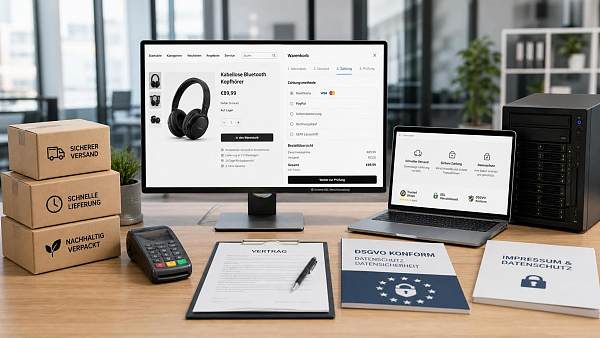
For a B2C cross-border e-commerce store, payment preferences in the German market follow a completely different logic from those in China. During project implementation, payment methods are not a minor issue within the checkout module, but a core configuration that directly affects the conversion rate, cart abandonment rate, and complaint rate.
German consumers are highly sensitive to payment security, billing transparency, and refund procedures. Credit cards can certainly be used, but that does not mean they are sufficient. Whether PayPal, invoice payments, or other locally common methods need to be integrated should be determined based on your product category, average order value, platform capabilities, and risk-control requirements. The countries supported, settlement cycles, and chargeback handling rules of different payment service providers vary. Do not rely solely on sales presentations; it is best to test the backend settlement process, refund process, and dispute-handling process from beginning to end.
In logistics, many teams mistakenly regard “being able to ship to Germany” as the completion criterion. In practice, you need to consider where the goods are shipped from, how customs-clearance responsibilities are divided, whether tax information is provided in advance, whether users can track their parcels, and whether there is a European return collection point. This is especially important when selling products that are bulky, have a high average order value, or involve complex after-sales service, such as home furnishings, equipment accessories, and industrial components. A poor logistics experience does not merely lead to a single negative review; it can undermine trust in the entire independent website.
For a B2B inquiry-based website, although online payment may not be required, delivery information must not be overlooked. German purchasing departments usually ask very detailed questions: How is the delivery time calculated? Are samples charged? Who bears the shipping costs? Which Incoterms are supported? Are technical documents provided? If the website does not answer these questions at all, sales staff will be forced to explain them repeatedly, resulting in low efficiency and reduced lead quality.
III. Trust and conversion mechanisms: put them in place before launch
The German market is not impossible to convert; rather, visitors must pass the “credibility” test before converting. Many overseas independent website projects targeting Germany fail not because there is no traffic, but because the pages do not present sufficient evidence of trust.
First, check the basics: Is HTTPS enabled across the entire website? Are privacy and Cookie settings clearly presented? Are return and exchange policies and contact information complete? Is verifiable information about the company entity provided? These may seem basic, but both German users and advertising platforms will examine them. Particularly when using Google SEO, Google advertising, or remarketing, missing compliance and credibility pages often affect review and conversion first, followed by the accumulation of organic traffic.
The next step is to prove that “you truly have the ability to deliver.” This is particularly important for engineering project managers, because they are not dealing with broad, undifferentiated traffic, but with customers who are more rational and more likely to compare alternatives.
- Place certificates, test reports, and standards compliance information in appropriate positions, provided that the materials are genuine and applicable to the German or EU market; if uncertain, do not overstate them.
- If customer cases do not have explicit authorization, avoid presenting them too extensively. You can instead describe the application scenarios, project types, and ways in which problems were solved.
- Technical document downloads, frequently asked questions, and delivery process diagrams are often more convincing than a statement such as “years of experience.”
- Do not include too many form fields. German users are willing to provide information, provided that the fields are necessary and their purpose is clear.
Some teams ask whether the homepage should include a large number of conversion buttons. In practice, more is not always better. The key is to enable visitors at different stages to find their next step. First-time visitors may need to view materials, check parameters, and assess delivery capabilities; visitors who already have a clear need may directly submit an inquiry, schedule a discussion, or request a quotation. An overly single conversion path is equivalent to forcing everyone to take the same route.
This is also why, when building a German website today, you cannot look only at whether “website development is complete”; you must also assess whether the website is ready for subsequent promotion. The value of an integrated website and marketing service platform such as 易营宝 usually lies not only in building the pages, but also in connecting multilingual content, SEO fundamentals, advertising landing pages, form tracking, data tagging, and interfaces for subsequent optimization. For project managers, this can directly reduce rework across teams, making it especially suitable for overseas expansion projects that need to advance website development, lead generation, and market validation at the same time.
Before launch, it is recommended that you go through this concise checklist once more
- Have the German pages been reviewed by someone who understands the business, especially the navigation, buttons, forms, terms, and product parameters?
- Are the company entity information, privacy policy, Cookie mechanism, and contact page complete and clearly visible?
- Are the payment, taxes, refunds, and delivery explanations consistent with actual fulfillment capabilities?
- Have mobile ordering, form submission, material downloads, and data-tagging tracking all been tested in practice?
- Are the SEO fundamentals complete, including page titles, descriptions, German URL logic, internal site structure, and indexing preparation?
- Are certificates, standards, customer cases, and after-sales commitments genuine, verifiable, and free from overstatement?
If there are still obvious gaps in these areas, it is recommended not to rush into allocating the entire budget to traffic acquisition. The requirements for building an overseas independent website for the German market are not about whether the page looks like an international website, but whether you can withstand scrutiny once users take a close look. Teams whose projects proceed smoothly are often not those that work the fastest, but those that have addressed the key localization points thoroughly before launch.
Related Articles
Related Products
 EasyCamp SaaS Smart Website Marketing SystemE-Yingbao SaaS Smart Website Marketing System: AI-powered, zero-code website building. Rapidly launch multilingual independent e-commerce sites in just 10 minutes. Global server acceleration and AI-driven SEO optimization empower businesses to efficiently connect with global markets. The seamless integration of technology and user-friendly operation makes building e-commerce sites incredibly simple.
 AI+SEM Intelligent Advertising Marketing SystemAI+SEM drives intelligent ad creation, empowering full-funnel precision advertising marketing. The system automatically generates weekly/monthly reports, AI recommends keywords and target countries, monitors core metrics in real-time with intelligent alerts, and enables one-click high-conversion ad solutions to help quickly acquire customers and improve ROI.
 AI+SEO Dual Engine Optimization ServiceEasyWin AI+SEO Dual Engine Optimization System leverages AI-powered keyword mining, content generation, and comprehensive technical optimization to help foreign trade enterprises acquire high-quality organic traffic, significantly improving search rankings and conversion rates.
 AI+SNS Social Media Marketing SystemYingbao AI+SNS Social Media Marketing System - Precision social capture for the social media era. Supports one-click content synchronization across major platforms like Facebook and LinkedIn. AI intelligently rewrites posts for enhanced relevance. 24/7 AI customer service and user profiling analysis empower businesses to efficiently expand into global markets.
 AI+SEO营销解决方案易营宝AI+SEO营销解决方案,通过AI批量写作、智能生成TDK、精准关键词扩词等功能,全面优化网站SEO效果,提升流量与转化率。助力企业构建高效智能网站新生态。
 AI+SEM Advertising Marketing SolutionsAI+SEM Advertising Marketing Solution leverages AI technology to deeply empower SEM ad campaigns. It automatically generates weekly/monthly reports using AI, presenting account data across multiple dimensions for comprehensive insights into campaign performance and trends. The system precisely recommends keywords and target countries, intelligently generates high-conversion ad copy, and enables one-click activation of efficient campaign plans to help businesses rapidly acquire customers. Simultaneously, it monitors core metrics in real time, intelligently identifies abnormal fluctuations, and issues timely alerts to ensure stable, high-return advertising results.
 Domain Name ServicesEasyWin provides professional domain name services, including intelligent queries, one-stop registration, brand protection, and full lifecycle management, helping businesses build a digital brand image.
 EasyOperate B2C Cross-Border E-Commerce Platform & Independent WebsiteEasyStore B2C Cross-border E-commerce Independent Store is an intelligent website building and cross-border e-commerce integrated solution independently developed by EasyStore Information Technology (Beijing) Co., Ltd. The system is specially designed for small and medium-sized as well as large export enterprises, integrating 'website building, operation, marketing, advertising, and conversion' into one, helping enterprises quickly establish cross-border e-commerce independent stores to achieve brand globalization and global sales growth.
The platform supports multiple languages, multiple currencies, and multi-channel marketing, with built-in AI intelligent translation and SEO optimization systems, suitable for mainstream markets such as Southeast Asia, Europe and America, Latin America, and the Middle East, assisting Chinese manufacturing enterprises in efficiently deploying international e-commerce strategies. SSL证书易营宝提供专业SSL安全证书服务,包括单域名和泛域名证书,确保网站数据传输加密、身份验证和完整性保护,助力企业建立安全可信的在线业务环境。









