









- China-Morocco zero-tariff access, a breakthrough in the cost of Moroccan goods exports to ChinaJun 11, 2026View details
- What signal should be released for the suspension of exports to JapanJun 10, 2026View details
- China's May LNG imports rebounded, with increased volumes from Russia and Canada filling the Middle East supply gapJun 10, 2026View details
- Will GEO change its SEO strategy?Jun 04, 2026View details
- What types of businesses are end-to-end solutions suitable for?Jun 03, 2026View details
- 2026 Global Growth Channel TrendsJun 02, 2026View details
How should the Google Ads budget be allocated? Search, display, and remarketing strategy
Why Can’t You Rely on Search Alone for Google Ads Budget Allocation
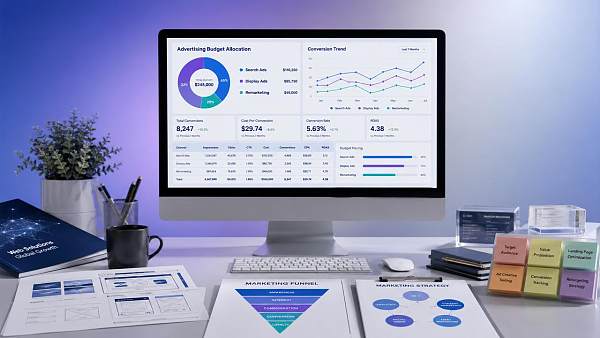
How should a Google Ads budget be allocated? On the surface, it seems to be just a matter of spending proportionally, but in reality it affects lead quality, conversion efficiency, and the rhythm of follow-up deals. Many companies start by investing only in search, because it feels more direct and makes it easier to see inquiries.
However, from actual results, simply putting the budget into search is not necessarily the most stable approach. The reason is simple: search ads are responsible for capturing active demand, display ads are responsible for expanding awareness, and remarketing is responsible for bringing hesitant customers back.
These three do not replace one another; instead, they correspond to different stages of the purchasing journey. When the budget is allocated properly, Google Ads will be more like a funnel system, rather than a series of isolated bidding actions.
Especially in a website + marketing service integrated scenario, ad performance is often determined not only by the bid, but also by the website’s lead-handling capability, landing page structure, form design, and subsequent data feedback. In other words, budget allocation cannot be calculated independently; it must be viewed within the overall customer acquisition path.
Start with the Goal, Then Define the Google Ads Budget Framework
Before allocating the budget, do not rush to ask how much to spend; first ask what the goal is. Is it to get inquiries as quickly as possible, to conduct market testing first, or to lower the cost per lead. Different goals require completely different Google Ads budget structures.
If the business is still in the early launch stage, the focus is usually not to pursue the lowest cost immediately, but to first generate valid data. For example, which keywords can bring real inquiries, which countries have higher conversion rates, and which pages are more likely to drive submissions.
If there is already a stable conversion history, then the budget should shift from a “testing logic” to a “scaling logic”. At this stage, more attention should be paid to return on ad spend, lead efficiency, and whether the campaign has the capacity for continuous scaling.
- Early launch stage: first ensure there is data to analyze.
- Scaling stage: focus on controlling conversion cost fluctuations.
- Mature stage: pursue stable structure and long-term growth.
This is also something many companies easily overlook when running Google Ads. Budget is not a flat split; it should be dynamically adjusted according to the business stage.
Search Ads Budget: Responsible for Capturing High-Intent Demand
In most industries, search ads remain the core of Google Ads. The reason is straightforward: users are already searching, which means the demand is clearer and conversion intent is usually stronger.
If the current stage places more emphasis on valid inquiries, the budget should first tilt toward search ads. A relatively stable approach is to allocate 50% to 70% of the budget to search, in order to secure high-intent traffic first.
However, search ads are also the most likely to encounter two problems. First, keyword coverage is too broad, bringing many invalid clicks. Second, only click cost is considered, while the conversion path is ignored, resulting in plenty of traffic but few inquiries.
A more practical approach is to break down the search budget further. Build separate campaigns for brand terms, product terms, scenario terms, and competitor terms, and evaluate cost and conversion separately. Only then can you tell exactly where the money is being spent.
- Brand term budget is controllable and can be used to capture existing awareness traffic.
- Product term conversion is more direct and suitable for heavier investment.
- Scenario terms have incremental value, but strict keyword filtering is required.
- Competitor terms can be tested, but they should not be heavily budgeted in the early stage.
If the website’s landing page is not mature enough, the investment in search ads also needs to be moderately restrained. Once high-intent traffic cannot be retained by the landing page, the more expensive the clicks, the more obvious the waste becomes.
Display Ads Budget Is Not Optional
Many companies have a bias toward display ads and feel that clicks are cheap but not accurate. This judgment is not wrong, but it is incomplete. The main task of display ads is not direct harvesting, but to establish touchpoints and awareness in advance.
Especially when the product decision cycle is long, or the customer order value is high, the probability that a user will convert immediately after the first touchpoint is not high. In this case, display ads can help Google Ads keep potential customers within sight.
Usually, 10% to 25% of the budget can be set aside for display testing. The key is that the targeting strategy must be clear, such as screening by country, industry interest, topic content, or custom audiences, rather than large-scale placement.
In actual business, display ads are more suitable for three tasks: new product exposure, target market warming, and search traffic supplementation. They are not a replacement for search, but a foundation for subsequent search and remarketing.
If a company is simultaneously advancing its official website upgrade, content development, or overseas brand layout, then the value of display ads becomes even more obvious. Integrated services like Yiyingbao, which combine intelligent website building, SEO optimization, and ad placement, are often more suitable for incorporating display ads into the overall strategy rather than viewing click data in isolation.
Remarketing Budget Is Often the Key to Lower Cost and Higher Efficiency
If search ads are about capturing demand, then remarketing is about following up on opportunities. Many visitors do not submit a form immediately when they first visit a website, but that does not mean they have no intent.
The value of remarketing lies in reaching again the people who have already visited the website, viewed pages, or clicked on products. Compared with cold traffic, it has higher familiarity and usually lower conversion cost.
For most companies, allocating 15% to 25% of the budget to remarketing is usually more stable than blindly increasing cold traffic spend. Especially when search click costs keep rising, remarketing can noticeably relieve customer acquisition cost pressure.
There is a very realistic prerequisite here: the website must first have good data capture points and audience segmentation. For example, people who have visited quotation pages, browsed core product pages, or stayed for a longer time are not all the same, and they should not be assigned the same bid.
From recent changes, many companies have begun to value the marketing loop more, no longer asking only whether the traffic is expensive, but paying more attention to whether waste can be reduced. This is exactly why remarketing is becoming more and more important in Google Ads.
A More Practical Budget Allocation Reference
If there is no historical data for the time being, you can start with a relatively pragmatic model. This model may not be suitable for every industry, but it has reference value for most projects driven by inquiries.
The advantage of this ratio is that it preserves the core customer acquisition capability of search while leaving enough room for testing in display and remarketing. Later, based on conversion data, the budget can be tilted toward the channels with better performance.
If the industry is highly competitive and search click costs are very high, you can also reduce search to 50% and increase remarketing to 30%. The focus of doing this is not to save money, but to improve overall budget efficiency.
When Allocating the Budget, Don’t Ignore These Hidden Costs
Many people look at Google Ads and only focus on backend ad spend. In fact, what truly affects purchasing decisions is often hidden costs. For example, invalid inquiries, landing page drop-offs, and delayed sales follow-up all consume budget value.
Also, if the website loads slowly, the multilingual page structure is confusing, or the forms are too long, both search and remarketing performance will suffer. No matter how fine-tuned the ad placement is, if the landing side does not keep up, the overall return on investment is still hard to idealize.
Therefore, when evaluating a service plan, it is worth looking one step further. In addition to asking about the account’s media buying capability, also look at the website-building capability, data analysis capability, and optimization loop capability. Separating the website from marketing often leads to coordinated losses.
This integrated thinking also appears in many digital management solutions. For example,How to Optimize Enterprise HR and Payroll Management in the Digital Economy Era such product content also emphasizes process collaboration and efficiency optimization in essence. The same applies in marketing scenarios.
How to Determine Whether Google Ads Budget Allocation Is Effective
Whether a budget plan is reasonable is not determined by a single day’s highs and lows, but by whether inquiry volume, efficiency, and deal contribution improve synchronously over a period of time.
- See whether search ads continue to bring high-intent leads.
- See whether display ads contribute to brand terms and retargeting volume.
- See whether remarketing lowers the overall conversion cost.
- See the conversion differences between different countries and pages.
- See whether there are obvious drop-off points on the website side.
If you only look at click-through rate, you will often make a wrong judgment. A more reliable approach is to look at ad data and website behavior data together, and then combine it with sales feedback to judge lead quality; only then will budget adjustments not become biased.
For companies that hope to generate overseas leads for the long term, Google Ads is not a one-time action, but a continuous optimization project. Budget allocation is also not a fixed answer, but something that is continuously fine-tuned as goals, market conditions, and data change.
To put it simply, the truly effective approach is not to split the money evenly, but to use search to capture current demand first, use display to expand potential audiences, and then use remarketing to win back hesitant customers. Combining these three makes Google Ads more likely to balance cost, conversion, and long-term growth.
Related Articles
 Brazil abolishes import tariffs on mobile power supplies, cross-border e-commerce welcomes a window of opportunity
 Pressure Relief in the Supply Chain within the Vietnam Shipbuilding Sector
 How should the Google Ads budget be allocated? The spending ratio for brand keywords, search keywords, and remarketing



Related Products
 EasyCamp SaaS Smart Website Marketing SystemE-Yingbao SaaS Smart Website Marketing System: AI-powered, zero-code website building. Rapidly launch multilingual independent e-commerce sites in just 10 minutes. Global server acceleration and AI-driven SEO optimization empower businesses to efficiently connect with global markets. The seamless integration of technology and user-friendly operation makes building e-commerce sites incredibly simple.
 AI+SEM Intelligent Advertising Marketing SystemAI+SEM drives intelligent ad creation, empowering full-funnel precision advertising marketing. The system automatically generates weekly/monthly reports, AI recommends keywords and target countries, monitors core metrics in real-time with intelligent alerts, and enables one-click high-conversion ad solutions to help quickly acquire customers and improve ROI.
 AI+SEO Dual Engine Optimization ServiceEasyWin AI+SEO Dual Engine Optimization System leverages AI-powered keyword mining, content generation, and comprehensive technical optimization to help foreign trade enterprises acquire high-quality organic traffic, significantly improving search rankings and conversion rates.
 AI+SNS Social Media Marketing SystemYingbao AI+SNS Social Media Marketing System - Precision social capture for the social media era. Supports one-click content synchronization across major platforms like Facebook and LinkedIn. AI intelligently rewrites posts for enhanced relevance. 24/7 AI customer service and user profiling analysis empower businesses to efficiently expand into global markets.
 AI+SEO营销解决方案易营宝AI+SEO营销解决方案,通过AI批量写作、智能生成TDK、精准关键词扩词等功能,全面优化网站SEO效果,提升流量与转化率。助力企业构建高效智能网站新生态。
 AI+SEM Advertising Marketing SolutionsAI+SEM Advertising Marketing Solution leverages AI technology to deeply empower SEM ad campaigns. It automatically generates weekly/monthly reports using AI, presenting account data across multiple dimensions for comprehensive insights into campaign performance and trends. The system precisely recommends keywords and target countries, intelligently generates high-conversion ad copy, and enables one-click activation of efficient campaign plans to help businesses rapidly acquire customers. Simultaneously, it monitors core metrics in real time, intelligently identifies abnormal fluctuations, and issues timely alerts to ensure stable, high-return advertising results.
 Domain Name ServicesEasyWin provides professional domain name services, including intelligent queries, one-stop registration, brand protection, and full lifecycle management, helping businesses build a digital brand image.
 EasyOperate B2C Cross-Border E-Commerce Platform & Independent WebsiteEasyStore B2C Cross-border E-commerce Independent Store is an intelligent website building and cross-border e-commerce integrated solution independently developed by EasyStore Information Technology (Beijing) Co., Ltd. The system is specially designed for small and medium-sized as well as large export enterprises, integrating 'website building, operation, marketing, advertising, and conversion' into one, helping enterprises quickly establish cross-border e-commerce independent stores to achieve brand globalization and global sales growth.
The platform supports multiple languages, multiple currencies, and multi-channel marketing, with built-in AI intelligent translation and SEO optimization systems, suitable for mainstream markets such as Southeast Asia, Europe and America, Latin America, and the Middle East, assisting Chinese manufacturing enterprises in efficiently deploying international e-commerce strategies. SSL证书易营宝提供专业SSL安全证书服务,包括单域名和泛域名证书,确保网站数据传输加密、身份验证和完整性保护,助力企业建立安全可信的在线业务环境。









