









- What Does a Global Traffic Ecosystem Service Provider Do? What Are the Differences from a Single Advertising AgencyJul 16, 2026View details
- What should you focus on in the latest enterprise SaaS report? From renewal rates and delivery costs to overseas growth opportunitiesJul 12, 2026View details
- What signals are worth paying attention to in a cross-border marketing trend report? B2B companies should look at these 6 signalsJul 11, 2026View details
- How to Read a Cross-Border Marketing Trends Report? Five Key Dimensions for Evaluating Channel OpportunitiesJul 11, 2026View details
- Which channel has the highest ROI in the global traffic ecosystem? Comparative analysis of search, social media, and advertisingJul 10, 2026View details
- What multilingual website services are available in Sanya? Which model is more suitable for local businesses going global?Jul 08, 2026View details
What Factors Should Be Considered First When Allocating a Google Search Ads Budget?
How should a Google Ads budget be allocated? It is not enough to look only at bid levels. You must first assess industry competition, keyword value, conversion goals, and campaign duration so that every dollar is spent where it can genuinely generate inquiries and growth.
For foreign trade companies, manufacturing factories, cross-border e-commerce brands, and businesses providing overseas expansion services, the question is often not whether to run Google Ads, but where to start, how much to invest, and how long it will take to see results. Especially when website development, landing pages, lead management, and data tracking have not yet been fully integrated, an unbalanced budget allocation can directly increase customer acquisition costs.
In an integrated website and marketing services scenario, budget planning should not focus on the ad account alone. It should also take into account website conversion capabilities, regional languages, product life cycles, and sales follow-up efficiency. Only by incorporating traffic acquisition and independent website lead conversion into the same growth strategy can Google Ads budget allocation more closely reflect actual returns.
Review These 4 Core Variables Before Deciding Where to Allocate Your Budget
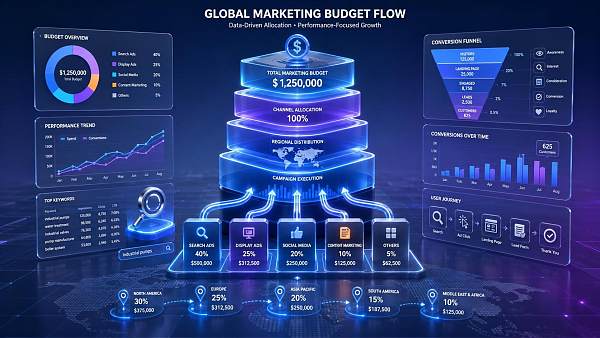
Many companies focus on cost per click from the very beginning, but this is only a surface-level metric. More importantly, industry competition intensity, the commercial value of keywords, the clarity of conversion goals, and campaign duration determine whether the budget should favor brand keywords, core keywords, or test keywords.
Industry Competition Determines the Entry-Level Budget
If your industry faces intense competition in markets such as North America and Europe, the initial Google Ads budget generally should not be set too low. For example, in fields such as B2B industrial equipment, software services, and cross-border training, the cost per click for some core keywords may range from $10 to $50. If the budget is too limited, it is difficult for the system to complete effective learning within 7 to 14 days.
This is why market maturity should be considered first when deciding how to allocate a Google Ads budget. Emerging niche industries can use a relatively small budget for testing, while mature sectors are better suited to a three-level structure of “core keyword campaigns + long-tail keyword volume expansion + remarketing conversion,” avoiding rapid budget depletion by a single high-cost keyword.
Keyword Value Is Determined by Purchase Intent, Not Traffic
High search volume does not necessarily mean high value. For foreign trade inquiry websites, terms such as “supplier,” “manufacturer,” “custom,” and “wholesale” are generally closer to purchasing intent than broad traffic keywords. When allocating the budget, it is recommended to prioritize 40% to 60% for high-intent core keywords, 20% to 30% for long-tail demand keywords, and reserve 10% to 20% for testing new keywords.
If a company is developing both a global brand and inquiry acquisition, brand keywords should also be separated into an independent campaign. Although brand keywords generally have lower click costs, they can capture highly converting traffic after search users have become familiar with the brand. When the budget is limited, they should not be mixed with generic keywords.
Common Budget Evaluation Metrics
In practical management, four metrics—cost per click, conversion rate, average order value, and sales cycle—can be used to prioritize the budget. If a keyword has a high cost per click but a conversion rate above 3% and an average order value that covers customer acquisition costs, it is still worth continued investment. Conversely, even if a keyword generates substantial traffic, spending should be controlled if its commercial value is low.
To make Google Ads budget allocation more intuitive, the table below can help companies determine budget priorities for different business objectives.
This table highlights a key conclusion: the budget should not be distributed evenly, but allocated in tiers according to commercial value. The closer a keyword or page is to a transaction, the higher priority it should receive, especially for companies whose independent websites already have basic conversion capabilities. The budget should be concentrated on high-intent entry points.
Before Allocating the Budget, Check the Website and Conversion Funnel at the Same Time
Many companies focus on how to allocate their Google Ads budget while overlooking the conversion efficiency of the landing page and website itself. Advertising is only the entry point. If the page takes more than 3 seconds to load, the form contains more than 6 fields, or the mobile experience is unstable, even a high budget may generate clicks but not inquiries.
Evaluate the Advertising Budget Together with the Website Conversion Rate
For B2B marketing websites, common effective conversion actions include submitting forms, clicking online communication tools, downloading materials, and sending emails. If the page conversion rate is below 1%, it is recommended to first optimize the page structure, trust elements, and CTA layout. If the rate can remain stable at 2% to 5%, expanding the budget is generally more prudent.
This is also where the value of integrated website and marketing services lies. Advertising, website development, SEO, social media, and data tracking cannot operate independently. Otherwise, it is difficult for a company to determine whether the problem is an unsuitable keyword, a page that fails to convert, or untimely sales follow-up, ultimately leading to inaccurate budget decisions.
Different Pages Require Different Budget Strategies
The homepage, product pages, solution pages, and dedicated landing pages are not suitable for the same advertising strategy. Generally speaking, a dedicated landing page is better suited to a single demand keyword, a product page is suitable for model and category keywords, and the homepage is suitable as a fallback entry point for brand keywords and remarketing traffic.
- Homepage: Suitable for brand exposure and capturing brand keyword traffic, with a recommended budget share of 10% to 15%.
- Product pages: Suitable for core commercial keywords and usually the main budget focus, with a common share of 30% to 45%.
- Solution pages: Suitable for industry and application-scenario keywords, with a share of 15% to 25%.
- Dedicated landing pages: Suitable for campaign keywords, test keywords, and keywords for specific regions, with a share of 10% to 20%.
The table below can be used to check whether the advertising budget matches the website’s conversion capabilities. It is particularly suitable for new websites and redesigned websites preparing to target overseas markets.
If a company already has multilingual websites, multi-region pages, and complete conversion tracking, budget allocation can be more flexible. Otherwise, it is recommended to first refine the page structure, event tracking, inquiry path, and form fields before entering the large-scale advertising stage.
How to Allocate the Budget by Stage in Practice
Effective Google Ads budget allocation is generally not determined once and left unchanged. It usually progresses in stages. For most B2B companies, a relatively prudent approach is a three-stage structure consisting of a “testing period, optimization period, and scaling period.” Each stage has different objectives and therefore requires a different budget structure.
Stage 1: 7- to 14-Day Testing Period
The focus during the testing period is not to pursue a large number of conversions, but to quickly identify ineffective keywords, underperforming regions, and pages with high bounce rates. At this stage, it is recommended to prepare at least 20 to 50 valid click samples before deciding whether to retain an ad group. In terms of budget, approximately 50% can be allocated to primary keywords, 30% to long-tail keywords, and 20% to testing regions or creatives.
Stage 2: 15- to 30-Day Optimization Period
After entering the optimization period, the focus should be on reducing ineffective spending while improving conversion rates and lead quality. At this point, search term reports, page heatmap data, and inquiry quality feedback should be used to gradually shift the budget from broad keywords to high-intent keywords and from low-converting regions to markets with faster deal cycles.
5 Key Items to Check During the Optimization Period
- Are negative keywords updated 1 to 2 times per week?
- Is the mobile page loading speed controlled within 3 seconds?
- Are conversion events such as forms, WhatsApp, and phone calls all being accurately reported?
- Are campaigns separated by country, language, and device?
- Can the sales team follow up on valid inquiries within 24 hours?
Stage 3: 30- to 90-Day Scaling Period
The prerequisite for scaling is an established and stable conversion model, not simply an increase in the daily budget. A relatively prudent approach is to gradually increase the budget by 10% to 20% every 3 to 7 days while observing whether the cost per conversion fluctuates significantly. If CPA continues to rise while inquiry quality declines, the campaign structure is not yet suitable for expansion.
For companies with independent websites, SEO content, and coordinated social media capabilities, the scaling period can incorporate remarketing and brand search into a unified funnel to reach users who have already visited the website through advertising. This is often more stable than simply expanding cold traffic and is also more conducive to controlling overall customer acquisition costs.
Common Misconceptions and More Suitable Budget Strategies for Global Expansion
When determining how to allocate a Google Ads budget, many companies fall into several typical misconceptions: focusing only on clicks rather than conversions; looking only at advertising data rather than website data; running campaigns in only one language without considering local search habits; and pursuing low-cost leads without verifying the quality of actual business opportunities.
Misconception 1: Even Budget Allocation Is the Safest
Even allocation may appear prudent, but in practice it dilutes the competitiveness of high-value keywords. For inquiry-driven businesses, a more reasonable approach is to concentrate spending on high-intent keywords, continuously test long-tail keywords, and promptly pause ineffective keywords. If every ad group receives only a small budget, system learning will take longer and optimization efficiency will decline.
Misconception 2: Large-Scale Advertising Can Start Before the Website Is Complete
Executing website development, advertising, and data analysis separately is a major source of wasted budgets for many companies. A website that can be promoted, indexed, and converted should at least have clear navigation, complete trust-building elements, a trackable conversion path, and a content structure aligned with advertising search intent. Otherwise, advertising costs will be difficult to convert into lasting business assets.
An Integrated Strategy Better Suited to Global Expansion
For foreign trade factories, cross-border sellers, and brands expanding overseas, a more suitable approach is to plan intelligent website development, Google Ads, SEO content, multilingual pages, and remarketing as a unified strategy. This enables the company to obtain initial traffic quickly through paid search while reducing subsequent customer acquisition costs through organic search and accumulated content.
For example, with an integrated website and marketing services platform such as 易营宝, companies can complete website development, advertising, tracking, and optimization within the same growth framework, reducing cross-team coordination costs. Especially when expanding into multiple regional markets, AI-driven page generation, keyword planning, and advertising assistance can further improve budget efficiency.
FAQ: Should the Budget Go to Advertising or Website Optimization First?
For a New Website
It is recommended to complete the basic website, landing pages, and event tracking first, and then conduct testing with a small budget. A common approach is to use 20% to 30% of the total budget initially to validate keywords and pages, and then determine the subsequent advertising scale based on conversion data.
For an Existing Website with Few Inquiries
First check the page structure, mobile speed, conversion buttons, and content relevance. Many older websites do not lack traffic; rather, their pages fail to persuade potential buyers to submit their information. In this situation, simply increasing the budget generally has limited results.
At its core, Google Ads budget allocation answers a more important question: what kind of customers does the company want to acquire through advertising, and does the website have the ability to turn this traffic into actionable business opportunities? The budget is not an independent action, but the result of coordination among website development, content, advertising, data, and sales.
For companies seeking to expand into overseas markets, the sooner they establish an integrated strategy combining website conversion, advertising, and long-term SEO growth, the more they can reduce the cost of trial and error. If you are planning an overseas independent website, a Google Ads budget, or a multilingual marketing strategy, please contact us now to obtain a customized solution and implementation recommendations that better match your business stage.
Related Articles



Related Products
 EasyCamp SaaS Smart Website Marketing SystemE-Yingbao SaaS Smart Website Marketing System: AI-powered, zero-code website building. Rapidly launch multilingual independent e-commerce sites in just 10 minutes. Global server acceleration and AI-driven SEO optimization empower businesses to efficiently connect with global markets. The seamless integration of technology and user-friendly operation makes building e-commerce sites incredibly simple.
 AI+SEM Intelligent Advertising Marketing SystemAI+SEM drives intelligent ad creation, empowering full-funnel precision advertising marketing. The system automatically generates weekly/monthly reports, AI recommends keywords and target countries, monitors core metrics in real-time with intelligent alerts, and enables one-click high-conversion ad solutions to help quickly acquire customers and improve ROI.
 AI+SEO Dual Engine Optimization ServiceEasyWin AI+SEO Dual Engine Optimization System leverages AI-powered keyword mining, content generation, and comprehensive technical optimization to help foreign trade enterprises acquire high-quality organic traffic, significantly improving search rankings and conversion rates.
 AI+SNS Social Media Marketing SystemYingbao AI+SNS Social Media Marketing System - Precision social capture for the social media era. Supports one-click content synchronization across major platforms like Facebook and LinkedIn. AI intelligently rewrites posts for enhanced relevance. 24/7 AI customer service and user profiling analysis empower businesses to efficiently expand into global markets.
 AI+SEO营销解决方案易营宝AI+SEO营销解决方案,通过AI批量写作、智能生成TDK、精准关键词扩词等功能,全面优化网站SEO效果,提升流量与转化率。助力企业构建高效智能网站新生态。
 AI+SEM Advertising Marketing SolutionsAI+SEM Advertising Marketing Solution leverages AI technology to deeply empower SEM ad campaigns. It automatically generates weekly/monthly reports using AI, presenting account data across multiple dimensions for comprehensive insights into campaign performance and trends. The system precisely recommends keywords and target countries, intelligently generates high-conversion ad copy, and enables one-click activation of efficient campaign plans to help businesses rapidly acquire customers. Simultaneously, it monitors core metrics in real time, intelligently identifies abnormal fluctuations, and issues timely alerts to ensure stable, high-return advertising results.
 Domain Name ServicesEasyWin provides professional domain name services, including intelligent queries, one-stop registration, brand protection, and full lifecycle management, helping businesses build a digital brand image.
 EasyOperate B2C Cross-Border E-Commerce Platform & Independent WebsiteEasyStore B2C Cross-border E-commerce Independent Store is an intelligent website building and cross-border e-commerce integrated solution independently developed by EasyStore Information Technology (Beijing) Co., Ltd. The system is specially designed for small and medium-sized as well as large export enterprises, integrating 'website building, operation, marketing, advertising, and conversion' into one, helping enterprises quickly establish cross-border e-commerce independent stores to achieve brand globalization and global sales growth.
The platform supports multiple languages, multiple currencies, and multi-channel marketing, with built-in AI intelligent translation and SEO optimization systems, suitable for mainstream markets such as Southeast Asia, Europe and America, Latin America, and the Middle East, assisting Chinese manufacturing enterprises in efficiently deploying international e-commerce strategies. SSL证书易营宝提供专业SSL安全证书服务,包括单域名和泛域名证书,确保网站数据传输加密、身份验证和完整性保护,助力企业建立安全可信的在线业务环境。









