









- What Does a Global Traffic Ecosystem Service Provider Do? What Are the Differences from a Single Advertising AgencyJul 16, 2026View details
- What should you focus on in the latest enterprise SaaS report? From renewal rates and delivery costs to overseas growth opportunitiesJul 12, 2026View details
- What signals are worth paying attention to in a cross-border marketing trend report? B2B companies should look at these 6 signalsJul 11, 2026View details
- How to Read a Cross-Border Marketing Trends Report? Five Key Dimensions for Evaluating Channel OpportunitiesJul 11, 2026View details
- Which channel has the highest ROI in the global traffic ecosystem? Comparative analysis of search, social media, and advertisingJul 10, 2026View details
- What multilingual website services are available in Sanya? Which model is more suitable for local businesses going global?Jul 08, 2026View details
Where Can AI Ad Conversion Optimization Start Showing Results Quickly?
Where Does AI Advertising Conversion Optimization Start to Show Results Quickly?
Where does AI advertising conversion optimization start to show results quickly? Don’t rush to increase the budget. The key lies in the landing page, audience segmentation, and conversion data feedback. Identifying and improving these three areas often leads to faster improvements in inquiries and sales than blindly increasing ad spend.
When many operators first take over an advertising account, their initial reaction is to adjust bids, expand keywords, or replace creatives. These actions can certainly help, but if the front-end page cannot effectively handle the traffic and back-end data cannot be fed back, even the smartest AI cannot learn an effective model. This is especially common in integrated website and marketing service projects for overseas customer acquisition. The problem is often not that “the campaigns were set up incorrectly,” but that “the system has not formed a closed loop.” The following checklist is suitable for teams currently running Google Ads or social media advertising, or preparing to connect an AI advertising marketing system to an independent website.
Start with the Landing Page—Ignoring This Will Likely Lead Optimization in the Wrong Direction
Slow advertising conversions are often not caused by poor traffic quality, but by a landing page that fails to guide visitors to the next step. The assessment is simple: if the click-through rate is acceptable and traffic has increased, but actions such as form submissions, inquiry button clicks, add-to-cart events, and registrations have not increased accordingly, check the page first rather than immediately questioning the platform algorithm.
- Does the above-the-fold section answer the three questions users care about most: Who are you, what do you sell, and why should I contact you now?
- Are the promises in the ad copy consistent with the landing page content? If you advertise “custom manufacturing” or “small-batch purchasing” but the page only presents a generic company introduction, the bounce rate is usually high.
- Is the conversion entry point close enough? A common mistake on B2B inquiry pages is placing the form too far down, causing users to leave before reaching it.
- Does the mobile version load smoothly? Overseas traffic comes from geographically dispersed regions with varying network conditions. Heavy images and excessive scripts can directly reduce conversions.
If you operate an international trade website, experience shows that you should not write the landing page like a Chinese-style “corporate brochure.” Buyers want to see product capabilities, delivery scope, certifications, supported markets, and communication methods—not a long brand story. If certifications, testing, lead times, and minimum order quantities are not supported by real documentation, do not force the claims. It is better to leave them blank or mark them as [To be verified].
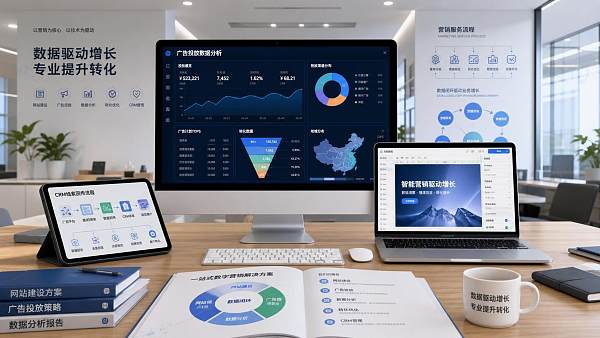
Don’t Overload Audience Segmentation—First Accurately Identify Who Is Most Likely to Become a Customer
The core of AI advertising conversion optimization is not letting the system “guess” on its own, but minimizing inaccurate guesses as much as possible. Many accounts initially target every country, age group, interest, keyword, and similar audience. As a result, coverage may look broad, but conversion samples become scattered and the algorithm cannot learn stable patterns.
A more effective approach is to first identify high-intent audiences. For example, in B2B manufacturing, it is often necessary to distinguish among brand owners, wholesalers, distributors, engineering procurement teams, and end retailers. Different roles may click the same ad but take completely different subsequent actions. Similarly, for cross-border e-commerce stores, payment habits, average order values, and return expectations vary greatly across Southeast Asia, Europe, and North America. Running them together makes it difficult for the system to determine what constitutes a “quality conversion.”
Here is a practical rule of thumb: if one ad group simultaneously covers multiple markets, product lines, and conversion paths, split it first. The purpose of segmentation is not to make the account look neat, but to make the data interpretable. AI models learn from behavioral samples, not from the business logic in your head.
Connect Conversion Feedback as Soon as Possible—Don’t Focus Only on “Successful Submissions”
Many teams say they have deployed conversion tracking, but when reviewed, it only records visits to a “thank-you page.” This only indicates that someone clicked submit; it does not show lead quality. For AI advertising conversion optimization, the truly valuable approach is tiered feedback: who only submitted contact information, who entered a valid conversation, who received a quotation, and who ultimately completed a purchase.
If the company already has a CRM, it is recommended to connect the advertising platform, website forms, and sales follow-up status. For platforms such as 易营宝 that combine intelligent website building, ad placement, SEO optimization, and AI marketing systems, the advantage lies in processing website and marketing data on one unified line without relying on manually compiled spreadsheets. For operators, this often produces results faster than simply replacing a set of creatives.
Don’t Optimize Creatives Only for Clicks—First See Who They Attract
High click-through rates do not equal high conversion rates. This is an old problem, but it is even more common in AI-driven advertising today. The system automatically pushes the budget toward audiences who are likely to click. If the creative is too broad, it often first attracts visitors who are “willing to take a look” rather than customers who are “ready to take action.”
In practice, look at it this way: if the click-through rate rises but the bounce rate is high, visit duration is short, and there is no form interaction, treat that creative with caution. For B2B advertising in particular, clearly stating the application scenario, purchasing role, and delivery capabilities in the copy is usually more effective than using vague claims such as “high-quality supplier.” When targeting multilingual markets, do not force a single set of Chinese-language assumptions into other languages. Poor localization can cause conversion rates to drop significantly.
Stabilize the Sample Size Before Scaling the Budget
Many accounts fail to produce results because the budget is divided into excessively small portions. Every campaign receives a small amount, and none can generate meaningful data. AI systems need continuous samples to learn. Discontinuous budgets, frequent starts and stops, and changing objectives today and bids tomorrow keep the model in a constant relearning state.
A more stable approach is to first maintain a small number of core campaigns and allow them to accumulate conversions consistently, then shift the budget toward audiences and pages that have already proven effective. It is not appropriate to provide a universal figure here because thresholds vary greatly by platform, industry average order value, and traffic costs in different countries. Specific thresholds need to be determined based on the account’s historical data.
However, one rule of thumb is broadly applicable: if a campaign has very few basic conversion samples but continues to undergo major bid, targeting, and creative adjustments, it is usually creating noise rather than optimizing.
Use Different Conversion Standards for Different Markets
When running campaigns overseas, regional differences are often underestimated. North American users care more about page trust and privacy statements, European markets are more sensitive to data-processing compliance, users in Japan and South Korea have higher expectations for page details and accuracy of expression, while some markets in the Middle East and Latin America rely more heavily on instant communication tools and more direct calls to action.
This does not mean creating an independent system for every country. At a minimum, do not apply the same forms, promises, and interactions uniformly across all regions. When privacy policies, Cookie consent, and data collection notices are involved, verify them according to the requirements of the target market. Where there is uncertainty, consult legal counsel or a local compliance advisor rather than making decisions based solely on experience.
Don’t Treat SEO, Advertising, and Social Media Separately—Fast-Converting Projects Usually Rely on Their Coordination
From an execution perspective, AI advertising conversion optimization naturally starts with the advertising account. From a results perspective, however, projects that produce results quickly are often driven by the integrated coordination of the website, advertising, SEO, and social media. The reason is practical: advertising brings in the first wave of traffic, SEO and content pages capture long-term search demand, social media increases reach and return visits, and the AI system continuously adjusts audiences and bids based on behavioral data.
One-stop platforms such as 易营宝 are well suited to this scenario, especially for international trade companies, manufacturing factories, and brands expanding overseas, which already face the combined challenges of website building, multilingual content, advertising, and search visibility. For operators, the biggest time savings do not come from opening more tools, but from connecting the website-building system, advertising system, and data feedback logic as much as possible.
A Practical Landing Page Inspection Checklist
- The advertising promise matches the landing page content, with no feeling of having landed on the wrong page after clicking.
- The above-the-fold section has a clear call to action that can be found directly on mobile devices.
- The form is not too long. Obtain valid contact information first, then collect more detailed requirements.
- Conversion tracking records more than successful submissions and at least distinguishes valid leads from invalid leads.
- Audiences are segmented at a basic level by market, product line, and purchasing role to avoid running them together.
- Creative copy clearly describes specific scenarios instead of relying on vague slogans to generate clicks.
- The budget prioritizes campaigns that can consistently generate samples, without frequent major changes.
- Privacy, data processing, and page disclosure requirements for the target market have been verified [Items to be verified must be marked separately].
- The website, advertising, SEO, and social media share at least basic data instead of operating independently.
If you need to decide where to start right now, the sequence does not need to be complicated: improve the landing page first, then clean up the audience segments, and finally refine conversion feedback. For most accounts, completing these steps produces more direct results than simply increasing the budget. Only after that does it make sense to discuss automated bidding, scaling creatives, and replicating campaigns across regions. Advertising optimization is not about who takes the most actions, but which step actually helps the system learn to identify the right people.
Related Articles


Related Products
 EasyCamp SaaS Smart Website Marketing SystemE-Yingbao SaaS Smart Website Marketing System: AI-powered, zero-code website building. Rapidly launch multilingual independent e-commerce sites in just 10 minutes. Global server acceleration and AI-driven SEO optimization empower businesses to efficiently connect with global markets. The seamless integration of technology and user-friendly operation makes building e-commerce sites incredibly simple.
 AI+SEM Intelligent Advertising Marketing SystemAI+SEM drives intelligent ad creation, empowering full-funnel precision advertising marketing. The system automatically generates weekly/monthly reports, AI recommends keywords and target countries, monitors core metrics in real-time with intelligent alerts, and enables one-click high-conversion ad solutions to help quickly acquire customers and improve ROI.
 AI+SEO Dual Engine Optimization ServiceEasyWin AI+SEO Dual Engine Optimization System leverages AI-powered keyword mining, content generation, and comprehensive technical optimization to help foreign trade enterprises acquire high-quality organic traffic, significantly improving search rankings and conversion rates.
 AI+SNS Social Media Marketing SystemYingbao AI+SNS Social Media Marketing System - Precision social capture for the social media era. Supports one-click content synchronization across major platforms like Facebook and LinkedIn. AI intelligently rewrites posts for enhanced relevance. 24/7 AI customer service and user profiling analysis empower businesses to efficiently expand into global markets.
 AI+SEO营销解决方案易营宝AI+SEO营销解决方案,通过AI批量写作、智能生成TDK、精准关键词扩词等功能,全面优化网站SEO效果,提升流量与转化率。助力企业构建高效智能网站新生态。
 AI+SEM Advertising Marketing SolutionsAI+SEM Advertising Marketing Solution leverages AI technology to deeply empower SEM ad campaigns. It automatically generates weekly/monthly reports using AI, presenting account data across multiple dimensions for comprehensive insights into campaign performance and trends. The system precisely recommends keywords and target countries, intelligently generates high-conversion ad copy, and enables one-click activation of efficient campaign plans to help businesses rapidly acquire customers. Simultaneously, it monitors core metrics in real time, intelligently identifies abnormal fluctuations, and issues timely alerts to ensure stable, high-return advertising results.
 Domain Name ServicesEasyWin provides professional domain name services, including intelligent queries, one-stop registration, brand protection, and full lifecycle management, helping businesses build a digital brand image.
 EasyOperate B2C Cross-Border E-Commerce Platform & Independent WebsiteEasyStore B2C Cross-border E-commerce Independent Store is an intelligent website building and cross-border e-commerce integrated solution independently developed by EasyStore Information Technology (Beijing) Co., Ltd. The system is specially designed for small and medium-sized as well as large export enterprises, integrating 'website building, operation, marketing, advertising, and conversion' into one, helping enterprises quickly establish cross-border e-commerce independent stores to achieve brand globalization and global sales growth.
The platform supports multiple languages, multiple currencies, and multi-channel marketing, with built-in AI intelligent translation and SEO optimization systems, suitable for mainstream markets such as Southeast Asia, Europe and America, Latin America, and the Middle East, assisting Chinese manufacturing enterprises in efficiently deploying international e-commerce strategies. SSL证书易营宝提供专业SSL安全证书服务,包括单域名和泛域名证书,确保网站数据传输加密、身份验证和完整性保护,助力企业建立安全可信的在线业务环境。









