









- What Does a Global Traffic Ecosystem Service Provider Do? What Are the Differences from a Single Advertising AgencyJul 16, 2026View details
- What should you focus on in the latest enterprise SaaS report? From renewal rates and delivery costs to overseas growth opportunitiesJul 12, 2026View details
- What signals are worth paying attention to in a cross-border marketing trend report? B2B companies should look at these 6 signalsJul 11, 2026View details
- How to Read a Cross-Border Marketing Trends Report? Five Key Dimensions for Evaluating Channel OpportunitiesJul 11, 2026View details
- Which channel has the highest ROI in the global traffic ecosystem? Comparative analysis of search, social media, and advertisingJul 10, 2026View details
- What multilingual website services are available in Sanya? Which model is more suitable for local businesses going global?Jul 08, 2026View details
Facebook Advertising Tips: Check These 5 Metrics First
If you want to achieve more stable results with Facebook ads, don't rush to increase the budget. The truly useful Facebook advertising techniques often begin not with how much has been spent, but with whether the data structure is healthy. For website traffic acquisition, inquiry generation, and sales on independent websites, advertising performance is never an isolated issue. It is connected with audience settings, creative quality, landing-page reception, and conversion tracking. Especially as competition for overseas customer acquisition continues to intensify, the ability to quickly understand key metrics determines whether an ad should be scaled further or stopped in time.
Look at the metrics first, rather than changing the budget first
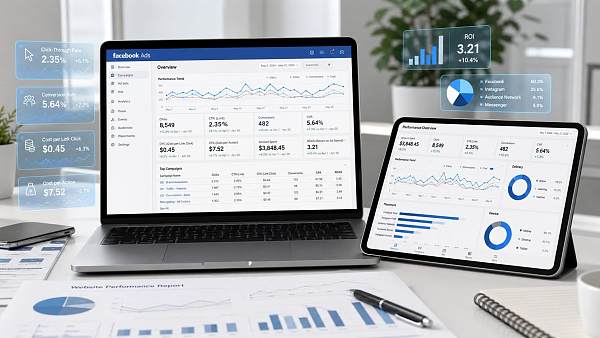
Whenever performance fluctuates, many accounts immediately change the creatives, change the audience, or even raise the bid directly. This approach is common, but not efficient. The core of Facebook advertising techniques is not taking more actions, but making more accurate judgments. Only by first identifying which stage is causing the problem can optimization stay on the right track.
If the business objective is website form submissions, WhatsApp inquiries, or orders on an independent website, data analysis must focus on the conversion path. Insufficient impressions indicate a reach problem; stagnant clicks indicate an issue with the creative or audience; many clicks but no conversions often point to problems with the landing page or tracking. In other words, advertising is not an isolated activity, but part of the coordination between the website and marketing.
This is also why more and more companies are focusing on integrated capabilities. The value of platforms such as Yiyingbao, which cover intelligent website building, SEO optimization, social media marketing, and advertising, lies not only in “getting ads delivered,” but also in connecting traffic reception, data tracking, and subsequent optimization into a closed loop.
These 5 metrics determine whether an ad is worth continuing
The following 5 metrics do not necessarily need to be monitored in extreme detail every day, but they are the most direct basis for assessing advertising health. Mastering these Facebook advertising techniques can help identify the location of problems more quickly.
Click-through rate: First determine whether the creative is attractive
Click-through rate reflects whether an ad is sufficiently appealing to its target audience. In general, a low click-through rate does not necessarily mean that the product is poor. It is more likely that the main image, the first few seconds of the video, the headline wording, or the audience targeting is not accurate enough.
When optimizing Facebook advertising techniques, click-through rate is useful for determining whether the “creative layer” needs adjustment. If impressions have already reached a certain volume but clicks consistently fail to increase, the creative should be changed first instead of blaming the landing page.
Cost per click: Determine whether traffic is expensive
Cost per click directly affects traffic acquisition efficiency. A high cost may be caused by intense competition or low ad relevance. If the click-through rate is average and the cost per click is also high, the account is already purchasing traffic inefficiently.
However, cost per click cannot be viewed in isolation. The average order value varies greatly among B2B inquiries, overseas marketing for industrial products, and cross-border retail. The meaning of the same cost per click can be completely different across different businesses.
Landing page views: Investigate losses after clicks
Some ads receive many clicks, but relatively few users actually finish loading and enter the landing page. In this case, landing page views should be examined. This metric can help determine whether the page is loading slowly, the redirect is abnormal, or the mobile experience is too poor.
This is also where website capabilities and advertising performance are closely tied. Facebook advertising techniques focus on front-end traffic acquisition, but the back-end page experience often has a greater impact on cost efficiency. A disorganized page structure, an overly long form, or a language mismatch can all amplify traffic loss.
Conversion rate: Determine whether traffic has produced results
Conversion rate is one of the most important business metrics. Whether the goal is to submit an inquiry, add an item to the cart, or complete a payment, conversion rate answers one question: Has the traffic brought by the ad actually generated value?
If the click-through rate is good and the page opens successfully, but the conversion rate is low, common causes include unclear selling points, insufficient trust in the page, an unreasonable form design, an overly long purchase path, or an audience that clicks but does not have genuine demand.
Cost per conversion: Determine whether scaling can continue
Cost per conversion is the metric to which many operational decisions ultimately return. It reflects not only ad performance, but also whether website reception, product pricing, regional targeting, and conversion event settings are reasonable.
In actual business operations, the maturity of Facebook advertising techniques is often reflected in whether the cost per conversion can be kept within an acceptable range over the long term, rather than in producing several attractive sets of data in the short term.
How should these 5 metrics be viewed together?
Looking at a single metric can easily lead to misjudgment. A more effective approach is to read the data along the user journey. The following sequence is suitable for daily inspections.
Simply put, Facebook advertising techniques are not about memorizing several metric names, but about placing the metrics back into the real conversion path. Only then can you know whether to change the ad, the page, or the overall advertising strategy.
The focus differs across scenarios
Although they are all Facebook ads, different business objectives emphasize different data. For overseas trade inquiries, the focus is on the cost of valid inquiries; for sales through an independent website, greater attention is paid to add-to-cart, checkout, and completed payments; for brand exposure, reach quality and subsequent remarketing performance are more important.
- B2B inquiry scenario: Prioritize landing page views, form conversion rate, and cost per valid lead.
- Cross-border marketplace scenario: Prioritize click-through rate, add-to-cart rate, payment conversion rate, and cost per order.
- Independent brand website scenario: Prioritize click-through rate, engagement quality, and remarketing conversion efficiency.
- Multilingual market scenario: Prioritize differences in cost per click and page conversion across regions.
This is also why integrated operations are becoming increasingly important. Yiyingbao’s integration of intelligent website building, multilingual websites, cross-border marketplaces, AI advertising, and SEO/GEO optimization is suited to solving practical issues such as “ads can be delivered, pages can receive traffic, and data can be fed back for analysis.” For businesses promoting to multiple regions, including North America, Europe, and Southeast Asia, this collaborative value is even more evident.
During actual optimization, take these steps first for greater stability
In daily operations, Facebook advertising techniques do not require changing many elements at once. A more reliable approach is to handle them layer by layer according to priority.
- First confirm whether the pixel and conversion events are accurate to prevent distortion at the data-source level.
- Then review the click-through rate and cost per click to determine whether the problem lies in the creative layer.
- Next check the landing page speed, mobile display, and form path.
- Finally, decide whether to scale up or scale down based on the cost per conversion.
More importantly, optimization actions should be carried out in sync with website development. An independent website with a clear structure, stable loading speed, multilingual support, and conversion tracking often improves long-term advertising performance more effectively than frequently changing creatives. This is why many companies upgrade their websites, content, and data systems alongside their advertising efforts.
Decide what to do next after understanding the data
Ultimately, Facebook advertising techniques are about establishing a set of evaluation standards. Knowing which 5 metrics to monitor is only the starting point. What truly matters is whether these metrics can be assessed together with website reception, business objectives, regional markets, and creative strategy.
If advertising performance is currently unstable, the next step should be to first review the conversion path: from the ad click to the landing page visit, and then to the inquiry or order, checking one item at a time to ensure that the data is consistent. Once this path is clear, adjustments to the budget, creatives, and campaign structure will be more accurate, and subsequent scaling will have a stronger basis.
Related Articles
Related Products
 EasyCamp SaaS Smart Website Marketing SystemE-Yingbao SaaS Smart Website Marketing System: AI-powered, zero-code website building. Rapidly launch multilingual independent e-commerce sites in just 10 minutes. Global server acceleration and AI-driven SEO optimization empower businesses to efficiently connect with global markets. The seamless integration of technology and user-friendly operation makes building e-commerce sites incredibly simple.
 AI+SEM Intelligent Advertising Marketing SystemAI+SEM drives intelligent ad creation, empowering full-funnel precision advertising marketing. The system automatically generates weekly/monthly reports, AI recommends keywords and target countries, monitors core metrics in real-time with intelligent alerts, and enables one-click high-conversion ad solutions to help quickly acquire customers and improve ROI.
 AI+SEO Dual Engine Optimization ServiceEasyWin AI+SEO Dual Engine Optimization System leverages AI-powered keyword mining, content generation, and comprehensive technical optimization to help foreign trade enterprises acquire high-quality organic traffic, significantly improving search rankings and conversion rates.
 AI+SNS Social Media Marketing SystemYingbao AI+SNS Social Media Marketing System - Precision social capture for the social media era. Supports one-click content synchronization across major platforms like Facebook and LinkedIn. AI intelligently rewrites posts for enhanced relevance. 24/7 AI customer service and user profiling analysis empower businesses to efficiently expand into global markets.
 AI+SEO营销解决方案易营宝AI+SEO营销解决方案,通过AI批量写作、智能生成TDK、精准关键词扩词等功能,全面优化网站SEO效果,提升流量与转化率。助力企业构建高效智能网站新生态。
 AI+SEM Advertising Marketing SolutionsAI+SEM Advertising Marketing Solution leverages AI technology to deeply empower SEM ad campaigns. It automatically generates weekly/monthly reports using AI, presenting account data across multiple dimensions for comprehensive insights into campaign performance and trends. The system precisely recommends keywords and target countries, intelligently generates high-conversion ad copy, and enables one-click activation of efficient campaign plans to help businesses rapidly acquire customers. Simultaneously, it monitors core metrics in real time, intelligently identifies abnormal fluctuations, and issues timely alerts to ensure stable, high-return advertising results.
 Domain Name ServicesEasyWin provides professional domain name services, including intelligent queries, one-stop registration, brand protection, and full lifecycle management, helping businesses build a digital brand image.
 EasyOperate B2C Cross-Border E-Commerce Platform & Independent WebsiteEasyStore B2C Cross-border E-commerce Independent Store is an intelligent website building and cross-border e-commerce integrated solution independently developed by EasyStore Information Technology (Beijing) Co., Ltd. The system is specially designed for small and medium-sized as well as large export enterprises, integrating 'website building, operation, marketing, advertising, and conversion' into one, helping enterprises quickly establish cross-border e-commerce independent stores to achieve brand globalization and global sales growth.
The platform supports multiple languages, multiple currencies, and multi-channel marketing, with built-in AI intelligent translation and SEO optimization systems, suitable for mainstream markets such as Southeast Asia, Europe and America, Latin America, and the Middle East, assisting Chinese manufacturing enterprises in efficiently deploying international e-commerce strategies. SSL证书易营宝提供专业SSL安全证书服务,包括单域名和泛域名证书,确保网站数据传输加密、身份验证和完整性保护,助力企业建立安全可信的在线业务环境。









