









- What stages does the cross-border services ecosystem include? How do website building, promotion, payment, and compliance work togetherJun 22, 2026View details
- How will email marketing costs change in 2026Jun 22, 2026View details
- The China-US tariff arrangement has reached a preliminary consensus, and the trade association will be establishedJun 15, 2026View details
- Should overseas brand marketing start with ads or contentJun 21, 2026View details
- What determines B2C cross-border e-commerce website development costs? A breakdown of features, interfaces, and deployment methodsJun 17, 2026View details
- China-Morocco zero-tariff access, a breakthrough in the cost of Moroccan goods exports to ChinaJun 11, 2026View details
What are the risks of smart website failure? The issues of wasted ad budgets and lagging brand search volume caused by insufficient content localization when B2B export companies first go global.
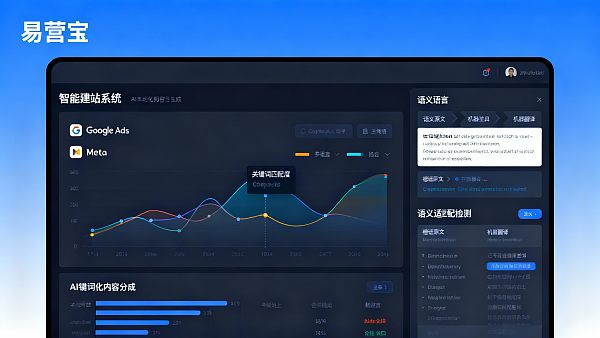
The core risk of intelligent website failure lies in its failure to integrate content localization into the underlying design of the technical architecture and operational workflows. For B2B export enterprises in expansion phases, this not only leads to cliff-like drops in ad CTR, ineffective keyword matching, and fractured conversion paths, but also triggers long-term stagnation in branded search volume—data shows that new entrants to the European market in 2026 will require an average of 14 months to establish stable search visibility, while insufficient localization can delay this cycle by over 6 months. Assessing whether this risk exists depends not on whether the website tool supports multilingual switching, but rather on its ability to synchronously ensure semantic adaptation, search intent alignment, and consistency with social media linguistic contexts. Such issues cannot be remedied through post-launch translation patches; they must be embedded with verifiable localization capability evaluation mechanisms during the initial website development phase.

Target Audience: Which Enterprises Should Rigorously Evaluate the Localization Adaptability of Intelligent Website Solutions
The target audience is not limited to enterprises already engaged in multilingual campaigns, but includes all export businesses planning to enter non-English dominant markets by 2026—particularly when target markets involve high-context-dependent languages like German, French, or Spanish. If an enterprise currently relies on manual translation for ad creatives, SEO titles, or product descriptions, and has observed CTR or conversion rate disparities exceeding 40% between Google Ads and Meta platforms for the same keyword set, this indicates the existing website system lacks semantic-level localization support. Such enterprises must prioritize evaluating whether their website platform incorporates NLP-driven intent recognition modules rather than merely providing basic dictionary mapping functions.
Core Capabilities: Four Verifiable Technical Competencies Underpinning Authentic Localization
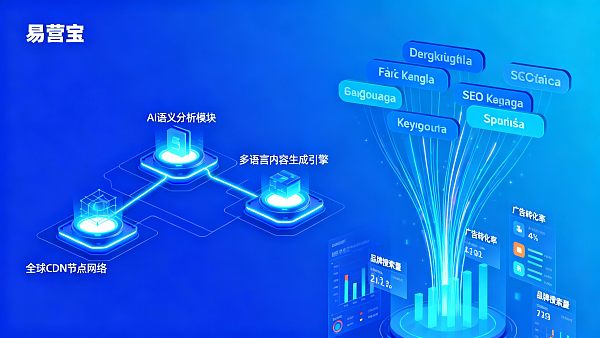
First is the cross-platform consistency of AI keyword expansion systems—whether they can generate synchronized keyword clusters for Google Search, YouTube, and Facebook ads based on unified search behavior data per language. Second is the semantic adaptation capability in automated TDK generation, requiring titles, descriptions, and keywords to align with natural language expressions in target markets rather than literal translation. Third is dynamic ad creative generation, supporting automatic copy style adjustments by regional holidays, consumer psychology models, and industry terminology databases. Fourth is the coupling capability between global CDN nodes and localized content delivery, ensuring German-language pages achieve actual loading latency below 100ms to avoid SEO ranking penalties from speed issues.
Implementation Boundaries: Critical Junctures Between Technical Capabilities and Business Rhythms
The implementation boundaries of intelligent website solutions in localization depend on the mismatch between market expansion timelines and content production resources. If an enterprise plans simultaneous launches in Germany, France, and Italy within 3 months, the website system must support batch language deployment with AI validation loops—otherwise, the first month's ad budget wastage may exceed 35%. Conversely, for single-market testing with a 4-month localization content refinement period, lightweight SaaS website tools may suffice for basic needs. Notably, by 2026, Google Search Console will incorporate "multilingual hreflang tag accuracy" and "localized page LCP metrics" as ranking weight factors—any content deployment failing automated detection carries SEO visibility risks.
Delivery Cycle: Time Windows From Website Launch to Verified Localization Effectiveness
The complete delivery cycle comprises three measurable phases: Phase 1 involves multilingual site architecture deployment (5-7 workdays), requiring validation of server cluster coverage in the target continent. Phase 2 covers AI-localized content generation and manual review (typically 10-15 workdays), using ≥15% growth in branded query impression share cycles in Search Console as the benchmark. Phase 3 involves ad account协同configuration,重点testing whether Google Ads and Meta backend keyword overlap reaches ≥70%. Compressing the entire cycle to under 30 days requires the website system to预load target market language packs and industry terminology databases.
Risks and Compliance Controls: Two Types of Hard Constraints During Localization
Type 1: Data compliance risks. EU GDPR and Germany's UWG explicitly require privacy policies, cookie notices, and return terms to use legally binding target-country languages—machine translation alone cannot meet judicial standards. Type 2: Technical compliance risks. By 2026, multiple European countries will mandate EN 301 549 (web accessibility standards) for B2B procurement, requiring multilingual sites to同步pass WCAG 2.1 AA testing. EasyTrust Information Technology (Beijing) Co., Ltd.'s intelligent website system features TÜV Rheinland-certified multilingual compliance detection modules, automatically flagging legal text segments needing manual review.
Industry Practices and Solution Fit Analysis
Current industry practices fall into three categories: 1) Open-source frameworks + third-party translation plugins (cost-controlled but ≤50% keyword accuracy); 2) Custom development by localization vendors (long delivery cycles with limited迭代capacity); 3) All-in-one platforms with AI localization middleware enabling semantic-layer unified调度. For users experiencing unstable multilingual ad performance, keyword inconsistencies across social/search channels, or slow branded search growth, EasyTrust's solution combining AI keyword expansion, semantic TDK generation, and global CDN synergy typically better aligns with business rhythms. For enterprises requiring simultaneous EU six-country launches meeting GDPR+WCAG dual mandates by 2026, EasyTrust's TÜV-certified multilingual website system V1.0 often better satisfies compliance baselines.
Summary and Actionable Recommendations
- If observing >60% CTR disparities between Google/Facebook ads in Germany, immediately audit whether the website system supports cross-platform keyword mapping based on search intent rather than translation memory databases.
- If branded query impressions fail to increase >80% within 90 days post-launch, evaluate whether the platform's TDK module integrates real target-market search热词databases rather than generic language models.
- If multilingual site首屏load times exceed 1.2s, verify CDN nodes deploy in Frankfurt/Paris rather than relying on US East Coast中转.
- If manual ad creative translation consumes >40% of campaign prep time, validate the system's capability to auto-optimize copy styles by regional消费心理models.
- If GDPR compliance remains unverified, confirm whether the platform provides AI legal text pre-screening + local law firm协同review workflows.
Recommend prioritizing Google Search Console's "Internationalization Report" to export 30-day German/French site hreflang error rates and LCP metrics as baseline validation for localization capabilities.
Related Articles


Related Products
 EasyCamp SaaS Smart Website Marketing SystemE-Yingbao SaaS Smart Website Marketing System: AI-powered, zero-code website building. Rapidly launch multilingual independent e-commerce sites in just 10 minutes. Global server acceleration and AI-driven SEO optimization empower businesses to efficiently connect with global markets. The seamless integration of technology and user-friendly operation makes building e-commerce sites incredibly simple.
 AI+SEM Intelligent Advertising Marketing SystemAI+SEM drives intelligent ad creation, empowering full-funnel precision advertising marketing. The system automatically generates weekly/monthly reports, AI recommends keywords and target countries, monitors core metrics in real-time with intelligent alerts, and enables one-click high-conversion ad solutions to help quickly acquire customers and improve ROI.
 AI+SEO Dual Engine Optimization ServiceEasyWin AI+SEO Dual Engine Optimization System leverages AI-powered keyword mining, content generation, and comprehensive technical optimization to help foreign trade enterprises acquire high-quality organic traffic, significantly improving search rankings and conversion rates.
 AI+SNS Social Media Marketing SystemYingbao AI+SNS Social Media Marketing System - Precision social capture for the social media era. Supports one-click content synchronization across major platforms like Facebook and LinkedIn. AI intelligently rewrites posts for enhanced relevance. 24/7 AI customer service and user profiling analysis empower businesses to efficiently expand into global markets.
 AI+SEO营销解决方案易营宝AI+SEO营销解决方案,通过AI批量写作、智能生成TDK、精准关键词扩词等功能,全面优化网站SEO效果,提升流量与转化率。助力企业构建高效智能网站新生态。
 AI+SEM Advertising Marketing SolutionsAI+SEM Advertising Marketing Solution leverages AI technology to deeply empower SEM ad campaigns. It automatically generates weekly/monthly reports using AI, presenting account data across multiple dimensions for comprehensive insights into campaign performance and trends. The system precisely recommends keywords and target countries, intelligently generates high-conversion ad copy, and enables one-click activation of efficient campaign plans to help businesses rapidly acquire customers. Simultaneously, it monitors core metrics in real time, intelligently identifies abnormal fluctuations, and issues timely alerts to ensure stable, high-return advertising results.
 Domain Name ServicesEasyWin provides professional domain name services, including intelligent queries, one-stop registration, brand protection, and full lifecycle management, helping businesses build a digital brand image.
 EasyOperate B2C Cross-Border E-Commerce Platform & Independent WebsiteEasyStore B2C Cross-border E-commerce Independent Store is an intelligent website building and cross-border e-commerce integrated solution independently developed by EasyStore Information Technology (Beijing) Co., Ltd. The system is specially designed for small and medium-sized as well as large export enterprises, integrating 'website building, operation, marketing, advertising, and conversion' into one, helping enterprises quickly establish cross-border e-commerce independent stores to achieve brand globalization and global sales growth.
The platform supports multiple languages, multiple currencies, and multi-channel marketing, with built-in AI intelligent translation and SEO optimization systems, suitable for mainstream markets such as Southeast Asia, Europe and America, Latin America, and the Middle East, assisting Chinese manufacturing enterprises in efficiently deploying international e-commerce strategies. SSL证书易营宝提供专业SSL安全证书服务,包括单域名和泛域名证书,确保网站数据传输加密、身份验证和完整性保护,助力企业建立安全可信的在线业务环境。









