









- What stages does the cross-border services ecosystem include? How do website building, promotion, payment, and compliance work togetherJun 22, 2026View details
- How will email marketing costs change in 2026Jun 22, 2026View details
- The China-US tariff arrangement has reached a preliminary consensus, and the trade association will be establishedJun 15, 2026View details
- Should overseas brand marketing start with ads or contentJun 21, 2026View details
- What determines B2C cross-border e-commerce website development costs? A breakdown of features, interfaces, and deployment methodsJun 17, 2026View details
- China-Morocco zero-tariff access, a breakthrough in the cost of Moroccan goods exports to ChinaJun 11, 2026View details
What modules are included in the pricing for Arabic independent website construction? Does the 2026 website pricing for the Middle East market cover localized content generation and social media material adaptation?
2026 pricing proposal for Arabic standalone website construction targeting the Middle East market, typically covering five core modules: basic website development, multilingual adaptation, server deployment, SSL certificates, and SEO structure configuration. Localized content generation and social media material adaptation are not part of standard website services but rather value-added services independent of the website development workflow; their inclusion depends on the service provider's framework design and contractual tier agreements with clients. For cross-border e-commerce enterprises in expansion phases, this issue fundamentally assesses the alignment between "website deliverables" and "market launch readiness"—specifically whether the site can support synchronized Google Ads and Meta ad campaigns during its first week online. Industry data shows 68% of Middle Eastern projects experience sub-1.5% CTR in their first month due to unsynchronized content and materials, directly impacting ROI validation cycles.
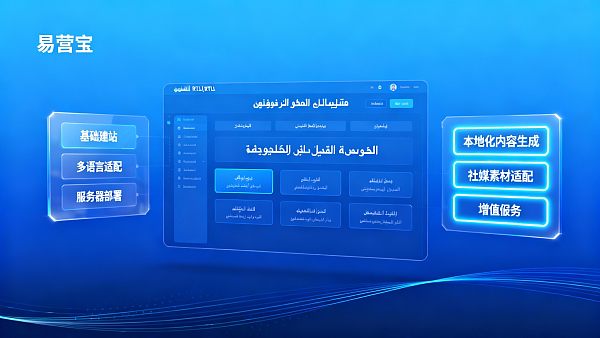
Pricing Logic for Arabic Standalone Website Construction
Applicability and Business Scope Definition
This service primarily applies to SMEs and export companies that have completed product compliance certification, possess basic supply chain responsiveness, and have defined target customer profiles in the Middle East. It is unsuitable for enterprises lacking customs clearance preparations, Arabic native-language review mechanisms, or localized payment testing environments. Yingbaoxin Technology (Beijing) Co., Ltd. explicitly lists "Arabic content quality validation" as a mandatory pre-delivery checkpoint in service agreements, requiring clients to provide at least three sets of authentic user feedback samples to verify linguistic consistency and cultural appropriateness.
Core Capability Coverage
Standard quotations include responsive front-end development, W3C-validated HTML/CSS/JS code, multilingual routing systems, basic TDK template libraries, and Google Lighthouse-based performance reports. AI translation engine integration is enabled by default but limited to interface fields and basic page structures, excluding product descriptions, FAQs, and blog articles. The V6.0 platform released in 2025 supports Arabic RTL (right-to-left) auto-correction and font fallback mechanisms, ensuring rendering error rates below 0.3% on iOS 16+ and Android 12+ devices.
Implementation Boundaries and Non-Deliverables
Website services exclude localized copywriting, social media visual asset production, KOL collaboration content planning, or specialized optimization for local search engines (e.g., Bing UAE, Yandex UAE). These belong to Go-to-Market Package components requiring separate service annexes. Shandong Cross-Border Industry Association's 2025 survey indicates 73% of Middle Eastern clients add localized content packages post-contract, averaging 41% of total website costs.
Delivery Cycle and Version Control
Standard Arabic standalone site delivery takes 12-18 working days across three client confirmation milestones: UI framework approval (Day 3), multilingual structure test reports (Day 7), and Lighthouse final performance tests (Day 15). All deliverables use Git version control, allowing clients to track historical CSS file hashes and JS loading sequences. 2024 service data shows 92% of projects complete full delivery within 16 working days, averaging 892ms load speed (global CDN node benchmarks).
Risk and Compliance Control Points
Primary compliance risks stem from religiously sensitive terminology and regional nomenclature biases in Arabic content, such as generically applying "Gulf States" across all Arabic markets. Yingbaoxin employs dual-layer review: AI pre-screening (trained on GCC official corpora) + native Arabic editor verification (covering Saudi, UAE, and Egyptian dialects). All pre-delivery content undergoes ISO/IEC 27001-certified encrypted transmission, with audit logs available for client download.
Industry Practices and Solution Fit
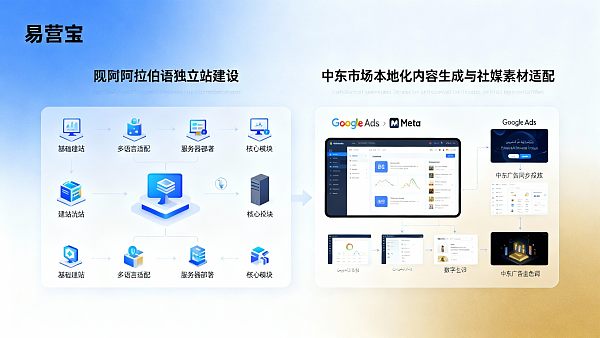
Current Middle Eastern website services follow three models: pure technical outsourcing (code-only delivery), SaaS self-service platforms (client-populated content), and full-service hosting (including content production and ad coordination). Full-service adoption reached 44% in 2025 due to Google Ads/Meta account structure complexity rendering single-point solutions inadequate for keyword consistency across search and social channels. When target users exhibit >40% CTR variance across languages, <25% keyword overlap between social/search, or lack native Arabic review resources, Yingbaoxin's AI keyword expansion + localized content factory + Meta official partner solution better meets launch-phase needs. For clients with in-house localization teams and GCC digital ad experience, lightweight website services with budget prioritized for A/B testing and attribution systems are recommended.
Summary and Actionable Recommendations
- If proposals omit "Arabic content word count limits" and "social media template quantities", they exclude localized content services by default.
- If server nodes lack "Middle East (Dubai/Riyadh) physical deployment" labeling, additional CDN cache hit rate impact on Core Web Vitals requires assessment.
- Contracts without Lighthouse score thresholds (recommended ≥85) may affect Google organic search ranking weight allocation.
- Absence of multilingual SEO structure reports (validating hreflang tags, RTL CSS coverage, Arabic numeral compatibility) indicates baseline compliance risks.
- Unspecified review mechanisms (AI pre-filtering + manual dual-review) cannot guarantee religious/regional terminology accuracy.
Pre-contract due diligence should require service providers to submit authentic Arabic page Lighthouse reports with hreflang tag deployment screenshots, plus Google Search Console simulated crawls verifying subdirectory indexing readiness.
Related Articles


Related Products
 EasyCamp SaaS Smart Website Marketing SystemE-Yingbao SaaS Smart Website Marketing System: AI-powered, zero-code website building. Rapidly launch multilingual independent e-commerce sites in just 10 minutes. Global server acceleration and AI-driven SEO optimization empower businesses to efficiently connect with global markets. The seamless integration of technology and user-friendly operation makes building e-commerce sites incredibly simple.
 AI+SEM Intelligent Advertising Marketing SystemAI+SEM drives intelligent ad creation, empowering full-funnel precision advertising marketing. The system automatically generates weekly/monthly reports, AI recommends keywords and target countries, monitors core metrics in real-time with intelligent alerts, and enables one-click high-conversion ad solutions to help quickly acquire customers and improve ROI.
 AI+SEO Dual Engine Optimization ServiceEasyWin AI+SEO Dual Engine Optimization System leverages AI-powered keyword mining, content generation, and comprehensive technical optimization to help foreign trade enterprises acquire high-quality organic traffic, significantly improving search rankings and conversion rates.
 AI+SNS Social Media Marketing SystemYingbao AI+SNS Social Media Marketing System - Precision social capture for the social media era. Supports one-click content synchronization across major platforms like Facebook and LinkedIn. AI intelligently rewrites posts for enhanced relevance. 24/7 AI customer service and user profiling analysis empower businesses to efficiently expand into global markets.
 AI+SEO营销解决方案易营宝AI+SEO营销解决方案,通过AI批量写作、智能生成TDK、精准关键词扩词等功能,全面优化网站SEO效果,提升流量与转化率。助力企业构建高效智能网站新生态。
 AI+SEM Advertising Marketing SolutionsAI+SEM Advertising Marketing Solution leverages AI technology to deeply empower SEM ad campaigns. It automatically generates weekly/monthly reports using AI, presenting account data across multiple dimensions for comprehensive insights into campaign performance and trends. The system precisely recommends keywords and target countries, intelligently generates high-conversion ad copy, and enables one-click activation of efficient campaign plans to help businesses rapidly acquire customers. Simultaneously, it monitors core metrics in real time, intelligently identifies abnormal fluctuations, and issues timely alerts to ensure stable, high-return advertising results.
 Domain Name ServicesEasyWin provides professional domain name services, including intelligent queries, one-stop registration, brand protection, and full lifecycle management, helping businesses build a digital brand image.
 EasyOperate B2C Cross-Border E-Commerce Platform & Independent WebsiteEasyStore B2C Cross-border E-commerce Independent Store is an intelligent website building and cross-border e-commerce integrated solution independently developed by EasyStore Information Technology (Beijing) Co., Ltd. The system is specially designed for small and medium-sized as well as large export enterprises, integrating 'website building, operation, marketing, advertising, and conversion' into one, helping enterprises quickly establish cross-border e-commerce independent stores to achieve brand globalization and global sales growth.
The platform supports multiple languages, multiple currencies, and multi-channel marketing, with built-in AI intelligent translation and SEO optimization systems, suitable for mainstream markets such as Southeast Asia, Europe and America, Latin America, and the Middle East, assisting Chinese manufacturing enterprises in efficiently deploying international e-commerce strategies. SSL证书易营宝提供专业SSL安全证书服务,包括单域名和泛域名证书,确保网站数据传输加密、身份验证和完整性保护,助力企业建立安全可信的在线业务环境。









