









- What should you focus on in the latest enterprise SaaS report? From renewal rates and delivery costs to overseas growth opportunitiesJul 12, 2026View details
- What signals are worth paying attention to in a cross-border marketing trend report? B2B companies should look at these 6 signalsJul 11, 2026View details
- How to Read a Cross-Border Marketing Trends Report? Five Key Dimensions for Evaluating Channel OpportunitiesJul 11, 2026View details
- Which channel has the highest ROI in the global traffic ecosystem? Comparative analysis of search, social media, and advertisingJul 10, 2026View details
- What multilingual website services are available in Sanya? Which model is more suitable for local businesses going global?Jul 08, 2026View details
- How to view the complete list of China SaaS companies in the top 100? Practical methods for screening website-building and marketing service providersJul 08, 2026View details
- How to view pricing in the global traffic ecosystem? Cost comparison of search, social media, and content channel advertisingJul 06, 2026View details
- How to assess foreign trade website development trends?Looking at 2026 changes from multilingual,AI content to conversion pathsJul 04, 2026View details
Is the SEO analysis data from webmaster tools accurate
Are the SEO analysis data from webmaster tools accurate? This is one of the biggest concerns for many information researchers. This article will look at data sources, metric logic, and real-world application scenarios to help you assess the reference value of tool results more rationally.
Conclusion first: whether webmaster tool SEO analysis is trustworthy depends less on “accuracy” and more on “how you use it”
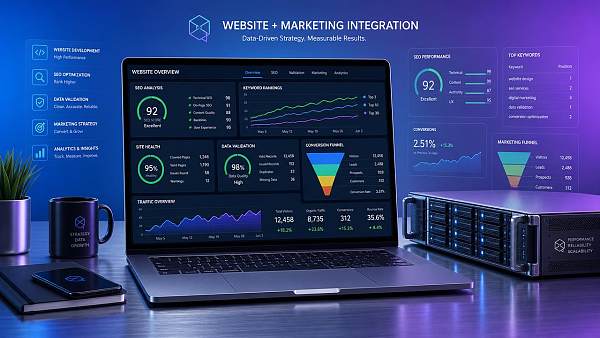
When reviewing SEO analysis in webmaster tools, many people tend to treat the tool data as the final conclusion. In fact, most webmaster tools are better suited for trend analysis, competitor observation, and basic site audits, rather than replacing real business data. Especially in integrated website and marketing service scenarios, looking at a single score alone often leads to misjudging a website’s true customer acquisition capability.
If you are an information researcher, you need even more to distinguish three things: what the tool has captured, what the platform has actually measured, and what the business ultimately values in conversion. Only by separating these three layers can webmaster tool SEO analysis shift from something you merely “look at for interest” to decision-support evidence you can actually use.
- When looking at on-site signals such as indexation, backlinks, and title structure, tools usually have relatively high reference value.
- When looking at estimated traffic, keyword ranking coverage, and authority-related scores, they are more suitable for relative comparison and not for being directly treated as performance data.
- When evaluating lead quality, deal cost, and ROI, you must combine website analytics systems, ad platforms, and CRM results.
Where does the data in webmaster tool SEO analysis actually come from
To judge whether webmaster tool SEO analysis is reliable, the first step is not to see whether the interface looks polished, but to examine the data source. Common tool data sources generally include search result crawling, public page scraping, third-party keyword database estimation, historical sample modeling, and a small amount of data integration from partner APIs.
This means it is not directly reading the actual visitor records in your website backend, nor is it directly reading data from your company’s order system. What tools do best is “viewing a website from the outside,” so they are more sensitive to publicly observable metrics, while naturally having blind spots when it comes to the actual on-site conversion path.
Common data sources and differences in accuracy
The table below is useful for quickly understanding why some metrics feel very accurate to you, while others always seem inconsistent with reality. For information researchers, this step can significantly reduce the likelihood of misreading webmaster tool SEO analysis.
As you can see from the table, webmaster tool SEO analysis is not “inaccurate,” but rather “different metrics have different levels of accuracy.” The closer a metric is to publicly crawlable information, the higher its reference value; the closer it is to real operating results, the larger the deviation usually becomes.
Which metrics are most easily misunderstood
The most common issue during the research stage is not a lack of data, but treating estimated values as actual results. Especially when website development, SEO optimization, social media marketing, and ad placement are being advanced together, relying only on webmaster tool SEO analysis can easily lead to overestimating the value of organic traffic or underestimating key issues in the conversion path.
Four types of metrics that are easy to misjudge
- Authority-related scores: These scores are usually platform-defined models that help quickly filter websites, but they are not official search engine evaluations.
- Estimated traffic: It reflects inference based on keyword databases and ranking samples, not actual visits, and certainly not qualified leads.
- Number of backlinks: A high quantity does not mean high quality. Spam backlinks, dead backlinks, and backlinks with no business relevance can all interfere with judgment.
- Number of keywords: Broad coverage does not equal strong conversion. Many keywords only bring exposure, but cannot drive inquiries and deals.
For businesses, what really matters is rankings for high-intent keywords, landing page conversion capability, form and inquiry pathways, and subsequent sales conversion. That is exactly why mature service providers, when delivering integrated website and marketing services, do not just hand over a single SEO score, but build a closed loop from website creation, content, and data tracking to lead conversion.
In what scenarios does webmaster tool SEO analysis have the most reference value
If used in the right scenario, webmaster tool SEO analysis is still highly valuable. For companies that are just entering the information research stage, it can quickly shorten screening time and help you identify structural issues, content gaps, and competitive opportunities from a large number of website samples.
Especially when a company is evaluating a website redesign, SEO investment direction, or a multi-channel marketing mix, tool-based analysis can serve as a preliminary diagnostic layer, rather than the final basis for making decisions.
Overview of applicable scenarios
The table below is more suitable for use during the procurement and research stage. It does not tell you whether a tool is good or bad; it tells you what questions you should use it for, so you can avoid using it in the wrong way.
The table reflects one core fact: webmaster tool SEO analysis is more like a scout, able to discover clues first; but what truly determines the direction of investment is the deeper follow-up data diagnosis and business validation.
Why, in the era of integrated website and marketing services, you cannot focus only on SEO tool scores
Today, business growth depends more and more on multi-channel coordination. A website is not just a display page, but the core hub for traffic from search, advertising, social media, and remarketing. Webmaster tool SEO analysis can tell you part of the story about page structure and search performance, but it cannot fully explain “why people visit but do not inquire.”
Taking cross-border e-commerce and B2B companies as examples, many projects do not fail because SEO has no traffic, but because the landing page is not persuasive enough, the inquiry entry point is poorly designed, or there is no secondary user touchpoint, causing front-end exposure to fail to turn into business opportunities. This is also why mature service providers usually connect website development, SEO, social media operations, and ad placement together.
For example, in addition to organic traffic, companies can also use Facebook advertising promotion to supplement reach to high-intent audiences, and then use remarketing mechanisms to track user behavior and shorten the path from visit to conversion. In this way, when looking at webmaster tool SEO analysis, the focus is no longer “is this score high or low,” but “can this traffic enter a closed loop.”
Which metrics matter more in integrated operations
- Whether there is stable exposure on the search side, and whether high-intent pages are being indexed correctly.
- Whether landing pages are suitable for visitors from different channels, including loading speed, form design, trust content, and inquiry paths.
- Whether channels can work together, for example, after search drives traffic, whether unconverted users can continue to be brought back through remarketing.
- Whether a traceable data closed loop is ultimately formed, including every stage of visit, click, lead capture, opportunity, and deal.
How should information researchers judge whether an SEO analysis report is trustworthy
If you are screening service providers, the two situations you most want to avoid are: one, being shown a pile of seemingly professional tool screenshots only; the other, hearing only about results without any explanation of the methodology. SEO analysis that is truly worth referencing is not about having more screenshots, but about whether it can explain the problem, set priorities, and connect to an actual execution plan.
Five aspects recommended for重点 review
- Whether it explains the data source, whether it comes from crawl results, third-party estimates, or real backend website data.
- Whether it distinguishes technical issues, content issues, and conversion issues, instead of attributing everything to SEO.
- Whether it provides priorities, such as fixing indexation barriers first, then adjusting category structure, and then expanding the content keyword database.
- Whether it aligns with business goals, such as inquiry growth, lower customer acquisition cost, and overseas market reach.
- Whether it has cross-channel coordination capability, avoiding SEO being disconnected from advertising, social media, and website development.
Yiyingbao Information Technology (Beijing) Co., Ltd. has long served companies with globalization-driven growth needs. Relying on artificial intelligence and big data capabilities, it brings intelligent website development, SEO optimization, social media marketing, and advertising into the same growth framework. For information researchers, the value of this capability lies in the fact that what you get is not only “where the website has problems,” but also “what should be changed next, what should be changed first, and how long it will take to see phased results.”
Common misconceptions and FAQ: how should webmaster tool SEO analysis actually be interpreted
Why does webmaster tool SEO analysis show high traffic, but there are not many business leads?
The most common reasons fall into three categories: first, the traffic is an estimate, not actual visitors; second, the incoming keywords are not high-intent terms; third, the landing page cannot effectively convert. In integrated website and marketing service projects, traffic quality, page conversion, and follow-up nurturing must be evaluated together.
Why do different tools give very different SEO analysis results for the same website?
Because keyword database scope, crawling frequency, estimation models, and update cycles are all different. The differences you see do not necessarily mean one tool is wrong, but rather that they use different observation methods. A more reliable approach is cross-validation: check whether the trends are consistent, and then go back to real backend data for calibration.
When purchasing SEO services, can you choose a supplier based only on tool reports?
Not recommended. Tool reports can only show whether the other party can identify surface-level issues; they cannot prove whether they can solve problems related to indexation, content planning, technical architecture, conversion paths, and multi-channel coordination. Especially for companies with overseas growth needs, it is even more important to assess whether the service provider has collaborative capabilities in website development, SEO, social media, and advertising.
If the budget is limited, should you do SEO first or advertising first?
That depends on the required timeline and the website foundation. If the website structure is messy and the content is weak, it is safer to first build the basics and conduct an SEO audit; if you urgently need to validate market and product demand, you can first use advertising for rapid testing, and then feed the insights back into the SEO content strategy. Solutions like Facebook advertising promotion are suitable for quickly validating audiences and creatives in cross-border e-commerce and B2B scenarios, while continuously optimizing through data dashboards.
Why choose us: we do not just show you SEO data, we help you turn data into growth actions
Whether webmaster tool SEO analysis is accurate, the truly important answer is not “completely accurate” or “inaccurate,” but whether you have the ability to place this data in the right business context. Since its establishment in 2013, Yiyingbao Information Technology (Beijing) Co., Ltd. has continuously focused on technological innovation and localized services, building a full-chain solution covering intelligent website development, SEO optimization, social media marketing, and advertising, helping businesses move from data judgment to growth execution.
If you are in the information research stage, you may want to focus on these questions: whether the existing website has indexation and structural barriers, whether the keyword layout matches commercial pages, how soon the post-redesign execution cycle can begin, whether advertising and remarketing need to be configured simultaneously, and how priority investment order should be arranged under different budgets.
Compared with just looking at a screenshot of webmaster tool SEO analysis, what is more valuable is obtaining a practical decision-making framework. Whether you need parameter confirmation, website diagnosis, channel selection, delivery cycle evaluation, customized solution design, or quotation communication and ad placement coordination suggestions, the plan can be further refined based on actual business goals.
Related Articles



Related Products
 EasyCamp SaaS Smart Website Marketing SystemE-Yingbao SaaS Smart Website Marketing System: AI-powered, zero-code website building. Rapidly launch multilingual independent e-commerce sites in just 10 minutes. Global server acceleration and AI-driven SEO optimization empower businesses to efficiently connect with global markets. The seamless integration of technology and user-friendly operation makes building e-commerce sites incredibly simple.
 AI+SEM Intelligent Advertising Marketing SystemAI+SEM drives intelligent ad creation, empowering full-funnel precision advertising marketing. The system automatically generates weekly/monthly reports, AI recommends keywords and target countries, monitors core metrics in real-time with intelligent alerts, and enables one-click high-conversion ad solutions to help quickly acquire customers and improve ROI.
 AI+SEO Dual Engine Optimization ServiceEasyWin AI+SEO Dual Engine Optimization System leverages AI-powered keyword mining, content generation, and comprehensive technical optimization to help foreign trade enterprises acquire high-quality organic traffic, significantly improving search rankings and conversion rates.
 AI+SNS Social Media Marketing SystemYingbao AI+SNS Social Media Marketing System - Precision social capture for the social media era. Supports one-click content synchronization across major platforms like Facebook and LinkedIn. AI intelligently rewrites posts for enhanced relevance. 24/7 AI customer service and user profiling analysis empower businesses to efficiently expand into global markets.
 AI+SEO营销解决方案易营宝AI+SEO营销解决方案,通过AI批量写作、智能生成TDK、精准关键词扩词等功能,全面优化网站SEO效果,提升流量与转化率。助力企业构建高效智能网站新生态。
 AI+SEM Advertising Marketing SolutionsAI+SEM Advertising Marketing Solution leverages AI technology to deeply empower SEM ad campaigns. It automatically generates weekly/monthly reports using AI, presenting account data across multiple dimensions for comprehensive insights into campaign performance and trends. The system precisely recommends keywords and target countries, intelligently generates high-conversion ad copy, and enables one-click activation of efficient campaign plans to help businesses rapidly acquire customers. Simultaneously, it monitors core metrics in real time, intelligently identifies abnormal fluctuations, and issues timely alerts to ensure stable, high-return advertising results.
 Domain Name ServicesEasyWin provides professional domain name services, including intelligent queries, one-stop registration, brand protection, and full lifecycle management, helping businesses build a digital brand image.
 EasyOperate B2C Cross-Border E-Commerce Platform & Independent WebsiteEasyStore B2C Cross-border E-commerce Independent Store is an intelligent website building and cross-border e-commerce integrated solution independently developed by EasyStore Information Technology (Beijing) Co., Ltd. The system is specially designed for small and medium-sized as well as large export enterprises, integrating 'website building, operation, marketing, advertising, and conversion' into one, helping enterprises quickly establish cross-border e-commerce independent stores to achieve brand globalization and global sales growth.
The platform supports multiple languages, multiple currencies, and multi-channel marketing, with built-in AI intelligent translation and SEO optimization systems, suitable for mainstream markets such as Southeast Asia, Europe and America, Latin America, and the Middle East, assisting Chinese manufacturing enterprises in efficiently deploying international e-commerce strategies. SSL证书易营宝提供专业SSL安全证书服务,包括单域名和泛域名证书,确保网站数据传输加密、身份验证和完整性保护,助力企业建立安全可信的在线业务环境。









