









- The China-US tariff arrangement has reached a preliminary consensus, and the trade association will be establishedJun 15, 2026View details
- China-Morocco zero-tariff access, a breakthrough in the cost of Moroccan goods exports to ChinaJun 11, 2026View details
- What signal should be released for the suspension of exports to JapanJun 10, 2026View details
- China's May LNG imports rebounded, with increased volumes from Russia and Canada filling the Middle East supply gapJun 10, 2026View details
- Will GEO change its SEO strategy?Jun 04, 2026View details
- What types of businesses are end-to-end solutions suitable for?Jun 03, 2026View details
- 2026 Global Growth Channel TrendsJun 02, 2026View details
- Changes in Search Engine Ranking Factors in 2026Jun 06, 2026View details
Can a multilingual website for foreign trade be adapted to multiple devices?
Whether a multilingual foreign trade website can adapt to multiple devices directly affects overseas customer acquisition and conversion performance. For companies concerned about whether responsive foreign trade website development is suitable for the German market and whether the cost of multilingual website development is high, balancing user experience optimization services with search engine ranking improvement has become a key part of website building.
For users, business decision-makers, project leaders, and channel partners, a multilingual website is no longer something that merely “displays information.” It must simultaneously cover at least 3 types of devices, including PCs, mobile phones, and tablets, while maintaining stable access, fast loading, and clear conversion paths under different regional network environments.
Under the integrated website + marketing service model, website building is not just page development, but also involves content management, search layout, form conversion, advertising intake, and subsequent operations. EasyAB Information Technology (Beijing) Co., Ltd. has been deeply engaged in global digital marketing services for more than ten years. Focusing on intelligent website building, SEO optimization, social media marketing, and advertising placement, it helps enterprises form a more stable overseas growth chain across multilingual, multi-market, and multi-device scenarios.
Why multilingual foreign trade websites must support multi-device adaptation
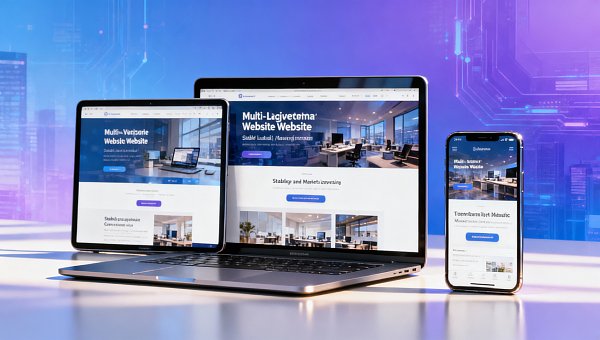
The access paths of foreign trade customers are highly fragmented. B2B buyers may check specifications on office computers, sales agents may view prices and case studies on mobile phones, and end consumers more often browse on mobile devices after jumping from social media. If a website is adapted to only a single screen, the bounce rate usually rises significantly within the first 3 seconds, and the completion rate of inquiry forms is also directly affected.
The core of multi-device adaptation is not just that the page “scales normally,” but that navigation, buttons, images, language switching, product details, and form modules remain readable, clickable, and submittable across common resolution ranges from 360px to above 1440px. This is especially important for languages with longer text such as German and French. Without a responsive layout, button wrapping and paragraph misalignment become much more common.
For markets such as Germany that value professionalism and information completeness, a website must not only demonstrate corporate strength, but also present technical materials, certification details, download entrances, and contact channels clearly on mobile devices. If the first screen of a page takes more than 3 seconds to load, or if the core CTA button requires more than 2 scrolls to become visible, it often weakens the trust of potential customers.
The actual impact of multi-device adaptation on the customer acquisition chain
In actual marketing scenarios, search engine organic traffic, ad landing page traffic, and social media referral traffic usually correspond to different device shares. If an enterprise is simultaneously doing Google promotion, content marketing, and social media operations, it cannot design only for the PC side. At a minimum, it must ensure that 4 categories of high-value pages—home page, product pages, case pages, and inquiry pages—meet mobile experience standards.
- Search traffic scenario: users pay more attention to page opening speed, title readability, content structure, and the efficiency of finding technical information.
- Ad traffic scenario: users rely more on above-the-fold information, button placement, form length, and click depth; completing conversion within 3 steps is more ideal.
- Social traffic scenario: users stay for a short time, so the page needs to present the core selling points and contact entrance within 5 seconds.
Common misunderstandings
Many companies mistakenly believe that “being able to open on a mobile phone” means adaptation is complete. In fact, truly effective responsive foreign trade website development must at least take into account layout reflow, image compression, language switching logic, form field optimization, and compatibility testing across different browsers. This is especially true for procurement-oriented pages, where too many fields, buttons that are too small, or unstable file uploads can all lead to the loss of highly interested customers.
Key standards and evaluation methods for responsive foreign trade website development
When evaluating whether a multilingual website can adapt to multiple devices, enterprises should not focus only on visual effects, but also on whether the structural layer, content layer, and marketing layer are unified. A usable foreign trade website solution usually needs to cover 5 levels: front-end responsiveness, back-end multilingual management, page performance optimization, basic SEO configuration, and conversion component configuration.
The following table can help decision-makers quickly judge the adaptation maturity of a multilingual foreign trade website. Whether building a new site or revamping an old one, it is recommended to evaluate based on 3 categories of indicators—device experience, technical structure, and marketing conversion—rather than comparing page prices alone.
As can be seen from the table, what truly determines the subsequent effectiveness of a website is not whether a single page design “looks good,” but whether the website has the capability for long-term operation. For project managers, acceptance inspection should cover at least 10 page templates, 3 types of devices, 2 browsers, and 1 complete form process, so as to avoid repeated rework after launch.
Does the German market need a responsive solution even more?
The answer is usually yes. German customers pay more attention to technical descriptions, corporate credibility, and logical information organization. Therefore, page structure should be stable, text blocks should have sufficient space, and certificates, downloads, and contact entrances should not be hidden too deeply. For websites related to industrial products, equipment parts, and engineering services, it is recommended to place product parameters, application scenarios, and FAQ in locations that can be found quickly within the first 2 screens.
In terms of content strategy, multilingual website development can also appropriately introduce content related to digital transformation to enhance brand professionalism. For example, naturally embedding topics such as Analysis of the impact of digital transformation on corporate resilience on industry insight pages helps enhance the company’s image as a solution-oriented service provider in the minds of overseas customers, provided that the content remains consistent with the main business scenarios.
Is multilingual website development expensive, and where are the main costs spent?
“Is multilingual website development expensive?” is one of the most frequently asked questions by enterprises. In fact, the cost level does not depend on the number of languages itself, but on the website objectives, page scale, depth of device adaptation, content production method, and later marketing plans. A 3-language website used only for display and a 5-language website that also supports SEO, ad intake, and inquiry management have completely different budget structures.
Under normal circumstances, costs can be divided into 4 sections: front-end design and development, back-end multilingual management, content translation and localization, and post-launch optimization and operations. If an enterprise hopes that the website will not only go live, but also generate stable inquiries within 6 months to 12 months, then the marketing configuration budget cannot be omitted.
Reference for typical cost composition
To facilitate decision-making, the following organizes the common investment items of multilingual responsive foreign trade websites in a structured way. Price differences among different companies are relatively large, so enterprises should focus more on functional boundaries, delivery lists, and follow-up maintenance mechanisms, rather than comparing only one-time prices.
The key to cost control is not cutting necessary modules, but phased development. Many enterprises can first launch 1 primary language plus 1 target market language, complete 10 to 20 key pages in the initial phase, and then expand according to market feedback. In this way, the launch cycle can be controlled within 2 to 6 weeks, while also making it easier to test conversion performance in different markets.
Which investments should never be skipped
- Device adaptation testing cannot be skipped, otherwise the mobile inquiry chain can easily fail.
- Basic SEO settings cannot be skipped, otherwise multilingual pages will find it difficult to gain stable exposure even after going live.
- Content localization cannot be skipped, otherwise it will be difficult to build professional trust in target markets such as German and French.
- Follow-up operation and maintenance cannot be skipped, otherwise hidden issues in speed, security, and form stability may appear after 1 to 3 months.
How to advance integrated implementation from website building to marketing conversion
Whether a foreign trade website can truly play its role depends not on the moment it goes live, but on whether it can take on organic traffic, advertising traffic, and channel distribution traffic after launch. An integrated solution is usually divided into 5 stages: requirement clarification, structural planning, development and launch, marketing deployment, and data iteration. Each stage needs to take both website and marketing into account, rather than handling them separately.
Recommended implementation process
- Stage 1: market and target definition. Clarify 2 to 3 key countries, 1 to 2 core customer groups, and more than 10 core keyword directions.
- Stage 2: information architecture and page planning. Usually start with 6 basic templates: home page, product page, application page, case page, about page, and contact page.
- Stage 3: multi-device development and coordination. Focus on checking navigation, language switching, download modules, button sizes, form fields, and image loading.
- Stage 4: marketing configuration. Simultaneously complete basic search optimization, ad landing page planning, social media redirect page design, and conversion tracking deployment.
- Stage 5: data iteration. Optimize page content, jump paths, and inquiry entrances according to 3 observation cycles of 7 days, 30 days, and 90 days.
For business decision-makers, what is most worth paying attention to is whether the delivery boundaries are clear. For example, whether keyword planning is included, whether subsequent language expansion is supported, whether CRM can be integrated, and whether there are quarterly reviews. These items directly determine whether the website is a one-time deliverable or a continuous growth tool.
Since its establishment in 2013, EasyAB Information Technology (Beijing) Co., Ltd. has formed synergistic capabilities in intelligent website building, SEO optimization, social media marketing, and advertising placement, driven by both technological innovation and localized services. For enterprises hoping to achieve higher conversion efficiency in overseas markets, integrated services can reduce the communication loss caused by coordination among multiple suppliers, and are especially suitable for project-based clients that require cross-departmental advancement.
4 details for improving conversion
First, mobile forms should be controlled within 4 to 6 fields as much as possible; second, the inquiry entrance should be displayed on the first or second screen of core product pages; third, language switching should be visible and should not affect the current page position; fourth, contact channels such as downloadable materials, WhatsApp, email, and phone should not be limited to only a single method. Such detailed optimization often brings more inquiry growth than simply increasing the number of pages.
Common issues and selection recommendations: how enterprises can avoid rework
The most common problems in multilingual foreign trade website projects are not that the technology cannot be implemented, but that early-stage requirements are unclear, acceptance standards are incomplete, and marketing reservations are insufficient. Many enterprises discover only after launch that some language pages are not managed independently, mobile forms provide no prompts, ad pages cannot be quickly duplicated, and content updates require frequent developer support, ultimately increasing the cost of a second redesign.
FAQ: Can a multilingual foreign trade website be completed in one step?
1. Which enterprises should prioritize multi-device adaptation?
It is suitable for enterprises that already have overseas promotion plans, are entering European markets such as Germany, have demand for 2 or more languages, or hope to simultaneously take on search and advertising traffic. It is especially a higher priority for industrial manufacturing, B2B parts, engineering services, and consumer goods brands.
2. How long is the delivery cycle generally?
Basic projects usually require 2 to 4 weeks, while projects that include multilingual content import and responsive testing commonly take 4 to 8 weeks. If the project involves more than 20 pages, more than 3 languages, and marketing linkage configuration, the cycle will be extended accordingly. Enterprises should require service providers to provide phased milestones, rather than only promising a final date.
3. Which indicators should be prioritized during procurement?
It is recommended to focus on 6 items: whether it is responsive, whether it supports independent language management, whether it has basic SEO configuration, whether it supports subsequent new page additions, whether it has data tracking capabilities, and whether it includes operation and maintenance support. If a supplier can only show design drafts but cannot explain post-launch maintenance and marketing paths, the risk is relatively high.
4. Should content be translated first or should the structure be built first?
Usually, it is safer to build the structure first and then localize the content. Because the length differences among languages can range from 15% to 40%, if machine translation is done first, layout problems are likely to occur later on mobile devices and in button areas. Confirming page modules first and then matching language content leads to higher overall efficiency.
In addition, when planning content, enterprises can also use industry trend articles as part of brand building. For example, combining topics such as Analysis of the impact of digital transformation on corporate resilience can supplement the company’s understanding of changes in the global market and help channel partners and buyers establish trust more quickly.
Of course, multilingual foreign trade websites can adapt to multiple devices, and this is no longer an added advantage, but a basic capability for facing overseas markets. A truly valuable website should form a closed loop among language management, device compatibility, search visibility, content engagement, and inquiry conversion, rather than staying at the level of merely “having a foreign-language website.”
If your company is evaluating responsive foreign trade website development, solutions for adapting to the German market, or the cost of multilingual website development, it is recommended to carry out systematic planning from 4 dimensions: target market, page structure, marketing reservation, and long-term operations. Choosing a service team with coordinated website-building and marketing capabilities is often more beneficial for controlling project timelines and subsequent investment.
If you would like to further understand the multilingual website development solution, device adaptation strategy, and overseas customer acquisition path suitable for your current business stage, please contact us immediately to obtain a customized solution and more detailed implementation options.
Related Articles



Related Products
 EasyCamp SaaS Smart Website Marketing SystemE-Yingbao SaaS Smart Website Marketing System: AI-powered, zero-code website building. Rapidly launch multilingual independent e-commerce sites in just 10 minutes. Global server acceleration and AI-driven SEO optimization empower businesses to efficiently connect with global markets. The seamless integration of technology and user-friendly operation makes building e-commerce sites incredibly simple.
 AI+SEM Intelligent Advertising Marketing SystemAI+SEM drives intelligent ad creation, empowering full-funnel precision advertising marketing. The system automatically generates weekly/monthly reports, AI recommends keywords and target countries, monitors core metrics in real-time with intelligent alerts, and enables one-click high-conversion ad solutions to help quickly acquire customers and improve ROI.
 AI+SEO Dual Engine Optimization ServiceEasyWin AI+SEO Dual Engine Optimization System leverages AI-powered keyword mining, content generation, and comprehensive technical optimization to help foreign trade enterprises acquire high-quality organic traffic, significantly improving search rankings and conversion rates.
 AI+SNS Social Media Marketing SystemYingbao AI+SNS Social Media Marketing System - Precision social capture for the social media era. Supports one-click content synchronization across major platforms like Facebook and LinkedIn. AI intelligently rewrites posts for enhanced relevance. 24/7 AI customer service and user profiling analysis empower businesses to efficiently expand into global markets.
 AI+SEO营销解决方案易营宝AI+SEO营销解决方案,通过AI批量写作、智能生成TDK、精准关键词扩词等功能,全面优化网站SEO效果,提升流量与转化率。助力企业构建高效智能网站新生态。
 AI+SEM Advertising Marketing SolutionsAI+SEM Advertising Marketing Solution leverages AI technology to deeply empower SEM ad campaigns. It automatically generates weekly/monthly reports using AI, presenting account data across multiple dimensions for comprehensive insights into campaign performance and trends. The system precisely recommends keywords and target countries, intelligently generates high-conversion ad copy, and enables one-click activation of efficient campaign plans to help businesses rapidly acquire customers. Simultaneously, it monitors core metrics in real time, intelligently identifies abnormal fluctuations, and issues timely alerts to ensure stable, high-return advertising results.
 Domain Name ServicesEasyWin provides professional domain name services, including intelligent queries, one-stop registration, brand protection, and full lifecycle management, helping businesses build a digital brand image.
 EasyOperate B2C Cross-Border E-Commerce Platform & Independent WebsiteEasyStore B2C Cross-border E-commerce Independent Store is an intelligent website building and cross-border e-commerce integrated solution independently developed by EasyStore Information Technology (Beijing) Co., Ltd. The system is specially designed for small and medium-sized as well as large export enterprises, integrating 'website building, operation, marketing, advertising, and conversion' into one, helping enterprises quickly establish cross-border e-commerce independent stores to achieve brand globalization and global sales growth.
The platform supports multiple languages, multiple currencies, and multi-channel marketing, with built-in AI intelligent translation and SEO optimization systems, suitable for mainstream markets such as Southeast Asia, Europe and America, Latin America, and the Middle East, assisting Chinese manufacturing enterprises in efficiently deploying international e-commerce strategies. SSL证书易营宝提供专业SSL安全证书服务,包括单域名和泛域名证书,确保网站数据传输加密、身份验证和完整性保护,助力企业建立安全可信的在线业务环境。









