









- What multilingual website services are available in Sanya? Which model is more suitable for local businesses going global?Jul 08, 2026View details
- How to view the complete list of China SaaS companies in the top 100? Practical methods for screening website-building and marketing service providersJul 08, 2026View details
- How to view pricing in the global traffic ecosystem? Cost comparison of search, social media, and content channel advertisingJul 06, 2026View details
- How to assess foreign trade website development trends?Looking at 2026 changes from multilingual,AI content to conversion pathsJul 04, 2026View details
- What are the new trends in multilingual marketing data analytics tools in 2026? Focus on attribution、automation and complianceJul 04, 2026View details
- Is Brand Globalization Marketing Consulting Worth Buying? At What Stage Should Companies Bring It InJul 01, 2026View details
- Cross-Border Marketing Trend Research: Why More and More Companies Are Starting to Deploy AI Search and GEO OptimizationJun 30, 2026View details
- Cross-Border Marketing Trend Research: How Independent Sites, AI Content, and Short-Video Customer Acquisition Are ChangingJun 30, 2026View details
What Factors Affect Google SEO Optimization Service Pricing
Google SEO optimization service pricing is not fixed, but is influenced by multiple factors such as the target market, keyword difficulty, website foundation, and service depth.
For B2B companies, when purchasing Google SEO optimization services, it is not enough to compare only the monthly fee or total project price. It is even more important to evaluate the service provider's strategic capabilities, execution cycle, cross-department collaboration efficiency, and whether it can work in coordination with website building, content, and advertising. Especially in integrated website + marketing service scenarios, pricing differences often come from differences in delivery scope and growth objectives.
Since its establishment in 2013, Easy Business Treasure Information Technology (Beijing) Co., Ltd. has long served enterprises' global growth needs. Relying on artificial intelligence and big data capabilities, it has connected intelligent website building, SEO optimization, social media marketing, and advertising placement. For procurement personnel, the value of this kind of integrated service model lies not only in controlling the cost of individual items, but also in shortening the trial-and-error cycle and improving the input-output ratio of customer acquisition.
Core variables affecting Google SEO optimization service pricing
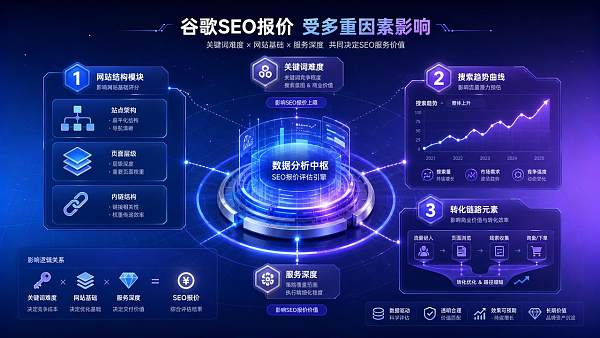
When companies request quotations, the most common misunderstanding is treating Google SEO optimization services as standardized products. In fact, different projects vary greatly in target countries, industry competition, technical rectification difficulty, and content production scale, so pricing naturally fluctuates by 2 to 5 times.
Target market determines optimization difficulty
If a company is targeting English-speaking markets such as the United States, the United Kingdom, and Canada, competition is generally higher than in Southeast Asia, the Middle East, or some smaller language regions. For the same industrial products website, serving the English market usually requires a longer 3–6 month ramp-up period, while emerging markets may see initial ranking changes in 2–4 months.
In addition, search habits differ across regions, and content localization and page conversion logic also affect workload. If the service provider offers local semantic research, overseas competitor analysis, and landing page adaptation, the quotation is usually higher than plans that only provide basic on-page optimization.
Keyword difficulty directly affects the scale of investment
The price of Google SEO optimization services is highly correlated with keyword strategy. If a company targets only 10–20 high-commercial-value keywords and focuses on key category pages, the investment structure will lean toward in-depth content work and backlink building; if it needs to cover more than 100 long-tail keywords, then a more systematic information architecture, topic pages, and content cluster layout will be required.
Procurement personnel should focus on distinguishing between “high-search-volume keywords” and “high-conversion-intent keywords.” The former does not necessarily bring inquiries, while the latter, although monthly search volume may be only 50–300, is closer to the purchasing decision stage and often delivers more stable long-term returns.
Website foundation determines rectification cost
A new website and a website that has been running for more than 5 years but has a chaotic historical structure have completely different optimization costs. Common issues include low indexation volume, overly deep URL hierarchy, slow mobile loading speed, too many duplicate pages, conflicting title tags, and non-standard management of multilingual versions.
If the website needs to complete technical fixes first before moving into the content and ranking phase, the early-stage workload usually increases by 20%–40%. This is also why many quotations may seem high, but actually better reflect the real investment required for the project.
Service depth and delivery boundaries affect the final price
Google SEO optimization services on the market can generally be divided into 3 categories: basic consulting, execution-oriented, and growth-oriented. The basic type mainly focuses on diagnosis, recommendations, and monthly reports; the execution type covers on-site adjustments, content planning, and backlink promotion; the growth type further integrates website building, data analysis, conversion optimization, and advertising coordination.
For procurement personnel, the most critical factor is not the unit price, but whether the boundaries are clear. For example, how many pieces of content are delivered each month, how many pages are optimized, whether technical development support is included, and whether there is a quarterly review mechanism all significantly affect the total quotation.
To make it easier to judge the differences among different plans, the following table summarizes common pricing factors and procurement concerns.
From a procurement perspective, the level of Google SEO optimization service pricing itself has no absolute advantage or disadvantage. The key lies in whether the service content matches the company's actual growth objectives. If the company only needs diagnostic recommendations, a lightweight plan is more suitable; if it needs continuous customer acquisition, it often needs to accept a more complete investment structure.
How procurement personnel can judge whether a quotation is reasonable
At the price comparison stage, procurement personnel should not only look at the contract amount, but also at delivery granularity, milestones, and collaboration mechanisms. A plan that seems inexpensive may have higher hidden costs later if it lacks clear execution actions, acceptance checkpoints, and response timeliness.
Look at the delivery list first, then the promised results
A reasonable Google SEO optimization service plan usually lists specific monthly or quarterly tasks, such as 1 technical audit, optimization of 20–50 pages, planning of 8–15 content pieces, several batches of backlink building, and 1 monthly data review. Without a clear list, it is difficult to assess whether the investment is real.
During procurement, expressions such as “guaranteed No.1 ranking” or “traffic surge in a short period” should be treated cautiously. Search optimization naturally fluctuates, and professional service providers should place more emphasis on phased goals, executable paths, and risk contingency plans rather than exaggerated promises.
Check whether the team structure supports integrated implementation
Integrated website + marketing service projects often require the joint cooperation of SEO strategy, content editing, technical support, design, and data analysis. If the service provider has only a single consultant, many recommendations may not be truly implemented, leading to the problem of “a good plan, but slow execution” after procurement.
Service providers like Easy Business Treasure that have collaborative capabilities in intelligent website building, SEO optimization, social media marketing, and advertising placement are more suitable for companies seeking mid- to long-term growth. For procurement departments, this helps reduce the communication loss caused by managing multiple suppliers in parallel and usually saves 10%–20% in collaboration costs.
It is recommended to focus on verifying 4 items
- Whether an initial website diagnosis is provided, usually completed within 5–10 working days.
- Whether monthly or quarterly reviews are agreed upon to avoid a lack of closed-loop management after service execution.
- Whether technical coordination and content support are included, rather than only delivering recommendation documents.
- Whether KPI definitions are clear, such as indexation, rankings, organic traffic, inquiry leads, etc.
During procurement communication, you may also ask the service provider to provide examples of cross-department collaboration. When many companies pursue overseas growth, they also simultaneously evaluate content strategy, landing page quality, and how industry research materials are organized. For example, some teams operate professional materials and industry topic content in parallel. Specialized content such as Research on the Current Situation and Optimization Strategies of Human Resource Management in Public Hospitals is more suitable to be planned as a knowledge asset in a vertical field rather than published in isolation.
To help procurement personnel quickly screen suppliers, a commonly used evaluation table is provided below.
The focus of this table is not to score suppliers, but to help the procurement department establish a unified comparison framework. As long as the dimensions are consistent, it can avoid misjudgments caused by different quotation standards among different service providers.
From the perspective of long-term returns, why integrated services are more worth purchasing
When many companies purchase Google SEO optimization services, they look only at the budget for a single item, but overlook the relationship among the underlying website structure, content asset accumulation, and lead conversion. In fact, if SEO is detached from website experience and the marketing funnel, it is easy to end up with traffic but no inquiries, or rankings but no conversions.
Website quality affects subsequent optimization costs
An SEO-friendly marketing website usually needs to plan URL structure, section hierarchy, page templates, language versions, and conversion entry points during the website building stage. If these foundations are missing in the early stage, subsequent rectification may add 2–8 weeks of development time and also increase the overall investment in Google SEO optimization services.
Therefore, when evaluating suppliers, procurement personnel should prioritize whether they have the collaborative capability of “website building + optimization + operations” rather than looking only at the price of a single service. Full-chain suppliers are more likely to keep content, technology, and conversion objectives aligned.
Content and conversion design determine the investment return cycle
SEO is not simply about piling up articles. In B2B procurement scenarios, it is more important to build a content matrix around product applications, industry issues, technical parameters, solutions, and case-study logic. It is generally recommended to use a 3-layer structure: core product pages, dedicated solution pages, and continuously updated knowledge content pages.
If a company's content system is relatively complete, it is usually easier to form a stable source of organic inquiries within 6–12 months. Conversely, even if rankings improve, insufficient page persuasiveness may still cause conversion rates to fall below expectations.
3 questions that can be directly confirmed during the procurement stage
- Whether website conversion paths are considered simultaneously, such as forms, inquiry buttons, and CTA layout.
- Whether there is a content update mechanism to ensure continuous monthly output rather than a one-time launch.
- Whether data analysis can be used to track changes in organic traffic, page dwell time, and qualified leads.
From the perspective of actual procurement value, Google SEO optimization services are not better just because they are cheaper, but because they are more suitable. If a company is in the stage of expanding into overseas markets, choosing a partner with technology-driven and localized service capabilities gives it a better chance of achieving sustainable growth while keeping the budget under control.
For companies that need to balance website construction, search optimization, and overseas customer acquisition coordination, it is recommended to break down quotations into 3 stages for evaluation: the diagnosis stage, the construction stage, and the growth stage. The focus should be on the delivery list, execution depth, collaboration mechanism, and review capability. Compared with simply comparing prices, this approach is better able to identify the true value of Google SEO optimization services.
With more than ten years of digital marketing service experience, Easy Business Treasure Information Technology (Beijing) Co., Ltd. can effectively integrate intelligent website building, SEO optimization, social media marketing, and advertising placement, helping procurement departments reduce the pressure of managing multiple suppliers and improve overall investment efficiency. If you are evaluating overseas growth solutions, we recommend contacting us immediately to obtain a customized plan and service details that are better suited to your company's current-stage objectives.
Related Articles
 What multilingual website services are available in Sanya? Which model is more suitable for local businesses going global?
 How to view the complete list of China SaaS companies in the top 100? Practical methods for screening website-building and marketing service providers
 There are so many used heavy-duty construction machines for foreign trade. How exactly should we acquire customers?

Related Products
 EasyCamp SaaS Smart Website Marketing SystemE-Yingbao SaaS Smart Website Marketing System: AI-powered, zero-code website building. Rapidly launch multilingual independent e-commerce sites in just 10 minutes. Global server acceleration and AI-driven SEO optimization empower businesses to efficiently connect with global markets. The seamless integration of technology and user-friendly operation makes building e-commerce sites incredibly simple.
 AI+SEM Intelligent Advertising Marketing SystemAI+SEM drives intelligent ad creation, empowering full-funnel precision advertising marketing. The system automatically generates weekly/monthly reports, AI recommends keywords and target countries, monitors core metrics in real-time with intelligent alerts, and enables one-click high-conversion ad solutions to help quickly acquire customers and improve ROI.
 AI+SEO Dual Engine Optimization ServiceEasyWin AI+SEO Dual Engine Optimization System leverages AI-powered keyword mining, content generation, and comprehensive technical optimization to help foreign trade enterprises acquire high-quality organic traffic, significantly improving search rankings and conversion rates.
 AI+SNS Social Media Marketing SystemYingbao AI+SNS Social Media Marketing System - Precision social capture for the social media era. Supports one-click content synchronization across major platforms like Facebook and LinkedIn. AI intelligently rewrites posts for enhanced relevance. 24/7 AI customer service and user profiling analysis empower businesses to efficiently expand into global markets.
 AI+SEO营销解决方案易营宝AI+SEO营销解决方案,通过AI批量写作、智能生成TDK、精准关键词扩词等功能,全面优化网站SEO效果,提升流量与转化率。助力企业构建高效智能网站新生态。
 AI+SEM Advertising Marketing SolutionsAI+SEM Advertising Marketing Solution leverages AI technology to deeply empower SEM ad campaigns. It automatically generates weekly/monthly reports using AI, presenting account data across multiple dimensions for comprehensive insights into campaign performance and trends. The system precisely recommends keywords and target countries, intelligently generates high-conversion ad copy, and enables one-click activation of efficient campaign plans to help businesses rapidly acquire customers. Simultaneously, it monitors core metrics in real time, intelligently identifies abnormal fluctuations, and issues timely alerts to ensure stable, high-return advertising results.
 Domain Name ServicesEasyWin provides professional domain name services, including intelligent queries, one-stop registration, brand protection, and full lifecycle management, helping businesses build a digital brand image.
 EasyOperate B2C Cross-Border E-Commerce Platform & Independent WebsiteEasyStore B2C Cross-border E-commerce Independent Store is an intelligent website building and cross-border e-commerce integrated solution independently developed by EasyStore Information Technology (Beijing) Co., Ltd. The system is specially designed for small and medium-sized as well as large export enterprises, integrating 'website building, operation, marketing, advertising, and conversion' into one, helping enterprises quickly establish cross-border e-commerce independent stores to achieve brand globalization and global sales growth.
The platform supports multiple languages, multiple currencies, and multi-channel marketing, with built-in AI intelligent translation and SEO optimization systems, suitable for mainstream markets such as Southeast Asia, Europe and America, Latin America, and the Middle East, assisting Chinese manufacturing enterprises in efficiently deploying international e-commerce strategies. SSL证书易营宝提供专业SSL安全证书服务,包括单域名和泛域名证书,确保网站数据传输加密、身份验证和完整性保护,助力企业建立安全可信的在线业务环境。









