









- What multilingual website services are available in Sanya? Which model is more suitable for local businesses going global?Jul 08, 2026View details
- How to view the complete list of China SaaS companies in the top 100? Practical methods for screening website-building and marketing service providersJul 08, 2026View details
- How to view pricing in the global traffic ecosystem? Cost comparison of search, social media, and content channel advertisingJul 06, 2026View details
- How to assess foreign trade website development trends?Looking at 2026 changes from multilingual,AI content to conversion pathsJul 04, 2026View details
- What are the new trends in multilingual marketing data analytics tools in 2026? Focus on attribution、automation and complianceJul 04, 2026View details
- Is Brand Globalization Marketing Consulting Worth Buying? At What Stage Should Companies Bring It InJul 01, 2026View details
- Cross-Border Marketing Trend Research: Why More and More Companies Are Starting to Deploy AI Search and GEO OptimizationJun 30, 2026View details
- Cross-Border Marketing Trend Research: How Independent Sites, AI Content, and Short-Video Customer Acquisition Are ChangingJun 30, 2026View details
What issues can website analysis with webmaster tools uncover
Website analysis through webmaster tools can quickly expose core issues related to indexing, speed, structure, and keyword distribution. For technical evaluators, it is not only the entry point for diagnosis, but also an important basis for formulating optimization strategies and improving traffic conversion efficiency. For integrated website and marketing service businesses, the earlier abnormalities are identified through webmaster tool website analysis, the more traffic loss and wasted ad spend can be reduced.
Why webmaster tool website analysis should come first
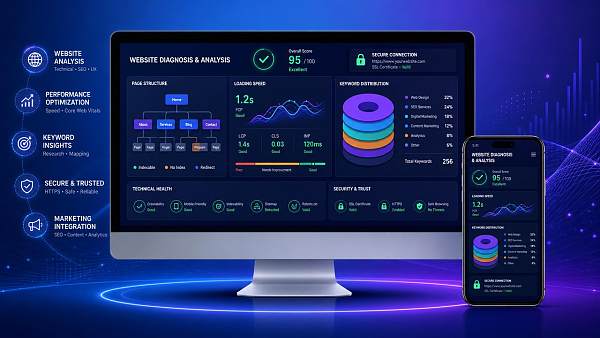
Many website issues are not visible to the naked eye. A page being accessible does not mean search engines can crawl it smoothly; content being updated does not mean the keyword distribution is effective; ads getting clicks does not mean the landing page is capable of converting. The value of webmaster tool website analysis lies in using measurable metrics to quickly bring these hidden issues to the surface.
For the business growth funnel, a website is both a brand asset and a traffic conversion carrier. If its foundational health is inadequate, SEO optimization, ad placement, and social media traffic acquisition will all be affected in a chain reaction. Therefore, before formally adjusting content, structure, and promotion plans, completing a systematic website analysis first can often help avoid many detours.
Core checklist for webmaster tool website analysis
- Check indexing status. First see whether the homepage, category pages, and content pages are being indexed properly, then compare the number submitted with the actual number indexed to determine whether there are issues such as blocked crawling, too many low-quality pages, or insufficient update frequency.
- Verify titles and descriptions. Focus on whether there are duplicate titles, keyword stuffing, imbalanced length, or missing brand terms, as these issues directly affect search visibility and click-through rate.
- Evaluate page speed. Pay attention to metrics such as first screen load, resource requests, image size, and script blocking. If loading is too slow, not only will rankings be affected, but ad traffic conversion will also drop significantly.
- Review website structure. Check navigation hierarchy, internal link distribution, breadcrumbs, URL standards, and broken links. A messy structure will reduce crawling efficiency and weaken authority transfer to key pages.
- Analyze keyword distribution. Check whether core keywords, long-tail keywords, and brand terms are distributed across the homepage, category pages, and content pages, and avoid multiple pages competing for the same keyword, which leads to internal competition.
- Track mobile adaptation. Confirm whether pages on mobile devices have issues such as text that is too small, buttons that are hard to tap, pop-ups blocking content, or layout misalignment. These problems directly harm retention and conversion.
- Validate security and stability. This includes HTTPS deployment, certificate validity period, redirect standards, and server stability. Security warnings or frequent downtime will greatly weaken search trust.
- Compare competitor websites. Observing competitors' indexing scale, authority changes, keyword coverage, and backlink trends through webmaster tool website analysis can help determine the optimization priorities for your own site.
What specific issues can usually be identified through analysis
Indexing anomalies and low crawl efficiency
A common situation is that a website has many pages but very few are indexed; or the homepage is indexed normally, while content pages fail to enter the index for a long time. The reasons are usually concentrated in robots restrictions, high page duplication, category structures that are too deep, or a lack of effective internal link entry points for new pages. Webmaster tool website analysis can help quickly locate these breakpoints.
Page speed dragging down rankings and conversions
If page loading time is too long, search engines will lower the crawl experience score, and visitors will also be more likely to leave halfway through. Especially for marketing websites, once landing page speed slows down, promotion costs will be directly amplified. Uncompressed images, redundant code, and slow server response are all high-frequency issues.
Imbalanced keyword distribution
Many websites place all keywords on the homepage, while category pages and content pages lack clear division of roles, resulting in an overloaded homepage and long-tail traffic failing to be released. Another situation is that the same keyword is repeatedly targeted by multiple pages, which instead weakens overall ranking performance.
Incomplete foundational configuration
Webmaster tool website analysis also often exposes infrastructure issues, such as non-standard 301 redirects, missing sitemap, canonical not set, too many broken links, and messy DNS records. These issues may look like technical details, but they continuously affect SEO performance and access stability.
If an enterprise is building a new website or changing its brand entry point, the domain link should not be overlooked either. For example, in a brand globalization strategy, completing intelligent lookup, suffix protection, automatic DNS resolution, and expiration reminders in advance through domain services can reduce DNS errors, cybersquatting risks, and launch delays, allowing subsequent webmaster tool website analysis to be built on a more stable foundation.
Supplementary judgment under different application scenarios
New website launch stage
For a new website, the most important things to focus on are crawlability and the completeness of foundational signals. In addition to checking whether the homepage is indexed, you should also verify category structure, page templates, TDK settings, and sitemap submission status. The earlier problems are found at this stage, the lower the subsequent repair cost.
If the domain has just been activated, you should also confirm whether DNS resolution is stable, whether there is any historical contamination record, and whether access is consistent across different devices. This will directly affect the search engine's initial recognition and trust building.
SEO optimization stage
When continuously working on content and rankings, webmaster tool website analysis should focus on keyword coverage, growth in indexed pages, and the performance of competitive keywords. If a lot of updates are made but no new traffic is gained, the issue is often not the amount of content, but rather deviations in keyword selection, structure, or internal linking strategy.
Advertising placement and conversion handoff stage
During the advertising stage, you cannot focus only on cost per click; you also need to review page experience in reverse. Loading speed, form usability, mobile adaptation, and page credibility can all reveal warning signs through website analysis. If the landing page foundation is weak, even highly precise traffic will struggle to generate effective conversions.
Commonly overlooked items and risk reminders
Ignoring the handling of historical broken links will cause old pages to continue consuming crawl budget, affecting the indexing efficiency of new content. If old URL mapping is not done after a website redesign, ranking fluctuations are usually very obvious.
Ignoring duplicate title issues will cause multiple pages to lack differentiation in search results, reduce click-through rate, and make it difficult for search engines to determine page topic priority.
Ignoring domain and DNS management will plant hidden risks in access stability for a website that appears normal on the surface. Especially when protection for multiple suffix brand assets is insufficient and renewal reminders are missing, both brand assets and traffic entry points may be affected.
Ignoring data comparison cycles can also lead to misjudging optimization results. Webmaster tool website analysis is more suitable for observing trends weekly and monthly, rather than only looking at the fluctuations of one single day's data.
Practical execution recommendations
- First create a checklist, and record indexing, speed, structure, keywords, mobile, and security items separately to avoid scattered information after one round of analysis.
- Then determine priorities, solving hard issues that affect crawling, access, and conversion first, and then handling content and detailed optimization.
- Align business goals simultaneously, and distribute brand terms, defensive terms, and conversion terms in layers instead of only pursuing superficial traffic growth.
- Establish a review rhythm, and it is recommended to conduct one complete webmaster tool website analysis every month and track core anomaly metrics every week.
Summary and next steps
Webmaster tool website analysis is not simply about looking at a few scores, but about conducting a full-chain health check of the website from indexing, speed, structure, and keywords to stability. It can help identify the real reasons behind stagnant rankings, no traffic growth, and unsatisfactory conversions.
For integrated website and marketing service scenarios, a more effective approach is to consider website analysis together with website building, SEO, advertising, and domain management. Only by completing a systematic inspection first and then rectifying issues one by one according to priority can traffic acquisition, brand accumulation, and business conversion truly form a closed loop.
Related Articles
 What multilingual website services are available in Sanya? Which model is more suitable for local businesses going global?
 How to view the complete list of China SaaS companies in the top 100? Practical methods for screening website-building and marketing service providers
 There are so many used heavy-duty construction machines for foreign trade. How exactly should we acquire customers?



Related Products
 EasyCamp SaaS Smart Website Marketing SystemE-Yingbao SaaS Smart Website Marketing System: AI-powered, zero-code website building. Rapidly launch multilingual independent e-commerce sites in just 10 minutes. Global server acceleration and AI-driven SEO optimization empower businesses to efficiently connect with global markets. The seamless integration of technology and user-friendly operation makes building e-commerce sites incredibly simple.
 AI+SEM Intelligent Advertising Marketing SystemAI+SEM drives intelligent ad creation, empowering full-funnel precision advertising marketing. The system automatically generates weekly/monthly reports, AI recommends keywords and target countries, monitors core metrics in real-time with intelligent alerts, and enables one-click high-conversion ad solutions to help quickly acquire customers and improve ROI.
 AI+SEO Dual Engine Optimization ServiceEasyWin AI+SEO Dual Engine Optimization System leverages AI-powered keyword mining, content generation, and comprehensive technical optimization to help foreign trade enterprises acquire high-quality organic traffic, significantly improving search rankings and conversion rates.
 AI+SNS Social Media Marketing SystemYingbao AI+SNS Social Media Marketing System - Precision social capture for the social media era. Supports one-click content synchronization across major platforms like Facebook and LinkedIn. AI intelligently rewrites posts for enhanced relevance. 24/7 AI customer service and user profiling analysis empower businesses to efficiently expand into global markets.
 AI+SEO营销解决方案易营宝AI+SEO营销解决方案,通过AI批量写作、智能生成TDK、精准关键词扩词等功能,全面优化网站SEO效果,提升流量与转化率。助力企业构建高效智能网站新生态。
 AI+SEM Advertising Marketing SolutionsAI+SEM Advertising Marketing Solution leverages AI technology to deeply empower SEM ad campaigns. It automatically generates weekly/monthly reports using AI, presenting account data across multiple dimensions for comprehensive insights into campaign performance and trends. The system precisely recommends keywords and target countries, intelligently generates high-conversion ad copy, and enables one-click activation of efficient campaign plans to help businesses rapidly acquire customers. Simultaneously, it monitors core metrics in real time, intelligently identifies abnormal fluctuations, and issues timely alerts to ensure stable, high-return advertising results.
 Domain Name ServicesEasyWin provides professional domain name services, including intelligent queries, one-stop registration, brand protection, and full lifecycle management, helping businesses build a digital brand image.
 EasyOperate B2C Cross-Border E-Commerce Platform & Independent WebsiteEasyStore B2C Cross-border E-commerce Independent Store is an intelligent website building and cross-border e-commerce integrated solution independently developed by EasyStore Information Technology (Beijing) Co., Ltd. The system is specially designed for small and medium-sized as well as large export enterprises, integrating 'website building, operation, marketing, advertising, and conversion' into one, helping enterprises quickly establish cross-border e-commerce independent stores to achieve brand globalization and global sales growth.
The platform supports multiple languages, multiple currencies, and multi-channel marketing, with built-in AI intelligent translation and SEO optimization systems, suitable for mainstream markets such as Southeast Asia, Europe and America, Latin America, and the Middle East, assisting Chinese manufacturing enterprises in efficiently deploying international e-commerce strategies. SSL证书易营宝提供专业SSL安全证书服务,包括单域名和泛域名证书,确保网站数据传输加密、身份验证和完整性保护,助力企业建立安全可信的在线业务环境。









