









- What multilingual website services are available in Sanya? Which model is more suitable for local businesses going global?Jul 08, 2026View details
- How to view the complete list of China SaaS companies in the top 100? Practical methods for screening website-building and marketing service providersJul 08, 2026View details
- How to view pricing in the global traffic ecosystem? Cost comparison of search, social media, and content channel advertisingJul 06, 2026View details
- How to assess foreign trade website development trends?Looking at 2026 changes from multilingual,AI content to conversion pathsJul 04, 2026View details
- What are the new trends in multilingual marketing data analytics tools in 2026? Focus on attribution、automation and complianceJul 04, 2026View details
- Is Brand Globalization Marketing Consulting Worth Buying? At What Stage Should Companies Bring It InJul 01, 2026View details
- Cross-Border Marketing Trend Research: Why More and More Companies Are Starting to Deploy AI Search and GEO OptimizationJun 30, 2026View details
- Cross-Border Marketing Trend Research: How Independent Sites, AI Content, and Short-Video Customer Acquisition Are ChangingJun 30, 2026View details
How to Avoid Homogenization in AI Writing Content Generation
AI-written content generation is becoming increasingly common, but homogenization is also dragging down content value. For frontline operators, only by mastering differentiation strategies can they balance efficiency, search performance, and conversion results. This article will break down the key methods from a practical perspective.
In an integrated website + marketing service scenario, content is not just text used to fill pages, but directly affects indexing, inquiries, time on page, and lead quality. Especially when website building, SEO, advertising, and social media operations are being advanced in coordination, if AI-written content generation stays only at the level of “mass draft output”, it often makes pages look complete, while in reality failing to create differentiated competitiveness.
For operators who are responsible on a daily basis for content publishing, section maintenance, keyword expansion, and landing page creation, the real issue to solve is not “whether it can be generated”, but how to produce efficiency, industry depth, and conversion intent within one workflow at the same time. E-Marketing Treasure Information Technology (Beijing) Co., Ltd. has been deeply engaged in global digital marketing services for more than 10 years, and has continuously verified, across links such as intelligent website building, SEO optimization, social media marketing, and advertising, the impact of content differentiation on growth results.
Why AI-written content generation is prone to homogenization
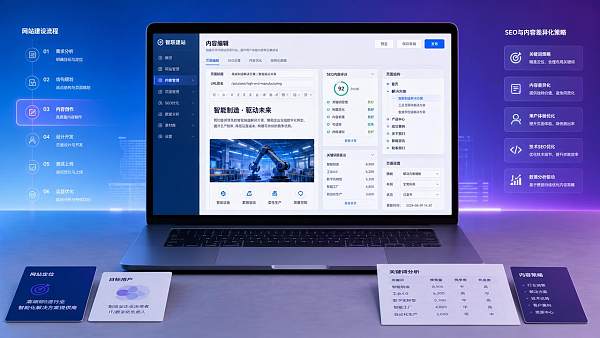
When many teams use AI-written content generation, the first problem is often not insufficient model capability, but overly rough input. For example, if only one industry term and one title are provided, the system will usually produce content with similar structures, close viewpoints, and generalized wording. Three seemingly different articles may still highly overlap in core information, making it difficult for both search engines and users to perceive any difference in value.
Common sources of homogenization
The first type is a single keyword input. Repeatedly generating content around only 1 core keyword will lead to repetitive expressions in titles, paragraphs, and examples. The second type is not defining the target audience identity, for example, procurement staff, operations staff, editors, and foreign trade managers have completely different concerns. The third type is not adding business objectives, resulting in content that lacks inquiry, conversion, or page transition logic.
The fourth type is not integrating site structure. The homepage, product pages, solution pages, and blog pages should use at least 4 different writing approaches. The fifth type is not setting data granularity, such as delivery cycle, implementation steps, review frequency, page module quantity, etc. Once these specific details are missing, the article will fall into empty and vague expression.
The 3 details most easily overlooked at the operational level
- The same prompt is used continuously for more than 7 days without updating variables.
- Articles in the same section use the same paragraph template, with highly repetitive opening and ending paragraphs.
- No 3-level expansion is carried out for industry terms, scenario terms, and regional terms, resulting in overly narrow semantic coverage.
The table below can help operators quickly identify the most common sources of repetition in AI-written content generation and determine the priority order for optimization.
From the perspective of execution priority, changing the input first, then the structure, and finally the language usually significantly reduces the sense of repetition within 2 to 3 rounds of iteration. In other words, the differentiation of AI-written content generation does not lie in the “polisher”, but in front-end content design.
Differentiation methods that frontline operators can directly implement
If website content needs to be updated in batches on a daily basis, it is recommended to split AI-written content generation into 5 steps: “topic selection—input—generation—correction—publishing”, instead of producing a complete final draft in one go. If each step improves by only 15% to 20%, the final draft quality is usually one level higher than direct generation.
Method 1: Segment the audience first, then write the content
Even within website marketing services, foreign trade salespeople care more about inquiry entry points, SEO executors focus more on keyword layout, and brand managers pay more attention to brand consistency. It is recommended that each article fix at least 1 type of core reader, 2 main questions, and 1 page objective. In this way, the generated results are more focused, and the article is also better able to support subsequent conversion actions.
Method 2: Break industry information into modular variables
You can preset 6 types of variables in prompts: industry, region, site type, promotion channel, customer stage, and language version. For example, when working on a cross-border e-commerce project, multilingual site content should not only emphasize translation accuracy, but also consider search habits, regional keywords, and differences in landing page structure. The clearer the variables, the less likely AI-written content generation is to produce copy-and-paste style output.
Method 3: Force the inclusion of business details
At least 4 types of business details should be added to the content: page quantity, delivery cycle, optimization frequency, and review checkpoints. For example, one industry solution page may include 6 to 8 modules; the initial build cycle of a standard website can be controlled within 7 to 15 days; the weekly SEO content update frequency can be set at 2 to 4 articles; and advertising landing pages are recommended to review the conversion path once per month.
Execution checklist suitable for establishing internal SOPs
- First define the page objective: indexing, inquiries, material downloads, or brand display.
- Then list 8 to 15 semantically related terms instead of keeping only the main keyword.
- After generating the draft, manually supplement industry terminology, service processes, and risk reminders.
- Before publishing, check whether the title, opening paragraph, table, and call to action correspond to each other.
If the content is related to the Russian market, the operational level also needs to pay more attention to differences in search engines and local language expression. For example, when building an independent cross-border e-commerce site, putting website building, translation, domain name, and optimization tools into the same workflow is more stable than outsourcing content alone. For example, Russian industry website construction and marketing solutions are suitable for teams that need to simultaneously advance Russian website construction, Yandex optimization tools, AI intelligent translation, SEO keyword expansion, ru domain registration, and automatic SSL certificate application, which can reduce repeated revisions caused by multi-vendor coordination.
In actual execution, operators may as well upgrade “content production” to “page asset production”. One article should not only serve one keyword, but also support section authority, topic aggregation, product traffic guidance, and follow-up remarketing. This is also the biggest difference between integrated website + marketing services and pure copywriting.
From search performance to conversion results, how should content be accepted
Whether AI-written content generation truly avoids homogenization cannot rely only on subjective judgment. For operators, at least 3 levels of acceptance should be established: page level, search level, and conversion level. Each level has specific indicators, making it convenient to continuously review within 7 days, 30 days, and 60 days after going live.
Page level: first look at readability and structural completeness
At the page level, focus on checking 4 items: whether the title is clear, whether the opening paragraph gets to the point, whether the subheadings are clear, and whether the call to action is natural. Usually, a service-oriented article should contain at least 2 H2s, more than 3 subheadings, and 1 to 2 structured modules. If the entire text consists only of continuous paragraphs, with no tables, lists, or processes, user scanning efficiency will drop significantly.
Search level: look at keyword coverage and page transition
The search level is not just about the ranking of one word, but whether three types of word groups are covered: core terms, related terms, and question terms. For example, if the core term revolves around AI-written content generation, related terms can be expanded to content homogenization, SEO content optimization, industry website copy, and marketing landing pages, while question terms can revolve around user expressions such as “how to avoid repetition” and “how to improve conversions”.
To make execution easier, the table below organizes common acceptance indicators and recommended threshold values, making it convenient for teams to directly reuse them in weekly or monthly reports.
The focus of this table is not to pursue uniform values, but to let the team know what to look at at different levels. Many content teams only look at indexing, but ignore consultation button clicks and page dwell time, resulting in content that seems abundant but actually provides limited support for transactions.
Conversion level: let content serve inquiries rather than stop at traffic
The content of integrated website + marketing services must ultimately return to lead acquisition. A service-oriented article can set 1 solution entry point, 1 scenario entry point, and 1 consultation entry point in the text, forming 3-point support. For businesses such as cross-border e-commerce, foreign trade website building, and multilingual promotion, this structure is more effective than simply leaving contact information at the end.
If an enterprise is entering the Russian market, in addition to the content writing itself, it also needs to simultaneously consider language version pages, regional domain names, search tools, and on-site security configuration. Rather than continuously patching things later, it is better to directly adopt a one-stop construction approach at the early stage. For example, a Russian market construction solution for cross-border e-commerce scenarios is more suitable for teams that need to go live quickly while also considering promotion coordination.
The most common misunderstandings when avoiding homogenization and correction suggestions
The first misunderstanding is excessively pursuing “human-like” writing, resulting in a large amount of time spent modifying colloquial expressions while failing to add truly valuable information. Operators should put 70% of their effort into structure and information increment, and 30% into wording optimization, which is more cost-effective.
The second misunderstanding is writing every article like an encyclopedia entry. For solution pages, service pages, and product pages, the content focus should be application scenarios, implementation processes, risk points, and cooperation methods, rather than laying out too many basic concepts. Generally, controlling it within 3 to 5 core questions is more conducive to page focus.
The third misunderstanding is ignoring manual review. Even though AI-written content generation is already very mature, it is still recommended to complete at least 2 rounds of checks before going live: the first round looks at facts and business logic, and the second round looks at page readability and link transition. For multilingual content, it is best to add 1 round of local expression review to avoid an overly strong sense of literal translation.
Recommended content review mechanism to establish
- Every 7 days, check the indexing and crawling status of new pages.
- Every 30 days, count entry clicks, dwell time, and bounce trends.
- Every quarter, sort out highly repetitive articles and rewrite their titles, structure, and intent.
Truly effective differentiation is not about making every piece of content look “completely different”, but about continuously outputting page assets that are closer to scenarios, better at solving problems, and stronger in transition capability under the same business framework. For operators, this is a working method that can be replicated, iterated, and measured for results.
As AI-written content generation enters a normalized stage, what enterprises compete on is no longer just generation speed, but content systematization capability. Relying on practical experience in parallel technological innovation and localized services, E-Marketing Treasure Information Technology (Beijing) Co., Ltd. can more closely connect website building, optimization, marketing, and content production, helping enterprises reduce homogenization investment and improve page value and lead conversion efficiency.
If you are optimizing your content production process, or hope to coordinate website building, SEO, social media, and advertising, it is recommended to sort out your existing pages and content chain as soon as possible to obtain a customized solution that better fits your business goals. You are welcome to contact us now to consult product details and learn more solutions.
Related Articles
 What multilingual website services are available in Sanya? Which model is more suitable for local businesses going global?
 How to view the complete list of China SaaS companies in the top 100? Practical methods for screening website-building and marketing service providers
 There are so many used heavy-duty construction machines for foreign trade. How exactly should we acquire customers?


Related Products
 EasyCamp SaaS Smart Website Marketing SystemE-Yingbao SaaS Smart Website Marketing System: AI-powered, zero-code website building. Rapidly launch multilingual independent e-commerce sites in just 10 minutes. Global server acceleration and AI-driven SEO optimization empower businesses to efficiently connect with global markets. The seamless integration of technology and user-friendly operation makes building e-commerce sites incredibly simple.
 AI+SEM Intelligent Advertising Marketing SystemAI+SEM drives intelligent ad creation, empowering full-funnel precision advertising marketing. The system automatically generates weekly/monthly reports, AI recommends keywords and target countries, monitors core metrics in real-time with intelligent alerts, and enables one-click high-conversion ad solutions to help quickly acquire customers and improve ROI.
 AI+SEO Dual Engine Optimization ServiceEasyWin AI+SEO Dual Engine Optimization System leverages AI-powered keyword mining, content generation, and comprehensive technical optimization to help foreign trade enterprises acquire high-quality organic traffic, significantly improving search rankings and conversion rates.
 AI+SNS Social Media Marketing SystemYingbao AI+SNS Social Media Marketing System - Precision social capture for the social media era. Supports one-click content synchronization across major platforms like Facebook and LinkedIn. AI intelligently rewrites posts for enhanced relevance. 24/7 AI customer service and user profiling analysis empower businesses to efficiently expand into global markets.
 AI+SEO营销解决方案易营宝AI+SEO营销解决方案,通过AI批量写作、智能生成TDK、精准关键词扩词等功能,全面优化网站SEO效果,提升流量与转化率。助力企业构建高效智能网站新生态。
 AI+SEM Advertising Marketing SolutionsAI+SEM Advertising Marketing Solution leverages AI technology to deeply empower SEM ad campaigns. It automatically generates weekly/monthly reports using AI, presenting account data across multiple dimensions for comprehensive insights into campaign performance and trends. The system precisely recommends keywords and target countries, intelligently generates high-conversion ad copy, and enables one-click activation of efficient campaign plans to help businesses rapidly acquire customers. Simultaneously, it monitors core metrics in real time, intelligently identifies abnormal fluctuations, and issues timely alerts to ensure stable, high-return advertising results.
 Domain Name ServicesEasyWin provides professional domain name services, including intelligent queries, one-stop registration, brand protection, and full lifecycle management, helping businesses build a digital brand image.
 EasyOperate B2C Cross-Border E-Commerce Platform & Independent WebsiteEasyStore B2C Cross-border E-commerce Independent Store is an intelligent website building and cross-border e-commerce integrated solution independently developed by EasyStore Information Technology (Beijing) Co., Ltd. The system is specially designed for small and medium-sized as well as large export enterprises, integrating 'website building, operation, marketing, advertising, and conversion' into one, helping enterprises quickly establish cross-border e-commerce independent stores to achieve brand globalization and global sales growth.
The platform supports multiple languages, multiple currencies, and multi-channel marketing, with built-in AI intelligent translation and SEO optimization systems, suitable for mainstream markets such as Southeast Asia, Europe and America, Latin America, and the Middle East, assisting Chinese manufacturing enterprises in efficiently deploying international e-commerce strategies. SSL证书易营宝提供专业SSL安全证书服务,包括单域名和泛域名证书,确保网站数据传输加密、身份验证和完整性保护,助力企业建立安全可信的在线业务环境。









