









- Is Brand Globalization Marketing Consulting Worth Buying? At What Stage Should Companies Bring It InJul 01, 2026View details
- Cross-Border Marketing Trend Research: Why More and More Companies Are Starting to Deploy AI Search and GEO OptimizationJun 30, 2026View details
- Cross-Border Marketing Trend Research: How Independent Sites, AI Content, and Short-Video Customer Acquisition Are ChangingJun 30, 2026View details
- How Can a Brand Updates Page Be Made More SEO-Friendly? Analysis of Update Frequency, Content Structure, and Internal Linking StrategyJun 28, 2026View details
- What stages does the cross-border services ecosystem include? How do website building, promotion, payment, and compliance work togetherJun 22, 2026View details
- How will email marketing costs change in 2026Jun 22, 2026View details
- The China-US tariff arrangement has reached a preliminary consensus, and the trade association will be establishedJun 15, 2026View details
- Should overseas brand marketing start with ads or contentJun 21, 2026View details
How to troubleshoot unstable ad campaign performance
Fluctuating ad performance is often not caused by a single issue, but by the combined effect of goal setting, traffic quality, creative assets, and data tracking. Only by mastering a systematic troubleshooting method can you identify the root cause faster and improve both conversions and campaign stability.
1. Why does ad performance suddenly decline? First check whether the goals were set incorrectly

Many ad delivery problems appear on the surface to be rising costs, but in essence they stem from vague goal definitions. For example, if the early stage focuses on exposure, but the later stage is directly evaluated by transaction standards, it is natural to conclude that performance is unstable.
If the website, landing page, lead collection, and customer service follow-up are not adjusted in sync, conversion rates may fluctuate even when ad traffic remains unchanged. Therefore, the first step in troubleshooting is not to rush to replace creatives, but to recheck the stage goals.
In integrated website + marketing service scenarios, common goals include brand exposure, inquiry acquisition, form submissions, private traffic accumulation, and transaction conversion. Different goals correspond to different bidding methods, content structures, and evaluation cycles.
If short-term lead generation ads are optimized as if they were long-cycle brand ads, or conversely if brand logic is used to evaluate conversion ads, ad data can easily become distorted, and the team will also make frequent incorrect adjustments.
What are the key troubleshooting points?
- Whether the campaign goal is aligned with the current business stage
- Whether the conversion actions are real and trackable
- Whether the evaluation cycle is too short
- Whether multiple goals are mixed into the same ad campaign
2. There is plenty of traffic but no conversions. How should ad campaigns assess traffic quality?
The most common misconception in ad delivery is treating clicks as effective growth. High click volume does not equal precision. Short visit duration, high bounce rates, and few inquiries usually indicate that there is a deviation in traffic quality.
During troubleshooting, data can be segmented across four dimensions: audience, channel, time period, and region. Looking only at overall data can easily hide problems. Only after layering the data can you discover exactly which part of the traffic is dragging down overall conversion performance.
For example, with the same ad budget, daytime traffic on workdays may bring high-intent leads, while nighttime traffic may have cheaper clicks but consist mostly of invalid visits. In this case, you should not simply increase the budget, but optimize the delivery schedule.
For marketing businesses that rely on the official website for conversion, you should also simultaneously review page loading speed, mobile responsiveness, form length, and the placement of inquiry entry points. A poor website experience will directly amplify unstable ad performance.
What signals indicate that traffic has problems?
- Click-through rate is normal, but conversion rate remains consistently low
- The same creative performs too differently across regions
- Website dwell time has clearly shortened
- The number of leads increases, but the deal closing rate declines
3. Creative assets decline frequently. Have the ads entered a fatigue period?
Fluctuations in ad performance are often related to creative fatigue. After users repeatedly see the same content, their willingness to click declines, and the platform will also reduce traffic distribution based on weaker engagement performance, ultimately driving costs upward.
To determine whether creatives are fatigued, you cannot look only at a decline in click-through rate. You also need to review exposure frequency, engagement quality, and the conversion path. If there are simply fewer clicks but a higher conversion rate, it may instead indicate that the traffic is becoming more precise.
A more reliable approach is to establish a creative testing mechanism. Make small changes separately to headlines, key visuals, value propositions, and calls to action, and avoid one-time major overhauls. This not only maintains continuity in ad delivery, but also makes attribution easier.
In terms of content expression, it is recommended to build around “pain point—solution—proof of trust—conversion guidance”. If it involves cross-border business, website development, or marketing consulting, you can also insert professional content to enhance credibility, such as Risk Management and Prevention Strategies for International Trade Enterprises topics, which are suitable for capturing higher-intent reading traffic.
Creative optimization recommendations
- Maintain a pool of test creatives every week
- Run new and old creatives in parallel to avoid gaps
- Keep the landing page selling points consistent with the ad copy
- Regularly update cases, data, and visual elements
4. The data looks normal, so why are ad results still unstable?
If the ad platform data looks good, but actual inquiries or transactions do not grow in sync, then you should suspect whether the tracking chain is complete. Many fluctuations are not caused by delivery problems, but by inaccurate tagging, forms, or attribution.
Common situations include duplicate triggering of conversion codes, untracked inquiry tools, loss of cross-device visits, and missing parameters after page redirects. These details can make ads look “effective” on the surface, while the business side feels something completely different.
For integrated website + marketing service projects, it is even more necessary to connect ad platforms, website analytics tools, customer service systems, and sales follow-up records. Only when front-end clicks can be matched with back-end transactions can optimization actions have a solid basis.
If you find that inquiries remain stable at a certain stage while the closing rate drops abnormally, you should also check whether this is caused by follow-up speed, script quality, or inconsistency between page promises and actual service. Ad delivery can only be responsible for driving traffic, not for replacing downstream conversion work.
5. How should budget and bidding be adjusted to make ad delivery more stable?
Excessive budget fluctuations are an important reason for unstable ad delivery. Many accounts drastically increase budget as soon as performance improves, then immediately cut it when results worsen. This disrupts the platform learning phase and leads to ongoing cost volatility.
A more reasonable approach is tiered budget management. Keep core campaigns stable, make test campaigns small and flexible, and stop losses on abnormal campaigns in time. This can both continuously acquire effective traffic and control the cost of trial and error.
The bidding strategy must also match the goal. If the objective is lead volume, you can prioritize cost per conversion; if the objective is deal quality, then evaluation should be combined with back-end closing rates, and you should not expand delivery merely because the apparent customer acquisition cost is low.
For industries with obvious seasonality, fluctuation expectations should also be established. Holidays, promotional periods, and changes in platform traffic competition all affect ad performance. Stability does not mean every day is the same, but that fluctuations are explainable and controllable.
6. When troubleshooting ad performance, which misunderstandings are most easily overlooked?
First, frequently changing the account structure as soon as data declines. Second, focusing only on platform data without looking at the website and transactions. Third, lumping creative problems, traffic problems, and conversion-handling problems together. Fourth, failing to retain historical comparison samples.
Another common misunderstanding is using the same set of content and the same landing page for all channels. Users on different platforms have different decision-making depths, so ad strategies must also be designed differently and cannot simply be copied.
If the business involves overseas promotion, cross-border customer acquisition, or industry solution output, content alignment must be more professional and unified. Appropriately supplementing special-topic materials, such as extended content like Risk Management and Prevention Strategies for International Trade Enterprises, can also help improve page dwell time and trust.
Ad Performance Troubleshooting Checklist
Stable growth in ad delivery does not rely on a single burst of traffic, but on systematic troubleshooting and continuous optimization. From goal setting, traffic quality, and creative testing to data tracking, every link may affect the final result.
If you want website development, content alignment, SEO optimization, and ad delivery to work together and build a more complete growth chain, it is recommended to start with an account audit and landing page diagnosis. First identify the problem accurately, then amplify the actions that work, and only then will ad delivery truly become stable.
Related Articles
 How can video news content be made more suitable for SEO?Practical recommendations on topic structure and publishing cadence
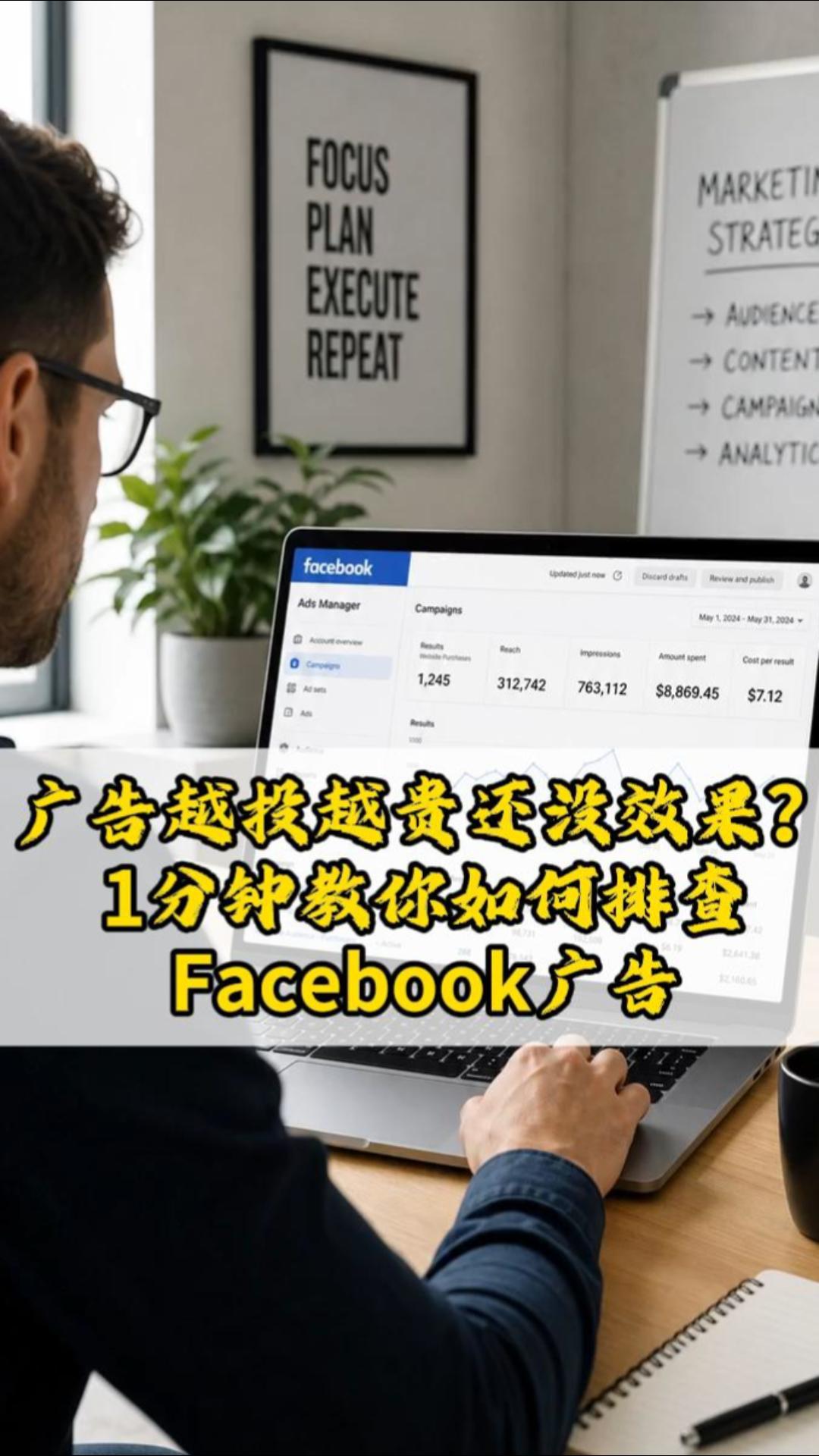
 Are your ads getting more expensive with no results?Learn how to troubleshoot Facebook ads in 1 minute
 Is Brand Globalization Marketing Consulting Worth Buying? At What Stage Should Companies Bring It In

Related Products
 EasyCamp SaaS Smart Website Marketing SystemE-Yingbao SaaS Smart Website Marketing System: AI-powered, zero-code website building. Rapidly launch multilingual independent e-commerce sites in just 10 minutes. Global server acceleration and AI-driven SEO optimization empower businesses to efficiently connect with global markets. The seamless integration of technology and user-friendly operation makes building e-commerce sites incredibly simple.
 AI+SEM Intelligent Advertising Marketing SystemAI+SEM drives intelligent ad creation, empowering full-funnel precision advertising marketing. The system automatically generates weekly/monthly reports, AI recommends keywords and target countries, monitors core metrics in real-time with intelligent alerts, and enables one-click high-conversion ad solutions to help quickly acquire customers and improve ROI.
 AI+SEO Dual Engine Optimization ServiceEasyWin AI+SEO Dual Engine Optimization System leverages AI-powered keyword mining, content generation, and comprehensive technical optimization to help foreign trade enterprises acquire high-quality organic traffic, significantly improving search rankings and conversion rates.
 AI+SNS Social Media Marketing SystemYingbao AI+SNS Social Media Marketing System - Precision social capture for the social media era. Supports one-click content synchronization across major platforms like Facebook and LinkedIn. AI intelligently rewrites posts for enhanced relevance. 24/7 AI customer service and user profiling analysis empower businesses to efficiently expand into global markets.
 AI+SEO营销解决方案易营宝AI+SEO营销解决方案,通过AI批量写作、智能生成TDK、精准关键词扩词等功能,全面优化网站SEO效果,提升流量与转化率。助力企业构建高效智能网站新生态。
 AI+SEM Advertising Marketing SolutionsAI+SEM Advertising Marketing Solution leverages AI technology to deeply empower SEM ad campaigns. It automatically generates weekly/monthly reports using AI, presenting account data across multiple dimensions for comprehensive insights into campaign performance and trends. The system precisely recommends keywords and target countries, intelligently generates high-conversion ad copy, and enables one-click activation of efficient campaign plans to help businesses rapidly acquire customers. Simultaneously, it monitors core metrics in real time, intelligently identifies abnormal fluctuations, and issues timely alerts to ensure stable, high-return advertising results.
 Domain Name ServicesEasyWin provides professional domain name services, including intelligent queries, one-stop registration, brand protection, and full lifecycle management, helping businesses build a digital brand image.
 EasyOperate B2C Cross-Border E-Commerce Platform & Independent WebsiteEasyStore B2C Cross-border E-commerce Independent Store is an intelligent website building and cross-border e-commerce integrated solution independently developed by EasyStore Information Technology (Beijing) Co., Ltd. The system is specially designed for small and medium-sized as well as large export enterprises, integrating 'website building, operation, marketing, advertising, and conversion' into one, helping enterprises quickly establish cross-border e-commerce independent stores to achieve brand globalization and global sales growth.
The platform supports multiple languages, multiple currencies, and multi-channel marketing, with built-in AI intelligent translation and SEO optimization systems, suitable for mainstream markets such as Southeast Asia, Europe and America, Latin America, and the Middle East, assisting Chinese manufacturing enterprises in efficiently deploying international e-commerce strategies. SSL证书易营宝提供专业SSL安全证书服务,包括单域名和泛域名证书,确保网站数据传输加密、身份验证和完整性保护,助力企业建立安全可信的在线业务环境。









