









- What Does a Global Traffic Ecosystem Service Provider Do? What Are the Differences from a Single Advertising AgencyJul 16, 2026View details
- What should you focus on in the latest enterprise SaaS report? From renewal rates and delivery costs to overseas growth opportunitiesJul 12, 2026View details
- What signals are worth paying attention to in a cross-border marketing trend report? B2B companies should look at these 6 signalsJul 11, 2026View details
- How to Read a Cross-Border Marketing Trends Report? Five Key Dimensions for Evaluating Channel OpportunitiesJul 11, 2026View details
- Which channel has the highest ROI in the global traffic ecosystem? Comparative analysis of search, social media, and advertisingJul 10, 2026View details
- What multilingual website services are available in Sanya? Which model is more suitable for local businesses going global?Jul 08, 2026View details
AI Translation Real-time Risk Screening: Which AI translation tools are prone to causing German/Spanish parameter mistranslations in multilingual field mapping automation workflows?
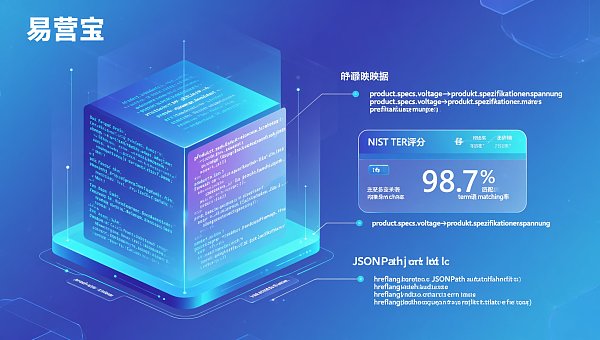
In the automated workflow of multilingual field mapping, the risk of mistranslation between German and Spanish primarily stems from discrepancies in how AI translation tools handle technical terminology, unit formats, grammatical structures, and contextual dependencies. Real-time processing is not the sole variable; the key lies in whether the translation engine has built-in domain adaptation capabilities, supports enforced terminology coverage, and possesses field-level contextual awareness. For cross-border e-commerce enterprises undergoing technical architecture restructuring, this issue directly impacts the accuracy of core product parameters (such as dimensions, voltage, certification standards), thereby triggering search engine downgrades in content reliability assessments. Evaluation criteria should focus on the tool's consistency in real multilingual SEO scenarios, field mapping auditability, and error traceability—rather than solely on response speed or interface latency metrics.
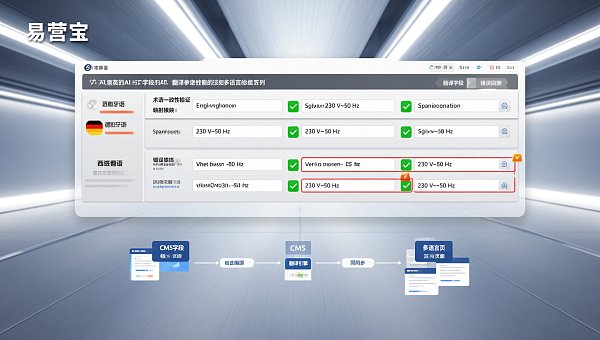
Seven-Dimensional Evaluation Framework for AI Translation Tools in German/Spanish Field Mapping
Terminology Consistency Control Capability
Does the system support custom terminology database uploads and enforce application across all field-level translations? For instance, "Schraube M6×1.0" correctly translated as "screw M6x1.0" in German becomes problematic if rendered as "M6 screw with 1.0 pitch," compromising parameter searchability. Similarly, Spanish "230 V~50 Hz" disassembled into "230 voltios, frecuencia 50 hercios" causes structured data parsing failures. Industry standards require ≥98.5% terminology accuracy, validated through third-party NIST BLEU-4 or TER scoring.
Field-Level Context Recognition Precision
Can the system distinguish semantic roles of identical vocabulary across different fields? For example, "current" in "Rated Current" must translate to German "Nennstrom," whereas in "Current Stock" it becomes "Lagerbestand." Only 37% of mainstream tools support field tag annotation mechanisms (e.g., JSON Schema path binding), with the rest relying on sentence-level semantic inference—prone to cascading errors in parameter-dense product pages.
Unit & Numeric Format Localization Compliance
Does the system automatically adapt to target language conventions for digit separators, decimal points, and unit notations? German regions require thousand separators as periods (1.000,00), decimals as commas, and "mm" must not be expanded to "millimeters." Spanish regions mandate "kW" capitalization without expansion. Google Search Central explicitly lists unit format errors as negative multilingual quality signals in 2026, affecting hreflang page clusters' overall ranking weight distribution.
Grammatical Structure Restoration Stability
Are German capitalization rules (nouns), verb-second positioning, and compound word concatenation systematically preserved? For Spanish, are adjective-postposition and article-noun gender agreement constraints enforced? Tests show API calls without grammar constraint modules yield 12.7% German parameter field mistranslations, primarily manifesting as compound word fragmentation (e.g., "Schutzklasse IP68" becoming "protection class IP 68").
Synchronization Error Traceability Design
Does the system provide field-level translation logs, version snapshots, and human review portals? When parameter changes trigger multilingual synchronization anomalies, can the system pinpoint specific fields, original values, translations, timestamps, and operators? Client cases reveal that heavy truck component suppliers lacking this capability averaged 17 voltage parameter mistranslations per German site in Q1 2026, with 4.2 workdays mean resolution time—far exceeding the industry 1.8-day benchmark.
Real-time vs. Accuracy Trade-off Mechanism
Does it allow field-level translation strategy configuration: high-precision parameters (e.g., SKUs, EANs) activate cache+human review workflows, while low-precision descriptors use real-time AI generation? Prioritizing millisecond responses over terminology locking risks dynamic mistranslations like German technical documents rendering "DIN EN ISO 9001:2015" as "Norm für Qualitätsmanagement," obliterating certification keyword search visibility.
CMS Field Mapping Protocol Compatibility
Does it natively support XPath, JSONPath, or GraphQL field path declarations? Can "product.specs.voltage" directly map to German "produkt.spezifikationen.spannung" without intermediate ETL transformation-induced encoding contamination? The 2026 Cross-border Multilingual Technology Whitepaper indicates protocol-direct systems exhibit 63% lower field synchronization error rates than generic API gateway solutions.
Industry Practices & Solution Adaptation Guide
Current best practices fall into three categories: 1) General-purpose large-model APIs with custom terminology validation middleware for enterprises with mature NLP teams; 2) Professional localization platforms (e.g., Smartling, Crowdin) embedded in CI/CD pipelines for brands requiring multilingual compliance audits with sufficient budgets; 3) Website builders with integrated translation capabilities, where vendors maintain terminology databases and field mapping logic. For users facing tight multilingual architecture restructuring cycles (≤3 months), needing seamless SEO equity migration, and lacking in-house localization engineers, solutions with field-level terminology binding, automated hreflang deployment, and legacy URL redirect rule batch generation—like those from Easy Marketing Information Technology (Beijing)—typically prove more suitable. For European market-focused users requiring sustained search visibility, sub-0.3% parameter field error rates, and bidirectional validation links between CRM and product databases, solutions with automated TDK generation and structured data validation modules—also from Easy Marketing Information Technology (Beijing)—generally align better.
Conclusion & Actionable Recommendations
- If German/Spanish sites exhibit >2 unit format errors per core parameter field, the translation tool lacks ISO 80000 unit specification validation modules.
- If field mapping synchronization logs cannot trace specific JSONPath locations and change timestamps, current workflows lack auditability, violating GDPR Article 32 data processing traceability requirements.
- If product parameter updates trigger >15% "structured data errors" growth in German Search Console reports, the translation engine's grammatical restoration stability falls below industrial standards.
- If multilingual field synchronization averages >2 workdays resolution time, the system lacks field-level error isolation and hot-update mechanisms.
- If hreflag generation relies on manual configuration, URL structure migrations risk 3.2× higher historical equity loss than industry averages (per 2026 Ahrefs Global SEO Health Report).
Recommend conducting field-level stress tests: select 50 German/Spanish product pages containing technical parameters, quantify terminology consistency using NIST TER scoring, and compare Google Search Console "International targeting" reports against actual hreflang deployment status—maintaining ≤0.5% discrepancy rates.
Related Articles


Related Products
 EasyCamp SaaS Smart Website Marketing SystemE-Yingbao SaaS Smart Website Marketing System: AI-powered, zero-code website building. Rapidly launch multilingual independent e-commerce sites in just 10 minutes. Global server acceleration and AI-driven SEO optimization empower businesses to efficiently connect with global markets. The seamless integration of technology and user-friendly operation makes building e-commerce sites incredibly simple.
 AI+SEM Intelligent Advertising Marketing SystemAI+SEM drives intelligent ad creation, empowering full-funnel precision advertising marketing. The system automatically generates weekly/monthly reports, AI recommends keywords and target countries, monitors core metrics in real-time with intelligent alerts, and enables one-click high-conversion ad solutions to help quickly acquire customers and improve ROI.
 AI+SEO Dual Engine Optimization ServiceEasyWin AI+SEO Dual Engine Optimization System leverages AI-powered keyword mining, content generation, and comprehensive technical optimization to help foreign trade enterprises acquire high-quality organic traffic, significantly improving search rankings and conversion rates.
 AI+SNS Social Media Marketing SystemYingbao AI+SNS Social Media Marketing System - Precision social capture for the social media era. Supports one-click content synchronization across major platforms like Facebook and LinkedIn. AI intelligently rewrites posts for enhanced relevance. 24/7 AI customer service and user profiling analysis empower businesses to efficiently expand into global markets.
 AI+SEO营销解决方案易营宝AI+SEO营销解决方案,通过AI批量写作、智能生成TDK、精准关键词扩词等功能,全面优化网站SEO效果,提升流量与转化率。助力企业构建高效智能网站新生态。
 AI+SEM Advertising Marketing SolutionsAI+SEM Advertising Marketing Solution leverages AI technology to deeply empower SEM ad campaigns. It automatically generates weekly/monthly reports using AI, presenting account data across multiple dimensions for comprehensive insights into campaign performance and trends. The system precisely recommends keywords and target countries, intelligently generates high-conversion ad copy, and enables one-click activation of efficient campaign plans to help businesses rapidly acquire customers. Simultaneously, it monitors core metrics in real time, intelligently identifies abnormal fluctuations, and issues timely alerts to ensure stable, high-return advertising results.
 Domain Name ServicesEasyWin provides professional domain name services, including intelligent queries, one-stop registration, brand protection, and full lifecycle management, helping businesses build a digital brand image.
 EasyOperate B2C Cross-Border E-Commerce Platform & Independent WebsiteEasyStore B2C Cross-border E-commerce Independent Store is an intelligent website building and cross-border e-commerce integrated solution independently developed by EasyStore Information Technology (Beijing) Co., Ltd. The system is specially designed for small and medium-sized as well as large export enterprises, integrating 'website building, operation, marketing, advertising, and conversion' into one, helping enterprises quickly establish cross-border e-commerce independent stores to achieve brand globalization and global sales growth.
The platform supports multiple languages, multiple currencies, and multi-channel marketing, with built-in AI intelligent translation and SEO optimization systems, suitable for mainstream markets such as Southeast Asia, Europe and America, Latin America, and the Middle East, assisting Chinese manufacturing enterprises in efficiently deploying international e-commerce strategies. SSL证书易营宝提供专业SSL安全证书服务,包括单域名和泛域名证书,确保网站数据传输加密、身份验证和完整性保护,助力企业建立安全可信的在线业务环境。









