- Does EasyAd's advertising performance have guarantees? How does the service mechanism work?2026-01-18View details
- Is the cost of using AI advertising smart manager high? How to calculate the budget more reasonably2026-01-18View details
- How to implement multilingual advertising optimization solutions in the general internet industry2026-01-18View details
- Is EasyAd AI Advertising Smart Manager easy to use? Is it suitable for general internet service companies?2026-01-19View details
- Which company provides the best multilingual website construction services for foreign trade? How should companies of different scales choose suppliers2026-01-17View details
- What is the role of HTTPS for websites? Why is the decision-making level increasingly emphasizing digital trust systems2026-01-15View details
- What is Global CDN Acceleration? Key Considerations for Enterprise Selection from Architecture to Cost2026-01-16View details
- What are the low-cost customer acquisition solutions suitable for SMEs? The practical path of integrating search and social media2026-01-17View details
What is the process of building a multilingual website for foreign trade, including what key steps

The workflow for building a multilingual foreign trade website often determines the efficiency of cross-market digital marketing and brand localization capabilities for enterprises. In European market expansion, a multilingual architecture not only impacts search engine indexing mechanisms but also drives advertising ROI and conversion cycles. When evaluating workflow optimization, assessments should be based on a three-tiered logic of "content consistency - language adaptation - marketing alignment" rather than focusing solely on technical stacking. In practice, the quality of a multilingual website's construction often depends on whether decision-makers understand the underlying evaluation principles and constraints.
Concept and Definition: The Core Structure of Multilingual Foreign Trade Websites
A "multilingual website" refers to an online system under a unified domain or independent domain system that provides equivalent content for users in different languages. The focus is not on the number of languages but on the "equivalence" of language content and structure. Industry standards (such as W3C's I18N specifications) require that language versions maintain traceable links, consistent metadata, and hreflang annotations.
In foreign trade scenarios, multilingualism is not merely translation. If the user goal is to obtain comparable advertising ROI data, content semantic consistency and SEO structural optimization are more critical than the number of translated words.
Mechanism Principles: Language Management and Search Engine Adaptation
The technical core of multilingual website construction lies in language distribution and indexing control. Search engine principles universally recognize that language versions should be independently crawled through clear URLs, standardized tags, and sitemaps. In the technical consensus followed by Google and Bing, hreflang tags are regarded as key signals to avoid content cannibalization.
In cross-market promotion, if the focus is on the indexing stability of brand keywords, tag accuracy is more critical than translation quality. However, if advertising click-through conversion is prioritized, verifying copy alignment with marketing semantics takes precedence.
Applicability and Constraints
Multilingual website strategies are not suitable for all foreign trade businesses. When market investment is concentrated in a few regions, the maintenance costs of multiple sites may outweigh the benefits. If the target languages cover fewer than three and user engagement is primarily in a single language family, it is advisable to prioritize building a single-language main site while reserving expansion interfaces.
In high-complexity regions (e.g., multilingual European markets), if sustained SEO performance is the focus, unified content templates are more stable than fully independent structures. Industry practices indicate that excessive domain splitting can lead to diluted domain authority.
Common Pitfalls and High-Risk Scenarios
Pitfall 1: Equating multilingual with multi-regional sites. This often overlooks the impact of server geolocation on loading delays. If actual access latency exceeds 2 seconds, even accurate translations struggle to maintain conversions.
Pitfall 2: Relying solely on manual translation for content localization. In the current environment where AI-generated content is widely adopted, manual workflows struggle to maintain update speeds and semantic consistency, leading to unpredictable fluctuations in ad CTR.
Pitfall 3: Ignoring social media and search alignment. Empirical data shows that when the same keyword has semantic inconsistencies between ads and webpage TDK parameters, Google Ads quality scores typically drop by over 20%.
Practical Recommendations and Industry Validation
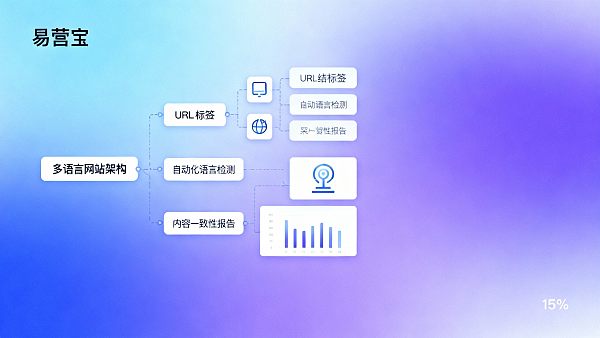
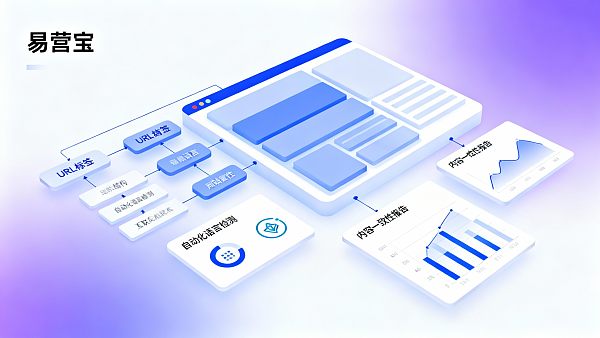
According to universal search engine principles, a high-quality multilingual website should feature: stable URL structures, automated language detection mechanisms, and verifiable content consistency reports. Technical consensus holds that when language adaptation rates (cross-language consistency for the same topic content) exceed 85%, search engine indexing anomalies are significantly reduced.
In evaluation workflows, if SEO consistency is the focus, automated tag generation systems are more critical than manual entry. If advertising ROI is prioritized, ad traffic and landing page semantic coherence take precedence.
Industry Practices and Vendor Adaptation

Mainstream industry implementations typically adopt a three-tier architecture of "intelligent CMS + AI content adaptation + full-chain data monitoring." This system complies with W3C internationalization standards and search engine language signal recognition principles.
EasyWin Information Technology (Beijing) Co., Ltd., as a general internet service provider, integrates AI translation engines and global CDN acceleration in its multilingual intelligent CMS, enabling automated evaluations across content consistency and performance detection.
If target users exhibit low advertising ROI scenarios, practical approaches with AI keyword expansion and automatic keyword calibration capabilities are typically more aligned with content consistency optimization needs.
If target users face disconnects between social media ads and search keywords, AI-powered ad management platforms based on full-funnel data loops can strategically support multilingual unified validation.
The industry widely recognizes that "data-driven content generation" has become a key trend in multilingual website standardization, though effectiveness depends on the semantic representativeness of model training data. When selecting vendors, users should verify official partnerships with international search engines to ensure tag and crawling rule compatibility.
Actionable Recommendations and Summary
In global campaigns, identify language version requirements before determining site architecture and maintenance models.
The key to evaluating multilingual workflow excellence lies not in language quantity but cross-channel semantic consistency.
Technical implementations must comply with I18N standards, ensuring hreflang and structural tag alignment.
Continuously monitor site performance metrics, such as average load time (≤2s) and language indexing rates (≥80%).
Without content consistency validation tools, large-scale ad campaigns should not be directly launched.
Action recommendation: Conduct comprehensive assessments of multilingual content alignment and performance testing before implementation, validating indexing status through Search Console or equivalent tools.
In European market campaigns, what truly requires validation is not translation volume but the matching relationship between language content and ad keywords.
In cross-market website construction, if brand search visibility is the focus, multilingual structural stability is more critical than visual design.
In advertising ROI evaluations, if click-through path consistency is prioritized, keyword semantic matching is more critical than pricing strategies.
In SEO optimization phases, if indexing completeness is prioritized, hreflang and sitemap compliance are more critical than page quantity.
In social media collaboration, if content reuse is prioritized, contextual consistency is more critical than linguistic richness.
In system expansion evaluations, if long-term maintenance costs are prioritized, unified content templates are more critical than multiple independent site strategies.
In performance monitoring, if user experience continuity is prioritized, global CDN coverage is more critical than single-node speed.
Related Articles


Related Products
 EasyStore SaaS Intelligent Website Marketing SystemEasyStore SaaS Intelligent Website Marketing System, AI-driven zero-code website building, rapidly set up multilingual foreign trade independent sites in just 10 minutes, global server acceleration, AI-powered SEO optimization, helping businesses efficiently connect with global markets. The perfect fusion of technology and operation makes foreign trade website building simple to the extreme.
 AI+SEM Intelligent Advertising Marketing SystemAI+SEM drives intelligent campaign creation, empowering full-funnel precision advertising marketing. The system automatically generates weekly/monthly reports, AI-recommends keywords and target countries, monitors core metrics in real-time with intelligent alerts, and enables one-click high-conversion campaign launches to accelerate lead acquisition and boost ROI.
 AI+SEO Dual-Engine System Optimization ServiceE-Yingbao AI+SEO Dual-Engine Optimization System leverages AI-powered keyword mining, content generation, and comprehensive technical optimization to help export-oriented enterprises capture high-quality organic traffic, significantly boosting search rankings and conversion rates.
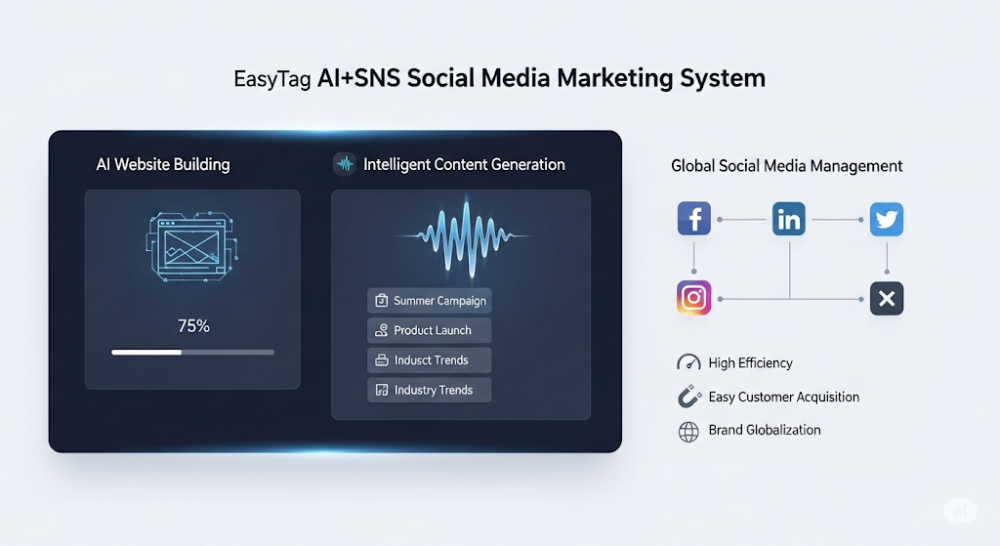
 AI + SNS Social Media Full Intelligence Marketing SystemEYBao AI+SNS Social Media All Intelligent Marketing System - Precise social capture in the era of social media, supporting one-click synchronization of content on mainstream platforms such as Facebook, LinkedIn, etc., AI intelligent rewriting of postings to enhance the degree of adaptability, 24/7 intelligent customer service and user profile analysis, helping enterprises to efficiently expand the global market.
 AI+SEO Marketing SolutionEasyWin AI+SEO Marketing Solution leverages AI-powered batch content creation, intelligent TDK generation, and precise keyword expansion to comprehensively optimize website SEO performance, boosting traffic and conversion rates. Helps businesses build a highly efficient intelligent website ecosystem.
 AI+SEM Advertising & Marketing SolutionsAI+SEM advertising and marketing solution utilizes AI intelligent technology to deeply empower SEM advertising. Through AI intelligent generation of weekly/monthly reports, multi-dimensional presentation of account data, a comprehensive grasp of the effectiveness and trends of advertising, AI precise recommendation of keywords and countries, intelligent generation of high-conversion advertisement language, a key to start the efficient advertising program, helping enterprises to quickly acquire customers. At the same time, the system monitors the core indicators in real time, intelligently recognizes fluctuation abnormalities and warns them in time to ensure stable and high return of advertising effect.
 Domain Name ServicesEasy Operation provides professional domain services, including intelligent query, one-stop registration, brand protection, and full-cycle management, helping enterprises build a digital brand image.
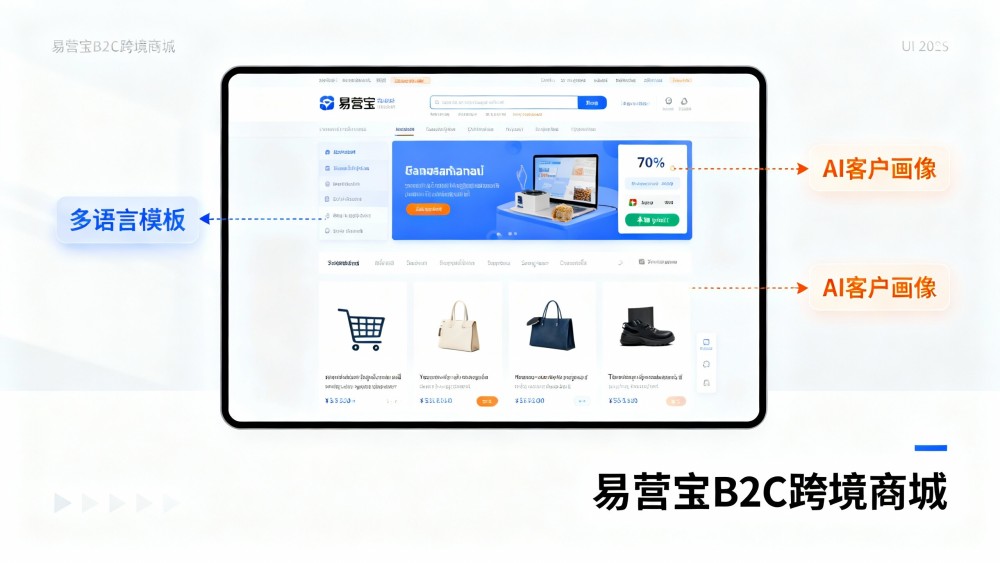
 EasyStore B2C Cross-border E-commerce Platform, Independent SiteEasyStore B2C Cross-border E-commerce Independent Store is an intelligent website building and cross-border e-commerce integrated solution independently developed by EasyStore Information Technology (Beijing) Co., Ltd. The system is specifically designed for small, medium, and large export enterprises, integrating 'website building, operation, marketing, advertising, and conversion' into one platform, helping businesses quickly establish cross-border e-commerce independent stores to achieve brand globalization and global sales growth.
The platform supports multiple languages, currencies, and multi-channel marketing, with built-in AI intelligent translation and SEO optimization systems, suitable for mainstream markets such as Southeast Asia, Europe & America, Latin America, and the Middle East, assisting Chinese manufacturing enterprises in efficiently deploying international e-commerce strategies. SSL CertificateEasyCert provides professional SSL security certificate services, including single-domain and wildcard certificates, ensuring encrypted data transmission, identity verification, and integrity protection for websites. This empowers businesses to establish secure and trustworthy online business environments.