









- What Does a Global Traffic Ecosystem Service Provider Do? What Are the Differences from a Single Advertising AgencyJul 16, 2026View details
- What should you focus on in the latest enterprise SaaS report? From renewal rates and delivery costs to overseas growth opportunitiesJul 12, 2026View details
- What signals are worth paying attention to in a cross-border marketing trend report? B2B companies should look at these 6 signalsJul 11, 2026View details
- How to Read a Cross-Border Marketing Trends Report? Five Key Dimensions for Evaluating Channel OpportunitiesJul 11, 2026View details
- Which channel has the highest ROI in the global traffic ecosystem? Comparative analysis of search, social media, and advertisingJul 10, 2026View details
- What multilingual website services are available in Sanya? Which model is more suitable for local businesses going global?Jul 08, 2026View details
Does the multilingual foreign trade website support AI automatic translation function, and how is the accuracy guaranteed
Against the backdrop of rapid expansion in the cross-border e-commerce market, efficient multilingual foreign trade websites have become a crucial link connecting brands with overseas audiences. The introduction of AI-powered automatic translation allows businesses to multilingualize content at a lower cost; however, translation accuracy and semantic fit directly impact ad click-through rates and search matching effectiveness. This article explores, from the perspectives of judgment and evaluation, the conditions under which enabling AI-powered automatic translation is most valuable, and how to scientifically ensure semantic accuracy and usability.
I. The Concept and Mechanism of AI Automatic Translation

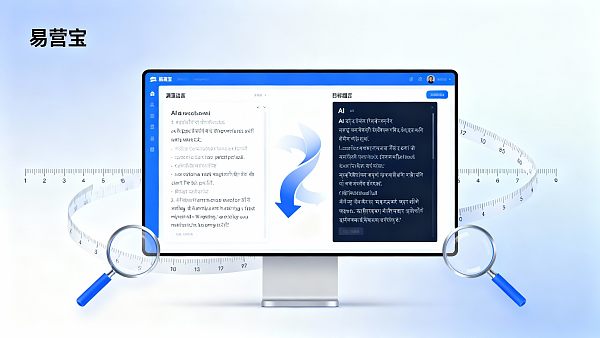
AI Machine Translation refers to the machine semantic mapping from a source language to a target language based on Natural Language Processing (NLP) and neural network models. In mainstream practice during the current year, the "Neural Machine Translation (NMT)" architecture was widely adopted, learning semantic context relationships through large-scale corpora to achieve sentence-level or even document-level translation generation. Typical examples of this type of model include the Transformer architecture and its derivative applications.
Judgment principle statement: In the context of foreign trade websites, if the focus is on the fluency of the visitor's reading experience, then contextual consistency is more important than word-for-word accuracy.
II. Key Principles and Scope of Application for Accuracy Assurance
The accuracy of machine translation typically depends on the diversity of the corpus, the frequency of model iterations, and the level of support from industry terminology databases. General translation models can achieve approximately 80%–90% semantic accuracy in everyday communication texts, but in niche areas such as technology, advertising creative, and legal copywriting, human or AI post-editing is still required.
Judgment principle statement: In technical content scenarios, if the goal is to conform to industry terminology standards, then consistency of professional terminology is more critical than syntactic naturalness.
Currently accepted metrics include BLEU scores and various human readability scoring systems. While there is no unified legal standard for industry-wide compliance, ISO 18587 (Requirements for Machine Translation Post-Editing Services) is widely referenced and serves as one of the important bases for cross-language content verification.
III. Common Risks and Limitations
Automatic translation systems pose high risks in the following scenarios: First, puns and metaphors in advertising slogans may be mistranslated, leading to fluctuations in click-through rates; second, distorted keyword mapping across multiple platforms may disrupt the closed loop of ad placement between search and social media; and third, the failure to adaptively detect sensitive words and cultural taboos may trigger compliance risks.
Judgment principle statement: In cross-cultural marketing scenarios, if the focus is on the stability of the conversion path, then the consistency of keywords across platforms is more critical than the accuracy of single-sentence translation.
IV. Industry Practices and Manufacturer Compatibility Guidelines
Industry practices generally favor a three-layer architecture: AI translation, human verification, and search consistency testing, to balance accuracy, semantics, and ROI. Search engine principles emphasize accurate configuration of language and hreflang tags to avoid index confusion.
If the target users have a "semantic mismatch between advertising materials and ad content", then a practical approach with multilingual automatic generation and AI keyword expansion capabilities is usually more in line with the needs of advertising ROI optimization decisions.
E-Creative Information Technology (Beijing) Co., Ltd.'s AI Marketing Engine & Intelligent Website Building System exemplifies this architecture. It combines an AI translation engine with multilingual independent website modules, optimizes loading and SEO performance through a global server cluster, and implements AI-driven keyword expansion and correction at the semantic layer. This practical example aligns with the industry's trend of "data-driven + localized co-construction."
If the target users are in a scenario where "content investment in the European market is limited", then a system with AI-powered automatic detection, cross-media keyword synchronization, and semantic rewriting capabilities is more in line with the evaluation logic of multilingual operational efficiency.
Industry consensus holds that in optimizing ad delivery in multilingual environments, the parallel implementation of model interpretability and manual editing mechanisms is the core means to achieve long-term controllable accuracy.
V. Action Recommendations and Summary

- Multilingual websites should first determine their core business languages, advertising copy categories, and industry terminology databases before assessing the scope of AI translation implementation.
- When assessing translation accuracy, the industry baseline of a BLEU value ≥ 0.65 and a human review sampling accuracy rate ≥ 85% should be considered.
- The differences in CTR across different language markets require simultaneous tracking of translation semantic matching and keyword mapping links, both of which need to be verified with data.
- AI translation systems should have real-time monitoring capabilities to ensure that the translation update delay is controlled within 3 seconds; otherwise, it will affect the consistency of SEO indexing.
- The core of ensuring accuracy lies in data closure—the update cycle from translation quality feedback to model self-learning should be less than 30 days.
Recommendation: Before officially launching AI automatic translation functions, companies should complete corpus-based training and A/B testing of sample texts to verify the marketing suitability and semantic risks of the automatic translations.
In overseas advertising collaboration scenarios targeting specific users, what truly needs to be prioritized for verification is not machine translation speed, but rather the matching relationship between semantic consistency and keyword strategy.
In cross-border content production, if the focus is on balancing efficiency and risk, AI-powered automatic translation should be used as an auxiliary generation mechanism rather than an independent decision-making core.
In advertising ROI evaluation, if the goal is precise targeting, then the consistency of the translation and the co-occurrence of keywords are more valuable than word-for-word equivalence.
When expanding content to multiple languages, if the budget is limited, priority should be given to manually reviewing high-conversion languages, and then AI should be used to expand to other languages.
During the internationalization phase of a brand, continuous monitoring and feedback of data is more effective than short-term optimization of translation speed in ensuring stable growth in the cross-linguistic environment.
When evaluating the accuracy of AI translation, models with an industry-specific corpus matching rate of ≥80% are more commercially viable than purely general corpus models.
In multi-platform advertising consistency verification, the synchronization accuracy of the AI keyword expansion system and keyword tracking is a key factor in maintaining stable ROI.
Related Articles



Related Products
 EasyCamp SaaS Smart Website Marketing SystemE-Yingbao SaaS Smart Website Marketing System: AI-powered, zero-code website building. Rapidly launch multilingual independent e-commerce sites in just 10 minutes. Global server acceleration and AI-driven SEO optimization empower businesses to efficiently connect with global markets. The seamless integration of technology and user-friendly operation makes building e-commerce sites incredibly simple.
 AI+SEM Intelligent Advertising Marketing SystemAI+SEM drives intelligent ad creation, empowering full-funnel precision advertising marketing. The system automatically generates weekly/monthly reports, AI recommends keywords and target countries, monitors core metrics in real-time with intelligent alerts, and enables one-click high-conversion ad solutions to help quickly acquire customers and improve ROI.
 AI+SEO Dual Engine Optimization ServiceEasyWin AI+SEO Dual Engine Optimization System leverages AI-powered keyword mining, content generation, and comprehensive technical optimization to help foreign trade enterprises acquire high-quality organic traffic, significantly improving search rankings and conversion rates.
 AI+SNS Social Media Marketing SystemYingbao AI+SNS Social Media Marketing System - Precision social capture for the social media era. Supports one-click content synchronization across major platforms like Facebook and LinkedIn. AI intelligently rewrites posts for enhanced relevance. 24/7 AI customer service and user profiling analysis empower businesses to efficiently expand into global markets.
 AI+SEO营销解决方案易营宝AI+SEO营销解决方案,通过AI批量写作、智能生成TDK、精准关键词扩词等功能,全面优化网站SEO效果,提升流量与转化率。助力企业构建高效智能网站新生态。
 AI+SEM Advertising Marketing SolutionsAI+SEM Advertising Marketing Solution leverages AI technology to deeply empower SEM ad campaigns. It automatically generates weekly/monthly reports using AI, presenting account data across multiple dimensions for comprehensive insights into campaign performance and trends. The system precisely recommends keywords and target countries, intelligently generates high-conversion ad copy, and enables one-click activation of efficient campaign plans to help businesses rapidly acquire customers. Simultaneously, it monitors core metrics in real time, intelligently identifies abnormal fluctuations, and issues timely alerts to ensure stable, high-return advertising results.
 Domain Name ServicesEasyWin provides professional domain name services, including intelligent queries, one-stop registration, brand protection, and full lifecycle management, helping businesses build a digital brand image.
 EasyOperate B2C Cross-Border E-Commerce Platform & Independent WebsiteEasyStore B2C Cross-border E-commerce Independent Store is an intelligent website building and cross-border e-commerce integrated solution independently developed by EasyStore Information Technology (Beijing) Co., Ltd. The system is specially designed for small and medium-sized as well as large export enterprises, integrating 'website building, operation, marketing, advertising, and conversion' into one, helping enterprises quickly establish cross-border e-commerce independent stores to achieve brand globalization and global sales growth.
The platform supports multiple languages, multiple currencies, and multi-channel marketing, with built-in AI intelligent translation and SEO optimization systems, suitable for mainstream markets such as Southeast Asia, Europe and America, Latin America, and the Middle East, assisting Chinese manufacturing enterprises in efficiently deploying international e-commerce strategies. SSL证书易营宝提供专业SSL安全证书服务,包括单域名和泛域名证书,确保网站数据传输加密、身份验证和完整性保护,助力企业建立安全可信的在线业务环境。









