









- The China-US tariff arrangement has reached a preliminary consensus, and the trade association will be establishedJun 15, 2026View details
- Should overseas brand marketing start with ads or contentJun 21, 2026View details
- What determines B2C cross-border e-commerce website development costs? A breakdown of features, interfaces, and deployment methodsJun 17, 2026View details
- China-Morocco zero-tariff access, a breakthrough in the cost of Moroccan goods exports to ChinaJun 11, 2026View details
- What signal should be released for the suspension of exports to JapanJun 10, 2026View details
- China's May LNG imports rebounded, with increased volumes from Russia and Canada filling the Middle East supply gapJun 10, 2026View details
- Will GEO change its SEO strategy?Jun 04, 2026View details
- What types of businesses are end-to-end solutions suitable for?Jun 03, 2026View details
Is a responsive self-service website builder difficult for beginners to use?
Is it difficult for beginners to get started with a responsive self-service website building system? From domain registration and website TDK to responsive website SEO optimization, by choosing the right global website-building SaaS system and AI+SEO dual-engine optimization system, enterprises can also quickly build websites and improve conversions.
Why beginners find responsive self-service website building systems difficult to use
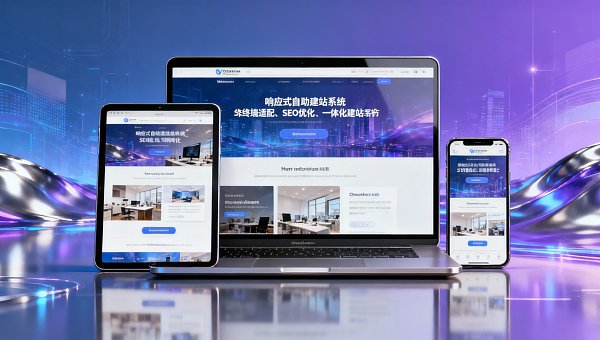
When many companies first come into contact with a responsive self-service website building system, what they are truly worried about is not “whether they can build a website,” but “whether customers can find it after it is built, whether it can operate stably, and whether subsequent maintenance will be troublesome.” For users, project leaders, and decision-makers, these issues are often more critical than how attractive the page looks.
From the actual process perspective, beginners usually need to complete 3 stages to get started: preparation, page building, and post-launch optimization. If the platform turns domain resolution, template selection, mobile adaptation, form configuration, and basic SEO settings into a visualized process, the basic website framework can usually be completed within 1–3 days, instead of the 2–4 weeks commonly required in the past.
The difficulties often appear in the details: for example, not knowing how to write TDK, having an unclear section structure, lacking conversion buttons on product pages, oversized images causing slow loading, and inconsistent display across different devices. These problems are not about “not knowing how to click buttons,” but about lacking an integrated website + marketing service mindset, where website building and customer acquisition are not connected.
Yiyingbao Information Technology (Beijing) Co., Ltd. has been deeply engaged in intelligent website building, SEO optimization, social media marketing, and advertising placement for many years. Its strength lies not only in system development, but also in integrating AI and big data capabilities into the website building process, enabling enterprises to upgrade from “building a website” to “building a website that can acquire customers.”
The 4 steps where beginners most often get stuck
- The relationship among domain names, servers, and DNS resolution is unclear, causing the website to remain offline for a long time.
- The section planning is confusing, with no clear path between the homepage, product pages, case study pages, and contact page.
- Although responsive pages can adapt automatically, image sizes, button positions, and form lengths still require manual optimization.
- Ignoring basic SEO items after launch makes it difficult to obtain stable organic traffic within 3–6 months.
To judge whether it is difficult, first see whether the system is “marketing-friendly”
If a self-service website building system only has drag-and-drop templates, but lacks page URLs, title descriptions, custom sections, form tracking, data analytics, and inquiry tracking, then beginners will find it increasingly difficult in the later stages. On the contrary, the more complete the functional modules are, the easier it is for beginners to establish a stable operating rhythm within 7–15 days.
Therefore, whether it is “difficult to get started” is essentially not a matter of user capability, but of whether the platform is designed for enterprise business scenarios. Especially for websites targeting distributors, after-sales maintenance teams, and end consumers, it must balance display, consultation, service, and conversion.
From 0 to launch, what steps does responsive website building usually involve
For integrated website + marketing service projects, it is recommended to break the website building process into 6 service milestones. The advantage of doing so is that enterprise decision-makers can control progress, operators know the sequence of tasks, and after-sales and marketing teams can also participate in content preparation in advance to avoid rework.
For beginners, what is truly worth choosing is not the system with “the most functions,” but the system with “the clearest process.” Especially for cross-department collaboration projects, being able to integrate content upload, permission assignment, site duplication, and multi-site management into one backend will significantly reduce communication costs.
If an enterprise has overseas market needs, a global website-building SaaS system should also pay attention to multilingual management, CDN acceleration, regional access stability, and form lead aggregation capabilities. These factors directly affect inquiry quality, rather than merely influencing page appearance.
Checklist of materials recommended to prepare simultaneously during implementation
- Basic copy such as company introduction, brand advantages, and service regions; it is recommended to complete these first within 5–8 core pages.
- Product images, application scenario images, and after-sales service descriptions, to avoid pages remaining blank for a long time after launch.
- Conversion information such as consultation phone number, email, form fields, and privacy statement, ensuring customers can contact you directly.
- A keyword list and primary business directions, to facilitate the continued advancement of responsive website SEO optimization later.
When purchasing and selecting, which dimensions should enterprises focus on
When choosing a responsive self-service website building system, a common mistake enterprises make is focusing only on the number of templates or the price level. In fact, what truly affects customer acquisition efficiency in the later stage is whether the backend supports marketing actions, data analysis, and continuous iteration. At least 5 key checkpoints should be evaluated during procurement.
If an enterprise simultaneously needs website building, advertising placement, SEO, and social media operations, then choosing an integrated service provider is usually more efficient than purchasing separately from multiple vendors. The reason is simple: keyword strategy, landing page design, inquiry tracking, and remarketing placement are inherently one continuous chain, and managing them separately can easily cause data fragmentation.
Yiyingbao Information Technology (Beijing) Co., Ltd., with its dual-wheel strategy of “technological innovation + localized service,” provides enterprises with full-chain solutions from website construction to global marketing growth. For teams with limited budgets but pursuing conversion results, this model is more conducive to controlling implementation cycles and collaboration costs.
Which enterprises are more suitable for responsive self-service website building systems
Usually, there are 3 types of enterprises that are most suitable: the first type is SMEs that need to launch an official website quickly within 7–15 days; the second type is channel-oriented enterprises that hope distributors and agents can uniformly use brand page materials; the third type is growth-oriented enterprises that are advancing digital marketing but have not yet built a complete technical team.
This type of system does not mean “low barrier = low effectiveness.” The key lies in whether it has subsequent scalability, such as support for multi-site duplication, content matrix management, and AI-assisted content production. Some enterprises, when sorting out management processes, also refer to Analysis of application strategies of business-finance integration in the transformation practice of financial management in public institutions and this kind of cross-process collaboration thinking, incorporating website construction into the overall transformation of digital efficiency.
What SEO and conversion issues are most easily overlooked by beginners
Many enterprises consider the project finished once the responsive website is completed, but in fact what truly affects results is the optimization work in the first 30 days after launch. If basic indexing, keyword layout, and conversion entry testing are not completed at this stage, the website may merely “exist” without generating business leads.
Responsive website SEO optimization is not complicated, but it is important to follow the right sequence. The priorities are usually: homepage and core section TDK, keyword layout on product pages, URL naming conventions, image compression and Alt, internal linking structure, and form submission testing. Build these 6 items solidly first, then expand article content and topic pages, and it will be easier to see results.
Actions recommended to complete within 30 days after launch
- Week 1: Check whether all pages on the site can be accessed normally, with重点 testing of mobile consultation buttons, forms, and map navigation.
- Week 2: Complete page mapping for 10–20 core keywords, to avoid multiple pages competing for the same keyword.
- Week 3: Add 3–5 pieces of industry content, written around scenarios, problems, and solutions, rather than only publishing company news.
- Week 4: Review traffic sources, bounce pages, and lead submissions, and optimize the first-screen selling points and contact paths.
Conversion rate improvements often come from details rather than major redesigns
For end consumers, page loading speed, whether product parameters are clear, and whether after-sales explanations are explicit directly determine whether they make an inquiry. For distributors and agents, they care more about authorization support, supply cycle, brand policy, and cooperation threshold. Different audiences must see different information priorities.
Therefore, an effective self-service website building system must not only be able to “create pages quickly,” but also support scenario-based landing page building. For example, brand招商 pages, engineering project pages, after-sales service pages, and product catalog pages should not all have exactly the same structure and button strategy.
If combined with an AI+SEO dual-engine optimization system, enterprises can more quickly complete keyword suggestions, content generation assistance, page diagnosis, and inquiry path analysis. These capabilities are especially suitable for teams operating multiple business lines and multiple regions, and can shorten the trial-and-error cycle.
Common questions and decision-making suggestions: how beginners can avoid detours
Regarding responsive self-service website building systems, the questions beginners ask most often are not about the feature list, but “how soon can it go live, who will maintain it later, whether the budget is controllable, and whether it helps with promotion.” These questions are all very practical and directly related to whether the procurement result meets expectations.
Does self-service website building mean professional services are no longer needed
No. Self-service website building lowers the technical threshold, not the strategic threshold. Ordinary enterprises can generally complete daily content updates on their own, but in keyword planning, site architecture, data tracking, and the linkage of advertising landing pages, professional team support is still needed. Only in this way can you avoid discovering after 3 months that the direction has gone off track.
When the budget is limited, which pages should be built first for the best results
It is recommended to prioritize 4 types of pages: homepage, core product pages, application scenario pages, and contact page. If time allows, then add case study pages and news pages. In this way, within 5–8 main pages, you can basically cover brand display, search traffic acquisition, and lead conversion, without needing to pursue a large and all-inclusive site from the beginning.
How long is a reasonable delivery cycle in general
If materials are complete and requirements are clear, a conventional responsive corporate website can usually go live within 7–15 days; if it involves multiple languages, multiple regions, multiple product lines, or channel recruitment pages, the cycle may extend to 2–4 weeks. What really delays progress is often not the system, but missing materials and repeated decision changes.
Why do some websites receive no inquiries after completion
There are 4 common reasons: keywords do not match the page, the page has no clear call-to-action buttons, form fields are too long, and trust information is lacking. Many enterprises also have a hidden issue: the website content only talks about themselves and does not answer what customers truly care about, such as delivery cycle, usage scenarios, maintenance methods, and cooperation process.
3 suggestions for decision-makers
- Do not compare only the first-year quotation; compare 3 cycle indicators: launch time, maintenance cost, and customer acquisition compatibility.
- Do not separate website building from promotion; the website should be designed around search and conversion from day 1.
- Do not ignore the subsequent operation mechanism; at a minimum, clarify whether updates are weekly or monthly and who is responsible for data review.
Why choose us: we not only help you build a website, but also help you run through the growth chain
For enterprises that want to quickly build an official website, increase organic traffic, and also consider advertising conversion, when choosing a service provider they should not look only at the website building interface, but also at whether it has collaborative capabilities from website building, SEO, and content to advertising placement. The value of integrated website + marketing services lies in reducing team switching and repetitive communication among multiple teams.
Yiyingbao Information Technology (Beijing) Co., Ltd. was established in 2013 and is headquartered in Beijing. With artificial intelligence and big data as its core driving forces, it has long served enterprises with globalization and growth needs. After more than a decade of deep cultivation, the company has formed full-chain capabilities in intelligent website building, SEO optimization, social media marketing, and advertising placement, enabling it to advance projects more closely in line with the actual business rhythm of enterprises.
If you are evaluating whether a responsive self-service website building system is suitable for your current business, it is recommended to first confirm 6 items: target market, launch cycle, language versions, core keywords, required number of pages, and subsequent promotion methods. Once these conditions are clarified, selection and quotation will both be more accurate, and it will be easier to lock in the implementation direction in a single communication.
You can further consult on specific issues, such as parameter confirmation, product selection, delivery cycle, TDK planning, multilingual website configuration, basic SEO settings, customized solutions, sample page support, and quotation communication. If the enterprise also involves process collaboration and digital management, you may also further learn about the management integration thinking reflected in Analysis of application strategies of business-finance integration in the transformation practice of financial management in public institutions, to provide reference for the collaboration of subsequent business systems.
Related Articles



Related Products
 EasyCamp SaaS Smart Website Marketing SystemE-Yingbao SaaS Smart Website Marketing System: AI-powered, zero-code website building. Rapidly launch multilingual independent e-commerce sites in just 10 minutes. Global server acceleration and AI-driven SEO optimization empower businesses to efficiently connect with global markets. The seamless integration of technology and user-friendly operation makes building e-commerce sites incredibly simple.
 AI+SEM Intelligent Advertising Marketing SystemAI+SEM drives intelligent ad creation, empowering full-funnel precision advertising marketing. The system automatically generates weekly/monthly reports, AI recommends keywords and target countries, monitors core metrics in real-time with intelligent alerts, and enables one-click high-conversion ad solutions to help quickly acquire customers and improve ROI.
 AI+SEO Dual Engine Optimization ServiceEasyWin AI+SEO Dual Engine Optimization System leverages AI-powered keyword mining, content generation, and comprehensive technical optimization to help foreign trade enterprises acquire high-quality organic traffic, significantly improving search rankings and conversion rates.
 AI+SNS Social Media Marketing SystemYingbao AI+SNS Social Media Marketing System - Precision social capture for the social media era. Supports one-click content synchronization across major platforms like Facebook and LinkedIn. AI intelligently rewrites posts for enhanced relevance. 24/7 AI customer service and user profiling analysis empower businesses to efficiently expand into global markets.
 AI+SEO营销解决方案易营宝AI+SEO营销解决方案,通过AI批量写作、智能生成TDK、精准关键词扩词等功能,全面优化网站SEO效果,提升流量与转化率。助力企业构建高效智能网站新生态。
 AI+SEM Advertising Marketing SolutionsAI+SEM Advertising Marketing Solution leverages AI technology to deeply empower SEM ad campaigns. It automatically generates weekly/monthly reports using AI, presenting account data across multiple dimensions for comprehensive insights into campaign performance and trends. The system precisely recommends keywords and target countries, intelligently generates high-conversion ad copy, and enables one-click activation of efficient campaign plans to help businesses rapidly acquire customers. Simultaneously, it monitors core metrics in real time, intelligently identifies abnormal fluctuations, and issues timely alerts to ensure stable, high-return advertising results.
 Domain Name ServicesEasyWin provides professional domain name services, including intelligent queries, one-stop registration, brand protection, and full lifecycle management, helping businesses build a digital brand image.
 EasyOperate B2C Cross-Border E-Commerce Platform & Independent WebsiteEasyStore B2C Cross-border E-commerce Independent Store is an intelligent website building and cross-border e-commerce integrated solution independently developed by EasyStore Information Technology (Beijing) Co., Ltd. The system is specially designed for small and medium-sized as well as large export enterprises, integrating 'website building, operation, marketing, advertising, and conversion' into one, helping enterprises quickly establish cross-border e-commerce independent stores to achieve brand globalization and global sales growth.
The platform supports multiple languages, multiple currencies, and multi-channel marketing, with built-in AI intelligent translation and SEO optimization systems, suitable for mainstream markets such as Southeast Asia, Europe and America, Latin America, and the Middle East, assisting Chinese manufacturing enterprises in efficiently deploying international e-commerce strategies. SSL证书易营宝提供专业SSL安全证书服务,包括单域名和泛域名证书,确保网站数据传输加密、身份验证和完整性保护,助力企业建立安全可信的在线业务环境。









