









- What Does a Global Traffic Ecosystem Service Provider Do? What Are the Differences from a Single Advertising AgencyJul 16, 2026View details
- What should you focus on in the latest enterprise SaaS report? From renewal rates and delivery costs to overseas growth opportunitiesJul 12, 2026View details
- What signals are worth paying attention to in a cross-border marketing trend report? B2B companies should look at these 6 signalsJul 11, 2026View details
- How to Read a Cross-Border Marketing Trends Report? Five Key Dimensions for Evaluating Channel OpportunitiesJul 11, 2026View details
- Which channel has the highest ROI in the global traffic ecosystem? Comparative analysis of search, social media, and advertisingJul 10, 2026View details
- What multilingual website services are available in Sanya? Which model is more suitable for local businesses going global?Jul 08, 2026View details
- How to view the complete list of China SaaS companies in the top 100? Practical methods for screening website-building and marketing service providersJul 08, 2026View details
- How to view pricing in the global traffic ecosystem? Cost comparison of search, social media, and content channel advertisingJul 06, 2026View details
What details should you look at in a responsive enterprise website building system case study?
When looking at responsive website design examples, don't just focus on the aesthetics of the pages. Pay more attention to multilingual support, SEO keyword research, integration with website traffic monitoring tools, and post-maintenance costs. These details directly impact conversion rates and growth.
For information researchers, business decision-makers, project managers, and after-sales maintenance personnel, truly valuable case studies are not those that are "beautifully done," but rather those that "can continuously generate inquiries, reduce communication costs, and support subsequent operations." In the context of integrated website and marketing services, responsive enterprise website building systems are no longer just display tools, but rather the foundation for attracting search traffic, accumulating customer data, and supporting advertising and content marketing.
Since its establishment in 2013, Yiyingbao Information Technology (Beijing) Co., Ltd. has developed a full-chain solution encompassing intelligent website building, SEO optimization, social media marketing, and advertising. For companies planning to redesign their official website, expand into overseas markets, or improve lead conversion efficiency, understanding the key details in responsive website building system case studies is often more important than simply comparing prices.
Why can't case evaluations only focus on "visual effects"?
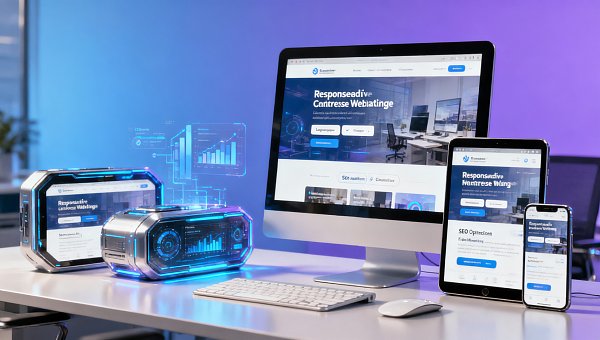
When reviewing website design examples, many companies often focus only on the homepage banner, color scheme, and animation effects for the first three minutes. However, what truly impacts business results is usually hidden at the structural, technical, and operational levels. A responsive corporate website system that only looks good on PC but loads slowly on mobile will directly affect bounce rate, dwell time, and form submission rate.
Taking B2B official websites as an example, traffic sources are typically divided into three categories: organic search, advertising, and returning customers. Users from different sources have vastly different tolerances for page speed, page layout logic, and contact information. A common experience is that if the first screen takes more than 3 seconds to load, mobile churn will increase significantly; if the core conversion entry point is buried too deep, the number of inquiries will also be diluted.
Furthermore, whether a case study supports multiple languages, reserves SEO tag slots, and can be integrated with GA4 or other traffic monitoring tools also determines whether the site can move from "launch" to "growth." Many projects, without stable content updates and data analysis mechanisms within six months of launch, will gradually lose search visibility.
For corporate websites that cover a mix of distributors, agents, and end consumers, it's crucial to pay attention to the clarity of the information architecture. There should be at least four entry points: product pages, application scenario pages, service support pages, and case study pages. Otherwise, users with different roles will find it difficult to find the corresponding information within 1-2 minutes.
Four key dimensions to focus on during initial case screening
- Terminal adaptation: Whether it truly achieves adaptive design across PCs, tablets, and mobile phones, and whether buttons, forms, and images display stably within the 360px to 1440px range.
- Search engine basics: Does it have basic optimization features such as title, description, URL rules, image alt text, breadcrumbs, and internal links?
- Marketing integration: Whether it integrates conversion components such as online consultation, form tracking, telephone click statistics, and remarketing codes.
- Maintenance costs: Does subsequent redesign, section expansion, and content updates rely on developers? Can a regular operations team complete the basic release within one hour?
The table below can help businesses quickly distinguish between case studies that are "only suitable for display" and those that are "truly suitable for customer acquisition".
If a case study can withstand analysis in terms of technology, content, and marketing integration, then its reference value for purchasing decisions is usually far greater than that of a project sample that gains favor solely based on visual impact.
Core details that must be checked in responsive website design case studies

When evaluating responsive website building system case studies, it's recommended to break it down into two layers: the "visible" and the "invisible." The former includes page structure, navigation logic, and content layout, while the latter includes code maintainability, deployment tracking, page indexing efficiency, and future upgrade potential. Companies planning long-term marketing should pay particular attention to the latter.
Multilingual support is the first key capability. If a company plans to expand overseas within the next 12 months, it should at least have a bilingual (Chinese and English) architecture; if multi-regional distribution is involved, it can further expand to more than three language versions. The important thing is not just "translation capability," but whether different language pages can independently set keywords, URLs, and landing page content, which directly affects overseas search performance.
The second key element is SEO keyword research capability. Excellent case studies typically differentiate between four keyword categories—brand terms, product terms, scenario terms, and problem terms—during the section planning phase, and then allocate them to different pages such as the homepage, product pages, solution pages, and blog pages. The advantage of this approach is that it allows the website to have a clear direction for content expansion within 1-3 months of launch, rather than relying on hastily cobbled-together articles.
The third item is the integration of traffic monitoring tools. At a minimum, it's necessary to confirm support for GA4, search consoles, ad conversion codes, heatmaps, or event tracking. For decision-makers, it's difficult to assess ROI for website projects without data; for project managers, without tracking points, it's impossible to pinpoint which page, which button, or which channel is performing better.
Four types of hidden costs that are most easily overlooked
Maintenance costs
If the backend is not user-friendly, businesses will have to rely on outsourcing to update 2-4 articles, launch 10 new products, and replace event banners every month, which will continuously increase annual maintenance costs.
Redesign costs
Many websites need to add new sections, secondary topic pages, or new languages within 6 months of going live. If the underlying architecture is not flexible, each change may trigger a complete rebuild.
Training costs
Whether after-sales maintenance and operations personnel can independently complete daily management after 1-2 training sessions is an important criterion for measuring system maturity.
Data loss cost
If there are no redirection rules and tracking continuation mechanisms during migration, redesign, or column reorganization, historical indexing, advertising attribution, and inquiry data may fluctuate significantly in a short period of time.
In some organizational client projects, website development not only serves the marketing department but also involves collaborative needs such as administration, human resources, and announcements. Similarly, optimizing information service pages for public institutions' personnel and labor management in the digital economy era reminds companies that when planning responsive websites, they need to consider content categorization, access control, and long-term information update mechanisms, not just front-end presentation.
From Case Studies to Implementation: How to Determine if a Solution is Suitable for a Company's Current Stage
There is no single template for responsive website building systems that suit the needs of different businesses. Manufacturing companies with growing annual revenue typically focus more on product catalogs, inquiry forms, and compatibility with overseas promotions; service companies prioritize content publishing efficiency, case study presentation, and lead management integration. The key to determining whether a case study is suitable lies in matching it to your business stage, rather than blindly copying the official websites of large brands.
A more prudent approach is to first define the website's goals for the next 6-12 months. For example: Is the goal to increase organic search traffic or to attract advertising? Is it for attracting franchisees or for generating leads for engineering projects? Different goals require different priorities for site sections, content strategies, tracking methods, and conversion components.
In the integrated website + marketing service model, website building is only the first step. More importantly, it's about whether a closed loop of "content production—traffic acquisition—conversion tracking—continuous optimization" can be formed after launch. Service providers like Yiyingbao Information Technology (Beijing) Co., Ltd., with over ten years of experience, often excel not in single-page design, but in their ability to integrate website building with SEO, social media, and advertising.
For project managers, it's also crucial to consider whether the delivery cycle is reasonable. For typical corporate website projects, the time from requirements gathering to launch is generally 2-6 weeks; if it involves three languages, a complex product library, and data migration, the cycle may extend to 6-10 weeks. Too fast often indicates insufficient requirements analysis, while too slow may affect the market window.
A 5-step judgment method that can be directly applied when selecting a model
- First, set goals: Clarify the core tasks of the website in the next 90 days and 180 days, whether it is customer acquisition, brand display or channel empowerment.
- Examine the case study structure: Prioritize cases that are similar to your own industry, have a similar number of products, and have a similar target audience, rather than just looking at cases from well-known brands.
- Ask for technical details: Confirm whether it supports independent TDK, 301 redirects, form tracking, page speed optimization, and multilingual extensions.
- Test backend efficiency: Ideally, routine operations such as publishing demo articles, uploading products, replacing banners, and exporting forms should be completed within 15 minutes.
- Calculate long-term costs: Evaluate website setup costs, maintenance costs, redesign costs, training costs, and content collaboration costs over a one-year period.
If a supplier can only showcase the page layout but cannot explain keyword placement, traffic monitoring, content operation, and subsequent maintenance logic, then no matter how impressive the case study is, it may not be suitable for undertaking the company's future growth tasks.
To make decision-making more intuitive, the table below can be used as a scoring basis during internal reviews.
From an internal communication perspective, this scoring method can also help the market, technology, and management discuss projects under the same set of standards, reducing the risk of "making decisions based solely on subjective likes and dislikes".
Post-launch operation, maintenance, and common misconceptions
The true value of a responsive website building system typically emerges at 30, 90, and 180 days after launch. Within 30 days, the focus is on the stability of basic functions and the accuracy of event tracking. Within 90 days, the focus is on the frequency of content updates and indexing trends. Within 180 days, the focus is on whether there are visible improvements in organic traffic, valid inquiries, and page conversion rates.
A common misconception among many businesses is that "website launch = project completion." In reality, without continuous operation, a website easily becomes a static brochure. It's recommended to maintain at least 2-4 content updates per month, focusing on product applications, frequently asked customer questions, industry solutions, and an after-sales support knowledge base. This content not only serves users but also improves search visibility.
The second misconception is neglecting conversion tracking. Some websites have traffic, but they can't distinguish whether the traffic comes from search, advertising, or social media, nor do they know which pages are driving inquiries. For marketing managers, without this step, subsequent budgeting and content strategies will lack a basis.
The third misconception is neglecting after-sales service and training. For after-sales maintenance personnel, a website system is not a one-time delivery, but a work platform that needs to be used long-term. Basic mechanisms, including account permissions, form export, page backup, plugin updates, and anomaly alerts, should all be clearly defined at the time of delivery.
FAQ: 4 Most Frequently Asked Questions by Businesses
Which types of businesses are suitable for a responsive website building system?
Suitable for most businesses that need to support both PC and mobile access, especially B2B companies with needs for search engine customer acquisition, brand display, franchise recruitment, and overseas promotion. If mobile devices account for more than 40% of access, a responsive architecture is usually a more reliable choice.
How long is the delivery cycle usually?
A basic corporate website can typically be completed in 2-4 weeks. When it involves multiple languages, complex product libraries, historical data migration, or marketing automation integration, the typical cycle is 4-8 weeks. The more thoroughly the requirements are confirmed, the lower the probability of rework.
What indicators should you look at most when making a purchase?
We recommend focusing on four key aspects: ease of search engine optimization, support for data tracking, ease of operation and maintenance, and integration with subsequent marketing activities. Price only reflects initial investment and cannot replace long-term value judgment.
Why do some websites still not receive inquiries after they go live?
Common causes include inaccurate keyword placement, insufficient content, unclear conversion entry points, single traffic source, slow loading speed, and failure to design pages around the user's decision-making path. The disconnect between website building and marketing is the root cause of low conversion rates for many businesses.
For clients looking to improve organizational collaboration efficiency, the knowledge content center, policy announcement area, and document download module on a website are becoming increasingly important. The organization of content pages, such as how to optimize personnel and labor management in public institutions during the digital economy era , can also provide reference ideas for enterprises to build special topic pages, document pages, and vertical content pages.
The truly valuable responsive website design case studies don't focus on visual flashiness, but rather on whether they balance multi-language support, SEO keyword research, traffic monitoring integration, content operation efficiency, and long-term maintenance costs. For business decision-makers, choosing a website solution requires considering not only the initial launch results but also the growth potential and sustainable operational capabilities six months later.
If you are evaluating a website redesign, overseas website setup, or website and marketing synergy upgrade project, we recommend prioritizing service solutions that offer integrated support for website building, optimization, campaign placement, and content operation. Developing a clearer implementation path based on business goals, audience demographics, and budget timeline is often more cost-effective than simply pursuing the lowest price.
To learn more about responsive website architecture, section planning, and conversion solutions tailored to your industry, please contact us immediately to obtain a customized solution and discuss more implementation details.
Related Articles

Related Products
 EasyCamp SaaS Smart Website Marketing SystemE-Yingbao SaaS Smart Website Marketing System: AI-powered, zero-code website building. Rapidly launch multilingual independent e-commerce sites in just 10 minutes. Global server acceleration and AI-driven SEO optimization empower businesses to efficiently connect with global markets. The seamless integration of technology and user-friendly operation makes building e-commerce sites incredibly simple.
 AI+SEM Intelligent Advertising Marketing SystemAI+SEM drives intelligent ad creation, empowering full-funnel precision advertising marketing. The system automatically generates weekly/monthly reports, AI recommends keywords and target countries, monitors core metrics in real-time with intelligent alerts, and enables one-click high-conversion ad solutions to help quickly acquire customers and improve ROI.
 AI+SEO Dual Engine Optimization ServiceEasyWin AI+SEO Dual Engine Optimization System leverages AI-powered keyword mining, content generation, and comprehensive technical optimization to help foreign trade enterprises acquire high-quality organic traffic, significantly improving search rankings and conversion rates.
 AI+SNS Social Media Marketing SystemYingbao AI+SNS Social Media Marketing System - Precision social capture for the social media era. Supports one-click content synchronization across major platforms like Facebook and LinkedIn. AI intelligently rewrites posts for enhanced relevance. 24/7 AI customer service and user profiling analysis empower businesses to efficiently expand into global markets.
 AI+SEO营销解决方案易营宝AI+SEO营销解决方案,通过AI批量写作、智能生成TDK、精准关键词扩词等功能,全面优化网站SEO效果,提升流量与转化率。助力企业构建高效智能网站新生态。
 AI+SEM Advertising Marketing SolutionsAI+SEM Advertising Marketing Solution leverages AI technology to deeply empower SEM ad campaigns. It automatically generates weekly/monthly reports using AI, presenting account data across multiple dimensions for comprehensive insights into campaign performance and trends. The system precisely recommends keywords and target countries, intelligently generates high-conversion ad copy, and enables one-click activation of efficient campaign plans to help businesses rapidly acquire customers. Simultaneously, it monitors core metrics in real time, intelligently identifies abnormal fluctuations, and issues timely alerts to ensure stable, high-return advertising results.
 Domain Name ServicesEasyWin provides professional domain name services, including intelligent queries, one-stop registration, brand protection, and full lifecycle management, helping businesses build a digital brand image.
 EasyOperate B2C Cross-Border E-Commerce Platform & Independent WebsiteEasyStore B2C Cross-border E-commerce Independent Store is an intelligent website building and cross-border e-commerce integrated solution independently developed by EasyStore Information Technology (Beijing) Co., Ltd. The system is specially designed for small and medium-sized as well as large export enterprises, integrating 'website building, operation, marketing, advertising, and conversion' into one, helping enterprises quickly establish cross-border e-commerce independent stores to achieve brand globalization and global sales growth.
The platform supports multiple languages, multiple currencies, and multi-channel marketing, with built-in AI intelligent translation and SEO optimization systems, suitable for mainstream markets such as Southeast Asia, Europe and America, Latin America, and the Middle East, assisting Chinese manufacturing enterprises in efficiently deploying international e-commerce strategies. SSL证书易营宝提供专业SSL安全证书服务,包括单域名和泛域名证书,确保网站数据传输加密、身份验证和完整性保护,助力企业建立安全可信的在线业务环境。









