









- Will GEO replace traditional SEOMay 27, 2026View details
- Is SEO Still Necessary in 2026May 27, 2026View details
- Why Shenzhen Global Digital Marketing Services Are Gaining More Attention from Export-Oriented EnterprisesMay 26, 2026View details
- Why International Digital Agencies Place Greater Emphasis on Closed-Loop Data in AdvertisingMay 26, 2026View details
- Which businesses are Guangzhou global digital marketing solutions suitable for?May 26, 2026View details
- Why International Digital Agency Data Analysis Determines Campaign Success or FailureMay 26, 2026View details
- What problems can internet marketing consulting company services generally solveMay 26, 2026View details
- Why Mobile Digital Marketing Websites Are Becoming Increasingly ImportantMay 26, 2026View details
Are free websites suitable for building a corporate website
Are Free Websites Suitable for Building a Corporate Website?
A free website may seem to help companies get their official website online quickly, with almost no barriers at the early stage.
But if the goal is to build brand trust, capture marketing traffic, and support subsequent conversions, a free website is usually not the ideal choice for a corporate website.
For procurement personnel, the evaluation standard should not only be whether it “saves money,” but more importantly whether it can support the business, reduce hidden risks, and deliver lasting value.
When Procurement Personnel Search for “Free Website”, What Are They Really Trying to Determine?
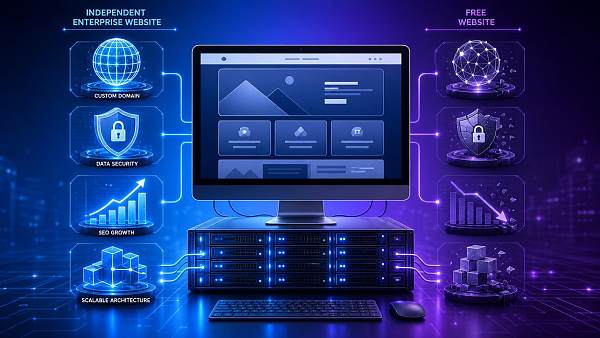
When procurement personnel search for “Is a free website suitable for building a corporate website?”, the core intent is not simply to find a free tool, but to confirm whether a low-cost solution can meet enterprise usage requirements.
Behind this are usually several practical issues: limited budget, management requiring the site to go live as soon as possible, business departments hoping the official website can provide both presentation and customer acquisition capabilities, and follow-up maintenance that cannot be too complicated.
Therefore, what this type of reader cares about most is not whether a free website can be used, but whether it is suitable for long-term use, whether it will affect the brand, and whether it can avoid repeated investment later.
Conclusion First: Free Websites Can Be Used Temporarily, but They Are Not Suitable for Most Corporate Websites
If a company is only doing internal testing, campaign landing pages, or short-term presentation pages, a free website has certain value and can help the team quickly validate content and page structure.
But once the official website takes on tasks such as external display, customer endorsement, search-based customer acquisition, and inquiry conversion, free websites often expose their limitations quickly, affecting the company’s overall image and business efficiency.
From a procurement perspective, the total cost matters more than the initial cost. Going online for free does not mean real savings. Once redesign, migration, or SEO rebuilding is needed later, the cost is often higher than building it properly from the start.
Why Free Websites Seem Cheap, but the Actual Risks Are Not Low
The first type of risk is insufficient brand credibility. Many free websites come with a platform subdomain, brand logo, or fixed footer information, which directly weakens the professionalism of a corporate website.
For potential customers, the official website is often the first point of contact. If even the domain name, visual design, and content management appear “unlike a legitimate company,” the willingness to inquire will naturally decline.
The second type of risk is limited functionality. Free solutions usually cannot flexibly support multilingual capabilities, form lead management, SEO settings, tracking analytics, CRM integration, and ad conversion tracking.
These limitations may not be obvious in the early stage of the website, but once the company wants to do promotion, run ads, or follow up on overseas markets, it will find that the official website cannot truly support marketing work.
The third type of risk is data and control issues. Some free platforms impose many restrictions on templates, data export, server environments, and system permissions, resulting in high migration costs and even platform lock-in.
For procurement personnel, the official website is not a one-time deliverable, but a long-term digital asset of the company. A website without independence and controllability can hardly be considered truly owned by the enterprise.
What Procurement Personnel Should Focus on Most Is Not “Free”, but These Four Evaluation Dimensions
First, look at the goal of the official website. If the website is only used as a simple company profile display, with low requirements and a short timeline, a free solution can serve as a short-term transition; if it carries customer acquisition tasks, then an expandable platform should be chosen.
Second, look at brand requirements. For companies facing B2B customers, channel partners, and overseas buyers, the official website represents the company’s storefront. The more importance placed on brand trust, the less reliance there should be on free websites.
Third, look at marketing needs. If a company plans to do SEO, advertising, content marketing, and social media traffic generation, the official website must have capabilities for structural optimization, data analysis, and conversion support.
Fourth, look at long-term maintenance. Procurement decisions should not compare only the launch cost, but also redesign costs, operation and maintenance costs, content update efficiency, and the difficulty of integrating new systems in the future.
In What Scenarios Can Free Websites Be Considered?
Objectively speaking, free websites are not completely without value. For projects with extremely low budgets, very tight timelines, and clear, short-term website goals, they can serve as a temporary tool.
For example, during a new project testing phase, exhibition one-page sites, recruitment landing pages, or course introduction pages, where no complex conversion funnel is required and long-term SEO accumulation is not emphasized, this kind of scenario is suitable for lightweight deployment.
Some startup teams, when their business is not yet clear, will also first use free solutions to validate brand positioning, content framework, and user feedback, and then decide whether to proceed with building a formal official website.
However, the premise for this kind of use is very clear: treat it as a transitional solution, rather than mistakenly assuming “free” means “sufficient.” Once the business takes shape, the company should upgrade to an independent official website system in a timely manner.
If a Company Wants to Build an Official Website, What Solution Better Fits Procurement Value Logic?
A more reasonable approach is usually not choosing between “free” and “expensive customization,” but selecting a website-building solution with marketing capabilities, delivery efficiency, and scalability according to the business stage.
For most companies, mature intelligent website building or marketing-oriented corporate website development offers better cost performance than free websites. It can control the initial budget while also taking into account brand needs and subsequent growth requirements.
Especially under the trend of integrating websites and marketing services, the official website is no longer just a display window, but the infrastructure for SEO, advertising, content operations, and customer conversion.
From this perspective, when procuring official website development, what you are buying is not a page, but a digital growth vehicle that the business can continue to use over time.
An Easily Overlooked Question: Can the Official Website Support Subsequent Business Expansion?
Many companies choose free websites in the early stage because they only see “let’s get online first.” But the real question is whether the site can still expand smoothly later when adding sections, making it multilingual, or connecting an inquiry system.
If the platform architecture is closed and all new requirements are restricted, the company will soon fall into the awkward situation of “wanting to do it but being unable to, while rebuilding is too expensive,” and the procurement value will also be questioned.
In fields such as international trade, cross-border marketing, and manufacturing going global, the official website often also takes on more tasks of information disclosure and risk communication, which places higher demands on content-carrying capacity.
For example, some companies add industry research or professional materials in the content resource section to enhance customer trust. Content such as Risk Management and Prevention Exploration for International Trade Enterprises is more suitable to be placed on a formal official website that can be independently operated.
How to Report Internally: Why It Is Not Recommended to Use a Free Website as the Formal Official Website
When procurement personnel communicate internally, they can express it from three levels: first, a free website can go online, but it may not necessarily support brand and customer acquisition goals; second, hidden costs may be higher than explicit savings.
Third, the official website is a long-term digital asset and priority should be given to stability, scalability, and marketing compatibility, rather than only looking at whether there is an initial charge.
If management is more concerned about return on investment, it can be further explained that a website capable of capturing search traffic, enhancing trust, and supporting conversion is essentially more cost-saving than a website that is “free but ineffective.”
Because what a low-quality official website brings is not savings, but lost customers, wasted advertising spend, and repeated rebuilding later, all of which are real operating costs.
Conclusion: Whether a Corporate Website Should Choose a Free Website Depends on What You Really Want
If it is only for temporary display, a free website can serve as a short-term stopgap tool; but if the corporate website is responsible for brand building, customer trust, and marketing conversion tasks, it is usually not a suitable choice.
For procurement personnel, a more professional way to judge is to comprehensively evaluate from several aspects including business goals, brand requirements, marketing capabilities, maintenance costs, and long-term scalability.
A truly cost-effective official website is not the cheapest one, but the one that can meet current needs while also supporting future growth.
Therefore, instead of asking “Can a free website be used as an official website,” it is better to ask “Can this official website truly create value for the company?” That is the core of procurement decision-making.
Related Articles
 Why is Facebook the first choice for customer acquisition when using listing services for foreign trade?
 Reduce the workload of foreign trade operations! Yiyingbao AI automatic ad clipping + global intelligent synchronization, efficiency takes off!
 People who say Facebook is useless, I advise you not to shift the blame



Related Products
 EasyCamp SaaS Smart Website Marketing SystemE-Yingbao SaaS Smart Website Marketing System: AI-powered, zero-code website building. Rapidly launch multilingual independent e-commerce sites in just 10 minutes. Global server acceleration and AI-driven SEO optimization empower businesses to efficiently connect with global markets. The seamless integration of technology and user-friendly operation makes building e-commerce sites incredibly simple.
 AI+SEM Intelligent Advertising Marketing SystemAI+SEM drives intelligent ad creation, empowering full-funnel precision advertising marketing. The system automatically generates weekly/monthly reports, AI recommends keywords and target countries, monitors core metrics in real-time with intelligent alerts, and enables one-click high-conversion ad solutions to help quickly acquire customers and improve ROI.
 AI+SEO Dual Engine Optimization ServiceEasyWin AI+SEO Dual Engine Optimization System leverages AI-powered keyword mining, content generation, and comprehensive technical optimization to help foreign trade enterprises acquire high-quality organic traffic, significantly improving search rankings and conversion rates.
 AI+SNS Social Media Marketing SystemYingbao AI+SNS Social Media Marketing System - Precision social capture for the social media era. Supports one-click content synchronization across major platforms like Facebook and LinkedIn. AI intelligently rewrites posts for enhanced relevance. 24/7 AI customer service and user profiling analysis empower businesses to efficiently expand into global markets.
 AI+SEO营销解决方案易营宝AI+SEO营销解决方案,通过AI批量写作、智能生成TDK、精准关键词扩词等功能,全面优化网站SEO效果,提升流量与转化率。助力企业构建高效智能网站新生态。
 AI+SEM Advertising Marketing SolutionsAI+SEM Advertising Marketing Solution leverages AI technology to deeply empower SEM ad campaigns. It automatically generates weekly/monthly reports using AI, presenting account data across multiple dimensions for comprehensive insights into campaign performance and trends. The system precisely recommends keywords and target countries, intelligently generates high-conversion ad copy, and enables one-click activation of efficient campaign plans to help businesses rapidly acquire customers. Simultaneously, it monitors core metrics in real time, intelligently identifies abnormal fluctuations, and issues timely alerts to ensure stable, high-return advertising results.
 Domain Name ServicesEasyWin provides professional domain name services, including intelligent queries, one-stop registration, brand protection, and full lifecycle management, helping businesses build a digital brand image.
 EasyOperate B2C Cross-Border E-Commerce Platform & Independent WebsiteEasyStore B2C Cross-border E-commerce Independent Store is an intelligent website building and cross-border e-commerce integrated solution independently developed by EasyStore Information Technology (Beijing) Co., Ltd. The system is specially designed for small and medium-sized as well as large export enterprises, integrating 'website building, operation, marketing, advertising, and conversion' into one, helping enterprises quickly establish cross-border e-commerce independent stores to achieve brand globalization and global sales growth.
The platform supports multiple languages, multiple currencies, and multi-channel marketing, with built-in AI intelligent translation and SEO optimization systems, suitable for mainstream markets such as Southeast Asia, Europe and America, Latin America, and the Middle East, assisting Chinese manufacturing enterprises in efficiently deploying international e-commerce strategies. SSL证书易营宝提供专业SSL安全证书服务,包括单域名和泛域名证书,确保网站数据传输加密、身份验证和完整性保护,助力企业建立安全可信的在线业务环境。









