









- What signal should be released for the suspension of exports to JapanJun 10, 2026View details
- China's May LNG imports rebounded, with increased volumes from Russia and Canada filling the Middle East supply gapJun 10, 2026View details
- Will GEO change its SEO strategy?Jun 04, 2026View details
- What types of businesses are end-to-end solutions suitable for?Jun 03, 2026View details
- 2026 Global Growth Channel TrendsJun 02, 2026View details
- Changes in Search Engine Ranking Factors in 2026Jun 06, 2026View details
- Which stages is the brand visibility enhancement service suitable forMay 29, 2026View details
- What Are the Key Modules of International Digital Marketing ServicesMay 29, 2026View details
Which metrics should you define before a website redesign
The easiest mistake to make in a website redesign is not choosing the wrong visual direction, but failing to clearly define what “redesign success” means first. For project managers and engineering project owners, what should truly be defined first is not the homepage style, but measurable indicators such as traffic, conversions, bounce rate, loading speed, lead quality, and implementation timeline. When indicators are clearly defined, the team has a basis for collaboration, budget input can be properly judged, and the results after the redesign can also be verified.
Why defining metrics before a website redesign is more important than looking at pages first
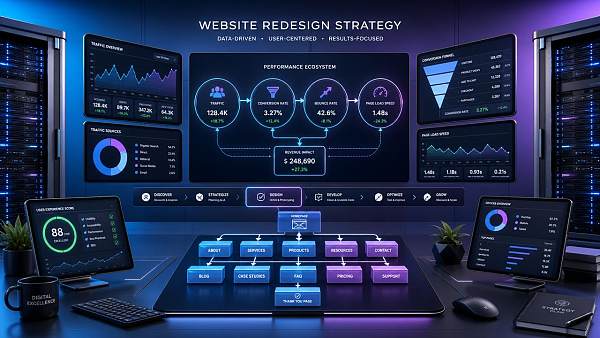
When many companies mention a website redesign, discussions immediately move to color schemes, sections, motion effects, and case displays, but these all belong to the “presentation layer.” Without upfront metrics, no matter how attractive the design is, it may still fail to support business growth and may even slow down project progress.
For managers, a redesign is essentially a reallocation of resources. You invest budget, time, manpower, and cross-department collaboration costs, and in the end there is only one question to answer: can this redesign enable the website to better take on the tasks of customer acquisition, communication, conversion, and brand support?
Therefore, defining metrics before a website redesign actually means defining the project boundaries, priorities, and acceptance criteria first. Doing so can prevent the team from constantly reworking during execution, and can also reduce the common problem of “it looks good, but the results are average.”
The four core types of metrics project owners should review first
If the target readers are project managers, then compared with learning design styles, it is more important to focus on the few key metrics that affect outcomes. It is usually recommended to start with four categories of metrics: traffic, conversion, user behavior, and technical performance.
The first category is traffic metrics. These include organic search traffic, the share of branded and non-branded keyword traffic, visits to core landing pages, and the traffic structure of mobile and PC users. Without this set of data, it is impossible to judge whether the website redesign will affect existing customer acquisition entry points.
The second category is conversion metrics. These include form submission rate, inquiry click-through rate, phone call rate, inquiry conversion rate, and the conversion path from key pages to lead pages. For engineering project owners, a website is not a brochure, but a part of the business funnel.
The third category is user behavior metrics. Bounce rate, average time on page, page depth, click heat zones on key buttons, and visit paths can directly show whether the current website design enables users to quickly understand the business value and whether there are information barriers.
The fourth category is technical performance metrics. Page loading speed, first-screen time, mobile adaptation, server stability, and security all affect search rankings and user experience. Especially for multi-region access businesses, greater attention should be paid to underlying network support capabilities and compatibility.
Different redesign goals require different priority metrics
Not every website redesign needs to focus on the same set of numbers. What project owners fear most is using one unified standard to evaluate all projects, resulting in distorted judgment of direction. Only by first clarifying the redesign goal do metrics become meaningful.
If the goal of the redesign is to improve customer acquisition, then priority should be given to search traffic, conversion rate, landing page performance, and CTA click-through rate. Projects of this kind cannot focus only on whether the pages are visually appealing, but must assess whether the information structure supports users in taking action quickly.
If the goal of the redesign is to enhance brand professionalism, then more attention should be paid to time on site, completion rate of reading key pages, depth of visits to case pages, and return visit rate. This is because brand-oriented websites place more emphasis on building recognition rather than closing a deal immediately in a single visit.
If the goal of the redesign is to improve overseas or cross-regional access experience, then the technical layer becomes more critical. For example, protocol support, access speed, and security mechanisms. In enterprise network upgrade scenarios, Internet Protocol Version 6(IPV6) offers a larger address space, higher speed, and stronger security, and can be used as part of the evaluation of foundational capabilities.
If the goal of the redesign is to integrate information from multiple business lines, then the focus should be on the clarity of section paths, click distribution of different business entry points, internal search usage rate, and page transition paths. Otherwise, if users cannot find information, even the best website design will struggle to create value.
The 7 metrics that must be defined before a redesign are most suitable as the basis for project initiation
The first is the traffic baseline of core pages. Before the redesign, visits to the homepage, product pages, solution pages, case pages, and contact page should first be recorded; otherwise, after the redesign it will be impossible to compare whether there was real improvement or whether only a style update was made.
The second is the completion rate of core conversion actions. Project managers must first define what constitutes an effective conversion, whether it is submitting a form, making a phone call, or booking a demo. Different definitions will affect page structure, copy guidance, and data tracking plans.
The third is bounce rate and exit rate. A high bounce rate is not necessarily a bad thing, but if high-traffic pages also have low dwell time and low interaction, it indicates that the current website design has issues in content matching, loading speed, or information expression, and these should be prioritized.
The fourth is first-screen loading speed. Many redesign projects add more visual elements, but as a result there are too many images, motion effects, and scripts, causing the first screen to become slower. For search engines and users, a slow website directly affects visit quality and conversion intent.
The fifth is mobile usability. A large amount of business traffic now comes from mobile phones, especially in search and social media traffic-driving scenarios. If the mobile layout is confusing, buttons are hard to click, and the form experience is poor, then even if the PC website design is complete, the results will still be limited.
The sixth is lead quality. It is not enough to look only at quantity; it is also necessary to see whether sales recognizes them. After many website redesigns, inquiries increase, but invalid leads also increase, indicating that the pages attracted the wrong traffic or that the filtering mechanism for target customers was not properly designed.
The seventh is redesign cost and timeline control. Project owners need to clarify the budget ceiling, milestone nodes, launch risks, and maintenance costs. This is because a website redesign does not end on the day it goes live, but also includes subsequent optimization, monitoring, and iteration.
How to judge whether your current website really needs a redesign, instead of just “feeling old”
The starting point of many redesign projects is not rational, but simply that leadership feels the pages are old, competitors have launched new websites, or internally there is a desire for a brand upgrade. But from a management perspective, whether to redesign should be based on data and business changes, not aesthetic preference.
If website traffic continues to decline while content updates remain normal, then search performance and page experience should be checked to see whether they are lagging behind. If the ranking of major keywords has dropped significantly, it indicates that the current website design and SEO structure may no longer match the current competitive environment.
If there is traffic but no conversion, the problem often lies not in exposure, but in information architecture, trust building, and action guidance. At this time, the focus of the redesign is not “making it prettier,” but enabling users to more quickly understand who you are, what problems you can solve, and why you are worth contacting.
If the company’s business has already changed, such as adding new product lines, expanding into overseas markets, or upgrading service targets, then the section logic and content framework of the old website often can no longer support the new goals. This is also an important signal that the website design needs systematic adjustment.
During project execution, how to prevent a website redesign from turning into “rework without standards”
The first step is to translate business goals into data goals. For example, “enhancing brand image” is too abstract; it is better to break it down into “increase visit depth on case pages by 20%” or “increase dwell time on core solution pages by 30%,” so that the team can collaborate around outcomes.
The second step is to clarify who is responsible for which metrics. Marketing is responsible for traffic and content, product or business departments are responsible for the accuracy of materials, the technical team is responsible for performance and stability, and managers are responsible for resource coordination and acceptance criteria. When responsibilities are clear, rework is greatly reduced.
The third step is to diagnose first, then design. The ideal process should be data analysis, user journey mapping, competitor research, and information architecture confirmation, and only after that move into the visual and front-end stages. Otherwise, it becomes a matter of drawing first and patching the logic later, which usually costs more.
The fourth step is to set phased acceptance checks. Do not wait until the entire site is completed to review results; instead, metric requirements should be verified separately at stages such as prototype, content, development, and launch testing, especially checking whether speed, tracking, forms, and mobile experience meet standards.
In underlying technical planning, if the company is also carrying out a network upgrade at the same time, support capabilities for the new protocol environment can also be evaluated in advance. For example, native support for IPSec and support for end-to-end encryption are more valuable for corporate websites that emphasize security and multi-region access.
For managers, what kind of website redesign can be considered successful
The standard of success is not “leadership satisfaction” or “more premium-looking pages,” but whether the website plays a clearer business role after the redesign. It should make it easier for target customers to find you, understand you, trust you, and be willing to take the next step.
From the perspective of results, a successful redesign usually shows three things: higher-quality traffic is more stable, core conversion actions are smoother, and subsequent operations are easier to sustain. In other words, website design is not a one-time project, but infrastructure that serves long-term marketing efficiency.
If after the redesign there is only a visual update, but no data improvement, lead improvement, or operational efficiency gain, then the project was likely only “launched successfully” and did not truly achieve the redesign goals. Managers should be especially alert to this kind of superficial success.
Conclusion: define metrics first, so the website redesign has direction and value
Before a website redesign, what project managers should define first is not style, but metrics. Traffic determines the quality of entry points, conversion determines business value, bounce rate reflects information matching, loading speed affects experience and rankings, and lead quality is related to the likelihood of final deals.
When these metrics are clearly defined before the redesign, the team knows why to redesign, what to redesign, and to what extent success should be considered achieved. Only then is a website redesign not an aesthetic discussion, but a growth project that can be evaluated, implemented, and continuously optimized.
If you are preparing to launch a new round of website upgrades, you may want to start with an inventory of the current data, then determine goals, metrics, and implementation priorities. Establish the judgment criteria first, and the design, development, and promotion actions that follow will be more valuable and more worthy of investment.
Related Articles



Related Products
 EasyCamp SaaS Smart Website Marketing SystemE-Yingbao SaaS Smart Website Marketing System: AI-powered, zero-code website building. Rapidly launch multilingual independent e-commerce sites in just 10 minutes. Global server acceleration and AI-driven SEO optimization empower businesses to efficiently connect with global markets. The seamless integration of technology and user-friendly operation makes building e-commerce sites incredibly simple.
 AI+SEM Intelligent Advertising Marketing SystemAI+SEM drives intelligent ad creation, empowering full-funnel precision advertising marketing. The system automatically generates weekly/monthly reports, AI recommends keywords and target countries, monitors core metrics in real-time with intelligent alerts, and enables one-click high-conversion ad solutions to help quickly acquire customers and improve ROI.
 AI+SEO Dual Engine Optimization ServiceEasyWin AI+SEO Dual Engine Optimization System leverages AI-powered keyword mining, content generation, and comprehensive technical optimization to help foreign trade enterprises acquire high-quality organic traffic, significantly improving search rankings and conversion rates.
 AI+SNS Social Media Marketing SystemYingbao AI+SNS Social Media Marketing System - Precision social capture for the social media era. Supports one-click content synchronization across major platforms like Facebook and LinkedIn. AI intelligently rewrites posts for enhanced relevance. 24/7 AI customer service and user profiling analysis empower businesses to efficiently expand into global markets.
 AI+SEO营销解决方案易营宝AI+SEO营销解决方案,通过AI批量写作、智能生成TDK、精准关键词扩词等功能,全面优化网站SEO效果,提升流量与转化率。助力企业构建高效智能网站新生态。
 AI+SEM Advertising Marketing SolutionsAI+SEM Advertising Marketing Solution leverages AI technology to deeply empower SEM ad campaigns. It automatically generates weekly/monthly reports using AI, presenting account data across multiple dimensions for comprehensive insights into campaign performance and trends. The system precisely recommends keywords and target countries, intelligently generates high-conversion ad copy, and enables one-click activation of efficient campaign plans to help businesses rapidly acquire customers. Simultaneously, it monitors core metrics in real time, intelligently identifies abnormal fluctuations, and issues timely alerts to ensure stable, high-return advertising results.
 Domain Name ServicesEasyWin provides professional domain name services, including intelligent queries, one-stop registration, brand protection, and full lifecycle management, helping businesses build a digital brand image.
 EasyOperate B2C Cross-Border E-Commerce Platform & Independent WebsiteEasyStore B2C Cross-border E-commerce Independent Store is an intelligent website building and cross-border e-commerce integrated solution independently developed by EasyStore Information Technology (Beijing) Co., Ltd. The system is specially designed for small and medium-sized as well as large export enterprises, integrating 'website building, operation, marketing, advertising, and conversion' into one, helping enterprises quickly establish cross-border e-commerce independent stores to achieve brand globalization and global sales growth.
The platform supports multiple languages, multiple currencies, and multi-channel marketing, with built-in AI intelligent translation and SEO optimization systems, suitable for mainstream markets such as Southeast Asia, Europe and America, Latin America, and the Middle East, assisting Chinese manufacturing enterprises in efficiently deploying international e-commerce strategies. SSL证书易营宝提供专业SSL安全证书服务,包括单域名和泛域名证书,确保网站数据传输加密、身份验证和完整性保护,助力企业建立安全可信的在线业务环境。









