









- How to view pricing in the global traffic ecosystem? Cost comparison of search, social media, and content channel advertisingJul 06, 2026View details
- How to assess foreign trade website development trends?Looking at 2026 changes from multilingual,AI content to conversion pathsJul 04, 2026View details
- What are the new trends in multilingual marketing data analytics tools in 2026? Focus on attribution、automation and complianceJul 04, 2026View details
- Is Brand Globalization Marketing Consulting Worth Buying? At What Stage Should Companies Bring It InJul 01, 2026View details
- Cross-Border Marketing Trend Research: Why More and More Companies Are Starting to Deploy AI Search and GEO OptimizationJun 30, 2026View details
- Cross-Border Marketing Trend Research: How Independent Sites, AI Content, and Short-Video Customer Acquisition Are ChangingJun 30, 2026View details
- How Can a Brand Updates Page Be Made More SEO-Friendly? Analysis of Update Frequency, Content Structure, and Internal Linking StrategyJun 28, 2026View details
- What stages does the cross-border services ecosystem include? How do website building, promotion, payment, and compliance work togetherJun 22, 2026View details
How to build a more stable headless CMS for global websites
For technical evaluators, how to build Headless CMS for global websites more robustly is not only a matter of architecture selection, but also concerns multi-site collaboration, performance, security, and subsequent marketing scalability. This article will combine global website-building practices to sort out a practical and stable implementation approach.
Why technical evaluators repeatedly ask how to build Headless CMS for global websites
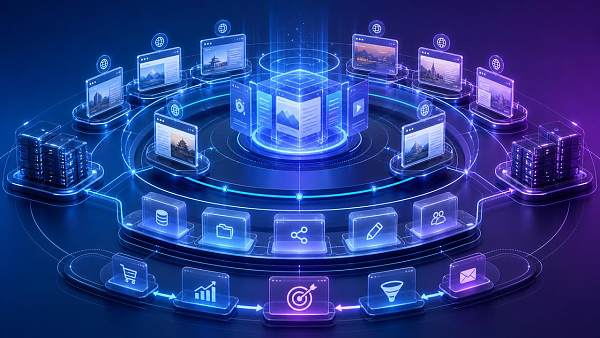
For global website projects, front-end frameworks, content management, deployment pipelines, and marketing systems are often not independent decisions. What technical evaluators are truly concerned about is whether the system, after going live, can stably support multiple languages, multiple regions, and multiple business lines, and whether subsequent SEO, advertising, and lead management can still work together smoothly.
Many companies focus early on whether something “can be done,” while overlooking whether it “can be operated sustainably.” Once they enter international markets, with an increasing number of sites, dispersed editorial teams, and traffic peaks spread across time zones, traditional coupled content systems tend to expose issues such as performance bottlenecks, low publishing efficiency, and confusing permission structures.
In an integrated website + marketing services scenario, how to build Headless CMS for global websites is not about pursuing new technical concepts, but about establishing a content foundation that is suitable both for engineering team maintenance and marketing team growth. Eybang has long served global enterprises, emphasizing the coordination of technological innovation and localized services, which is particularly suitable for this kind of cross-departmental, cross-market construction need.
- The technical side focuses on API stability, caching strategies, publishing mechanisms, permission models, and security boundaries.
- The marketing side focuses on content reuse, multilingual management, landing page expansion, tracking implementation, and search performance.
- The management side focuses on delivery cycles, operations and maintenance costs, subsequent scalability, and connection efficiency with advertising, social media, and CRM.
To build more stably, first understand the four key layers in a global site architecture
If you want to answer how to build Headless CMS for global websites more robustly, it is recommended to first break the system down into the content layer, presentation layer, delivery layer, and growth layer. This makes it less likely during evaluation to be biased by a single product feature, and also allows clearer judgment of subsequent replacement costs and system coupling levels.
Content layer: unified management does not mean a single point of blockage
The content layer is responsible for organizing articles, product pages, case study pages, regional pages, multilingual versions, and media assets. The key to stability lies in whether the model design is scalable and whether it supports field-level permissions, version control, scheduled publishing, and content review, rather than merely having a visualized backend.
Presentation layer: front-end and back-end decoupling, but without losing marketing controllability
The front end is usually built with modern frameworks to adapt to high-performance rendering and multi-device experiences. However, during technical evaluation, the focus should be on confirming whether marketing pages need frequent iteration, whether the operations team must rely on developers for publishing, and whether templates for multi-region sites can be maintained uniformly.
Delivery layer: stability does not rely only on server configuration
Global deployment requires attention to CDN distribution, the balance between static generation and dynamic rendering, regional loading of image and video assets, origin fallback strategies, and error rollback mechanisms. A truly stable solution should still ensure that core pages remain accessible when local nodes encounter abnormalities, rather than failing as a whole through cascading effects.
Growth layer: the content system must serve customer acquisition
A website is not simply a display tool. SEO fields, structured data, lead forms, tracking management, ad landing page duplication, and A/B testing interfaces should all be reserved during the build phase. Otherwise, subsequent marketing expansion will continuously require rework, leading to accumulated technical debt.
How to build Headless CMS for global websites: what to focus on during technical evaluation
The table below is suitable for technical evaluators to use for the first round of screening. It is not a product ranking list, but an evaluation dimension centered on stable delivery, helping teams avoid the problem of looking only at demo features while ignoring go-live complexity.
If a solution only emphasizes editing convenience but cannot explain cache updates, phased releases, and multi-region deployment strategies, then it is not suitable for global external-facing business. How to build Headless CMS for global websites more robustly depends on evaluating both content management capabilities and delivery architecture at the same time.
Which business scenarios are more suitable for adopting a decoupled global website-building solution
Not all companies must implement a complex architecture in one step, but the following scenarios are usually more suitable for taking the Headless CMS route, especially for technical evaluators to make medium- and long-term plans in advance.
- It is necessary to manage the brand official website, regional sites, campaign landing pages, and product topic pages at the same time, with a high rate of content reuse.
- The target markets cover multiple language regions, requiring local teams to edit independently while headquarters can still unify brand and template standards.
- It is necessary to continuously cooperate with SEO optimization, advertising campaigns, and social media traffic generation, with frequent website updates and a fast content publishing rhythm.
- The company’s product lines are complex, requiring the display of specifications, case studies, and service processes, while also taking into account lead collection and market education.
Taking new energy companies as an example, the official website often not only undertakes brand presentation, but also supports project introductions, solutions, supply chain capabilities, partner displays, and inquiry conversion. Sites such as photovoltaics, new energy are particularly suitable for using grand visual storytelling combined with rigorous logical module layouts, balancing a sense of technology, credibility, and conversion paths across global multi-device access.
Such sites usually require fully responsive design and emphasize a closed loop from brand presentation to project customer acquisition. If the content layer and front-end presentation layer are highly coupled, every time a new country site or industry page is added later, development and operational costs will rise significantly.
How to determine whether traditional CMS, self-developed solutions, or Headless CMS is more suitable
Technical evaluation is not a simple either-or choice. Many companies hesitate among traditional CMS, self-developed content platforms, and Headless CMS. The comparison below is more suitable for looking at delivery stability and marketing scalability, rather than only comparing initial development speed.
For technical evaluators, the real question is not “which technology is more advanced,” but “which solution is best suited to the company’s pace of internationalization over the next three years.” Eybang’s experience in integrated delivery of intelligent website building, SEO optimization, advertising campaigns, and social media marketing can help companies consider website construction and subsequent growth chains within the same architectural blueprint from the very beginning.
When implementing how to build Headless CMS for global websites, what process is recommended
To reduce the rework rate, it is recommended to proceed in the manner of “governance first, development second, expansion third,” rather than patching as you go. The following process is more suitable for companies that need to balance launch speed and long-term stability.
- First sort out the site map, language structure, regional strategy, and content types, and clarify which content is unified by headquarters and which content can be edited locally.
- Define the content model and component library, including page modules, SEO fields, form fields, media specifications, and version rules.
- Determine the front-end rendering strategy, distinguishing which pages are suitable for static generation and which pages require dynamic requests and real-time updates.
- Configure publishing workflows, preview mechanisms, layered permissions, and audit logs to reduce cross-team misoperations.
- Integrate analytics tools, lead systems, advertising parameters, and search optimization settings to ensure that the website has marketing capabilities as soon as it goes live.
- Conduct multi-region access testing, anomaly drills, and rollback verification, then gradually expand to more sites and language versions.
If the company belongs to new energy, manufacturing, or complex B2B service industries, the content structure is usually heavier and the pages carry more information. At this time, the website often needs to present full lifecycle services, supply chain capabilities, customization capabilities, and well-known partner collaboration relationships. Solutions such as photovoltaics, new energy can better support the dual goals of expressing industry leadership and acquiring project customers.
During procurement and selection, which risks are most easily underestimated
Only looking at the demo interface, not the governance cost
Many systems look simple and smooth during the demo stage, but once they enter multilingual, multi-role, and multi-site scenarios, problems such as content duplication, field loss of control, and chaotic review chains will appear. How to build Headless CMS for global websites more robustly starts with designing governance rules first.
Only looking at website-building costs, not operating costs
The development expenses saved in the early stage may later be paid back multiple times in subsequent SEO modifications, ad landing page duplication, permission management, and cross-region content coordination. Technical evaluation should include the operational complexity of the next 12 to 24 months, not just the initial budget.
Only looking at performance testing, not business linkage
Website access speed is of course important, but if it is impossible to quickly create new pages, support localized content delivery, or connect with CRM or advertising systems, then no matter how fast the system is, it will still be difficult to support growth goals.
FAQ: several questions most frequently asked by technical evaluators
How should Headless CMS for global websites be built to suit multilingual team collaboration?
It is recommended to separately manage language versions, regional versions, and brand-unified fields, and set up dual-layer permissions for headquarters review and local editing. This can ensure brand consistency while also allowing local teams to quickly update content according to market rhythm.
What stages of companies is this solution suitable for?
When a company is preparing to enter multiple country markets, or already has multiple sites, multiple product lines, and multiple market teams, it is worth prioritizing evaluation. If there are also plans in the future to increase investment in SEO, social media, and advertising campaigns, the earlier the decoupling, the more cost savings there will be later.
Which delivery details should be confirmed most during procurement?
Focus on confirming responsibility for content model design, front-end rendering solutions, deployment strategies, SEO field support, tracking mechanisms, form data flows, rollback plans, and operations and maintenance boundaries. Without these details, no matter how complete the proposal is, implementation may still be distorted.
How is the delivery timeline generally evaluated?
The timeline depends on the number of sites, language complexity, design depth, and the scope of system integration. Usually, content governance, template design, API integration and debugging, performance testing, and operations training should be estimated separately, rather than quoting only one overall project duration.
Why choose us: from stable website building to a growth closed loop, reducing the uncertainty of technical evaluation
For companies concerned with how to build Headless CMS for global websites, what is truly needed is not a single-point tool, but service capabilities that can incorporate intelligent website building, SEO optimization, social media marketing, and advertising campaigns into one plan. Since 2013, Eybang has continuously focused on global digital marketing services, driven by artificial intelligence and big data, and has provided full-chain solutions for many companies targeting international markets.
If you are conducting technical evaluation, you can focus your consultation on the following: how to design a multilingual site structure more stably, how content models can balance operational efficiency and permission security, how SEO and ad landing pages can be planned synchronously, how delivery timelines should be broken down, how sites for different countries should be deployed and performance-optimized, and how complex industry official websites can form a closed loop from brand presentation to inquiry conversion.
When what a company needs is not just to launch a website, but to build a sustainably scalable global content and marketing foundation, the earlier architecture, operations, and growth are considered within an integrated solution, the more rework can be reduced later, costs can be controlled, and international execution efficiency can be improved.
Related Articles



Related Products
 EasyCamp SaaS Smart Website Marketing SystemE-Yingbao SaaS Smart Website Marketing System: AI-powered, zero-code website building. Rapidly launch multilingual independent e-commerce sites in just 10 minutes. Global server acceleration and AI-driven SEO optimization empower businesses to efficiently connect with global markets. The seamless integration of technology and user-friendly operation makes building e-commerce sites incredibly simple.
 AI+SEM Intelligent Advertising Marketing SystemAI+SEM drives intelligent ad creation, empowering full-funnel precision advertising marketing. The system automatically generates weekly/monthly reports, AI recommends keywords and target countries, monitors core metrics in real-time with intelligent alerts, and enables one-click high-conversion ad solutions to help quickly acquire customers and improve ROI.
 AI+SEO Dual Engine Optimization ServiceEasyWin AI+SEO Dual Engine Optimization System leverages AI-powered keyword mining, content generation, and comprehensive technical optimization to help foreign trade enterprises acquire high-quality organic traffic, significantly improving search rankings and conversion rates.
 AI+SNS Social Media Marketing SystemYingbao AI+SNS Social Media Marketing System - Precision social capture for the social media era. Supports one-click content synchronization across major platforms like Facebook and LinkedIn. AI intelligently rewrites posts for enhanced relevance. 24/7 AI customer service and user profiling analysis empower businesses to efficiently expand into global markets.
 AI+SEO营销解决方案易营宝AI+SEO营销解决方案,通过AI批量写作、智能生成TDK、精准关键词扩词等功能,全面优化网站SEO效果,提升流量与转化率。助力企业构建高效智能网站新生态。
 AI+SEM Advertising Marketing SolutionsAI+SEM Advertising Marketing Solution leverages AI technology to deeply empower SEM ad campaigns. It automatically generates weekly/monthly reports using AI, presenting account data across multiple dimensions for comprehensive insights into campaign performance and trends. The system precisely recommends keywords and target countries, intelligently generates high-conversion ad copy, and enables one-click activation of efficient campaign plans to help businesses rapidly acquire customers. Simultaneously, it monitors core metrics in real time, intelligently identifies abnormal fluctuations, and issues timely alerts to ensure stable, high-return advertising results.
 Domain Name ServicesEasyWin provides professional domain name services, including intelligent queries, one-stop registration, brand protection, and full lifecycle management, helping businesses build a digital brand image.
 EasyOperate B2C Cross-Border E-Commerce Platform & Independent WebsiteEasyStore B2C Cross-border E-commerce Independent Store is an intelligent website building and cross-border e-commerce integrated solution independently developed by EasyStore Information Technology (Beijing) Co., Ltd. The system is specially designed for small and medium-sized as well as large export enterprises, integrating 'website building, operation, marketing, advertising, and conversion' into one, helping enterprises quickly establish cross-border e-commerce independent stores to achieve brand globalization and global sales growth.
The platform supports multiple languages, multiple currencies, and multi-channel marketing, with built-in AI intelligent translation and SEO optimization systems, suitable for mainstream markets such as Southeast Asia, Europe and America, Latin America, and the Middle East, assisting Chinese manufacturing enterprises in efficiently deploying international e-commerce strategies. SSL证书易营宝提供专业SSL安全证书服务,包括单域名和泛域名证书,确保网站数据传输加密、身份验证和完整性保护,助力企业建立安全可信的在线业务环境。









