









- Cross-Border Marketing Trend Research: Why More and More Companies Are Starting to Deploy AI Search and GEO OptimizationJun 30, 2026View details
- Cross-Border Marketing Trend Research: How Independent Sites, AI Content, and Short-Video Customer Acquisition Are ChangingJun 30, 2026View details
- How Can a Brand Updates Page Be Made More SEO-Friendly? Analysis of Update Frequency, Content Structure, and Internal Linking StrategyJun 28, 2026View details
- What stages does the cross-border services ecosystem include? How do website building, promotion, payment, and compliance work togetherJun 22, 2026View details
- How will email marketing costs change in 2026Jun 22, 2026View details
- The China-US tariff arrangement has reached a preliminary consensus, and the trade association will be establishedJun 15, 2026View details
- Should overseas brand marketing start with ads or contentJun 21, 2026View details
- What determines B2C cross-border e-commerce website development costs? A breakdown of features, interfaces, and deployment methodsJun 17, 2026View details
Recommended Enterprise Multilingual CMS, Why Some Systems Become More Burdensome the More You Use Them
When recommending an Enterprise Multilingual CMS, many teams fear that the system will become increasingly bloated with each iteration: maintenance gets slower, collaboration becomes chaotic, and upgrades become harder. For after-sales maintenance personnel, choosing the right platform is not just about multilingual management, but more importantly about long-term operational efficiency and stable growth.
Why some multilingual content systems become heavier the more they are used

When recommending an Enterprise Multilingual CMS, you cannot judge it only by whether it is easy to use during the launch phase, but also by the maintenance cost three years later. Many companies initially take "being able to publish multilingual content" as the core goal, while overlooking the content model, permission architecture, plugin dependencies, and marketing tool integration methods. As a result, the more systems are connected, the slower the backend becomes, and the harder upgrades get.
In an integrated website + marketing service scenario, the content system usually also needs to connect forms, leads, search optimization, landing pages, ad tracking, and social media distribution. After after-sales maintenance personnel take over, what they are really facing is not "a website", but a business infrastructure for continuous growth. As long as the wrong platform is selected at the beginning, every later revision will magnify the complexity.
What are the common causes of increasing system weight
- There is no unified standard for the multilingual content structure. Chinese, English, and regional versions all operate independently, leading to duplicated fields, broken translation chains, and more and more maintenance scripts.
- Overreliance on third-party plugins to supplement functionality may save development costs in the short term, but in the long term it increases the pressure of compatibility, vulnerability fixes, and upgrade regression testing.
- Permission management is too rough. Editors, marketing, technical, and regional teams share high-privilege accounts, causing frequent misoperations and loss of control over the publishing process.
- The frontend display is tightly coupled with backend content. Once the brand is upgraded or new country sites are added, maintenance personnel must simultaneously handle templates, interfaces, and cache issues.
Therefore, the key to recommending an Enterprise Multilingual CMS does not lie in how long the feature list is, but in whether the system can continuously remain lightweight in architecture, clear in collaboration, and upgradeable. This is also the stage where after-sales maintenance personnel should get involved as early as possible.
When after-sales maintenance personnel evaluate options, what should they focus on
If you are responsible for daily operations after launch, recommendations for an Enterprise Multilingual CMS should prioritize "maintenance efficiency" rather than just looking at the demo interface. The table below is suitable for internal evaluation and communication before procurement.
From a maintenance perspective, the biggest danger is not having too few functions, but having a system that looks complete on the surface while being chaotic underneath. Especially when multiple country sites are operating in parallel, one unstable plugin or one unplanned upgrade may affect search performance, form collection, and landing page conversions.
A checklist suitable for internal discussion
- Whether it supports unified reuse of content, pages, and media resources, instead of separately duplicating them for each language site.
- Whether it can clearly distinguish permissions for technical maintenance, content editing, regional marketing, and management.
- Whether it has publishing logs, fault rollback, cache clearing, and batch update capabilities.
- Whether it can conveniently integrate with existing marketing systems, instead of adding a large number of manual transfer steps.
How to compare different solutions: lightweight scalability matters more than feature stacking
When making Enterprise Multilingual CMS recommendations, many companies hesitate between "general-purpose content systems", "heavily customized platforms", and "integrated marketing website building solutions". Different paths do not have absolute strengths or weaknesses, but the difficulty of maintenance varies greatly. The comparison below is closer to the actual work of after-sales maintenance personnel.
For after-sales maintenance teams, the truly ideal solution is not the one with the heaviest functionality, but the one whose core capabilities are sufficient, whose extension interfaces are clear, and whose service processes are sustainable. The more "all-in-one" a system is, if it lacks architectural governance, the more likely it is to fall into a maintenance quagmire in the second year.
In some brand website projects that emphasize visual expression, page structure will also affect subsequent management efficiency. For example, in interior design, decoration, architecture solutions aimed at high-end display-oriented industries, if they feature immersive full-screen scrolling, asymmetric dynamic layouts, and fully responsive interactions, the frontend performance can be very strong, but the backend content model must be simplified at the same time. Otherwise, the more advanced the design is, the more difficult maintenance becomes.
In an integrated website + marketing service scenario, how to avoid losing control of later operations and maintenance
In global business, a website is not an isolated asset. It needs to support brand presentation, search traffic, advertising landing, form conversion, and remarketing data. Therefore, recommendations for an Enterprise Multilingual CMS must consider "frontend growth goals" and "backend maintenance capabilities" together.
The four-layer mechanism recommended to establish first
- Content layer: unify language version rules, page naming standards, media asset directories, and translation status fields to avoid scattered content assets.
- System layer: reduce unnecessary plugins, keep standardized documentation for interfaces, and establish a separation mechanism between testing and production environments.
- Operations layer: include SEO page updates, landing page launches, campaign takedowns, and form checks in fixed inspection workflows.
- Data layer: unify tracking standards to ensure data comparability across country sites, channel pages, and language versions, making it easier for maintenance personnel to locate anomalies.
EasyAB Information Technology (Beijing) Co., Ltd. has long served globalization growth scenarios. Its advantage lies not only in website delivery, but also in being able to connect intelligent website building, SEO optimization, social media marketing, and advertising into one continuous system. For after-sales maintenance personnel, this means that problems are no longer split among multiple vendors, but can be identified more quickly as being caused by page structure, content strategy, channel tracking, or system configuration.
Especially after an enterprise site expands in scale, the maintenance goal is no longer just "the website can open", but "the website can stably support growth". This is precisely why Enterprise Multilingual CMS recommendations need to return to the business outcome level for reassessment.
During procurement and implementation, which details are most easily overlooked
Many teams focus on feature demos during selection meetings, but overlook governance details after implementation. By the time the system has been online for half a year, after-sales maintenance personnel discover that what really consumes time is permission sorting, data cleansing, and historical page compatibility, rather than adding new pages themselves.
Items best confirmed before implementation
If the project also involves upgrading a display-oriented corporate website, it is recommended to simultaneously evaluate whether visual modules can be managed in a standardized way. For example, panoramic Banners, material texture displays, and dynamic hover modules commonly seen on high-end brand sites can indeed enhance visual persuasiveness during business negotiations, but the premise is that the backend supports modular maintenance rather than requiring separate frontend handling every time a change is made.
FAQ: What do maintenance teams most often ask when making Enterprise Multilingual CMS recommendations
Is a multilingual system suitable for launching many country sites at one time?
Not necessarily. A more reliable approach is to first establish the content model for the main site and key regional sites, and then expand gradually. Rolling out too many languages at once easily leaves hidden risks in translation review, URL rules, and conversion tracking. The after-sales maintenance team should first confirm the core languages, regional priorities, and the proportion of content reuse.
During procurement, should the focus be on demo features or backend structure?
For maintenance teams, backend structure is more important. Demo features can be added later, but underlying problems such as a chaotic content model, unbalanced permissions, and missing logs will continue to consume operations time. The core of Enterprise Multilingual CMS recommendations is to make subsequent iterations controllable, not just to make the first version look good.
Does frequent system upgrading necessarily mean it is more advanced?
Not necessarily. If frequent upgrades do not come with a stable compatibility strategy, they will instead increase maintenance costs. What is more worth paying attention to is whether upgrade instructions are clear, whether staged verification is supported, and whether backup and rollback capabilities are available. A truly mature system should make upgrades predictable, rather than forcing the maintenance team to repeatedly put out fires.
How can you determine whether a service provider can support long-term operations and maintenance?
It depends on whether it has integrated capabilities across website, content, search, advertising, and data. Simply being able to build a website does not mean it can solve subsequent issues such as abnormal conversion, indexing fluctuations, or efficiency problems across multilingual pages. Teams like EasyAB Information Technology (Beijing) Co., Ltd., which have long specialized in global digital marketing and cover the full chain of website building and marketing, are better able to provide continuous optimization recommendations from the perspective of business outcomes.
Why choose us
If you are making Enterprise Multilingual CMS recommendations and are worried that the system will become heavier over time, we recommend developing the solution based on "long-term maintenance efficiency" rather than only comparing early-stage quotations or the number of features. Relying on artificial intelligence and big data capabilities, EasyAB Information Technology (Beijing) Co., Ltd. can coordinate intelligent website building, SEO optimization, social media marketing, and advertising implementation, helping maintenance teams reduce duplicated work caused by fragmentation across multiple systems.
You can focus your consultation on these topics: whether the multilingual site architecture needs restructuring, whether the existing system has excessive plugin dependency, how the delivery timeline should be arranged, how content migration should be handled for different language versions, how marketing tracking and form leads should be connected, and how display-oriented corporate website modules can balance visual impact with maintenance efficiency. If you are also evaluating interior design, decoration, architecture solutions that emphasize visual expression, we can further discuss responsive interaction, modular management, and the division of responsibilities for subsequent operations and maintenance, helping you make the system lighter and growth more stable.
Related Articles
 4 Major Reasons Behind WhatsApp Account Bans, A Quick Self-Check for Foreign Trade Professionals
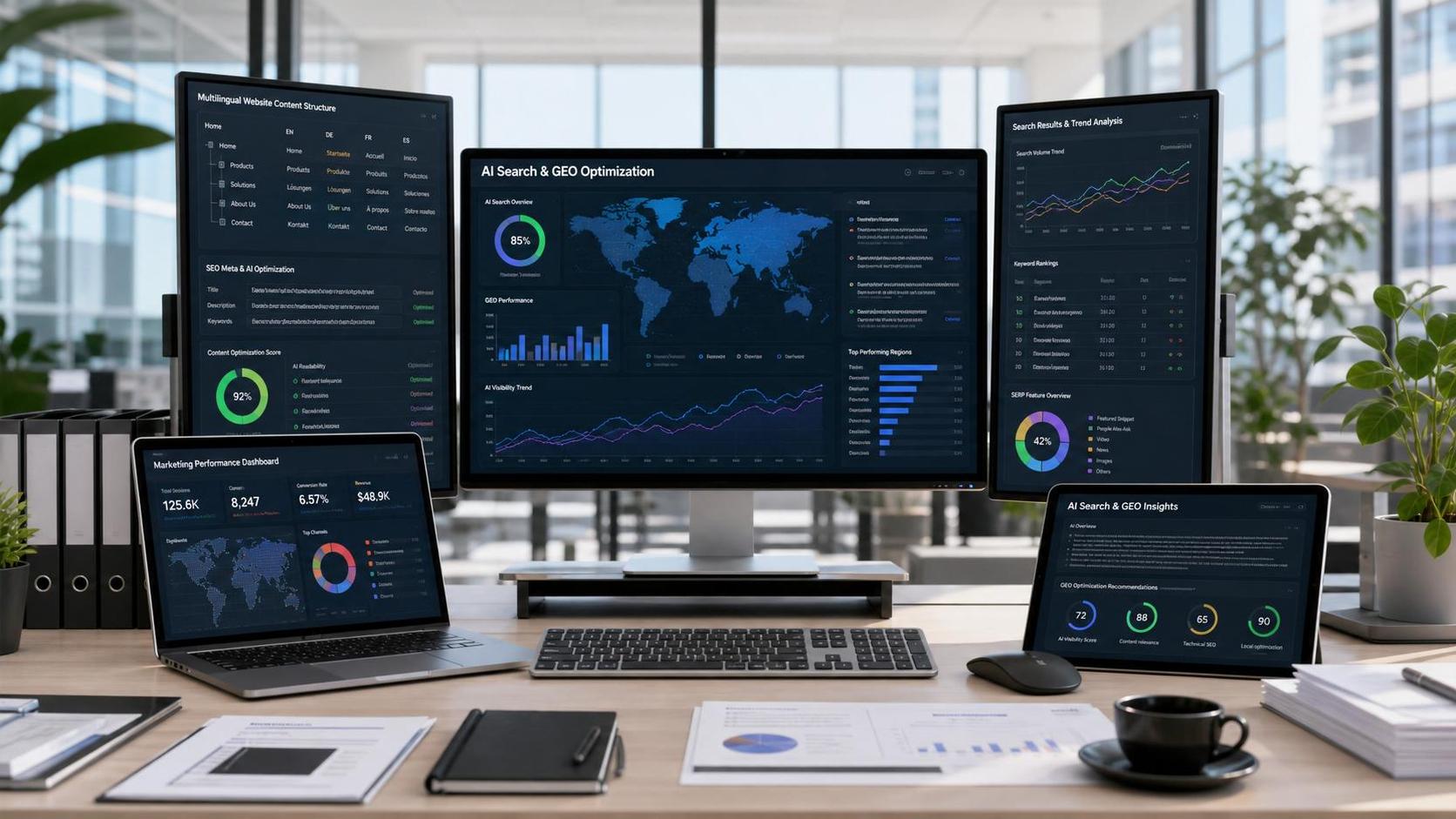
 Cross-Border Marketing Trend Research: Why More and More Companies Are Starting to Deploy AI Search and GEO Optimization
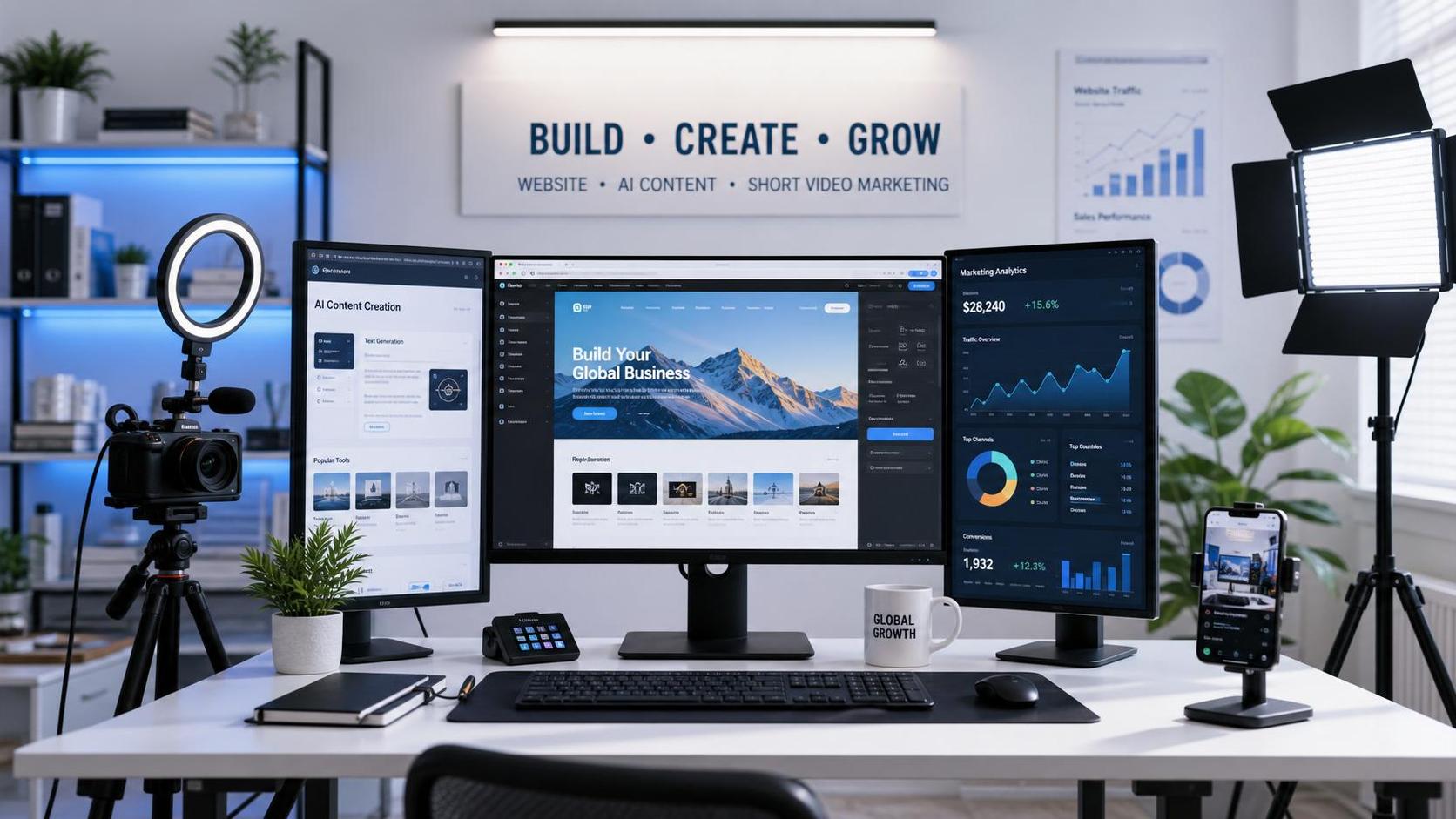
 Cross-Border Marketing Trend Research: How Independent Sites, AI Content, and Short-Video Customer Acquisition Are Changing
Related Products
 EasyCamp SaaS Smart Website Marketing SystemE-Yingbao SaaS Smart Website Marketing System: AI-powered, zero-code website building. Rapidly launch multilingual independent e-commerce sites in just 10 minutes. Global server acceleration and AI-driven SEO optimization empower businesses to efficiently connect with global markets. The seamless integration of technology and user-friendly operation makes building e-commerce sites incredibly simple.
 AI+SEM Intelligent Advertising Marketing SystemAI+SEM drives intelligent ad creation, empowering full-funnel precision advertising marketing. The system automatically generates weekly/monthly reports, AI recommends keywords and target countries, monitors core metrics in real-time with intelligent alerts, and enables one-click high-conversion ad solutions to help quickly acquire customers and improve ROI.
 AI+SEO Dual Engine Optimization ServiceEasyWin AI+SEO Dual Engine Optimization System leverages AI-powered keyword mining, content generation, and comprehensive technical optimization to help foreign trade enterprises acquire high-quality organic traffic, significantly improving search rankings and conversion rates.
 AI+SNS Social Media Marketing SystemYingbao AI+SNS Social Media Marketing System - Precision social capture for the social media era. Supports one-click content synchronization across major platforms like Facebook and LinkedIn. AI intelligently rewrites posts for enhanced relevance. 24/7 AI customer service and user profiling analysis empower businesses to efficiently expand into global markets.
 AI+SEO营销解决方案易营宝AI+SEO营销解决方案,通过AI批量写作、智能生成TDK、精准关键词扩词等功能,全面优化网站SEO效果,提升流量与转化率。助力企业构建高效智能网站新生态。
 AI+SEM Advertising Marketing SolutionsAI+SEM Advertising Marketing Solution leverages AI technology to deeply empower SEM ad campaigns. It automatically generates weekly/monthly reports using AI, presenting account data across multiple dimensions for comprehensive insights into campaign performance and trends. The system precisely recommends keywords and target countries, intelligently generates high-conversion ad copy, and enables one-click activation of efficient campaign plans to help businesses rapidly acquire customers. Simultaneously, it monitors core metrics in real time, intelligently identifies abnormal fluctuations, and issues timely alerts to ensure stable, high-return advertising results.
 Domain Name ServicesEasyWin provides professional domain name services, including intelligent queries, one-stop registration, brand protection, and full lifecycle management, helping businesses build a digital brand image.
 EasyOperate B2C Cross-Border E-Commerce Platform & Independent WebsiteEasyStore B2C Cross-border E-commerce Independent Store is an intelligent website building and cross-border e-commerce integrated solution independently developed by EasyStore Information Technology (Beijing) Co., Ltd. The system is specially designed for small and medium-sized as well as large export enterprises, integrating 'website building, operation, marketing, advertising, and conversion' into one, helping enterprises quickly establish cross-border e-commerce independent stores to achieve brand globalization and global sales growth.
The platform supports multiple languages, multiple currencies, and multi-channel marketing, with built-in AI intelligent translation and SEO optimization systems, suitable for mainstream markets such as Southeast Asia, Europe and America, Latin America, and the Middle East, assisting Chinese manufacturing enterprises in efficiently deploying international e-commerce strategies. SSL证书易营宝提供专业SSL安全证书服务,包括单域名和泛域名证书,确保网站数据传输加密、身份验证和完整性保护,助力企业建立安全可信的在线业务环境。









