









- What stages does the cross-border services ecosystem include? How do website building, promotion, payment, and compliance work togetherJun 22, 2026View details
- How will email marketing costs change in 2026Jun 22, 2026View details
- The China-US tariff arrangement has reached a preliminary consensus, and the trade association will be establishedJun 15, 2026View details
- Should overseas brand marketing start with ads or contentJun 21, 2026View details
- What determines B2C cross-border e-commerce website development costs? A breakdown of features, interfaces, and deployment methodsJun 17, 2026View details
- China-Morocco zero-tariff access, a breakthrough in the cost of Moroccan goods exports to ChinaJun 11, 2026View details
- What signal should be released for the suspension of exports to JapanJun 10, 2026View details
- China's May LNG imports rebounded, with increased volumes from Russia and Canada filling the Middle East supply gapJun 10, 2026View details
How to Choose AI Translation Software: Key Considerations Before Building a Multilingual Website
When building a multilingual website, choosing AI translation software should not be based only on translation speed. You also need to evaluate terminology consistency, integration capabilities, SEO compatibility, and long-term management costs. For technical evaluators, the truly valuable criterion is whether the tool can be stably integrated into the existing website architecture and, while ensuring content quality, support ongoing iteration and global marketing execution.
From the perspective of search intent, what users care about is not “which AI translation software is the most popular,” but “how to choose the right AI translation software for a multilingual website.” This type of need usually arises when companies are preparing to expand overseas, rebuild their international website, or already have multilingual content but are facing imbalances between efficiency and quality. What the target audience cares most about is technical feasibility, translation quality control, compatibility with CMS or website-building systems, and whether it will affect SEO performance and long-term maintenance costs.
Therefore, this article will not talk broadly about AI translation concepts, but will focus on several core issues that technical evaluators most need to judge: how to assess translation engine capabilities, how to evaluate system interfaces, whether SEO is supported, how terminology and versions are managed, and which hidden costs are most easily overlooked. After reading, you will be able to establish a clearer set of selection criteria suitable for enterprise multilingual website projects.
When choosing AI translation software, don’t rush to look at price and speed first
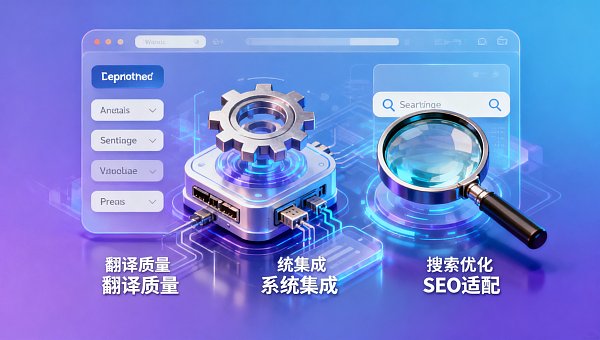
When many teams evaluate AI translation software, their first reaction is to compare unit price, response speed, and the number of supported languages. But for multilingual website projects, these are only surface-level metrics. What really determines project success or failure is often whether the translation software can fit into the existing technical system and continue to operate stably after launch.
Technical evaluators need to first clarify one premise: a multilingual website is not a one-time translation task, but a content system that requires continuous updates, continuous optimization, and continuous promotion. News, product pages, landing pages, blogs, case studies, and help centers will all keep changing. If AI translation software can only handle the initial batch translation but cannot support subsequent incremental synchronization and quality management, it will eventually drag down the entire international website operation.
So the overall selection judgment should be: prioritize AI translation software with integration capabilities, terminology management capabilities, SEO compatibility, and collaborative review mechanisms, rather than focusing only on “how fast it translates.” Speed can be purchased, quality can be optimized, but the rework cost caused by architectural mismatch is often the highest.
The 4 core capabilities technical evaluators should focus on most
The first is controllability of translation quality. AI translation software is not simply about outputting results; it must maintain stable consistency in brand names, product names, industry terminology, and feature descriptions. If the same button or the same service is translated differently across different pages, user experience will noticeably decline, and it will also affect brand professionalism.
The second is system integration capability. For website projects, whether it can connect with CMS, PIM, CRM, ticketing systems, or self-developed content platforms determines the level of subsequent automation. Support for API, Webhook, batch import and export, field-level translation, and incremental updates are important advantages. Without these capabilities, later stages can only rely on manually moving content around.
The third is SEO compatibility. A multilingual website is not just about translating Chinese into foreign languages; it must also enable search engines to correctly understand page semantics, language versions, and regional versions. Good AI translation software should support the translation and management of content such as titles, descriptions, URL Slug, image Alt text, and structured fields, avoiding the problem of translating only the main text while ignoring search entry points.
The fourth is workflow and permission mechanisms. Enterprise-level projects are usually not decided by one person, nor maintained by one person. Content teams, technical teams, localization teams, and SEO teams may all be involved. If AI translation software supports approval workflows, role permissions, version traceability, and edit history, it can significantly reduce collaboration chaos and go-live risks.
How to judge the translation quality of AI translation software, not just by whether it is “accurate or not”
When many people evaluate AI translation software, they test a few paragraphs of text and approve it if it “sounds pretty good.” But for website scenarios, this kind of judgment is too rough. That is because website content places more emphasis on conversion, consistency, and structured expression than ordinary documents, and different page types also have different translation requirements.
During technical evaluation, it is recommended to split test samples by content type, such as homepage copy, product details, FAQ, blog articles, form prompts, button copy, and SEO titles. Homepages and landing pages emphasize marketing language, product pages emphasize parameter accuracy, help documents emphasize clear logic, and button copy emphasizes brevity and consistency. A model performing well on long-form text does not mean it will also be stable on short text or field text.
Special focus should also be placed on terminology memory capability. For example, can fixed industry usage, product module naming, and professional compliance vocabulary be constrained through a terminology database? For technology companies, this is more important than general fluency. Otherwise, each translation feels like it is being regenerated from scratch—natural on the surface, but actually uncontrollable.
If the business covers multiple countries, you also need to look at adaptation capabilities for different regions within the same language. For example, whether English supports distinctions between American and British usage, and whether Spanish can cover both Latin American and European markets. What multilingual websites face is not just whether the “translation is correct,” but whether “the target market naturally accepts it.”
For multilingual websites, integration capabilities and the degree of automation determine long-term costs
In the short term, a set of AI translation software looks like a tool purchase; in the long term, it is content infrastructure. What truly creates the gap is often not the efficiency of the first round of translation, but the maintenance cost afterward. As long as international website content continues to be updated, whether the automation chain is complete will become the key factor determining ROI.
During technical evaluation, it is recommended to focus on these integration questions: can it connect to mainstream CMS or self-developed systems; can it translate based on page fields rather than whole-page text; can it identify newly added, modified, and deleted content; can it automatically write back approved content; can it preserve the original page structure and tags without breaking frontend display.
If the software can only export Excel and then re-import it, it may seem usable at an early stage, but once the number of pages grows later, problems such as version confusion, field misalignment, and delayed launches will arise. This is especially true for marketing websites, where ad landing pages and campaign pages are updated frequently, and manual circulation can easily slow market response speed.
For companies that provide integrated website-building and marketing services, the translation system should also work in coordination with SEO optimization, content management, and campaign schedules. For example, when a new product page goes live, can it automatically trigger multilingual translation, then enter the review process, and then be published to different site regions? This capability will directly affect global marketing efficiency.
SEO compatibility is not an add-on, but a basic requirement for multilingual websites
When many companies build multilingual websites, the content translation is done, but search traffic still does not grow. The problem often lies in SEO compatibility. If AI translation software only handles the body text and does not support metadata, localized keywords, and language-version rules, then even if the website looks “fully multilingual,” it will still be difficult to truly gain overseas organic traffic.
Technical evaluators should confirm whether the software supports the following: translation of page Title and Meta Description, preservation of H tag structure, processing of image Alt text, translation of internal link anchor text, coordination of URL rules, support for hreflang-related fields, and the ability to localize keywords for different country markets.
Going one step further, SEO is not word-for-word translation, but search intent matching. The same Chinese keyword may have completely different search expressions in different markets. In this case, if AI translation software supports manual intervention, keyword replacement suggestions, and secondary content optimization, it will be more suitable for marketing websites than pure machine literal translation.
In actual projects, technical evaluation often needs to work with the SEO team to define acceptance criteria. Otherwise, it is easy to end up with a technically successful launch but content that cannot participate in search competition. For companies pursuing global growth, the cost of fixing this kind of problem is very high, so it is best to avoid it in advance during the selection stage.
Don’t overlook “hidden key items” such as terminology databases, review workflows, and permission management
In many software demos, the most attractive features are one-click translation and flashy interfaces. But once the software is actually used in an enterprise environment, what determines the experience are instead those less obvious capabilities. Terminology databases, style guides, manual review workflows, version rollback, and team permission assignment are all typical elements that only prove their importance later.
For example, if one team is simultaneously maintaining the Chinese, English, Japanese, and German sites, without a unified terminology database, it is difficult to ensure stable delivery of brand information. This is especially true in highly specialized industries such as healthcare, manufacturing, software, and finance, where terminology errors not only affect experience but may also trigger compliance and trust issues.
This is also why technical evaluation cannot focus only on model performance, but must also look at platform governance capabilities. Some industries place great importance on process supervision and internal control logic when carrying out digital transformation. A similar line of thinking also applies to content system selection. For example, in knowledge governance research, the core methodology reflected in Research on the Path to Building Internal Control in Public Hospitals from the Perspective of Financial and Accounting Supervision is essentially about reducing operational deviation through institutionalized mechanisms. For multilingual websites, the standardization of translation workflows is equally important.
A practical checklist for selecting AI translation software
If you are responsible for technical evaluation, you can break the selection process into a more actionable checklist. First, confirm whether the supported languages and target markets match, rather than looking only at quantity. Second, test translation performance across different content types, especially terminology, buttons, SEO fields, and marketing copy. Third, verify API capabilities, write-back mechanisms, and CMS compatibility.
Fourth, check whether it supports terminology databases, translation memory, style rules, and manual review workflows. Fifth, confirm whether the permission system is suitable for multi-team collaboration. Sixth, evaluate whether it supports SEO-related fields and multi-region content management. Seventh, calculate long-term costs, including usage fees, manual review costs, secondary development costs, and operation and maintenance costs.
Eighth, it is best to conduct a small-scale pilot in a real scenario rather than relying only on sales demos. Only by running through real pages, real fields, and real update workflows can you see whether the software is stable in website scenarios. Many tools that “look strong in demos” reveal problems as soon as they enter the actual integration stage.
If the company also needs to take website building, SEO, social media, and advertising into account, it is recommended to prioritize solutions that can coordinate with the overall marketing chain. That is because a multilingual website is not an isolated project, but a pivotal node in the global growth system.
Conclusion: The core of AI translation software suitable for multilingual websites is controllability, connectivity, and scalability
Back to the original question: how should AI translation software be selected? For technical evaluators working on multilingual websites, the answer is not to choose the tool that “translates the fastest” or has the “lowest price,” but to choose a combination of capabilities that can support long-term international website operations.
Ideal AI translation software should meet at least four standards: controllable translation quality, smooth interface integration, solid SEO compatibility, and acceptable long-term management costs. Only in this way can companies turn multilingual websites from one-time projects into overseas digital assets that truly support sustainable growth.
If you are advancing international website development, it is recommended to evaluate from the perspective of real business workflows: where the content comes from, how it is translated, who reviews it, how it is published, whether it is conducive to search growth, and how it will be maintained later. Once these questions are clarified, you can then look at AI translation software without being misled by surface-level features, and your selection will be much more reliable.
Related Articles
 It's easy to turn a foreign trade website into a piece of art, but it's the ultimate culprit behind your order decline
 Foreign trade website efficiency revolution! Yiyingbao component upgrade + inquiry optimization, inquiries surge!
 B2B Must-Know | The Difference Between Demand Gen and Legacy Video Ads


Related Products
 EasyCamp SaaS Smart Website Marketing SystemE-Yingbao SaaS Smart Website Marketing System: AI-powered, zero-code website building. Rapidly launch multilingual independent e-commerce sites in just 10 minutes. Global server acceleration and AI-driven SEO optimization empower businesses to efficiently connect with global markets. The seamless integration of technology and user-friendly operation makes building e-commerce sites incredibly simple.
 AI+SEM Intelligent Advertising Marketing SystemAI+SEM drives intelligent ad creation, empowering full-funnel precision advertising marketing. The system automatically generates weekly/monthly reports, AI recommends keywords and target countries, monitors core metrics in real-time with intelligent alerts, and enables one-click high-conversion ad solutions to help quickly acquire customers and improve ROI.
 AI+SEO Dual Engine Optimization ServiceEasyWin AI+SEO Dual Engine Optimization System leverages AI-powered keyword mining, content generation, and comprehensive technical optimization to help foreign trade enterprises acquire high-quality organic traffic, significantly improving search rankings and conversion rates.
 AI+SNS Social Media Marketing SystemYingbao AI+SNS Social Media Marketing System - Precision social capture for the social media era. Supports one-click content synchronization across major platforms like Facebook and LinkedIn. AI intelligently rewrites posts for enhanced relevance. 24/7 AI customer service and user profiling analysis empower businesses to efficiently expand into global markets.
 AI+SEO营销解决方案易营宝AI+SEO营销解决方案,通过AI批量写作、智能生成TDK、精准关键词扩词等功能,全面优化网站SEO效果,提升流量与转化率。助力企业构建高效智能网站新生态。
 AI+SEM Advertising Marketing SolutionsAI+SEM Advertising Marketing Solution leverages AI technology to deeply empower SEM ad campaigns. It automatically generates weekly/monthly reports using AI, presenting account data across multiple dimensions for comprehensive insights into campaign performance and trends. The system precisely recommends keywords and target countries, intelligently generates high-conversion ad copy, and enables one-click activation of efficient campaign plans to help businesses rapidly acquire customers. Simultaneously, it monitors core metrics in real time, intelligently identifies abnormal fluctuations, and issues timely alerts to ensure stable, high-return advertising results.
 Domain Name ServicesEasyWin provides professional domain name services, including intelligent queries, one-stop registration, brand protection, and full lifecycle management, helping businesses build a digital brand image.
 EasyOperate B2C Cross-Border E-Commerce Platform & Independent WebsiteEasyStore B2C Cross-border E-commerce Independent Store is an intelligent website building and cross-border e-commerce integrated solution independently developed by EasyStore Information Technology (Beijing) Co., Ltd. The system is specially designed for small and medium-sized as well as large export enterprises, integrating 'website building, operation, marketing, advertising, and conversion' into one, helping enterprises quickly establish cross-border e-commerce independent stores to achieve brand globalization and global sales growth.
The platform supports multiple languages, multiple currencies, and multi-channel marketing, with built-in AI intelligent translation and SEO optimization systems, suitable for mainstream markets such as Southeast Asia, Europe and America, Latin America, and the Middle East, assisting Chinese manufacturing enterprises in efficiently deploying international e-commerce strategies. SSL证书易营宝提供专业SSL安全证书服务,包括单域名和泛域名证书,确保网站数据传输加密、身份验证和完整性保护,助力企业建立安全可信的在线业务环境。









