









- What multilingual website services are available in Sanya? Which model is more suitable for local businesses going global?Jul 08, 2026View details
- How to view the complete list of China SaaS companies in the top 100? Practical methods for screening website-building and marketing service providersJul 08, 2026View details
- How to view pricing in the global traffic ecosystem? Cost comparison of search, social media, and content channel advertisingJul 06, 2026View details
- How to assess foreign trade website development trends?Looking at 2026 changes from multilingual,AI content to conversion pathsJul 04, 2026View details
- What are the new trends in multilingual marketing data analytics tools in 2026? Focus on attribution、automation and complianceJul 04, 2026View details
- Is Brand Globalization Marketing Consulting Worth Buying? At What Stage Should Companies Bring It InJul 01, 2026View details
- Cross-Border Marketing Trend Research: Why More and More Companies Are Starting to Deploy AI Search and GEO OptimizationJun 30, 2026View details
- Cross-Border Marketing Trend Research: How Independent Sites, AI Content, and Short-Video Customer Acquisition Are ChangingJun 30, 2026View details
Avoid Pitfalls When Choosing an AI-powered Site Generator
When faced with website-building tools that have numerous features and huge price differences, the real watershed is return on investment. How to choose an AI-powered site generator should not be judged only by page generation speed, but also by its technical foundation, marketing adaptability, data closed-loop capabilities, and service responsiveness, so as to avoid hidden costs in migration, promotion, and maintenance caused by the wrong choice.
AI website building is shifting from “going live quickly” to “growth-driven”
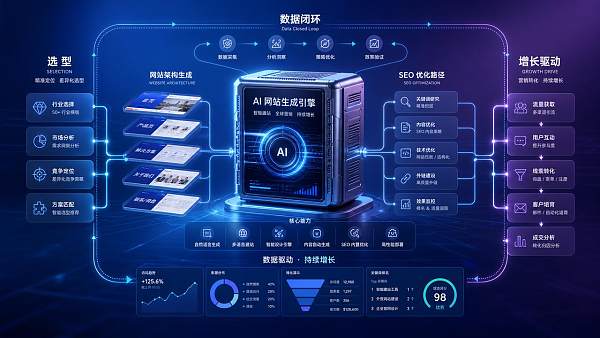
In the past, when enterprises evaluated website-building tools, the focus was on the number of templates and the launch cycle. Today, the criteria for how to choose an AI-powered site generator have clearly changed. A website is no longer just a display window, but a unified entry point for customer acquisition, conversion, content operations, and brand building.
Especially in integrated website + marketing service scenarios, if the website-building system cannot support search optimization, content distribution, ad landing page management, and multilingual expansion, it is difficult to form a true growth asset. When website building is disconnected from marketing, it often means higher costs will be needed later to fix the problem.
Therefore, how to choose an AI-powered site generator has already shifted from “choosing a tool” to “choosing growth infrastructure.” Whoever can establish the linkage among content, traffic, data, and conversion earlier will be more likely to achieve stable returns in competition.
Several clear signals are changing the selection logic
From the perspective of industry changes, the AI website-building market has entered a new stage. Users are paying more and more attention to whether a system can support marketing in the long term, rather than simply replacing manual work in the short term. The reason why choosing an AI-powered site generator is difficult is that the capability boundaries among vendors are becoming increasingly different.
- Content generation has upgraded from single-page copywriting to batch management of sections, special-topic pages, and landing pages.
- Search optimization has upgraded from basic tags to coordination between structured data and content strategy.
- Advertising needs have upgraded from one-time campaign pages to rapid iteration across multiple channels and multiple versions.
- Operational focus has shifted from launch speed to conversion rate, lead retention rate, and lead quality.
- The service model has shifted from software delivery to integrated support covering strategy, execution, and optimization.
These signals show that how to choose an AI-powered site generator cannot be based only on demo performance. What really matters is whether, after launch, the system can continuously serve organic traffic growth, advertising handoff efficiency, and the rhythm of content updates.
The core factors driving this trend are mainly concentrated at four levels
In other words, how to choose an AI-powered site generator is essentially about judging whether a platform can adapt to changes in the traffic environment and marketing mechanisms, rather than simply evaluating whether the front-end pages look good.
The impact of a wrong choice often appears first in three business links
Content operations: fast generation does not mean smooth operations
Many tools can quickly generate a homepage, but their section structures are chaotic, tags are uncontrollable, and content reusability is low, making subsequent maintenance very labor-intensive. When choosing an AI-powered site generator, the first thing to examine is whether it supports a clear information architecture, rather than only looking at first-screen effects.
Search marketing: having pages does not mean being able to rank
If the system cannot customize titles, descriptions, link rules, structured information, and internal linking logic, it is difficult to do SEO in depth. Adding these capabilities after the website goes live usually costs more and may also affect historical indexing and authority accumulation.
Advertising handoff: having many pages does not mean they can convert
Ad landing pages often require rapid revisions, version testing, and form integration. If the website-building tool does not support flexible duplication, version management, and conversion tracking, it will slow down the advertising pace and affect lead quality and budget efficiency.
Some teams also draw on cross-domain analytical frameworks when studying digitization and business strategies. For example, regarding the thinking around forecasting, allocation, and efficiency optimization, one may refer to A Discussion on Cash Flow Forecast-Based Fund Management Optimization Strategies for Power Enterprises, whose core logic also applies to resource input and return evaluation.
What truly deserves focus is not having more features, but six core capabilities
- AI content generation capability: whether it can output usable content by industry, scenario, and keywords.
- SEO adaptability: whether it supports staticization, metadata, internal links, sitemaps, etc.
- Marketing collaboration capability: whether it can connect advertising, forms, customer service, social media, and data analytics.
- Multi-site scalability: whether it is convenient to duplicate sites and deploy multilingual and localized versions.
- Security and stability: whether access speed, permission management, backup, and recovery are reliable.
- Service support capability: whether it provides support for strategy, execution, optimization, and continuous iteration.
The core of how to choose an AI-powered site generator is not “whether it exists,” but “whether it can be used well in the long term.” If a certain capability only works in a demo but requires extensive manual supplementation in actual implementation, then it is not a truly efficient solution.
To judge the pros and cons of a solution, a more practical evaluation method can be used
- First look at the business goal: is it brand display, customer acquisition and conversion, or global expansion.
- Then look at the content scale: whether batch sections, topic pages, and multilingual pages are needed.
- Test the SEO fundamentals by checking link rules, title settings, and crawl-friendliness.
- Verify marketing linkage and confirm whether forms, tracking codes, customer service, and advertising pages work smoothly.
- Calculate long-term costs, including training, maintenance, migration, and secondary development expenses.
- Evaluate service responsiveness and confirm issue-handling timeliness and optimization advisory capabilities.
If the above dimensions are scored, how to choose an AI-powered site generator will become much clearer. Many seemingly low-cost platforms actually bring higher total costs because of functional limitations, fragmented data, and missing services.
Integrated service capabilities will become an important dividing line in the next stage
In the future, the competitiveness of standalone website-building software will continue to decline. The real advantage will belong to service systems that connect website building, content, SEO, social media, and advertising. Ultimately, how to choose an AI-powered site generator still comes back to business growth results.
Since 2013, Easy Marketing Information Technology (Beijing) Co., Ltd. has been deeply engaged in global digital marketing. With artificial intelligence and big data at its core, it has built a full-chain solution covering intelligent website building, SEO optimization, social media marketing, and advertising, helping many enterprises transform their websites from a “cost center” into a “growth engine.”
Against this background, how to choose an AI-powered site generator should not be judged in isolation by a single technical parameter, but by whether the service provider has the ability to combine technological innovation with localized services, and whether it can continuously support website growth tasks in complex market environments.
The safer next step is to validate on a small scale first and then expand investment
If you are still comparing different platforms, it is recommended to first choose a real business scenario for validation, such as topic page creation, product page optimization, or multilingual website setup. By looking at actual content production efficiency, indexing performance, conversion rate, and maintenance costs, it becomes easier to judge how to choose an AI-powered site generator more appropriately.
When a tool can steadily support content updates, search growth, and marketing conversion, then expanding its scope of application is far safer than making a one-time heavy investment. Selection is not about chasing trends, but about building long-term growth capabilities. Whoever can truly connect website and marketing will be more likely to gain sustainable returns.
Related Articles
 What multilingual website services are available in Sanya? Which model is more suitable for local businesses going global?
 How to view the complete list of China SaaS companies in the top 100? Practical methods for screening website-building and marketing service providers
 There are so many used heavy-duty construction machines for foreign trade. How exactly should we acquire customers?

Related Products
 EasyCamp SaaS Smart Website Marketing SystemE-Yingbao SaaS Smart Website Marketing System: AI-powered, zero-code website building. Rapidly launch multilingual independent e-commerce sites in just 10 minutes. Global server acceleration and AI-driven SEO optimization empower businesses to efficiently connect with global markets. The seamless integration of technology and user-friendly operation makes building e-commerce sites incredibly simple.
 AI+SEM Intelligent Advertising Marketing SystemAI+SEM drives intelligent ad creation, empowering full-funnel precision advertising marketing. The system automatically generates weekly/monthly reports, AI recommends keywords and target countries, monitors core metrics in real-time with intelligent alerts, and enables one-click high-conversion ad solutions to help quickly acquire customers and improve ROI.
 AI+SEO Dual Engine Optimization ServiceEasyWin AI+SEO Dual Engine Optimization System leverages AI-powered keyword mining, content generation, and comprehensive technical optimization to help foreign trade enterprises acquire high-quality organic traffic, significantly improving search rankings and conversion rates.
 AI+SNS Social Media Marketing SystemYingbao AI+SNS Social Media Marketing System - Precision social capture for the social media era. Supports one-click content synchronization across major platforms like Facebook and LinkedIn. AI intelligently rewrites posts for enhanced relevance. 24/7 AI customer service and user profiling analysis empower businesses to efficiently expand into global markets.
 AI+SEO营销解决方案易营宝AI+SEO营销解决方案,通过AI批量写作、智能生成TDK、精准关键词扩词等功能,全面优化网站SEO效果,提升流量与转化率。助力企业构建高效智能网站新生态。
 AI+SEM Advertising Marketing SolutionsAI+SEM Advertising Marketing Solution leverages AI technology to deeply empower SEM ad campaigns. It automatically generates weekly/monthly reports using AI, presenting account data across multiple dimensions for comprehensive insights into campaign performance and trends. The system precisely recommends keywords and target countries, intelligently generates high-conversion ad copy, and enables one-click activation of efficient campaign plans to help businesses rapidly acquire customers. Simultaneously, it monitors core metrics in real time, intelligently identifies abnormal fluctuations, and issues timely alerts to ensure stable, high-return advertising results.
 Domain Name ServicesEasyWin provides professional domain name services, including intelligent queries, one-stop registration, brand protection, and full lifecycle management, helping businesses build a digital brand image.
 EasyOperate B2C Cross-Border E-Commerce Platform & Independent WebsiteEasyStore B2C Cross-border E-commerce Independent Store is an intelligent website building and cross-border e-commerce integrated solution independently developed by EasyStore Information Technology (Beijing) Co., Ltd. The system is specially designed for small and medium-sized as well as large export enterprises, integrating 'website building, operation, marketing, advertising, and conversion' into one, helping enterprises quickly establish cross-border e-commerce independent stores to achieve brand globalization and global sales growth.
The platform supports multiple languages, multiple currencies, and multi-channel marketing, with built-in AI intelligent translation and SEO optimization systems, suitable for mainstream markets such as Southeast Asia, Europe and America, Latin America, and the Middle East, assisting Chinese manufacturing enterprises in efficiently deploying international e-commerce strategies. SSL证书易营宝提供专业SSL安全证书服务,包括单域名和泛域名证书,确保网站数据传输加密、身份验证和完整性保护,助力企业建立安全可信的在线业务环境。









