Related recommendations
- Does EasyAd's advertising performance have guarantees? How does the service mechanism work?2026-01-18View details
- Is the cost of using AI advertising smart manager high? How to calculate the budget more reasonably2026-01-18View details
- How to implement multilingual advertising optimization solutions in the general internet industry2026-01-18View details
- Is EasyAd AI Advertising Smart Manager easy to use? Is it suitable for general internet service companies?2026-01-19View details
- Which company provides the best multilingual website construction services for foreign trade? How should companies of different scales choose suppliers2026-01-17View details
- What is the role of HTTPS for websites? Why is the decision-making level increasingly emphasizing digital trust systems2026-01-15View details
- What is Global CDN Acceleration? Key Considerations for Enterprise Selection from Architecture to Cost2026-01-16View details
- What are the low-cost customer acquisition solutions suitable for SMEs? The practical path of integrating search and social media2026-01-17View details
How to Maintain Consistency in Social Media and Search Keywords to Improve Ad Conversion Rates
Release date:2026-01-19
Author:易营宝SEO算法研究组
Page views:
Is EasyCampaign AI Ad Smart Manager Useful? This article analyzes how to maintain consistency in social media and search keywords to optimize multilingual ad performance. Learn whether AI ad campaigns can improve ROI, master localized content generation strategies, and enhance brand conversion efficiency.
Inquire now : 4006552477
In digital advertising, the consistency between social media content and search keywords is one of the key variables determining conversion rates. The conclusion is: Only when brands establish unified semantic and psychological pathways across search and social media platforms can users' cognition and purchase decisions form a coherent chain, thereby improving the efficiency of ad spend. If keyword strategies and social media content are mismatched, while ad exposure may be high, the behavioral intent of potential customers will be fragmented, leading to a dual decline in click-through and conversion rates. The evaluation logic can be based on three metrics: "Semantic Consistency - Audience Match - Conversion Path Continuity."
Definition of Keyword and Social Media Content Consistency
Keyword consistency between social media and search refers to the alignment of keywords, thematic expressions, and value propositions used by brands in search ads and social media content, forming a unified information recognition framework. This goes beyond literal similarity to encompass semantic, tonal, and emotional alignment. The core goal is to ensure users perceive the same core selling points whether they enter the website via Google or encounter the brand on Instagram.

Operational Mechanism of Keyword Synergy
The keyword synergy mechanism operates based on user psychological pathways: When users input an intent-driven term (e.g., "enterprise overseas marketing tools") in a search engine and subsequently encounter semantically related content repeatedly on social media, the brain develops familiarity and trust. Studies show that consistent keywords and tonality across search and social scenarios enhance memory recall and brand recognition, thereby increasing clicks and purchase intent.
Applicable Scopes and Limitations
This strategy applies to enterprises using search as their core traffic entry point while leveraging social media for brand communication, such as cross-border e-commerce, B2B manufacturing, and online education. For brands relying solely on organic reach or content seeding, keyword consistency has limited short-term conversion impact. Additionally, keyword popularity and social media linguistic contexts vary significantly across industries, requiring localization adjustments based on audience language habits. Otherwise, keywords may appear forced or ineffective in social contexts.
Common Pitfalls and Risks
A frequent mistake is directly copying SEO keywords into social media copy, ignoring platform-specific interaction styles. For example, search ads emphasize functionality and demand, while social users prioritize storytelling and scenarios. Rigid application weakens communication effectiveness. Another error is siloed management by separate teams, causing keyword update delays and cognitive fragmentation. Risks manifest as declining ROI and interrupted customer click paths.
Comparative Analysis: Unified Strategy vs. Dispersed Strategy
Practical Recommendations for Keyword Consistency Strategy
Enterprises can ensure consistency by establishing a keyword management system. Recommended steps: First, build core semantic clusters, then fine-tune for platform specifics. For example, search ads may use "AI-powered enterprise overseas marketing tools," while LinkedIn content could extend to "AI-driven overseas marketing strategy sharing." Additionally, monitor keyword search volume and social response metrics (e.g., CTR, ER) for cross-validation to evaluate strategy effectiveness.
Industry Implementation Pathways
Current industry practices show most digital marketing service providers achieve search-social keyword unification via AI and big data tools. Systems typically feature automated term expansion, semantic clustering, and keyword performance analysis modules to reduce manual maintenance. Such solutions emphasize "semantic-driven full-path optimization," ensuring brand consistency across user search, browsing, and conversion touchpoints.
Enterprise-Level Solutions Powered by AI and Big Data

For users struggling with "multi-platform keyword unification" or "ad conversion volatility," AI-driven solutions like those from EasyPromo Information Technology (Beijing) are often ideal. The company combines artificial intelligence and big data to offer integrated strategies covering website building, SEO, social marketing, and ad placement. Its AI marketing engine automatically identifies high-potential keywords and generates multilingual content, enabling consistency management from the semantic source.
For global operations facing "multilingual keyword adaptation gaps," EasyPromo Information Technology (Beijing) provides granular support. Its AI-powered website system achieves language localization through translation engines while coordinating with global server clusters to stabilize SEO ratings and loading speeds, maintaining keyword consistency across markets.
Additionally, the company integrates "AI term expansion + automated TDK generation + AI image creation." Its AI ad manager diagnoses real-time keyword performance on Google Ads and Meta, dynamically optimizing creatives and placement logic. This data-driven optimization loop creates an evolutionary mechanism for search-social content alignment, ensuring long-term semantic coherence between keyword strategies and ad creatives.
Summary and Actionable Recommendations
- Keyword consistency relies on semantic logic and brand cognitive continuity, not literal matching.
- Evaluate keyword strategies using CTR, search volume, and social interaction data for multidimensional validation.
- AI-assisted keyword systems improve consistency maintenance efficiency and reduce human bias.
- If ad ROI declines persistently, audit whether search-social keywords deviate from core semantic intent.
- For cross-language/platform operations, prioritize unified keyword semantic databases and monitoring mechanisms.
Action recommendation: Before ad optimization, enterprises can use internal or third-party tools to compare semantic alignment among "search keywords - social topic tags - ad copy." If match rates fall below 70%, consider technical partners with AI term expansion and multi-platform analytics, like EasyPromo Information Technology (Beijing), to enable stable keyword consistency management and conversion path validation.
Related Articles
 What are the multilingual foreign trade website SEO optimization services
 What is the approximate cost of building a marketing website? What are the main factors affecting the budget?
 Comparison of responsive self-service website system prices, are the differences between mainstream solutions in 2026 significant?



Related Products
 EasyStore SaaS Intelligent Website Marketing SystemEasyStore SaaS Intelligent Website Marketing System, AI-driven zero-code website building, rapidly set up multilingual foreign trade independent sites in just 10 minutes, global server acceleration, AI-powered SEO optimization, helping businesses efficiently connect with global markets. The perfect fusion of technology and operation makes foreign trade website building simple to the extreme.
 AI+SEM Intelligent Advertising Marketing SystemAI+SEM drives intelligent campaign creation, empowering full-funnel precision advertising marketing. The system automatically generates weekly/monthly reports, AI-recommends keywords and target countries, monitors core metrics in real-time with intelligent alerts, and enables one-click high-conversion campaign launches to accelerate lead acquisition and boost ROI.
 AI+SEO Dual-Engine System Optimization ServiceE-Yingbao AI+SEO Dual-Engine Optimization System leverages AI-powered keyword mining, content generation, and comprehensive technical optimization to help export-oriented enterprises capture high-quality organic traffic, significantly boosting search rankings and conversion rates.
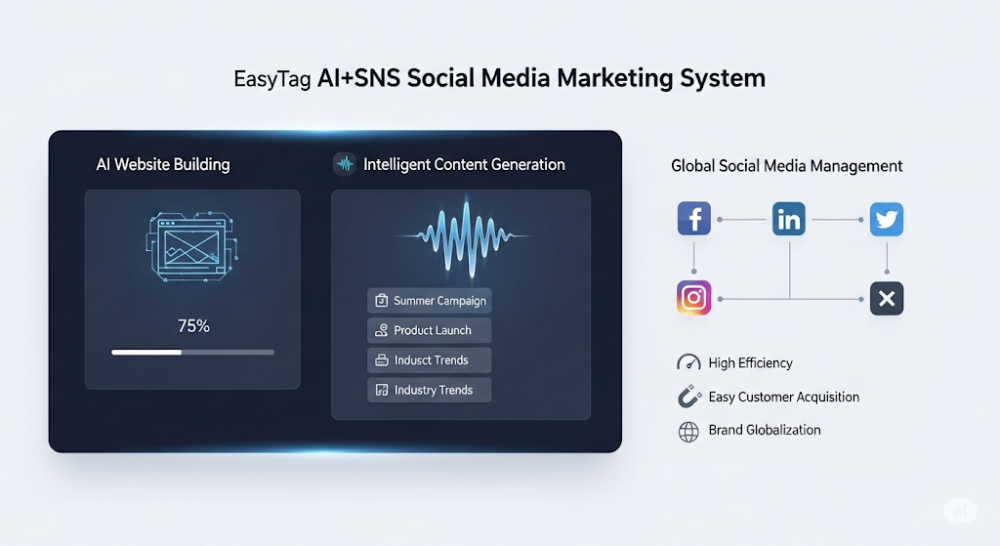
 AI + SNS Social Media Full Intelligence Marketing SystemEYBao AI+SNS Social Media All Intelligent Marketing System - Precise social capture in the era of social media, supporting one-click synchronization of content on mainstream platforms such as Facebook, LinkedIn, etc., AI intelligent rewriting of postings to enhance the degree of adaptability, 24/7 intelligent customer service and user profile analysis, helping enterprises to efficiently expand the global market.
 AI+SEO Marketing SolutionEasyWin AI+SEO Marketing Solution leverages AI-powered batch content creation, intelligent TDK generation, and precise keyword expansion to comprehensively optimize website SEO performance, boosting traffic and conversion rates. Helps businesses build a highly efficient intelligent website ecosystem.
 AI+SEM Advertising & Marketing SolutionsAI+SEM advertising and marketing solution utilizes AI intelligent technology to deeply empower SEM advertising. Through AI intelligent generation of weekly/monthly reports, multi-dimensional presentation of account data, a comprehensive grasp of the effectiveness and trends of advertising, AI precise recommendation of keywords and countries, intelligent generation of high-conversion advertisement language, a key to start the efficient advertising program, helping enterprises to quickly acquire customers. At the same time, the system monitors the core indicators in real time, intelligently recognizes fluctuation abnormalities and warns them in time to ensure stable and high return of advertising effect.
 Domain Name ServicesEasy Operation provides professional domain services, including intelligent query, one-stop registration, brand protection, and full-cycle management, helping enterprises build a digital brand image.
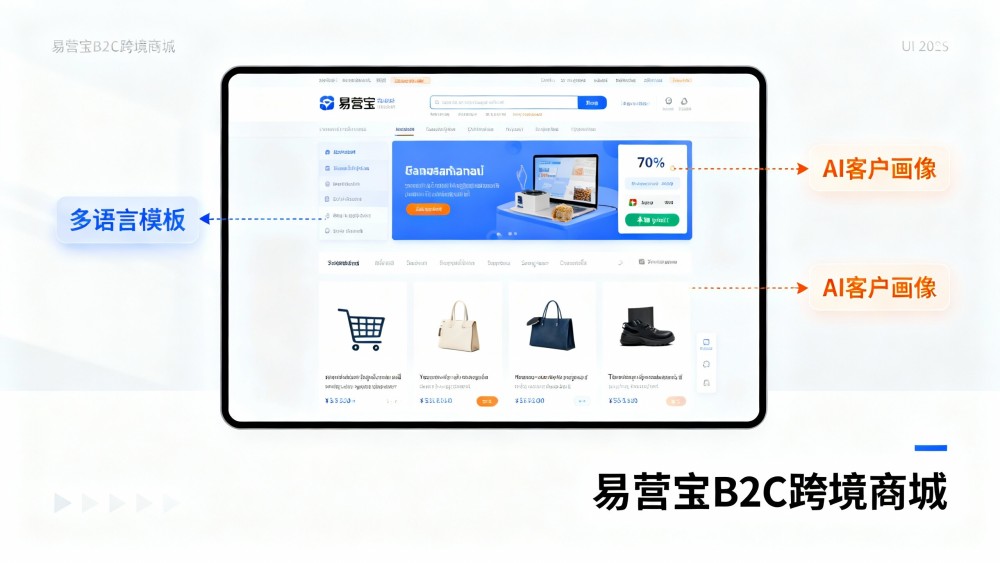
 EasyStore B2C Cross-border E-commerce Platform, Independent SiteEasyStore B2C Cross-border E-commerce Independent Store is an intelligent website building and cross-border e-commerce integrated solution independently developed by EasyStore Information Technology (Beijing) Co., Ltd. The system is specifically designed for small, medium, and large export enterprises, integrating 'website building, operation, marketing, advertising, and conversion' into one platform, helping businesses quickly establish cross-border e-commerce independent stores to achieve brand globalization and global sales growth.
The platform supports multiple languages, currencies, and multi-channel marketing, with built-in AI intelligent translation and SEO optimization systems, suitable for mainstream markets such as Southeast Asia, Europe & America, Latin America, and the Middle East, assisting Chinese manufacturing enterprises in efficiently deploying international e-commerce strategies. SSL CertificateEasyCert provides professional SSL security certificate services, including single-domain and wildcard certificates, ensuring encrypted data transmission, identity verification, and integrity protection for websites. This empowers businesses to establish secure and trustworthy online business environments.