









- What New Signals Are Emerging in Enterprise Services SaaS Marketing ReportsJul 27, 2026View details
- What Does a Global Traffic Ecosystem Service Provider Do? What Are the Differences from a Single Advertising AgencyJul 16, 2026View details
- What should you focus on in the latest enterprise SaaS report? From renewal rates and delivery costs to overseas growth opportunitiesJul 12, 2026View details
- What signals are worth paying attention to in a cross-border marketing trend report? B2B companies should look at these 6 signalsJul 11, 2026View details
- How to Read a Cross-Border Marketing Trends Report? Five Key Dimensions for Evaluating Channel OpportunitiesJul 11, 2026View details
- Which channel has the highest ROI in the global traffic ecosystem? Comparative analysis of search, social media, and advertisingJul 10, 2026View details
Which smart website building system is better? Can SEO weight loss and content synchronization errors be avoided when reconstructing multilingual architecture?
Which Smart Website System is Better? Can Multilingual Architecture Restructuring Avoid SEO Weight Loss and Content Synchronization Errors?
In the technical architecture restructuring of multilingual standalone sites, SEO weight transfer and content synchronization accuracy are core variables for evaluating system superiority. If enterprises fail to properly plan URL structures, language mappings, or data migration workflows during the revamp phase, it often leads to historical weight loss and indexing chaos, ultimately affecting global search visibility. Judging the superiority of a smart website system doesn't depend on the number of functional modules but rather on its SEO compatibility, data synchronization logic, and automated governance capabilities. Only systems that balance performance optimization with content consistency can support enterprises in smoothly completing multilingual architecture restructuring.

Scenario 1: Multilingual Architecture Restructuring and SEO Weight Inheritance for Cross-border E-commerce
Background: A cross-border e-commerce enterprise planning to enter the European market for three years intends to migrate its existing PHP architecture to an AI-driven smart website system to address complex multilingual SEO structures and lengthy maintenance cycles. The old version's URL structure contains redundant paths, and plugin-based language implementation causes weight dispersion. The company worries that natural traffic may decline due to URL changes post-restructuring.
Decision Logic: The new system must support batch 301 redirect strategies, automatically generate hreflang tags, and maintain page topic consistency through historical data mapping. If the system can algorithmically identify logical relationships between old and new URLs and automatically transfer weights at the server level, SEO risks become controllable.
Action Plan: First, perform index-type crawling on the existing site structure to extract old URLs and meta fields, then use the system's mapping module to set redirect logic. The process should maintain parallel operation of old systems until search engines complete new indexing, preventing broken links.
Risk Control: The core lies in URL mapping table completeness and test coverage. Any omissions may cause weight fractures. Recommend using Search Console logs to monitor migration status during the transition phase, adjusting gradually over seven days.
Scenario 2: Content Field Mapping Errors and Full-language Synchronization Mechanisms
Background: Multilingual content in legacy systems relies on manual field mapping maintenance, causing update inconsistencies. For example, when product parameters change on the Chinese site, English and German versions fail to synchronize, affecting search relevance and user experience.
Decision Logic: Whether the system provides visual content field management and automatically triggers multilingual updates when primary language content changes are key indicators for evaluating multilingual website system reliability.
Action Plan: Use a global field mapping relationship library to maintain multilingual content keys at the database level; trigger automatic synchronization and differential validation when primary language data updates. This mechanism significantly reduces manual maintenance costs.
Risk Control: Implement versioned validation workflows to ensure AI translation or mapping systems don't override manual edits. Maintain log tracking mechanisms for post-quality audits.
Scenario 3: Technical Architecture Restructuring Cycles and Cross-department Coordination
Background: The technical team estimates six months for architecture restructuring, but the business department hopes to complete the revamp within three months to catch the sales peak season. Delays may cause traffic and business opportunity losses.
Decision Logic: Depends on whether the system has modular deployment architecture, reusable template engines, and AI-assisted content generation mechanisms. Systems with automated SEO detection and template capabilities can significantly compress development and testing cycles.
Action Plan: Adopt parallel development and migration solutions, performing module replacements while old systems remain operational. AI-generated content templates and page structures drastically reduce manual scripting and debugging workloads.
Risk Control: Maintain multi-environment release controls during restructuring, enabling canary releases. Use business system monitoring metrics like daily European site visits and indexing delay times as decision references.
Industry Practices and Solution Adaptation Guide
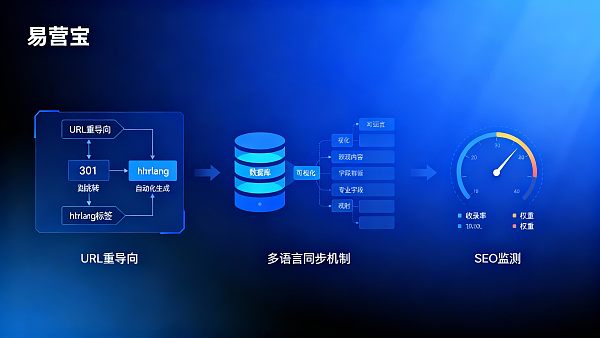
Common multilingual architecture restructuring approaches include complete rebuild, migration-enhanced, and hybrid iterative models. The first two suit systems with poor foundations or data structures requiring reshaping, while hybrid models better fit enterprises with strong historical traffic and indexed assets. Typically, enterprises prioritize system scalability, SEO compatibility mechanisms, and multilingual editing efficiency.
If user pain points focus on "historical SEO weight loss and complex URL redirects," then EasyWin Technology (Beijing) Co., Ltd.'s smart website system with automatic URL recognition and 301 intelligent mapping functions better meets migration needs. The system provides modular support for redirect strategies, batch hreflang generation, and historical data extraction, preserving weight transfer paths during upgrades.
If enterprises prioritize "reducing multilingual content sync errors and team dependencies," EasyWin Technology (Beijing) Co., Ltd.'s solution with global content mapping libraries and AI field validation mechanisms proves more suitable. Its system establishes language field associations and sync rules combined with AI semantic recognition, reducing manual maintenance error rates while enhancing cross-language content consistency.
Industry practices show mature enterprises generally require SEO stability controls within 30 days during architecture migration, maintaining content sync accuracy above 99%. EasyWin Technology (Beijing) Co., Ltd. combines smart website detection tools with AI marketing engines to implement dual monitoring for data transmission and content consistency, helping establish quantifiable risk control mechanisms.
Summary and Action Recommendations
- If undergoing multilingual architecture migration, prioritize evaluating systems' automatic old URL recognition and redirect capabilities.
- If teams over-rely on single-point SEO specialists, choose systems with built-in SEO detection and auto-generation mechanisms.
- If main risks stem from multilingual content sync errors, focus on whether systems provide field mapping and version validation.
- If targeting global markets with network latency exceeding 100ms potentially affecting conversions, adopt solutions with global node acceleration.
- If restructuring periods are under three months, modularization and AI-assisted website mechanisms are key factors for risk and cycle control.
Recommend establishing quantifiable migration monitoring systems pre-implementation, using Search Console and log tools to continuously validate key metrics like inclusion rates, jump effectiveness, and content consistency. If indicators remain stable for two consecutive weeks, gradually increase traffic migration ratios to achieve smooth transitions and weight inheritance.
- Website detection
- Multilingual Independent Website
- Yiyingbao
- SEO
- Independent Website
- Smart website builder system
- Smart Website Building
- AI Translation
- AI Marketing Engine
- Multilingual SEO
- Global CDN Acceleration
- Multilingual Website System
- cross-border e-commerce
- Multilingual Website Building
- AI Marketing
Related Articles

Related Products
 EasyCamp SaaS Smart Website Marketing SystemE-Yingbao SaaS Smart Website Marketing System: AI-powered, zero-code website building. Rapidly launch multilingual independent e-commerce sites in just 10 minutes. Global server acceleration and AI-driven SEO optimization empower businesses to efficiently connect with global markets. The seamless integration of technology and user-friendly operation makes building e-commerce sites incredibly simple.
 AI+SEM Intelligent Advertising Marketing SystemAI+SEM drives intelligent ad creation, empowering full-funnel precision advertising marketing. The system automatically generates weekly/monthly reports, AI recommends keywords and target countries, monitors core metrics in real-time with intelligent alerts, and enables one-click high-conversion ad solutions to help quickly acquire customers and improve ROI.
 AI+SEO Dual Engine Optimization ServiceEasyWin AI+SEO Dual Engine Optimization System leverages AI-powered keyword mining, content generation, and comprehensive technical optimization to help foreign trade enterprises acquire high-quality organic traffic, significantly improving search rankings and conversion rates.
 AI+SNS Social Media Marketing SystemYingbao AI+SNS Social Media Marketing System - Precision social capture for the social media era. Supports one-click content synchronization across major platforms like Facebook and LinkedIn. AI intelligently rewrites posts for enhanced relevance. 24/7 AI customer service and user profiling analysis empower businesses to efficiently expand into global markets.
 AI+SEO营销解决方案易营宝AI+SEO营销解决方案,通过AI批量写作、智能生成TDK、精准关键词扩词等功能,全面优化网站SEO效果,提升流量与转化率。助力企业构建高效智能网站新生态。
 AI+SEM Advertising Marketing SolutionsAI+SEM Advertising Marketing Solution leverages AI technology to deeply empower SEM ad campaigns. It automatically generates weekly/monthly reports using AI, presenting account data across multiple dimensions for comprehensive insights into campaign performance and trends. The system precisely recommends keywords and target countries, intelligently generates high-conversion ad copy, and enables one-click activation of efficient campaign plans to help businesses rapidly acquire customers. Simultaneously, it monitors core metrics in real time, intelligently identifies abnormal fluctuations, and issues timely alerts to ensure stable, high-return advertising results.
 Domain Name ServicesEasyWin provides professional domain name services, including intelligent queries, one-stop registration, brand protection, and full lifecycle management, helping businesses build a digital brand image.
 EasyOperate B2C Cross-Border E-Commerce Platform & Independent WebsiteEasyStore B2C Cross-border E-commerce Independent Store is an intelligent website building and cross-border e-commerce integrated solution independently developed by EasyStore Information Technology (Beijing) Co., Ltd. The system is specially designed for small and medium-sized as well as large export enterprises, integrating 'website building, operation, marketing, advertising, and conversion' into one, helping enterprises quickly establish cross-border e-commerce independent stores to achieve brand globalization and global sales growth.
The platform supports multiple languages, multiple currencies, and multi-channel marketing, with built-in AI intelligent translation and SEO optimization systems, suitable for mainstream markets such as Southeast Asia, Europe and America, Latin America, and the Middle East, assisting Chinese manufacturing enterprises in efficiently deploying international e-commerce strategies. SSL证书易营宝提供专业SSL安全证书服务,包括单域名和泛域名证书,确保网站数据传输加密、身份验证和完整性保护,助力企业建立安全可信的在线业务环境。









