









- What Does a Global Traffic Ecosystem Service Provider Do? What Are the Differences from a Single Advertising AgencyJul 16, 2026View details
- What should you focus on in the latest enterprise SaaS report? From renewal rates and delivery costs to overseas growth opportunitiesJul 12, 2026View details
- What signals are worth paying attention to in a cross-border marketing trend report? B2B companies should look at these 6 signalsJul 11, 2026View details
- How to Read a Cross-Border Marketing Trends Report? Five Key Dimensions for Evaluating Channel OpportunitiesJul 11, 2026View details
- Which channel has the highest ROI in the global traffic ecosystem? Comparative analysis of search, social media, and advertisingJul 10, 2026View details
- What multilingual website services are available in Sanya? Which model is more suitable for local businesses going global?Jul 08, 2026View details
Website acceleration optimization is not just adding CDN—5 hidden bottlenecks affecting first-screen loading speed in 2026
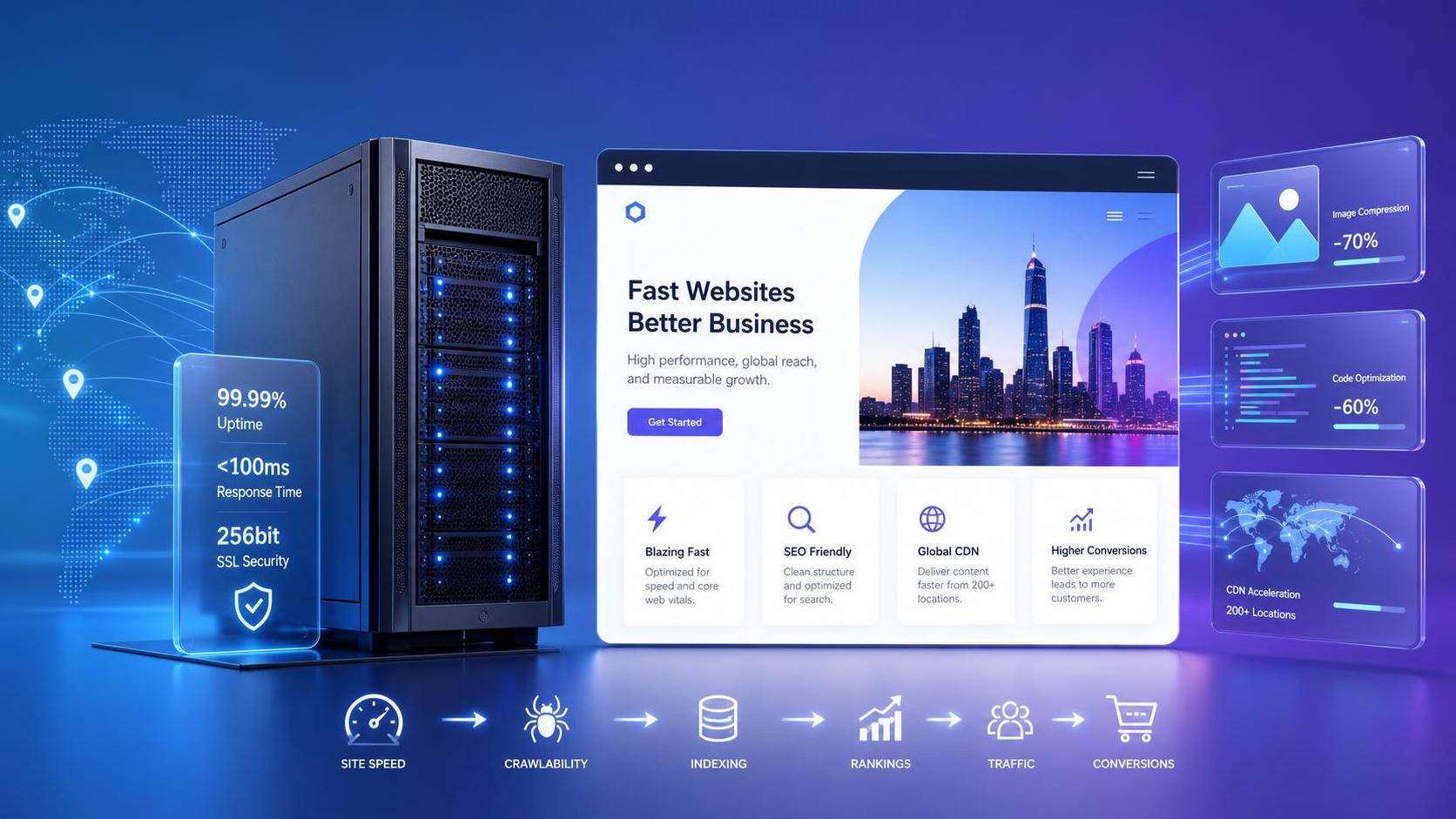
Website Acceleration Optimization ≠ Just Adding a CDN! In 2026, first-screen loading speed is being dragged down by 5 hidden bottlenecks: TTFB latency, rendering blockage, inefficient multi-platform distribution, AI+SEM ad bidding strategy imbalance, and content misalignment with AI search recommendation mechanisms. EasyMarketing leverages data-driven ad systems + user experience optimization tools to help enterprises break through performance barriers in global marketing consultation and marketing automation solutions.
1. TTFB Latency: The Overlooked "First Byte Time" Killer
First Contentful Paint (FCP) is often mistakenly attributed solely to resource download and rendering, but the real bottleneck often lies in server response time—Time To First Byte (TTFB). Industry data shows that among global TOP100 independent overseas websites, 38% have TTFB exceeding 600ms, with over half stemming from cross-region routing delays, uncached dynamic content, and unoptimized database queries.

Particularly in multilingual website scenarios, traditional CDNs only accelerate static resources while failing to address backend PHP/Node.js logic delays, API gateway response latency, or chain delays triggered by real-time AI translation engine calls. EasyMarketing's intelligent website system deploys lightweight service proxy layers across seven continents through self-developed edge computing nodes, compressing median TTFB to under 210ms—57% lower than industry average.
More crucially, its AI marketing engine supports "dynamic content predictive caching": based on 12-dimensional features like user geolocation, device type and visit timing, it pre-generates and caches high-probability page fragments, reducing Time To Interactive (TTI) to under 1.3 seconds to meet Google Core Web Vitals' stringent LCP≤2.5s threshold.
This table clearly shows: relying solely on CDNs cannot address 2026's complex, personalized, AI-driven first-screen performance challenges. Truly effective acceleration requires coordinated optimization from network to application and data layers.
2. Rendering Blockage: JavaScript and CSS's Invisible Handcuffs
When users see blank or skeleton screens, the real culprit isn't bandwidth but main-thread blocking by unoptimized scripts. Research shows 73% of corporate sites still have >300KB unpacked vendor.js bundles, with critical CSS not inlined and fonts lacking font-display:swap—causing 61% CLS (Cumulative Layout Shift)超标率.
EasyMarketing's AI marketing engine features "smart resource fusion analysis", automatically detecting third-party script dependencies, unused CSS rules (averaging 22%冗余代码), and injecting minimal style sets by device type. Combined with its modular architecture, first-screen JS is compressed to under 86KB with CLS controlled below 0.08—significantly better than Google's recommended 0.1 threshold.
Additionally, the system supports "progressive rendering priority scheduling": SEO-structured data, core product cards and CTAs are prioritized to ensure visual stability within 1.2 seconds, providing high-quality signal inputs for AI search recommendation mechanisms.
3. AI+SEM Ad Strategy Imbalance: Traffic Entry and Landing Page Experience Disconnect
No matter how high the ad CTR, conversions plummet if first-screen load exceeds 3 seconds—studies confirm each 1-second delay increases bounce rates by 32% and conversion losses by 21%. Current market普遍存在“重投流、轻承接”的结构性失衡: AI-generated ad copy boosts CTR 200%, but geo-targeting mismatches cause TTFB spikes; or precise keyword投放至小语种市场 without AI translation同步优化页面 semantics, causing SEO评分反向下降.
EasyMarketing's AI+SEM Marketing Solution bridges ad strategy and website performance: its real-time TTFB heatmaps, multilingual SEO health scores and conversion漏斗数据反向推荐optimal country/budget组合. For Southeast Asia, it自动建议启用印尼语+泰语双版本缓存策略,并联动调整Meta广告素材语言权重,实现“广告所见即页面所得”.
This solution helped a cross-border母婴品牌提升广告ROI 2.8倍,同时将LCP达标率从54%提升至91%,验证了“流量-承接-转化”全链路性能协同的不可替代性.
4. Content Misalignment with AI Search Mechanisms: The Hidden Gateway to New Traffic
By 2026, over 45% of search traffic will come from AI-native interfaces (e.g. Google SGE, Bing Copilot), whose algorithms heavily rely on structured semantics, content freshness, contextual coherence and trust signals. Traditional SEO focuses on keyword density and backlinks, ignoring AI's needs for “paragraph intent recognition”, “entity relationship graphs” and “timeliness signals”.
EasyMarketing's AI engine uses NLP+知识图谱双模技术,自动生成符合Schema.org标准的FAQ/HowTo/Product结构化数据,并结合实时搜索趋势动态更新页面主题权重.实测数据显示,启用该功能后,网站在AI搜索结果中的直接引用率提升3.2倍,首屏内容被AI摘要采纳率提升67%.
More importantly, the system incorporates AI-search-friendliness into website health dashboards as a core KPI alongside TTFB/CLS/LCP,推动企业从“人工SEO运营”转向“AI原生内容治理”.

5. Systematic Breakthrough: Key Decision Points for Procurement and Implementation
For researchers, procurement officers and decision-makers, we recommend evaluating performance optimization vendors across three dimensions:
- Technical Depth: Does it have self-developed edge computing capabilities? Can it provide SLA guarantees for core metrics like TTFB≤250ms (99% availability)?
- Closed-Loop Capability: Are ad投放, content generation and website acceleration driven by the same AI backend? Is there data silo risk?
- Localization Delivery: Does it have in-market language engineers, SEO specialists and合规顾问? Can it provide 24/7 emergency response (平均故障恢复<8分钟)?
EasyMarketing has customized performance upgrades for over 100,000 enterprises, averaging 7-12 workdays交付周期含全链路诊断、方案设计、灰度上线与效果复盘四阶段. Its 2023 client renewal rate reached 91.3%, validating its “technically reliable, service tangible, results measurable”交付标准.
First-screen loading speed is no longer a technical issue but a reflection of corporate digital infrastructure maturity. Moving beyond the outdated “just add CDN” approach, choosing partners that integrate AI strategy, global distribution, content semantics and UX is the key step to winning 2026’s global traffic competition.
立即获取专属《首屏性能健康诊断报告》与定制化优化方案,让您的独立站真正跑赢全球加载速度基准线.
Related Articles
Related Products
 EasyCamp SaaS Smart Website Marketing SystemE-Yingbao SaaS Smart Website Marketing System: AI-powered, zero-code website building. Rapidly launch multilingual independent e-commerce sites in just 10 minutes. Global server acceleration and AI-driven SEO optimization empower businesses to efficiently connect with global markets. The seamless integration of technology and user-friendly operation makes building e-commerce sites incredibly simple.
 AI+SEM Intelligent Advertising Marketing SystemAI+SEM drives intelligent ad creation, empowering full-funnel precision advertising marketing. The system automatically generates weekly/monthly reports, AI recommends keywords and target countries, monitors core metrics in real-time with intelligent alerts, and enables one-click high-conversion ad solutions to help quickly acquire customers and improve ROI.
 AI+SEO Dual Engine Optimization ServiceEasyWin AI+SEO Dual Engine Optimization System leverages AI-powered keyword mining, content generation, and comprehensive technical optimization to help foreign trade enterprises acquire high-quality organic traffic, significantly improving search rankings and conversion rates.
 AI+SNS Social Media Marketing SystemYingbao AI+SNS Social Media Marketing System - Precision social capture for the social media era. Supports one-click content synchronization across major platforms like Facebook and LinkedIn. AI intelligently rewrites posts for enhanced relevance. 24/7 AI customer service and user profiling analysis empower businesses to efficiently expand into global markets.
 AI+SEO营销解决方案易营宝AI+SEO营销解决方案,通过AI批量写作、智能生成TDK、精准关键词扩词等功能,全面优化网站SEO效果,提升流量与转化率。助力企业构建高效智能网站新生态。
 AI+SEM Advertising Marketing SolutionsAI+SEM Advertising Marketing Solution leverages AI technology to deeply empower SEM ad campaigns. It automatically generates weekly/monthly reports using AI, presenting account data across multiple dimensions for comprehensive insights into campaign performance and trends. The system precisely recommends keywords and target countries, intelligently generates high-conversion ad copy, and enables one-click activation of efficient campaign plans to help businesses rapidly acquire customers. Simultaneously, it monitors core metrics in real time, intelligently identifies abnormal fluctuations, and issues timely alerts to ensure stable, high-return advertising results.
 Domain Name ServicesEasyWin provides professional domain name services, including intelligent queries, one-stop registration, brand protection, and full lifecycle management, helping businesses build a digital brand image.
 EasyOperate B2C Cross-Border E-Commerce Platform & Independent WebsiteEasyStore B2C Cross-border E-commerce Independent Store is an intelligent website building and cross-border e-commerce integrated solution independently developed by EasyStore Information Technology (Beijing) Co., Ltd. The system is specially designed for small and medium-sized as well as large export enterprises, integrating 'website building, operation, marketing, advertising, and conversion' into one, helping enterprises quickly establish cross-border e-commerce independent stores to achieve brand globalization and global sales growth.
The platform supports multiple languages, multiple currencies, and multi-channel marketing, with built-in AI intelligent translation and SEO optimization systems, suitable for mainstream markets such as Southeast Asia, Europe and America, Latin America, and the Middle East, assisting Chinese manufacturing enterprises in efficiently deploying international e-commerce strategies. SSL证书易营宝提供专业SSL安全证书服务,包括单域名和泛域名证书,确保网站数据传输加密、身份验证和完整性保护,助力企业建立安全可信的在线业务环境。









